Free Daily Podcast Summary
Edible Activist: Daily Summaries Delivered
by Melissa L. Jones
Get key takeaways, quotes, and insights from Edible Activist in a 5-minute read. Delivered straight to your inbox.
Latest Episodes
The most recent episodes — sign up to get AI-powered summaries of each one.
- 1 weeks ago57 min
#191: When the Pulpit Meets the Soil: The Church as a Food Hub
In this episode Melissa L. Jones welcomes back Pastor Heber Brown III — founder of the Black Church Food Security Network — eleven years into a movement now spanning 300 congregations. He does not come to celebrate. He comes to tell the truth. They go deep on what it really takes to activate a Black church around food sovereignty, why he refused to hand Black data to a PWI, and what we stand to lose if our generation does not step up before the elders who carry living memories of Black self sufficiency are gone. Pastor Brown also shares what he is building next — a refocused Black church census with Morgan State University, Freedom School inside Sunday school and a succession plan rooted in abundance. He is not stepping back. He is planting seeds for what comes next.
- Apr 7, 202642 min
#190: The Community Creates the Market: Brooklyn Supported Agriculture
The community creates the market! For Chef Mu that is not a tagline -- it is what he witnesses every time he shows up. In this episode, Melissa L. Jones sits down with Mustafa Abdul Rahim -- known as Chef Mu — culinary professional, food justice advocate, Chopped finalist, and market manager for Brooklyn Supported Agriculture, a Black-led worker-owned food cooperative rooted in the heart of Bed-Stuy, Brooklyn, celebrating 10 years of impact. Chef Mu speaks candidly about what it means to build a food system that puts people first — from a sliding scale model that considers wealth not just income, to showing up as a "veg tender" who knows his community by name. He challenges the way we think about where our food comes from, who profits from it, and why the most radical thing you can do is choose differently.
- Mar 24, 202642 min
#189: Nana Kumi: The Land Remembers
The land remembers. And Nana listening. In this episode, Melissa L. Jones sits down with Nana Kumi, a queer Black southern artist, filmmaker, herbalist, and land steward from Natchez, Mississippi — and project director of Spirit in Our Roots, an art-based land initiative uplifting Black growers and land stewards across Mississippi and Louisiana. Nana's work lives at the intersection of ancestral technology, plant medicine, and Black southern imagination, creating visual and spiritual landscapes that invite rest, memory, and radical dreaming. Nana takes us through a childhood in rural Natchez where imagination became survival, to a career in New York that Covid cracked wide open, to coming home to the land and the ancestors waiting there. She speaks to the memory held in soil, in water, in trees, and in the plants that guide her creative work in ways she is still learning to name. This one is medicine.
- Mar 16, 202643 min
#188: Growing Resilience in the South with Sade Meeks
Some of the most powerful lessons come from the most ordinary moments — a grandmother's garden, a Sunday dinner table, a bowl of grits. Melissa L. Jones is joined by Sade Meeks, dietitian, storyteller, and founder of GRITS (Growing Resilience in the South), recording live from Jackson, Mississippi. Sade's journey is one of homecoming — from standing on a booster seat to watch her mama cook, to crying in a California coffee shop realizing her purpose was back home in the South. Together, they explore why Black Southern food has never been the problem, how Sunday dinner is a form of medicine, and what it means to build a movement out of the stories our elders are still living to tell — including Sade's grandmother, whose century of living — and the stories she carried — are at the very heart of this work.
- Nov 24, 202546 min
#187: Designing a Just Food Future with Dr. Celeste Davis
Host Melissa L. Jones sits down with Dr. Celeste Davis—public health educator, design strategist, and director of the Public Health Scholars Program at American University—for a thoughtful conversation on how food justice, public health, and community power shape one another in today’s shifting landscape. Through her path as a bridge-builder, Dr. Celeste shares why food justice is rooted in dignity, culture, policy, labor, land, and the structures that determine who gets to thrive. She reflects on the possibilities and limits of policy, the importance of local action, and how design thinking and empathy can create systems that feel liberatory rather than transactional. Grounded in her work with emerging public health leaders, she offers a hopeful vision for collectively designing a more just and community-centered future.
- Nov 12, 202538 min
#186: From Lineage to Land: Umi’s Journey of Ancestral Farming
Returning-generation farmer and community herbalist Bianca “Umi” Anthony shares how she’s reclaiming seven acres of her family’s 1950s land in rural Bertie County, NC—reviving legacy, building Seed of Life Farm, and raising her three kids “no screens” while they learn to grow. We talk medicinal herbs and cut flowers, creating a healing space for community retreats, the realities of solo stewardship and mentorship, and why a deer fence and basic infrastructure matter for the first growing season. Umi invites listeners into a vision of generational healing rooted in the soil.
- Nov 6, 202545 min
#185: Nurturing Our Seeds: Detroit Roots, Community Power
Erin Cole, founder of Nurturing Our Seeds in Detroit, shares how a porch-side safety moment on Helen Street—mowing vacant lots for elders—grew from a first flower patch into mustard and turnip greens, and ultimately a neighborhood farm and seed-saving hub. We dig into living soil, herb-based compost teas, seed starting as food sovereignty as they supply transplants to 14 Black farms and save okra seed with the Ujamaa Seed Cooperative, and adapting to climate chaos with part-shade cucumbers. We also talk land access and how the Detroit Black Farmer Land Fund strengthens community control—plus Erin’s quest to breed a hot pink okra.
- Oct 13, 202544 min
#184: SWAP: Fashioning Environmental Justice with Zsameria Rayford
From living-room swaps to a decade of citywide pop-ups, Zsameria Rayford’s SWAP DC → SWAP Universe shows how style and sustainability move together. This episode digs into the operational backbone, the ethos, and the outcomes—thousands of pounds of textiles kept out of landfills while neighbors trade clothing, plants, books, and ideas. We connect circular fashion to health and land stewardship and outline replicable models for your own community swap. A clear, on-the-ground example of the community-rooted change celebrated on Edible Activist.
Get Edible Activist summaries in your inbox
Free AI-powered daily recaps. Key takeaways, quotes, and mentions — in a 5-minute read.
Get Free Summaries →Free forever for up to 3 podcasts. No credit card required.
You Might Also Like
Listeners also like.
Land Food Life
Kara Kroeger, Nutrition Coach, Agroecology Educator, and Food System Consultant
Food is Freedom
Free the People
Black in the Garden
Colah B
Fair Hill Farmstead Life
Judith Horvath, Fair Hill Farm
Wild Edible World: A Foraging Podcast
Wild Edible World

Food Heals
Allison Melody
Awesome Vegans with Elysabeth Alfano
Elysabeth Alfano
Lets Eat Plants Podcast
Kadeem Frazier
Real Food Real People
Real Food Real People

The Healthification Podcast
Kate Galli
The Urban Exodus Podcast
Urban Exodus, hosted by Alissa Hessler
Seeds And Their People
Seeds And Their People
About Edible Activist
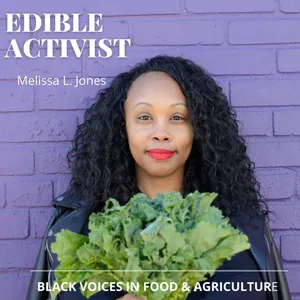
Edible Activist is a podcast that feeds you empowering narratives and perspectives from the voices of emerging black people and people of color in food and agriculture who are stewarding the land, healing communities, and advocating for food justice and economic power across the globe. Hosted by Melissa L. Jones, she interviews a diverse group of everyday growers, farmers, entrepreneurs, artists, and other extraordinary individuals, who exemplify activism in their own edible way!
Customized Recaps
AI-powered recaps with compact key takeaways, quotes, and insights.
Straight to Your Inbox
Get key takeaways from Edible Activist in a 5-minute read.
Save Hours Every Week
Stay current on your favorite podcasts without falling behind.
Frequently Asked Questions
What is Podzilla's Edible Activist daily summary?
It's a free AI-powered email that summarizes new episodes of Edible Activist as soon as they're published. You get the key takeaways, notable quotes, and links & mentions — all in a quick read.
How does the Edible Activist podcast summary work?
When a new episode drops, our AI transcribes and analyzes it, then generates a personalized summary tailored to your interests and profession. It's delivered to your inbox every morning.
Is this an official Edible Activist product?
No. Podzilla is an independent service that summarizes publicly available podcast content. We're not affiliated with or endorsed by Melissa L. Jones.
Can I get summaries of other podcasts too?
Absolutely! The free plan covers up to 3 podcasts. Upgrade to Pro for 15, or Premium for 50. Browse our full catalog at /podcasts.
What topics does Edible Activist cover?
Edible Activist covers topics including Leisure, Science, Arts, Food, Garden, Nature, Home & Garden. Our AI identifies the specific themes in each episode and highlights what matters most to you.
Start getting Edible Activist summaries tomorrow morning.
Free forever for up to 3 podcasts. No credit card required.
Free forever for up to 3 podcasts. No credit card required.