Free Daily Podcast Summary
Breakthroughs: Daily Summaries Delivered
by Northwestern University Feinberg School of Medicine
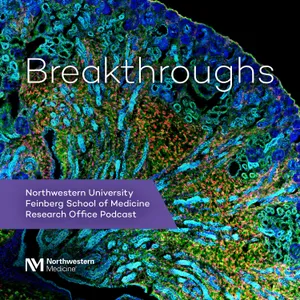
Breakthroughs is a podcast about groundbreaking research and the scientists leading these discoveries at Northwestern University Feinberg School of Medicine. We are driven by our mission to transform the practice of medicine and profoundly impact human health beyond the individual patient. We believe better answers only come from discovery.
Latest Episodes
The most recent episodes — sign up to get AI-powered summaries of each one.
- 1 weeks ago23 min
Decoding the Immune Response in Early-Stage Bladder Cancer with Joshua Meeks, MD, PhD
Why does a standard immunotherapy work remarkably well for some bladder cancer patients, but fail for others? In this episode, Northwestern Medicine physician-scientist Joshua Meeks, MD, PhD, breaks down his recent research published in the Journal of Clinical Investigation and European Urology uncovering how the tumor microenvironment and immune cellular communication influence response to Bacillus Calmette-Guérin (BCG) immunotherapy. Find out how single-cell RNA sequencing, macrophage–T-cell interactions, and urinary tumor DNA biomarkers are paving the way for targeted, personalized bladder cancer care.
- 3 weeks ago19 min
Rewind: Decoding Metabolism and Why When You Eat Matters with Joseph Bass, MD, PhD
We are re-sharing an episode that we originally released in March 2023 about circadian rhythms and metabolism, looking at how the timing of food consumption can impact weight gain and health. Since this episode was released Dr. Bass has led several other studies looking at circadian rhythms and weight loss. Most recently, his team published in the Proceedings of the National Academy of Sciences about an experimental RNA therapy that induces the body to burn calories and preserving lean mass, thereby enhancing the benefits of GLP-1s. More on the recent study can be found here: https://news.feinberg.northwestern.edu/2026/09/21/rna-therapy-may-help-preserve-muscle-during-glp-1-weight-loss/
- Sep 28, 202617 min
How Our Genes Predispose Us to Infection with Jean-Laurent Casanova, MD, PhD
Why does one person become critically ill from a virus while another person exposed to the same microbe remains completely healthy? This is the "infection enigma," and Jean-Laurent Casanova, MD, PhD, has spent his career trying to solve it. A French pediatrician and immunologist, Casanova is the winner of Northwestern University's 2026 Mechthild Esser Nemmers Prize in Medical Science. In this episode, Casanova discusses his paradigm-shifting discoveries and what they reveal about immunity, genetic predisposition and why some people develop life-threatening infections while others do not.
- Sep 14, 202622 min
Why It's Important to Analyze Research Data by Sex with Nicole Woitowich, PhD
For decades, biomedical research relied heavily on male subjects, leaving important gaps in our understanding of how diseases and treatments affect women. In 2016, the NIH introduced a policy requiring that all eligible funding applicants consider the influence of sex in their research to better understand health and disease for all. Nearly a decade later, has research truly changed? In this episode, Nicole Woitowich, PhD, executive director of Northwestern University Clinical and Translational Science Institute (NUCATS), discusses her new study examining how well biomedical research is incorporating sex differences, and where science is still falling short. Read more about Woitowich's appointment as executive director of NUCATS. Check out the study published in Nature Communications Medicine. Learn more about the research from a Northwestern Now story.
- Jun 8, 202621 min
What is the Genetic Overlap Between Autism and Schizophrenia? with Peter Penzes, PhD
In this episode, Peter Penzes, PhD, director of the Center for Autism and Neurodevelopment at Northwestern University Feinberg School of Medicine, discusses a recent discovery of a schizophrenia biomarker and how this research could one day offer earlier diagnosis, more precise treatment, and better outcomes for patients. Learn more about how the field of neurodevelopmental research has evolved over the past decade with major advances in genetics, brain imaging and laboratory models. Large genomic studies have uncovered many more genes associated with risk of developing autism, schizophrenia and related conditions, while new technologies, including brain organoids grown from patients' stem cells, are giving scientists new insight into how these disorders develop and affect brain function.
- May 26, 202620 min
How a Tiny Device Could Transform Fetal Surgery with Aimen Shaaban, MD
Fetal surgery can be lifesaving for babies diagnosed with complex conditions before birth, but it comes with significant challenges, including limited ability to monitor the fetus in real time. A Northwestern Medicine team has developed a first-of-its-kind flexible probe, designed for continuous real-time fetal monitoring during surgery. This innovation is the result of a collaboration between Northwestern University bioelectronics pioneer John Rogers, PhD, and Aimen Shaaban, MD, director of the Chicago Institute for Fetal Health. In this episode, Shaaban explains how the device works, how the collaboration took place and what it will take to bring this technology out of the lab and into clinical care.
- May 11, 202616 min
Is Antimicrobial Resistance Threatening Modern Medicine? with Jennie Kwon, DO
As the new chief of Infectious Diseases at Northwestern University Feinberg School of Medicine, Jennie Kwon, DO, is working in a rapidly evolving field rich with opportunities for discovery and impact. Her own research focus is one of the most pressing challenges in medicine today: antimicrobial resistance. In this episode, she discusses the growing global threat of antimicrobial resistance and why this crisis could fundamentally disrupt modern medicine.
- Apr 20, 202623 min
New Insights Into Dopamine with Raj Awatramani, PhD, and Daniel Dombeck, PhD
We are re-sharing this episode on dopamine and subtypes of dopaminergic neurons that may provide new insights into how we think about the role of dopamine. Rajeshwar Awatramani, PhD, and Daniel Dombeck, PhD led this research, and in this episode they explain how the results could change the field of dopamine research and pave the way for new research possibilities, especially concerning Parkinson's disease, a condition marked by a loss of dopamine neurons and motor system challenges.
Get Breakthroughs summaries in your inbox
Free AI-powered daily recaps. Key takeaways, quotes, and mentions — in a 5-minute read.
Get Free Summaries →Free forever for up to 3 podcasts. No credit card required.
You Might Also Like
Listeners also like.
Get Better Faster
Doctors and researchers discuss functional medicine and root-cause approaches to chronic illness and health optimization.

Extend Podcast with Darshan Shah, MD
Explores science-backed strategies and expert insights to extend healthspan and optimize longevity through actionable health protocols.
Huberman Lab
Explores neuroscience and science-based tools for understanding and improving brain function, behavior, and health.
Health Discovered
Doctors explore surprising stories to uncover insights about health and well-being.
From Our Neurons to Yours
Discusses neuroscience research and its implications for understanding the brain and treating neurological conditions.
Inquiring Minds
Explores the intersection of science and society through critical thinking and in-depth analysis.
The Dr. Hyman Show
Explores root causes of chronic disease and promotes functional medicine, nutrition, and preventive health through expert discussions.

Made for Health | Peptides | Lyme | Chronic Infections | Long Covid | Insulin Resistance | Hypermobility
A physician explores science-based approaches to treating chronic conditions and restoring health.
LONGEVITY with Nathalie Niddam
Explores science-backed strategies for extending healthspan through nutrition, biohacking, peptides, and emerging longevity research.
The Health Continuum
High-performing professionals learn science-based health strategies to sustain energy, focus, and resilience in demanding careers.
Health Matters
NewYork-Presbyterian
Paul Saladino MD podcast
A physician explores the root causes of chronic disease and optimal health through science and personal experimentation.
About Breakthroughs
Breakthroughs is a podcast about groundbreaking research and the scientists leading these discoveries at Northwestern University Feinberg School of Medicine. We are driven by our mission to transform the practice of medicine and profoundly impact human health beyond the individual patient. We believe better answers only come from discovery.
Customized Recaps
AI-powered recaps with compact key takeaways, quotes, and insights.
Straight to Your Inbox
Get key takeaways from Breakthroughs in a 5-minute read.
Save Hours Every Week
Stay current on your favorite podcasts without falling behind.
Frequently Asked Questions
What is Podzilla's Breakthroughs daily summary?
It's a free AI-powered email that summarizes new episodes of Breakthroughs as soon as they're published. You get the key takeaways, notable quotes, and links & mentions — all in a quick read.
How does the Breakthroughs podcast summary work?
When a new episode drops, our AI transcribes and analyzes it, then generates a personalized summary tailored to your interests and profession. It's delivered to your inbox every morning.
Is this an official Breakthroughs product?
No. Podzilla is an independent service that summarizes publicly available podcast content. We're not affiliated with or endorsed by Northwestern University Feinberg School of Medicine.
Can I get summaries of other podcasts too?
Absolutely! The free plan covers up to 3 podcasts, any in the catalog. Basic raises that to 15, Pro to 40 and Max to 100. Browse our full catalog at /podcasts.
What topics does Breakthroughs cover?
Breakthroughs covers topics including Medicine, Fitness, Health & Fitness. Our AI identifies the specific themes in each episode and highlights what matters most to you.
Start getting Breakthroughs summaries tomorrow morning.
Free forever for up to 3 podcasts. No credit card required.
Free forever for up to 3 podcasts. No credit card required.