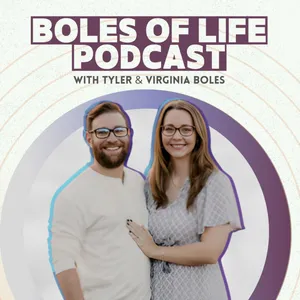
Free Daily Podcast Summary
Boles of Life: Daily Summaries Delivered
by Boles of Life
Welcome to the Boles of Life podcast. Hosted by Tyler and Virginia Boles.As we’ve gone through life we've learned something important. Life is MESSY. It gets complicated. BUT we've also learned that we can create tools to help us jump into the mess of life and make an adventure of it. Welcome to our messy adventures of faith, family, and food! Check out the video podcast for every episode on YouTube.You can find all things Boles of Life related at bolesoflife.com.Boles of Life is also on Facebook and Instagram @Bolesoflife.
Latest Episodes
The most recent episodes — sign up to get AI-powered summaries of each one.
- Yesterday1h 13m
Diabetes, Midwives, and Homebirth - The Story of Our Fourth Child
After a year away, Tyler and Virginia are back with an episode they never aired: the birth story of their fourth child, Shepherd Wayne. It begins with shattering glass and low blood sugar at 3 a.m., and water breaking an hour later. From there, they share how they decided on a fourth baby, how a last-minute midwife change reshaped their plans, and how a gentle labor turned into a much harder delivery with shoulder dystocia. The baby weighed in at 12 pounds! Along the way, they talk about why birth stories matter, what God’s provision looked like through two very different midwives, and what they learned about preparing ahead for the unexpected.-----Key Takeaways:Birth stories, especially ones that go well and ones that go sideways, help normalize something God designed the body to do.Shoulder dystocia is not only about baby size or diabetes; the mother’s position can matter too.Asking your midwife in advance how she handles complications gives you something to lean on when things move fast.A last-minute midwife change turned out to be provision rather than a setback.Sometimes the plan for a gentle labor and the reality of a hard push live in the same story, and both can be received with gratitude.-----Episode Breakdown:0:00:00 A year later: welcome back and what’s next0:01:29 3 a.m. Pyrex crash and the water breaking0:06:13 Why share a birth story0:09:00 How we got to baby number four0:14:47 Sponsor break: Formed in the Everyday0:17:51 The midwife who couldn’t attend this birth0:20:28 A new midwife and the “high risk” label0:24:58 Moving church buildings and a false start on opening Sunday0:27:54 Past labors and praying for a gentle one0:30:28 Waters break and meeting Susan, the on call midwife0:35:34 Labor at home with the grandmas on kid duty0:42:38 Transition and pushing begins0:45:18 Shoulder dystocia explained0:50:01 In the moment: Virginia’s peace and Tyler’s view from the bedside0:52:48 Shepherd arrives1:01:20 Weighing in at 12 pounds even1:06:39 Biggest baby of the year, two years running1:09:29 The 2 a.m. call and midwives who walk by faith1:11:49 Closing and how to support the podcast*Timestamps are based on the ad-free recording and may drift slightly if ads play.-----Best Ways to Support the Podcast✅ Stay ConnectedFollow us on social media, join our email list, and visit our website for updates, resources, and more. → www.bolesoflife.com📢 Share & Spread the WordLove this episode? Share it with a friend! Also, leaving a rating or review helps more people discover the podcast—and we truly appreciate it.📚 Explore Free & Premium ResourcesWe’ve got free tools to support you and in-depth paid resources for those wanting to go deeper. Every purchase helps us continue creating valuable content!💙 Become a SupporterIf you’ve been impacted by this podcast, consider giving a one-time gift or joining as a monthly supporter. Your generosity helps us keep making meaningful content!🙏 Thank You for Being Part of the Journey!Your support—big or small—makes all the difference. We’re grateful for you!
- Oct 14, 20251h 58m
Faith, Freedom, and the Baptist Faith and Message
“Faith, Freedom, and the Baptist Story”In this episode, Tyler and Virginia conclude the Confessions portion of their series on Creeds, Confessions, and Catechisms by unpacking The Baptist Faith and Message (1925 → 1963 → 2000). From the earliest Baptist push for freedom of conscience to the modern struggle for unity and clarity, they trace how cooperation, conviction, and controversy have shaped Baptist identity for nearly four centuries.⸻🧭 Episode Breakdown0:00:00 – Opening banter: recording without kids, nesting, and “keeper of the messes”0:01:52 – Series recap: from creeds to confessions, now the Baptist Faith and Message0:03:35 – Why the BFM is a confession and how Baptists differ from Reformed/Presbyterian roots0:04:54 – From 1646 England → 1845 America: voluntary association, cooperation, and autonomy0:07:02 – Early Baptist beginnings (Roger Williams, 1638) and why Baptists spread rapidly in the U.S.0:11:09 – Missions as the glue: Triennial Convention (1814) and national cooperation0:13:18 – The slavery split: Georgia test case → 1845 Southern Baptist Convention formation0:16:49 – Theological misreadings used to defend slavery and the long-term racial fallout0:21:04 – Post–Civil War segregation, Black Baptists forming new conventions, and the 1995 apology0:27:26 – Debates over the SBC name and the tension between rebranding vs. repentance0:30:34 – 1845–1925: “No creed but the Bible,” local autonomy, and the move toward a unified statement0:33:05 – Modernist crisis (Darwin, higher criticism), seminary controversies → need for a confession0:37:38 – 1925 Convention: adoption of the BFM and Cooperative Program (E.Y. Mullins influence)0:45:41 – The BFM’s tone: “Not a creed but a guide” — Scripture’s authority and voluntary cooperation0:47:58 – 1963 revision: Herschel Hobbs committee, “Jesus Christ is the criterion,” and 1960s context0:55:20 – 1963 BFM becomes denominational reference point as further tensions unfold0:56:07 – Conservative Resurgence strategy and SBC politics into the 1990s0:57:05 – 1998–2000 revision: Adrian Rogers leadership, inerrancy, and family/gender language0:59:02 – Complementarian wording and pastoral leadership debates1:05:22 – Seminaries, leaders, and institutional change (Southern Seminary, Al Mohler, and consolidation)1:18:44 – Reflection: from liberal drift to conservative reform → the 2000 update1:24:24 – Critiques of the 2000 process and representative balance1:26:40 – The 1998 amendment on family roles and its cultural impact1:27:48 – Final adoption of the 2000 BFM and modern wording1:54:55 – Closing reflections, series wrap-up, and preview of the Catechisms series⸻✏️ Key Takeaways• Baptist history shows a recurring tension between freedom and unity, independence and cooperation.• The Baptist Faith and Message emerged from crisis moments — 1925’s modernism, 1963’s cultural upheaval, and 2000’s conservative resurgence.• Each revision affirms Scripture’s ultimate authority while reflecting its generation’s struggles.• From slavery to modern gender debates, Baptists have wrestled with how culture shapes theology.• Despite division, the BFM continues to anchor seminaries, missions, and churches in shared confession.⸻🔗 Boles of Life Ad LinksWith Jesus👉 https://amzn.to/4h4vfGc⸻📚 SourcesFind the full show notes outline and sources for the episode here.⸻📌 Next EpisodeEpisode 8 → Catechisms: Questions That Shape Faith — Exploring the Heidelberg, Westminster Shorter, and New City Catechisms and how they form disciples today.⸻❤️ Thanks for listening to the Boles of Life Podcast, where we explore our messy adventures of faith, family, and food.⸻Best Ways to Support the Podcast🔗 Stay ConnectedGet the latest updates, exclusive content, and community conversations by joining us online:🌐 Website📬 Email List📸 Instagram👍 Facebook🎥 YouTube⭐ Spread the WordYour support makes a huge difference! Help
- Sep 29, 20251h 44m
Civil War, The Search for Unity, and the Westminster Confession
“Unity, clarity, and the rise of Reformed theology.”In this episode, Tyler and Virginia continue the Confessions portion of their series on Creeds, Confessions, and Catechisms by unpacking the Westminster Confession of Faith (1646). From Henry VIII’s six wives to Bloody Mary, from Scottish resistance to English civil war, they trace the turbulent history that led to the Westminster Assembly. Along the way, they explore the theology, politics, and legacy of this confession that still shapes Reformed churches today.⸻🧭 Episode Breakdown0:00:00 – Opening banter: baby due dates, church move, and overstimulated kids0:02:57 – Series recap: Creeds → Augsburg → now Westminster0:05:27 – From Germany to England: 1530s → 1640s0:08:00 – Three church government systems: Episcopal, Presbyterian, Congregationalist0:13:03 – Henry VIII & the break from Rome (1534)0:15:51 – Edward VI & the Book of Common Prayer0:19:50 – “Bloody Mary” restores Catholicism0:21:02 – Elizabeth I & the “middle way”0:23:26 – Puritans and the push for purity0:27:07 – King James VI/I & the King James Bible0:32:12 – Charles I, Laud, and sparks of civil war0:36:01 – Scottish resistance & riots over the prayer book0:39:05 – Parliament recalled; grievances erupt0:42:12 – English Civil War: Cavaliers vs. Roundheads0:43:09 – The Westminster Assembly is convened (1643)0:45:52 – Who was there: divines, parliament, and Scottish commissioners0:47:48 – Daily rhythm & slow path to unity0:49:46 – Tensions: politics vs. theology0:52:04 – Timeline: 1643 debates → 1646 draft → 1648 approval0:55:18 – Parliament’s revisions & Scotland’s adoption0:57:35 – What’s inside: 74 pages of doctrine0:58:45 – Chapter 1: The Bible’s authority (Sola Scriptura)0:59:35 – Covenant theology explained1:04:03 – Predestination: God’s sovereign choice1:12:31 – Church government & state relations1:16:53 – Worship & sacraments: baptism and communion1:34:12 – The Restoration & Westminster outlawed in England1:35:29 – Scotland holds firm; lasting Presbyterian standard1:36:51 – Influence beyond Presbyterians; Baptist overlaps1:38:14 – Final reflections: unity, politics, and lasting framework⸻✏️ Key TakeawaysThe Westminster Confession was born out of civil war, political crisis, and the need for clear doctrine.Over 120 theologians (“the Westminster Divines”), parliamentarians, and Scottish commissioners worked together to craft it.Its careful structure emphasized Scripture’s authority, covenant theology, and God’s sovereignty.Alongside the Confession came the Larger and Shorter Catechisms, a Directory for Worship, and a Psalter — a complete reformed framework.Though outlawed in England after the monarchy’s restoration, it became the enduring standard for Presbyterian churches worldwide and influenced many Baptist confessions.⸻🔗 Boles of Life Ad Links👉 Mint Mobile Referral Link⸻📚 Resources & MentionsThe Gospel Coalition — What Is the Westminster Confession of Faith?Dromore Presbyterian — What Is the Westminster Confession of Faith (and Why Do We Not Subscribe to It)?EBSCO Research Starters — Westminster Confession of FaithThe Gospel Coalition — 9 Things You Should Know About the Westminster Confession of FaithGotQuestions — What Is the Westminster Confession of Faith?Wikipedia — Westminster Confession of FaithWikipedia — English Civil WarWikipedia — Westminster Assembly<a href="https://en.wikipedia.org/wiki/Westmi
- Sep 22, 20251h 34m
Here I Stand: The Legacy of the Augsburg Confession
“Salvation by grace through faith — the heartbeat of the Reformation put into writing.”In this episode, Tyler and Virginia kick off the Confessions section of their series on Creeds, Confessions, and Catechisms by unpacking the Augsburg Confession (1530). From Martin Luther’s bold stand to Philip Melanchthon’s careful diplomacy, to emperors, invasions, and lasting legacies, they explore how this historic document still shapes Christian belief and practice today.⸻🧭 Episode Breakdown0:00:00 – Opening banter: Nelly’s Confessions, family life, and series transition0:01:23 – From Creeds to Confessions: Why the shift matters0:06:20 – What makes a confession different from a creed? (mission statement analogy)0:12:45 – Setting the stage: Martin Luther, indulgences, and the spark of the Reformation0:39:29 – The political backdrop: Ottoman invasion, Charles V, and the call to Augsburg0:41:44 – Why Luther couldn’t appear & Philip Melanchthon steps up0:43:50 – The structure of the Augsburg Confession: 21 articles of faith + 7 on abuses1:12:58 – The princes stand firm despite threats of war1:20:10 – Long-term impact: breaking Catholic unity & paving the way for religious liberty1:29:18 – Closing reflections: holding firm in faith amidst subtle pressures today1:31:10 – Next episode preview: The Westminster Confession⸻✏️ Key TakeawaysThe Augsburg Confession was the foundational document of Lutheran belief, second only to Scripture itself.Written by Philip Melanchthon, it balanced truth with diplomacy — aiming to reform, not revolt.Confessions serve as identity markers, much like a mission statement, clarifying core beliefs and differences.The Confession’s defense of justification by faith shaped not only Lutheran churches but the future of religious liberty in Europe.These convictions remain a reminder today: without knowing what we stand on, our faith can be easily swayed.⸻🔗 Boles of Life Ad LinksGiant Wall Calendar Designed by Tyler⸻📚 Resources & MentionsA Summary of the Augsburg ConfessionA Guide to the Augsburg ConfessionAugsburg Confession (Living Lutheran)What is the Augsburg Confession? (GotQuestions)Augsburg Confession (Wikipedia)Schmalkaldic League (Wikipedia)Schmalkaldic War (Wikipedia)Second Schmalkaldic War (Wikipedia)Protestation at Speyer (Wikipedia)Augsburg Interim (Wikipedia)Peace of Passau (Wikipedia)Peace of Augsburg (Wikipedia)Diet of Worms (Wikipedia)Augsburg Confession (Book of Concord)Defense of the Augsburg Confession (Book of Concord)⸻📌 Next EpisodeEpisode 6 → The Westminster Confession: Unity, clarity, and the rise of Reformed theology.⸻❤️ Thanks for listening to the Boles of Life Podcast, where we explore our messy adventures of faith, family, and food.⸻Best Ways to Support the Podcast🔗 Stay Connected Get the latest upda
- Sep 15, 20251h 31m
Defining Christ's Nature and the Trinity: The Chalcedonian Definition & Athanasian Creed
“Jesus is 100% God and 100% man — and that truth was hammered into history at Chalcedon.”Tyler and Virginia wrap up the Creeds section of their series on Creeds, Confessions, and Catechisms by tackling two of the most detailed and precise doctrinal statements in church history — the Chalcedonian Definition (451 AD) and the Athanasian Creed (5th–6th century).From the debates over Christ’s two natures, to the Athanasian Creed’s bold claims about salvation, to why these ancient words still steady our faith today, this episode explores how the early church gave us enduring language for confessing Christ as fully God and fully man — and why that still matters.⸻🧭 Episode Breakdown0:00:00 – Opening banter: toenails, cleats, and family life0:05:25 – Introducing the Chalcedonian & Athanasian Creeds0:06:19 – Setting the stage: councils after Nicaea0:08:04 – Heresies about Christ’s nature (Nestorianism & Eutychianism)0:13:34 – Pope Leo’s “Tome” and the Robber Council0:19:02 – The Council of Chalcedon (451 AD)0:23:41 – The Chalcedonian Definition explained0:37:01 – Why Christ’s two natures matter for salvation0:41:57 – The Athanasian Creed: origins & purpose0:47:32 – Trinitarian precision and salvation warnings1:12:23 – Why these creeds still matter today1:25:16 – Closing reflections & preview of what’s next⸻✏️ Key TakeawaysThe Chalcedonian Definition defended Christ’s two complete natures — fully God and fully man, united without confusion.The Athanasian Creed is the most detailed statement on the Trinity and insists that salvation depends on rightly confessing God.Early church debates about Christology (heresies like Apollinarianism and Arianism) still shape how we understand the gospel.Creeds are not just historical artifacts — they’re still used in worship, evangelism, and discipleship today.Knowing these foundations strengthens our faith and guards us against shallow or distorted views of Jesus.⸻🔗 Boles of Life Ad LinksContact Virginia for Nutrition Counseling⸻📚 Resources & MentionsMiaphysitism (Wikipedia)Theology of the Oriental Orthodox Churches (Wikipedia)Chalcedonian Definition (Wikipedia)Early Creeds Overview (CRI Voice)Definition of Chalcedon (PDF)Council of Chalcedon (Monergism)Catholic Encyclopedia: Athanasian Creed (New Advent)Athanasian Creed (Wikipedia)The Athanasian Creed Explained (Ligonier Ministries)⸻📌 Next EpisodeEpisode 5 → Moving into the Confessions: The Augsburg Confession and why it sparked a Reformation.⸻❤️ Thanks for listening to the Boles of Life Podcast, where we explore the messy adventures of faith, family, and food.⸻Best Ways to Support the Podcast🔗 Stay ConnectedGet the latest updates, exclusive content, and community conversations by joining us online:🌐 Website📬 Email List📸 Instagram👍 Facebook🎥 YouTube⭐ Spread the WordYour support makes a huge difference! Help more people find the podcast by sharing, rating, and reviewing:📢 <a href="https://www.bolesoflife.com/podcast" t
- Sep 8, 20251h 9m
From Heresy to Harmony: The Story of the Nicene Creed
“The Nicene Creed: Unity in the Face of Heresy”Tyler and Virginia continue their series on Creeds, Confessions, and Catechisms with a deep dive into the Nicene Creed — the most unifying and widely accepted creed in church history.From the church’s battle with Arianism, to the political pressures at the Council of Nicaea, to why the Nicene Creed still matters for discipleship today, this episode traces how fourth-century debates about Christ’s divinity continue shaping the church’s confession in our distracted digital age.⸻🧭 Episode Breakdown0:01 – Opening & Tyler’s correction from Apostles’ Creed episode2:10 – Historical setting of the Nicene Creed5:35 – Persecution under Rome and Constantine’s shift9:42 – Arius and the controversy over Christ’s divinity13:25 – Council of Nicaea and the fight for “homoousios”18:14 – Creed wording: Begotten, not made22:40 – Political and theological fallout post-council28:02 – The role of Athanasius as “defender of orthodoxy”33:15 – The expansion at the Council of Constantinople (381 AD)37:44 – The Trinity clearly confessed43:20 – Why Protestants still need the Nicene Creed49:35 – Creeds and discipleship in a culture of relativism55:01 – Practical application: confessing truth in community1:01:20 – Closing reflections and preview of next episode⸻✏️ Key Takeaways:• The Nicene Creed was born out of the church’s need to define Jesus as truly God and truly man.• Arius’s teaching threatened to reduce Jesus to a created being, which would undermine salvation itself.• “Homoousios” (of the same substance) was the key word that anchored Christ’s divinity.• The Creed has remained the most universally accepted Christian statement of faith across denominations.• Confessing creeds today strengthens discipleship and offers stability against cultural relativism.⸻🔗 Boles of Life Ad Links:Earthly Wellness: https://bolesoflife.com/resources#paidresources⸻📚 Resources Mentioned:Glenn Packiam – What's a Christian Anyway? Athanasius – On the Incarnation (Public Domain)Rowan Williams – Arius: Heresy and Tradition📚 Sources:CRIVoiceWhats a Christian Sermon Notes GuideWikipedia Nicene CreedWikipedia Constantine the GreatChurch History 101 Nicene CouncilChurch History 101 Post NiceneAncient Origins Council of NicaeaGot Questions Council of Constantinople⸻📌 Next Episode:Episode 4 → The Athanasian Creed: why it’s the most detailed Trinitarian confession in church history.⸻❤️ Thanks for listening to the Boles of Life Podcast, where we explore the messy adventures of faith, family, and food.⸻Best Ways to Support the Podcast 🔗 Stay Connected Get the latest updates, exclusive content, and community conversations by joining us online:🌐 Website📬 Email List📸 Instagram👍 Facebook🎥 YouTube⭐ Spread the Word Your support makes a huge difference! He
- Sep 1, 20251h 22m
The Apostles Creed: Ancient Faith for Modern Believers
“God called you to a personal faith, but never to a private faith.”Tyler and Virginia continue their new series on Creeds, Confessions, and Catechisms with a deep dive into the Apostles’ Creed — the oldest and most widely known Christian creed.From the Creed's origins in the early church to its most controversial line about Christ's descent to the dead, persecution in the early church, Reformation debates, and even Guido d’Arezzo inventing music notes, this episode shows why a short ancient creed still has weight in our distracted digital age.⸻🧭 Episode Breakdown:0:01 - Opening & Tyler's Nicene Creed correction (it's 1,700 years old, not 1,000!)3:05 - Virginia introduces musical notation connection7:24 - Virginia recites the complete Apostles Creed8:38 - Dating centuries explained (why 300s = 4th century)9:49 - Early church persecution and creed development13:00 - Apostolic authorship myth debunked15:02 - "Rule of faith" from early church fathers17:25 - Development timeline: 100s to 750 AD23:12 - Why it was never officially adopted by councils25:01 - Protestant ignorance of church history discussion30:00 - Three branches of Christianity explained31:01 - Line-by-line analysis begins: "God the Father Almighty"33:53 - "Jesus Christ his only son, our Lord"35:35 - Virgin birth and incarnation37:18 - THE BIG DISCUSSION: "He descended to the dead"40:04 - Hebrew afterlife concepts: Sheol, Abraham's bosom, lake of fire46:00 - "Harrowing of hell" tradition explained51:00 - Why Protestants struggle with this concept57:44 - Resurrection and what Jesus is doing now1:04:10 - Holy Spirit, universal church, communion of saints1:09:13 - Forgiveness, resurrection of the body, life everlasting1:12:05 - Why this matters: Practical applications1:18:00 - Pete Scazzero's discipleship argument1:20:16 - Final thoughts on formation and memorization⸻✏️ Key Takeaways:The Apostles Creed developed over 700 years (100s-750 AD) through practical church use"He descended to the dead" is about Sheol, not HellProtestants' rejection of purgatory led to abandoning ancient "middle realm" conceptsCreeds provide doctrinal anchors and tools for evangelism in our chaotic worldChurch history knowledge strengthens discipleship and apologetics💡 The Big QuestionWhat does it mean to confess a creed in a world that resists fixed truth?⸻🔗 Boles of Life Ad LinksVirginia's Wimiscal TShirts⸻📚 Episode Resources & SourcesDominion: How the Christian Revolution Remade the World by Tom Holland The First Notes by Julie Andrews & Emma Walton Hamilton – story of Guido d’Arezzo & the origins of music notationCRIVoice - Christian Creeds, Confessions, and CatechismsLogos - The Apostles Creed: Its History and OriginsLife.Church - The Apostles’ Creed Explained - A Line-By-Line GuideTGC - Why You Should Study the Apostles’ CreedThe Holy Post - Rethinking Heaven & the Harrowing of Hell⸻📌 Next EpisodeEpisode 3 → The Nicene Creed: how it pushed back against heresy and became the most unifying Christian creed.⸻❤️ Thanks for listening to the Boles of Life Podcast, where we explore the messy adventures of faith, family, and food.⸻Best Ways to Support the Podcast 🔗 Stay Connected Get the latest updates, exclusive content, and community conversations by joining us online:🌐 Website📬 Email List📸 Instagram
- Aug 25, 202536 min
Why The Church Writes Things Down - (An Introduction to Creeds, Confessions & Catechisms)
Tyler and Virginia kick off their new mini-series exploring the rich tradition of Christian written statements that have guided believers for centuries. Did you know that 20-23% of all books sold in the US annually are Christian? From the very first printed book (the Gutenberg Bible) to modern catechisms, Christians have always been "people who write stuff down."In this introductory episode, they break down the "Three C's" - Creeds, Confessions, and Catechisms - explaining what makes each unique and why they matter for modern believers navigating information overload and cultural drift.⸻🧭 Episode Breakdown:0:00 – 9:44 | Christians and books: why we've always written things down9:44 – 15:04 | The Three C's explained: Creeds, Confessions & Catechisms15:04 – 18:08 | Is this indoctrination? An honest conversation about formation18:08 – 27:18 | Other types of Christian statements you might encounter27:18 – 33:52 | Why these ancient documents matter in our digital age33:52 – 37:00 | What's coming next: diving into the Apostles' Creed⸻📚 Key Takeaways:Creeds (early church, 100-400s AD): Short, memorable statements covering core Christian beliefs (God, Jesus, Holy Spirit, sin, salvation)Confessions (late Catholic/Reformation era): Longer, more comprehensive documents covering wider Christian doctrine, including sacramentsCatechisms (various eras): Question-and-answer format for teaching, often with short and long answers⸻🤔 The Big Question: In an age of information overload and trending theology, how do we stay grounded in truth that has stood the test of time?Tyler's answer: "God called you to a personal faith, but he never called you to a private faith." These documents represent generations of community wrestling with Scripture together.⸻📌 Coming Up Next:The Apostles' Creed - the oldest and shortest creed that most Christians have heard of, diving into its history and why each line matters.⸻Thanks for joining us as we explore these "messy adventures in faith, family, and food!" ❤️⸻Best Ways to Support the Podcast🔗 Stay Connected Get the latest updates, exclusive content, and community conversations by joining us online:🌐 Website📬 Email List📸 Instagram👍 Facebook🎥 YouTube⭐ Spread the Word Your support makes a huge difference! Help more people find the podcast by sharing, rating, and reviewing:📢 Share the Podcast💬 Leave a Comment on Spreaker🍏 Rate & Review on Apple Podcasts🎵 Rate on Spotify📚 Explore Free & Premium Resources Dive deeper with tools designed to support your journey:🎁 Free Resources📖 Paid Resources💙 Become a Supporter If this podcast has encouraged you, consider giving a one-time or monthly gift to help us continue creating meaningful content:🎁 One-Time Gift💖 Monthly Supporter🙏 Thank You for Being Part of This Community! Your support—big or small—keeps this podcast going, and we’re grateful for you!
Get Boles of Life summaries in your inbox
Free AI-powered daily recaps. Key takeaways, quotes, and mentions — in a 5-minute read.
Get Free Summaries →Free forever for up to 3 podcasts. No credit card required.
You Might Also Like
Podcasts in similar categories.

The Jamie Kern Lima Show
Entrepreneur Jamie Kern Lima interviews experts and celebrities about overcoming self-doubt and building self-belief.

Makes Sense - with Dr. JC Doornick
Explores everyday mysteries and thought-provoking questions about human behavior and reality.

The Drop the Needle Podcast
Interviews exploring spirituality, mindset, and music, featuring healers, artists, and teachers discussing personal growth and meaningful songs.

The Mel Robbins Podcast
A motivational podcast offering research-backed tools and personal stories to help listeners make positive life changes.

The Level Up Podcast w/ Paul Alex
A former detective shares real stories and practical strategies on building passive income, financial freedom, and entrepreneurial success.
Live Free with Josh Howerton
A Christian teaching podcast focused on helping listeners know Christ, live free, and impact the world for God's glory.

From Underdog to Entrepreneur: Building Dreams with Pat Miller
A former underdog interviews successful entrepreneurs to share strategies for overcoming odds and building businesses from the ground up.
Something You Should Know
Expert interviews and practical tips to improve your life, career, finances, and relationships.

The Diary Of A CEO with Steven Bartlett
Raw, unfiltered conversations with influential figures and experts exploring personal growth, mindset, and the realities of success.
Mick Unplugged
A leadership podcast exploring the deep personal motivations behind high achievers’ success by asking what drives them at their core.

SmartLess
Three hosts engage in improvised conversations with a mystery guest, blending humor and personal stories through authentic dialogue.

Passion Struck with John R. Miles
Explores human flourishing through science-based conversations on resilience, purpose, and intentional living.
About Boles of Life
Welcome to the Boles of Life podcast. Hosted by Tyler and Virginia Boles.As we’ve gone through life we've learned something important. Life is MESSY. It gets complicated. BUT we've also learned that we can create tools to help us jump into the mess of life and make an adventure of it. Welcome to our messy adventures of faith, family, and food! Check out the video podcast for every episode on YouTube.You can find all things Boles of Life related at bolesoflife.com.Boles of Life is also on Facebook and Instagram @Bolesoflife.
Customized Recaps
AI-powered recaps with compact key takeaways, quotes, and insights.
Straight to Your Inbox
Get key takeaways from Boles of Life in a 5-minute read.
Save Hours Every Week
Stay current on your favorite podcasts without falling behind.
Frequently Asked Questions
What is Podzilla's Boles of Life daily summary?
It's a free AI-powered email that summarizes new episodes of Boles of Life as soon as they're published. You get the key takeaways, notable quotes, and links & mentions — all in a quick read.
How does the Boles of Life podcast summary work?
When a new episode drops, our AI transcribes and analyzes it, then generates a personalized summary tailored to your interests and profession. It's delivered to your inbox every morning.
Is this an official Boles of Life product?
No. Podzilla is an independent service that summarizes publicly available podcast content. We're not affiliated with or endorsed by Boles of Life.
Can I get summaries of other podcasts too?
Absolutely! The free plan covers up to 3 podcasts, any in the catalog. Basic raises that to 15, Pro to 40 and Max to 100. Browse our full catalog at /podcasts.
What topics does Boles of Life cover?
Boles of Life covers topics including Education, Religion & Spirituality, Spirituality, Christianity, Kids & Family, Family, Self-Improvement. Our AI identifies the specific themes in each episode and highlights what matters most to you.
Start getting Boles of Life summaries tomorrow morning.
Free forever for up to 3 podcasts. No credit card required.
Free forever for up to 3 podcasts. No credit card required.