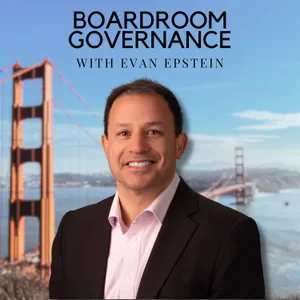
Free Daily Podcast Summary
Boardroom Governance with Evan Epstein: Daily Summaries Delivered
by Evan Epstein
Boardroom Governance with Evan Epstein features in-depth conversations with leading voices in corporate governance, including founders, board members, executives, investors, scholars, lawyers, and other trusted advisors. Through long-form interviews, the podcast explores the people, decisions, trends, risks, and ideas shaping today’s boardrooms. Each conversation combines practical governance insights with personal experiences, leadership lessons, and the career journeys of some of the most accomplished minds in business.
Latest Episodes
The most recent episodes — sign up to get AI-powered summaries of each one.
- 5 days ago47 min
Pamela Fletcher: Electrification, AI, and the Boardroom
Intro About the podcast sponsor: The American College of Governance Counsel Start of interview *reference to the Boardroom Governance Summit 2027 Pam Fletcher’s Origin Story: growing up in the Midwest, and why she always wanted to work in the automotive industry From GM to Electric Vehicles: Pam’s early career at GM, the evolution of electrification, the EV1, and working on the Chevrolet Volt From Automotive to Aviation: moving from electric and autonomous vehicles to sustainability at Delta Leading Sion Power: battery technology as an enabler of electrification, robotics, wearables, and other emerging technologies, and pivoting the company from automotive to defense Batteries, China, and National Strategy: China’s dominance across critical minerals, processing, batteries, and electric vehicles, and why Pam views battery supply chains as a strategic national issue The Road to EV Adoption: why electric vehicle adoption varies across the U.S., the importance of charging infrastructure and faster charging times, and what consumers need before EVs reach broader adoption Building a Board Career: how Pam moved from operating roles into board service. Lumentum, AI, and Data Centers: how optical technology enables data centers to scale compute while reducing some of the limitations associated with copper and heat Data Centers, Energy, and Water: why Pam believes innovation can address concerns around power consumption, cooling, and water use as AI infrastructure expands Chemours and Critical Technologies: the company’s role in semiconductor manufacturing, data-center cooling, and critical materials that enable emerging technologies Bringing Semiconductor Manufacturing Back to the U.S.: lessons from the pandemic chip shortage, the CHIPS Act, and why domestic manufacturing matters for supply-chain resilience and the middle class What Boards Are Focused on Now: why strategy needs to be revisited more frequently, how technology is changing customers and operations, and why AI has become a standing boardroom issue Helping Boards Put AI to Work: why Pam believes AI adoption is becoming non-negotiable and how boards can track small wins, usage, innovation, and operational impact Advice for Effective Directors: what serving as a CEO taught Pam about board service and why directors should ask whether they are showing up in the way the company actually needs Books, News: A Tale of Two Cities, business news consumption Pam’s Mentors: Mary Barra, Doug Parks, and the impact of Elon Musk on technology and industry Quotes and principles Pam Thinks About: taking risks, treating people as you would want to be treated, and surrounding yourself with people smarter than you are An unusual passion The living person she most admires: her husband, and the role he has played in her career and personal growthPamela Fletcher is the former CEO of Sion Power, serves on the boards of Lumentum and Chemours, and previously held senior leadership roles at General Motors and Delta. ---Follow Boardroom Governance:Website: https://boardroom-governance.com/ Subscribe to the NewsletterYouTube channel: https://www.youtube.com/@BoardroomGovernanceLinkedIn: https://www.linkedin.com/company/board-gov/Follo
- 1 weeks ago22 min
Adaptive Governance: AI, Private Equity, and Board Leadership
Introduction and about the inaugural Boardroom Governance Summit Adaptive Governance and AI Disruption: Barney Harford on what he is seeing across public, private equity, and venture-backed boards, and why directors need to think beyond first-order effects of AI Public, Private Equity, and Venture Boards: why serving across different ownership models gives directors a broader view of risk, opportunity, and disruption The Chief AI Officer’s Role: Thomas Evans on AI transformation, workforce reskilling, strategic partnerships, product development, and why a CAIO must understand the entire enterprise before building an AI strategy Private Equity Governance and Value Creation: Victor Gustaf Gao on faster information-to-decision cycles, full-potential analysis, value creation plans, and how PE boards structure discussions around a defined investment thesis What Public and Private Boards Can Learn From Each Other: combining investor, operator, and independent-director perspectives while being explicit about trade-offs, scenarios, and priorities AI’s Promise for Consumers and Founders: how AI agents may transform marketplaces, travel, recommendations, and consumer experiences, and why companies need a clear AI strategy to remain fundable and competitive. Example of cvent. AI Strategy, Investment, and Cybersecurity: how AI priorities change depending on capital constraints, profitability, infrastructure needs, data protection, and cyber risk. CEO Succession in a Changing Private Equity Landscape: why longer holding periods may force succession decisionsBarney Harford, board director at United Airlines; Victor Gustaf Gao of The Carlyle Group; and Thomas Evans, former CAIO at Lucid Motors, bring perspectives across public company boards, private equity, venture-backed companies, and enterprise AI transformation.Recorded at the inaugural Boardroom Governance Summit in Healdsburg, California, on August 27, 2026.Special thanks to Keith Giarman of DHR Global for helping bring this panel together and for DHR Global’s support of the inaugural Summit.Join us for the next Boardroom Governance Summit, August 25–27, 2027, in Healdsburg, California. Register here. ---Follow Boardroom Governance:Website: https://boardroom-governance.com/ Subscribe to the NewsletterYouTube channel: https://www.youtube.com/@BoardroomGovernanceLinkedIn: https://www.linkedin.com/company/board-gov/Follow Evan Epstein:Website: evanepstein.coX: https://x.com/evanepstein LinkedIn: https://www.linkedin.com/in/epsteinevan/---Music: “Seeing The Future” by Dexter Britain, via Free Music Archive, licensed under the Creative Commons Attribution-NonCommercial-ShareAlike 3.0 United States License.
- 2 weeks ago29 min
Sue Siegel: Innovation, AI, and the Future of Life Sciences
Introduction and about the inaugural Boardroom Governance Summit Sue Siegel’s Background: from molecular biology and operating roles to venture capital, GE Ventures, Chief Innovation Officer of GE, and board service Innovation as a System: why breakthrough technology alone is not enough, and why boards need to understand the systems required to move innovation from invention to value creation When Success Stifles Innovation: why successful core businesses can become one of the biggest obstacles to new ideas, and how boards can help companies challenge what already works AI’s Impact on Life Sciences: combining imaging, clinical data, genomics, and other information to generate new insights, predictions, and digital twins AI and the Future of Personal Health: how tools like ChatGPT and Claude are changing how patients prepare for medical visits and how AI may reshape disease management Precision Medicine: how AI and genomic data are helping identify more personalized cancer therapies and monitor disease progression Regulating AI Across the Product Life Cycle: how continuously improving models create new questions about approval, liability, and board oversight in healthcare Biotech Funding and the IPO Drought: why capital has become harder to raise in life sciences and how regulation and reimbursement add friction for investors Navigating Shareholder Activism: Sue’s experience at Illumina with Carl Icahn and her framework to “diagnose, disaggregate, and decide” Red-Teaming the Company: why boards should proactively examine the thesis an activist might bring around capital allocation, governance, strategy, margins, M&A, and board composition U.S.-China Tensions in Life Sciences: China’s evolution from a manufacturing base and market into a major source of pharmaceutical innovation, alongside growing tensions around data, talent, clinical trials, and supply chains Corporate Venture Capital’s Growing Role: how CVC has evolved into a strategic tool for identifying technologies, business models, and innovation outside the companySue Siegel is the former Chief Innovation Officer of GE and an experienced public company director. She serves on the boards of Illumina, Align Technology, Stanford Health Care, KFF, and chairs The Engine, built by MIT.Recorded at the inaugural Boardroom Governance Summit in Healdsburg, California, on August 27, 2026.Join us for the next Boardroom Governance Summit, August 25–27, 2027, in Healdsburg, California. Register here. ---Stay connected with Boardroom Governance:Website: boardroom-governance.comNewsletter: Boardroom Governance on SubstackYouTube: Boardroom GovernanceLinkedIn: Evan EpsteinX: @evanepsteinSubscribe to the Boardroom Governance newsletter for governance insights and exclusive subscriber content: evanepstein.substack.com---Music: “Seeing The Future” by Dexter Britain, via Free Music Archive, licensed under the Creative Commons Attribution-NonCommercial-ShareAlike 3.0 United States License.
- 2 weeks ago1h 0m
Michael Camuñez: Geopolitics, Board Independence, and the Courage to Dissent
Intro About the podcast sponsor: The American College of Governance Counsel Start of interview Michael Camuñez’s Origin Story: growing up in New Mexico and California, Harvard and Stanford Law School, public service, private practice, and moving between government, business, and corporate governance About his firm Monarch Global Strategies The U.S.-Mexico Relationship: why the relationship is "indispensable but under strain." Geopolitics and the Modern Board: why geopolitical risk now affects nearly every company Should Boards Add Geopolitical Experts? Why Michael believes directors need broad capabilities and boards should resist becoming overly specialized Energy, Wildfires, and Grid Resilience: lessons from Michael’s service on the board of Edison International and balancing safety, affordability, electrification, climate risk, and grid modernization Governing an Investment Fund: how serving as a director at Capital Group differs from a conventional corporate board Independence as a Behavior: why independence requires asking hard questions, challenging assumptions, and exercising individual judgment The Packard Foundation: institution-building, philanthropy, climate change, oceans, children and families, and long-term systemic change Stanford and the Future of Higher Education: public trust, affordability, civic education, viewpoint diversity, AI, research security, and university governance Immigration and America’s Talent Advantage: why attracting global talent has historically been central to U.S. innovation and entrepreneurship Board Diversity and Groupthink: why demographic diversity and diversity of thought should reinforce one another A “Courage Recession” in Governance: why directors need to challenge consensus, ask uncomfortable questions, and distinguish collegiality from conformity Books That Have Influenced Michael:Bread and Wine by Ignazio Silone (1936)All the King’s Men by Robert Penn Warren (1946) Michael’s Mentors: Eli Segal and Linda Griego, and the importance of allyship and opening doors for others Quotes Michael Thinks About: “Comparison is the thief of joy” and the lessons of Ozymandias about ambition and legacy An unusual passion: Johnny Cash karaoke The living person Michael most admires: Hugo Morales, founder of Radio BilingüeMichael Camuñez is CEO and co-founder of Monarch Global Strategies and serves on the boards of public, private and non-profit boards. ---Stay connected with Boardroom Governance:Website: boardroom-governance.comNewsletter: Boardroom Governance on SubstackYouTube: Boardroom GovernanceLinkedIn: Evan EpsteinX: @evanepsteinSubscribe to the Boardroom Governance newsletter for governance insights and exclusive subscriber content: evanepstein.substack.com---Music: “Seeing The Future” by Dexter Britain, via <a href="https://freemusicarchive.
- 3 weeks ago40 min
James D. White: What Makes Boards Work
Intro About the podcast sponsor: The American College of Governance Counsel Start of interview James D. White’s Origin Story. James’s current work across public and private company boards. The Jamba Juice Turnaround: taking over as CEO during a crisis, reshaping the culture, and rebuilding the board Combining the Chair and CEO Roles: when it can work, why leadership structure depends on context, and the importance of a strong lead independent director The CEO–Board Chair Relationship: working with The Honest Company CEO Carla Vernón and why trust between the CEO and chair is central to board effectiveness Working With Founders: lessons from Jessica Alba, Ron Shaich and Max Levchin, and navigating the founder–CEO–chair relationship His experience with IPOs: lessons from The Honest Company, CAVA, and Affirm, and why an IPO is the beginning of the journey rather than the destination Private vs. Public Markets: why companies are staying private longer and why James believes the public markets will remain an important source of capital Pattern Recognition Across Boards: how his experience across consumer, retail, restaurant, and food companies informs his role as a director Director Tenure and Overboarding: why James generally thinks about board service in a 7-9 year window and when independence or relevance can begin to fade Board Culture: how meeting structure, communication, onboarding, offboarding, and the balance between strategy and compliance shape board effectiveness Board Evaluations and Refreshment: why boards struggle to remove underperforming directors and how continuous feedback can make renewal easier Are Some Board Skills Becoming Obsolete? How AI and rapid technological change are forcing boards to rethink whether they have the right capabilities around the table Board Diversity: why James believes boards should draw from the broadest possible pool of talent and reflect the customers and markets they serve Directors Academy and the Future of Governance: training the next generation of directors, the craft of governance, and preparing boards for AI and geopolitical change Keeping Pace With Change: why every board should ask whether it has the right people to help management navigate the current moment Books That Have Influenced James:The Leadership Engine by Noel Tichy (2007)Doing What Matters by Jim Kilts (2007)Know What Matters by Ron Shaich (2023) His mentors The quotes he thinks of often, or lives his life by What Makes an Effective Director? Why the best directors understand context, stay in learning mode, ask how they can help, and contribute beyond formal board meetings An unusual passion: jazz and music festivals The living person he most admires: his 94-year-old father, and lessons about hard work and familyJames D. White is an experienced CEO, board chair, and director who has served on more than 20 public and private company boards. ---Stay connected with Boardroom Governance:Website: boardroom-governance.comNewsletter: Boardroom Governance on SubstackYouTube: Boardroom GovernanceLinkedIn: Evan EpsteinX: @evanepstein
- Oct 8, 202644 min
Leo Strine: Before You Use Artificial Intelligence, Use Your Human Intelligence
Introduction and about the inaugural Boardroom Governance Summit AI and the enduring role of the board: why new technology does not change directors’ fundamental responsibilities, and why human judgment remains essential Demystifying AI: understanding how the technology is actually used inside the business, asking clear questions, and testing AI through real-world applications AI, Investment, and Talent: evaluating AI spending, automation, hiring decisions, and whether technology is actually improving the business Delaware and the Competition for Corporate Domicile: why DE has historically balanced the interests of investors and management Long-Term Leadership: why directors should consider more than the immediate political or market environment when making governance decisions. Impact of climate change. AI, Energy, and Corporate Responsibility: data centers, energy and water consumption, environmental impact, and the broader costs of AI. "I think it's a very scary time." Public Benefit Corporations: how the Delaware PBC structure works and why companies like OpenAI and Anthropic are experimenting with new governance models Purpose vs. Branding: why benefit corporations can create useful governance flexibility, but only if companies are willing to stand behind measurable commitments What Good Corporate Citizenship Looks Like: responsibilities to customers, employees, communities, the environment, and the broader workforce Boards, Workers, and Economic Opportunity: why boards should understand the workforce beyond executive compensation and how business can help reduce economic anxiety The Growth of Private Markets: venture capital, private equity, accredited-investor exemptions, and the accountability gap between public and private companies Disclosure and Market Trust: why SEC reporting, fiduciary enforcement, and access to reliable information remain strengths of U.S. capital markets. About quarterly reporting. AI Inside the Boardroom: the risks of AI-generated minutes, recording board meetings, transcription, discovery, and two-party consent laws Before Artificial Intelligence, Use Human Intelligence: AI agents, privilege, confidential information, hallucinations, and the importance of verifying AI-generated information Leo E. Strine, Jr. is Of Counsel at Wachtell, Lipton, Rosen & Katz and previously served as Chief Justice of the Delaware Supreme Court and Chancellor of the Delaware Court of Chancery.Recorded at the inaugural Boardroom Governance Summit in Healdsburg, California, on August 27, 2026.Join us for the next Boardroom Governance Summit, August 25–27, 2027, in Healdsburg, California. Register here. ---Stay connected with Boardroom Governance:Website: boardroom-governance.comNewsletter: Boardroom Governance on SubstackYouTube: Boardroom GovernanceLinkedIn: Evan EpsteinX: @evanepsteinSubscribe to the Boardroom Governance newsletter for governance insights and exclusive subscriber content: evanepstein.substack.com---Music: “Seeing The Future” by Dexter Britain, via Free Music Archive, licensed under the Creative Commons Attribution-NonCommercial-ShareAlike 3.0 United States License.
- Oct 1, 202634 min
Leading Boards Through Rapid Change | Sabastian Niles and Jackie Liu
Introduction and about the inaugural Boardroom Governance Summit Collaborative Board Leadership: strengthening collaboration among directors and with management Moving Beyond Pattern Recognition: shrinking decision windows, comfort with ambiguity, and approaching disruption with a beginner’s mind. Board Focus and the Governance Gap: why more information does not necessarily produce better decisions Navigating AI Regulation: conflicting rules across jurisdictions, practical judgment calls, and focusing on the regulations most relevant to the business. Trust as a Driver of Innovation: why companies cannot wait for regulatory clarity to build trust, and how trusted technology can accelerate adoption. The Board as a Strategic Asset: constructive engagement with management, access to leaders across the company, and adapting committee responsibilities to emerging risks. Scenario Planning and The Art of the Long View: challenging the assumptions behind business plans and deciding where to lead, where to follow, and where to wait. Fiduciary Duties in the AI Era: why these duties remain unchanged, even as directors confront new technologies and risks. AI Policies for Directors: why a board’s AI policy should be tailored to directors’ responsibilities. Mission-Critical Risks and Oversight: revisiting risk priorities, applying an all-of-board approach to AI governance, and allocating responsibilities across committees. Governing the Agentic Enterprise: distinguishing augmentation, automation, and autonomy, with clear boundaries, human override, and accountability. AI Agents and Liability: asking where agents operate, whether their decisions are material to the business, and how responsibility is allocated when something goes wrong.---Sabastian Niles is President and Chief Legal Officer at Salesforce. Jackie Liu is a partner at Morrison & Foerster and serves on the board of CEVA, a Nasdaq-listed company.Recorded at the inaugural Boardroom Governance Summit in Healdsburg, California, on August 27, 2026.Join us for the next Boardroom Governance Summit, August 25–27, 2027, in Healdsburg, California. Register here. ---Stay connected with Boardroom Governance:Website: boardroom-governance.comNewsletter: Boardroom Governance on SubstackYouTube: Boardroom GovernanceLinkedIn: Evan EpsteinX: @evanepsteinSubscribe to the Boardroom Governance newsletter for governance insights and exclusive subscriber content: evanepstein.substack.com---Music: “Seeing The Future” by Dexter Britain, via Free Music Archive, licensed under the Creative Commons Attribution-NonCommercial-ShareAlike 3.0 United States License.
- Sep 29, 202656 min
Ryan Nowicki Stewart (CEO, Pennant AI): AI, Proxy Voting, and the Future of Governance
Intro About the podcast sponsor: The American College of Governance Counsel Start of interview Ryan Nowicki Stewart’s Origin Story The origin of Pennant AI and Ryan’s goal of building a “world model for corporate governance” Why institutional investors struggle to scale governance oversight across thousands of portfolio companies How Proxy Voting Works: annual meetings, shareholder votes, engagement, and why governance decisions can have major financial consequences Proxy Season: why voting is concentrated in the spring in the U.S., but governance engagement is increasingly a year-round and global process Ryan’s decision to join Y Combinator and why a corporate governance startup fit into the YC ecosystem His experience with technology founders and executives perception on current proxy voting system Building a “living, breathing operating system” for governance rather than relying on static reports and PDFs The continuing role of proxy advisors and why institutional investors are looking for alternatives to legacy providers Who Pennant Serves: institutional investors, public companies, and corporate advisors Why Pennant does not publish a house voting policy and instead helps investors implement their own governance frameworks Founder Control, Dual-Class Shares, and Investor Power: the shifting balance among founders, boards, management, and institutional investors. Reference to Stripe's Investor Letter from August 2026 “the Singularity started on 1/1/26” Public and Private Markets Converging: SpaceX, Anthropic, OpenAI, Stripe, and new approaches to ownership and governance. *Reference to E210 with Eric Ries. Global Governance: Japan, the U.K., the U.S., and how shareholder engagement differs across markets. *Reference to E221 with Stavros Gadinis. Y Combinator, OpenAI credits, and why Pennant remains model-agnostic Choosing AI Models for Governance: why different models perform better at different governance tasks Pennant’s Governance Arena: testing how frontier AI models respond to governance questions Pennant after YC Demo Day: new investors, enterprise clients, and plans to grow the company What Ryan wants directors to understand about AI, shareholder engagement, and why technology can create more time for meaningful investor conversations Books that have influenced Ryan:Horrible Histories by Terry Deary (1993-2013)The Thinking Machine by Stephen Witt (2025)Mobilize by Palantir CTO Shyam Sankar and Madeline Hart (2026) His mentors: Stephanie Creary and Abe Friedman (reference to E43 with Abe from 2021) A quote Ryan thinks of often: “Success is not final, failure is not fatal: it is the courage to continue that counts” An unusual habit: Settlers of Catan. An unusual passion: the Australian Baseball League The living person he most admires: Angela Merkel, and lessons from her patient, evidence-driven approach to leadership Where to find Pennant AI and follow Ryan’s work
Get Boardroom Governance with Evan Epstein summaries in your inbox
Free AI-powered daily recaps. Key takeaways, quotes, and mentions — in a 5-minute read.
Get Free Summaries →Free forever for up to 3 podcasts. No credit card required.
You Might Also Like
Listeners also like.

BoardVision
NACD

King Dems Podcast
Discusses leadership, AI, and business growth with CEOs and entrepreneurs through practical insights on strategy, innovation, and mindset.
Leading By Example: Executives Making An Impact
Executives share pivotal moments and personal experiences that shaped their leadership and decision-making in real-world business environments.

The Room Podcast
Tech founders and funders share behind-the-scenes stories from pivotal moments in their careers.
Strategic Succession: Bridging Governance and Legacy
Examines strategic succession planning for families with complex assets, emphasizing governance, ownership, and long-term continuity.

Expert Intelligence with Paul Estes
Explores the intersection of human expertise and AI in shaping the future of work through interviews with industry leaders and innovators.

HBR IdeaCast
Features leading thinkers in business and management discussing key ideas and trends.

TED Tech
Experts examine how technology reshapes society, science, design, and business through TED Talks hosted by Sherrell Dorsey.

The AI XR Podcast
Insightful interviews with tech founders and executives on AI, virtual reality, augmented reality, and the future of spatial computing.

David Senra
David Senra hosts conversations with the greatest living founders.

All-In with Chamath, Jason, Sacks & Friedberg
Four tech investors discuss technology, markets, politics, and poker with candid, in-depth analysis.
The In-Between Tech and Trust Podcast
Explores how technology impacts trust through conversations with experts in business, politics, neuroscience, and tech.
About Boardroom Governance with Evan Epstein
Boardroom Governance with Evan Epstein features in-depth conversations with leading voices in corporate governance, including founders, board members, executives, investors, scholars, lawyers, and other trusted advisors. Through long-form interviews, the podcast explores the people, decisions, trends, risks, and ideas shaping today’s boardrooms. Each conversation combines practical governance insights with personal experiences, leadership lessons, and the career journeys of some of the most accomplished minds in business.
Customized Recaps
AI-powered recaps with compact key takeaways, quotes, and insights.
Straight to Your Inbox
Get key takeaways from Boardroom Governance with Evan Epstein in a 5-minute read.
Save Hours Every Week
Stay current on your favorite podcasts without falling behind.
Frequently Asked Questions
What is Podzilla's Boardroom Governance with Evan Epstein daily summary?
It's a free AI-powered email that summarizes new episodes of Boardroom Governance with Evan Epstein as soon as they're published. You get the key takeaways, notable quotes, and links & mentions — all in a quick read.
How does the Boardroom Governance with Evan Epstein podcast summary work?
When a new episode drops, our AI transcribes and analyzes it, then generates a personalized summary tailored to your interests and profession. It's delivered to your inbox every morning.
Is this an official Boardroom Governance with Evan Epstein product?
No. Podzilla is an independent service that summarizes publicly available podcast content. We're not affiliated with or endorsed by Evan Epstein.
Can I get summaries of other podcasts too?
Absolutely! The free plan covers up to 3 podcasts, any in the catalog. Basic raises that to 15, Pro to 40 and Max to 100. Browse our full catalog at /podcasts.
How often does Boardroom Governance with Evan Epstein release new episodes?
Boardroom Governance with Evan Epstein publishes weekly. Our AI generates a summary within hours of each new episode.
What topics does Boardroom Governance with Evan Epstein cover?
Boardroom Governance with Evan Epstein covers topics including Technology, Education, Business, Management, Courses. Our AI identifies the specific themes in each episode and highlights what matters most to you.
Start getting Boardroom Governance with Evan Epstein summaries tomorrow morning.
Free forever for up to 3 podcasts. No credit card required.
Free forever for up to 3 podcasts. No credit card required.