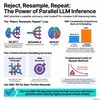
Reject, Resample, Repeat: Understanding Parallel Reasoning in Language Model Inference
This research paper investigates Sequential Monte Carlo (SMC) and other particle filtering algorithms as a theoretical framework for improving large language model (LLM) inference. The authors introduce a principled approach to analyze inference-time interventions, such as parallel reasoning and pruning, by utilizing process reward models to steer generation. Their findings establish non-asymptotic guarantees for SMC based on criteria like bounded action-level coverage and divergence between true and approximate reward distributions. To address limitations in standard SMC, they propose SMC with Rejection Sampling (SMC-RS), which maintains high accuracy even when reward models are nearly perfect. Empirically, the study demonstrates that SMC consistently outperforms Best-of-N sampling on complex mathematical reasoning tasks and benchmarks. Ultimately, the work bridges the gap between ad hoc sampling heuristics and rigorous statistical theory to optimize the accuracy-cost tradeoff in AI inference.
Podzilla Summary coming soon
Sign up to get notified when the full AI-powered summary is ready.
Free forever for up to 3 podcasts. No credit card required.
Listen to This Episode
More from Best AI papers explained

The Evolution of Digital Search: From Blue Links to Delegated Decision-Making

Ask, Don’t Judge: Binary Questions for Interpretable LLM Evaluation and Self-Improvement

From Reasoning Traces to Reusable Modules: Understanding Compositional Generalization in Language Model Reasoning
Understanding Reasoning from Pretraining to Post-Training
Get summaries like this every morning.
Free AI-powered recaps of Best AI papers explained and your other favorite podcasts, delivered to your inbox.
Free forever for up to 3 podcasts. No credit card required.