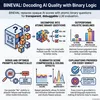
Ask, Don’t Judge: Binary Questions for Interpretable LLM Evaluation and Self-Improvement
The research introduces BINEVAL, a novel evaluation framework that improves the reliability of Large Language Models (LLMs) by decomposing complex quality criteria into atomic binary questions. Unlike traditional holistic grading, which often produces opaque and inconsistent scores, this method utilizes a "decompose-then-verify" approach to generate transparent, multidimensional assessments. By aggregating simple yes/no verdicts into calibrated scores, the system achieves superior alignment with human judgment across tasks like summarization and dialogue. Beyond measurement, the framework supports an iterative optimization loop that uses question-level feedback to refine both evaluator rubrics and generation prompts. This diagnostic granularity allows developers to pinpoint specific failure modes, such as factual misattributions or formatting errors, that broader metrics typically obscure. Ultimately, BINEVAL demonstrates that breaking evaluation into checkable sub-tasks makes LLM outputs more interpretable, debuggable, and actionable for continuous model improvement.
Podzilla Summary coming soon
Sign up to get notified when the full AI-powered summary is ready.
Free forever for up to 3 podcasts. No credit card required.
Listen to This Episode
More from Best AI papers explained

The Evolution of Digital Search: From Blue Links to Delegated Decision-Making
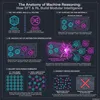
From Reasoning Traces to Reusable Modules: Understanding Compositional Generalization in Language Model Reasoning
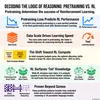
Understanding Reasoning from Pretraining to Post-Training
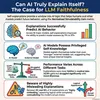
A Positive Case for Faithfulness: LLM Self-Explanations Help Predict Model Behavior
Get summaries like this every morning.
Free AI-powered recaps of Best AI papers explained and your other favorite podcasts, delivered to your inbox.
Free forever for up to 3 podcasts. No credit card required.