
From Reasoning Traces to Reusable Modules: Understanding Compositional Generalization in Language Model Reasoning
This research introduces a hierarchical latent selection model to explain how large language models develop robust reasoning through post-training. The authors argue that supervised fine-tuning (SFT) provides the essential building blocks, while reinforcement learning (RL) decomposes these traces into reusable atomic skills and routing mechanisms. By isolating these components, RL enables models to solve out-of-distribution problems through novel combinations of learned modules. Controlled experiments on synthetic tasks prove that training on compositional traces is superior to learning isolated skills. The study concludes that an ideal training protocol uses SFT to ensure broad module coverage and RL to explore unseen compositions. This division of labor allows models to generalize systematically beyond the specific demonstrations provided during initial tuning.
Podzilla Summary coming soon
Sign up to get notified when the full AI-powered summary is ready.
Free forever for up to 3 podcasts. No credit card required.
Listen to This Episode
More from Best AI papers explained

The Evolution of Digital Search: From Blue Links to Delegated Decision-Making

Ask, Don’t Judge: Binary Questions for Interpretable LLM Evaluation and Self-Improvement
Understanding Reasoning from Pretraining to Post-Training
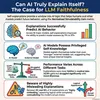
A Positive Case for Faithfulness: LLM Self-Explanations Help Predict Model Behavior
Get summaries like this every morning.
Free AI-powered recaps of Best AI papers explained and your other favorite podcasts, delivered to your inbox.
Free forever for up to 3 podcasts. No credit card required.