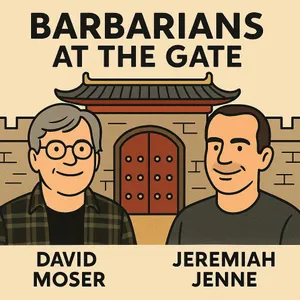
Free Daily Podcast Summary
Barbarians at the Gate: Daily Summaries Delivered
by Barbarians at the Gate
A semi-serious deep dive into Chinese history and culture broadcast from Beijing and hosted by Jeremiah Jenne and David Moser.
Latest Episodes
The most recent episodes — sign up to get AI-powered summaries of each one.
- 1 weeks ago30 min
Mao More Than Ever
Mao Zedong died on September 9, 1976. Fifty years later, Jeremiah and David compare notes on a mostly quiet anniversary. Jeremiah reports that there were enough tributes to beat the over/under, but David argues that the Party would still prefer to keep things as ritualistic as possible. Mao is still dead. We will all bow. And moving on.David recalls how Mao was remembered in the 1980s, when Deng Xiaoping's (reputed) formula that the chairman's policies were two-thirds correct, one-third incorrect was treated as the last word, even as xiangsheng artists could still mock the Cultural Revolution so long as the punchlines landed squarely on the Gang of Four. Jeremiah discusses how and why Mao nostalgia never goes out of fashion, morphing with the times and the exigencies of the era.The two also catch up on their summer vacations. David is back in Beijing, his broken leg mended with the help of a dominant physical therapist. Jeremiah reports in from a 27th-floor balcony overlooking a container port in Shenzhen.
- 3 weeks ago42 min
The Last Emperor of China with author Paul French
China’s last emperor (Puyi), his empress (Wanrong), and concubine (Wenxiu) spent two years sequestered in the Forbidden City before their expulsion in 1924. Around them were holdover dowagers, scheming eunuchs, corrupt officials, and two foreign teachers of English. Many people know Puyi’s tutor, Reginald Johnston, either from Johnston’s memoir, Twilight in the Forbidden City, or from Peter O’Toole’s portrayal in Bernardo Bertolucci’s Puyi biopic, The Last Emperor. But it is Wanrong’s tutor, the young American Isabel Ingram, and her letters that are at the heart of our guest’s new book about these pivotal two years in Chinese history.Author Paul French has made a career of evocative stories of old China, including the New York Times bestseller Midnight in Peking and City of Devils: A Shanghai Noir. The Economist has called him “a champion storyteller.” His new book, The Last Emperor of China: Twilight of the Forbidden City (out today in the UK), is built around the unpublished letters of Ingram and Johnston. They describe the trials and tribulations (but also the small pleasures and moments of joy) shared by three remarkable young people: Puyi, Wanrong, and Wenxiu. They longed to escape, but when they were finally expelled from the courtyards of Beijing’s imperial palace, they found only despair and tragedy.Paul joins Jeremiah to discuss the origins of this book, his use of previously unpublished sources, including memoirs, diaries, and letters, and whether the more lurid rumors of the relationship between Puyi and his empress have any basis in fact.
- Jul 29, 202635 min
Somerset Maugham's On a Chinese Screen: Missionaries, Taipans, and Expats Who Never Leave (but probably should)
In this Barbarians at the Gate x China Books Review crossover, Jeremiah Jenne is joined by CBR Associate Editor Alexander Boyd to discuss the latest addition to the China Archives: W. Somerset Maugham's On a Chinese Screen (1922), a collection of vignettes from Maugham's trip through China in the winter of 1919–1920.Maugham came to China and mostly found... the English. Missionaries who profess love for a country they secretly loathe, taipans dreading burial in Chinese soil, diplomats who could be posted to Peking or Bern without noticing the difference. Jeremiah and Alexander match these hundred-year-old archetypes to expats they have known, and chart the "Cycle of China Funk," the wave pattern that should replace the PowerPoint version of culture shock and adaptation. They follow Maugham's habit of recycling real people into his fiction, including handing the scholar Gu Hongming's rebuke of Western power to a stage villain in East of Suez. And they bring Gerald Haxton out of the shadows: the hard-drinking companion who made the whole trip and never appears in the book.Next month on the China Archives: Shen Fu's Six Records of a Floating Life.Keywords: Somerset Maugham, On a Chinese Screen, China Books Review, Barbarians at the Gate podcast, Gu Hongming, Gerald Haxton, expat life in China, China travel writing, British colonialism in China, China Archives
- Jul 16, 202640 min
Barbarian Remix: The Secrets and History behind Beijing's Forbidden City
It’s the summer travel season, and one of the most popular sites here in Beijing is the Palace Museum at the Forbidden City. To talk about China’s most famous imperial palace, we are joined by Matthew Hu Xinyu, Trustee of the Beijing Cultural Heritage Protection Center (CHP) and founder of the Courtyard Institute. Matthew provides us with updates on renovated sections of the Palace Museum previously inaccessible to tourists, such as the Palace of Compassion and Tranquility (Cining Gong 慈宁宫), where the Empress Dowager celebrated her birthdays and worshipped the Buddha, and the living quarters of the imperial concubines located north and west of Longzong Gate. Matthew also gives us a fascinating overview of the complex task of renovating the centuries-old compound and the challenges the Palace Museum faces in restoring, protecting, and exhibiting its 1.8 million artifacts. Palaces, artifacts, and historical figures mentioned on the podcast: Hall of Mental Cultivation, Yangxin Dian养心殿 Palace of Established Happiness建福宮Jianfu Gong jinzhuan金砖 ”metal/gold bricks” Dr. Shan Jixiang 单霁翔, curator of the Palace Museum from 2012 to 2019 Imperial Fasting Palace Zhai Gong斋宫 “Dwelling in the Fuchun Mountains” Fuchun Shanju Tu 富春山居圖, a famous Yuan Dynasty painting by Huang Gongwang (黃公望, 1269-1354). The painting was divided into two pieces after being rescued from a fire. The two sections were later separated; the main section is now housed at the Taipei Palace Museum, and the smaller section, referred to as “The Remaining Mountain,” 剩山圖 Sheng Shan Tu, is part of the Beijing collection. “Precious Works of the Stone Canal Pavilion” 石渠宝笈 Shiqu Baoji. A vast Qing collection of paintings and calligraphy by emperors and famous artists, divided into categories such as books, paintings, scrolls, and calligraphy. Hall of Three Rarities Sanxi Tang 三希堂 “Reign behind the curtain” Chuilian tingzheng垂帘听政 Retirement Lodge Juanqin Zhai倦勤斋 Palace of Longevity and Health Shoukang Gong寿康宫 Fragile Cargo: China’s Wartime Race to Save the Treasures of the Forbidden City by Adam Brookes. “The gripping true story of the bold and determined museum curators who saved the priceless treasures of China’s Forbidden City in the years leading up to World War II and beyond.” “Masters in the Forbidden City” Wo zai Gugong xiu wenwu 我在故宫修文物. State media documentary on the ongoing restoration projects of the Forbidden City. Available on YouTube:https://www.youtube.com/watch?v=Pw6awYYu_6sThis episode originally aired in July 2023.
- Jul 2, 20261h 1m
Neysun Mahboubi on the past, present, and future of US-China Academic Exchanges
We are honored to have Professor Neysun Mahboubi, Director of the Penn Project on the Future of U.S.-China Relations, a program that provides a platform for talented U.S.-based China scholars to contribute academically informed analysis on the most important issues in U.S.-China relations. Neysun recounts his experiences as a legal scholar in China during the 1990s Reform and Opening Up period, focusing on his mentors and the legal scholars who were at the forefront of legal reform in the PRC. A passionate advocate for scholarly research on China, Neysun emphasizes the value of on-the-ground research, for those who are able to do so, in these increasingly complicated times. Neysun A. Mahboubi is Director of the Penn Project on the Future of U.S.-China Relations at the University of Pennsylvania, where he teaches courses on Chinese history, law, and policy and hosts the China Studies podcast. He is also a Non-Resident Senior Fellow with the Asia Program at the Foreign Policy Research Institute.
- Jun 18, 202639 min
AI Slop, AI Detectors, and Authentic Voice: A China-Tech Insider on Writing and Working With AI
Should we view today’s powerful AI language tools as intellectual crutches or as incredibly useful assets? Can they be safely integrated into our existing toolkit for business and academia, or should we approach them with justified caution? And why is the Western world terrified of AI, whereas China is already incorporating it into all sectors of society? Spoiler alert: The West views AI as a possible extinction risk, to be monitored and controlled, while China pragmatically views it as merely a tool to improve the lives of ordinary people. In this episode, we’re delighted to welcome back Zhang Yajun, founder of Zhang Global Advisory. Yajun shares her insights on the rapidly expanding role of Artificial Intelligence in global business communication and academic research. Yajun offers a more measured and practical take. From personal experience, she knows that non-native speakers can effectively use AI to produce writing that is clear, idiomatic, and faithful to their original ideas — while still preserving their authentic "human tone" and avoiding the sterile, formulaic output that AI often generates.
- Jun 4, 202626 min
China Books Review x Barbarians at the Gate: The Private Life of Chairman Mao
The Politburo had given Mao Zedong’s personal physician Li Zhisui a direct order: prepare the Chairman’s body so that he can be on permanent display. Li was aghast. It was not what Mao had wanted, and besides, “How to pickle your country’s leader” wasn’t one of the courses he studied in medical school. But after the turbulence of the Cultural Revolution, Mao’s death meant a potential political showdown between the Gang of Four, including Mao’s wife, Jiang Qing, and Mao’s chosen successor, Hua Guofeng. Dr. Li did not want to be caught in the middle. So Li and his team did the best they could. Spoiler alert: it involved a massage that nobody would want to give. Li Zhisui’s controversial memoir, The Private Life of Chairman Mao, was published in 1994. Readers were titillated by Mao’s sex life, questionable hygiene regime, and gruesome medical maladies. Defenders of Mao labeled the book pure propaganda. Dr. Li was a disloyal liar, and his collaborators and publishers were pushing anti-Mao agendas. Jeremiah is joined by Alexander Boyd, Associate Editor of the China Books Review, to discuss Mao Zedong, Li Zhisui, and Jeremiah’s recent retrospective essay about The Private Life of Chairman Mao. Who was Dr. Li? What did it take to survive in the courtyards of power at the peak of Mao’s paranoia? And did Dr. Li really witness all of the major events he described in his book?
- May 5, 202648 min
This Was Funnier in China: Jesse Appell's Cross-Cultural Comedy Journey
On this episode, we sit down with the one and only Jesse Appell—Chinese TV stand-up comedian, blogger, lecturer, tea entrepreneur, and passionate bridge-builder for US–China cultural exchange. In his newly published book, Jesse shares the unlikely story of how a Fulbright Fellowship to study the traditional Chinese humor form “crosstalk” (xiangsheng) launched him from student to television star, with his video clips capturing more than half a billion views on the Chinese Internet.
Get Barbarians at the Gate summaries in your inbox
Free AI-powered daily recaps. Key takeaways, quotes, and mentions — in a 5-minute read.
Get Free Summaries →Free forever for up to 3 podcasts. No credit card required.
You Might Also Like
Listeners also like.
Pekingology
A deep dive into Chinese politics, the Communist Party’s operations, and the global implications of China’s domestic and foreign policies.

Coffee Break Chinese
Learn Mandarin Chinese through structured lessons focusing on practical language for speaking with native speakers.

Dan Snow's History Hit
Dan Snow visits historic sites worldwide to explore the stories behind pivotal events, figures, and monuments.
基本无害 Mostly Harmless
Explores the mechanisms behind how creative works are made, experiences are lived, and ideas take shape.

School of War
Discussions with military leaders, policymakers, and historians on the strategy, history, and consequences of war.

Mo News
Daily news coverage with analysis, interviews, and listener Q&A on global headlines from Mosheh Oinounou and Jill Wagner.

Forum Borealis
In-depth interviews with authors and thinkers on unconventional topics in history, science, philosophy, and politics.

张小珺Jùn|商业访谈录
深度对话科技与商业领域人物,探讨AI、创业、投资及行业变革背后的思考与故事。

Danny Jones Podcast
Danny explores ways to become smarter.

跨国串门儿计划
使用AI技术将英文播客翻译为中文,保留原声线,让中文听众听懂外语内容。
BG2Pod with Brad Gerstner and Bill Gurley
Bi-weekly discussions on technology, markets, investing, and capitalism with Brad Gerstner and Bill Gurley.
Ancient Civilisations
Explores the history, people, and achievements of ancient civilizations through narrative storytelling.
About Barbarians at the Gate
A semi-serious deep dive into Chinese history and culture broadcast from Beijing and hosted by Jeremiah Jenne and David Moser.
Customized Recaps
AI-powered recaps with compact key takeaways, quotes, and insights.
Straight to Your Inbox
Get key takeaways from Barbarians at the Gate in a 5-minute read.
Save Hours Every Week
Stay current on your favorite podcasts without falling behind.
Frequently Asked Questions
What is Podzilla's Barbarians at the Gate daily summary?
It's a free AI-powered email that summarizes new episodes of Barbarians at the Gate as soon as they're published. You get the key takeaways, notable quotes, and links & mentions — all in a quick read.
How does the Barbarians at the Gate podcast summary work?
When a new episode drops, our AI transcribes and analyzes it, then generates a personalized summary tailored to your interests and profession. It's delivered to your inbox every morning.
Is this an official Barbarians at the Gate product?
No. Podzilla is an independent service that summarizes publicly available podcast content. We're not affiliated with or endorsed by Barbarians at the Gate.
Can I get summaries of other podcasts too?
Absolutely! The free plan covers up to 3 podcasts. Upgrade to Pro for 15, or Premium for 50. Browse our full catalog at /podcasts.
How often does Barbarians at the Gate release new episodes?
Barbarians at the Gate publishes biweekly. Our AI generates a summary within hours of each new episode.
What topics does Barbarians at the Gate cover?
Barbarians at the Gate covers topics including History, Culture, Society & Culture, Travel, Places & Travel. Our AI identifies the specific themes in each episode and highlights what matters most to you.
Start getting Barbarians at the Gate summaries tomorrow morning.
Free forever for up to 3 podcasts. No credit card required.
Free forever for up to 3 podcasts. No credit card required.