Free Daily Podcast Summary
School of War: Daily Summaries Delivered
by Nebulous Media
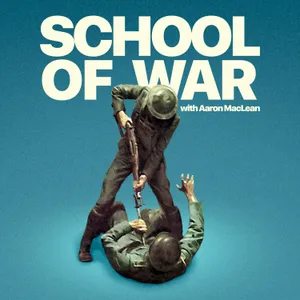
In School of War, CBS News National Security Analyst and Free Press columnist Aaron MacLean sits down with secretaries of state, top military historians, war planners, and key political decision-makers to help understand the lessons of war. Aaron MacLean is a former senior fellow at Hudson Institute. He has worked as a foreign policy advisor and legislative director to Sen. Tom Cotton of Arkansas and spent seven years in the U.S. Marine Corps.
Latest Episodes
The most recent episodes — sign up to get AI-powered summaries of each one.
- 2 days ago59 min
Why John Boyd Still Matters
John Boyd was one of the most influential military thinkers of the 20th century, and the intellectual godfather of the U.S. Marines’ military strategy. Today, as artificial intelligence continues to transform battlefields in Ukraine and the Middle East, author and retired Marine officer Ian Brown argues that Boyd’s ideas are more relevant than ever. Today, Brown joins Aaron MacLean to discuss how Ukraine is harnessing Boyd’s concept of narrative warfare, what Boyd can teach us about conflict in the age of AI, drones, and precision strikes, and his new book co-authored with Frans P. B. Osinga, Snowmobiles and Grand Ideals. 2:20 Who Was John Boyd?7:25 What Boyd Learned From Dogfighting15:37 From Air Combat to the OODA Loop23:49 Is the OODA Loop Really About Speed?29:33 What Do Blitzkrieg and Insurgency Have in Common?36:44 Surfaces and Gaps41:25 Why Did the Marine Corps Embrace Boyd?48:25 The Marine Corps’ Warfighting Doctrine50:25 Does Modern Warfare Challenge Boyd?53:18 Information as a Weapon53:53 Boyd’s Ideas Meet Drone Warfare54:55 From Nagorno-Karabakh to Ukraine This episode of School of War is brought to you by Maven Smart System, the builder platform for the American warfighter, fielded across the force and live on the frontline today. Learn more at palantir.com. This episode of School of War is also brought to you by Stratolaunch, a leading pure-play hypersonics company. Stratolaunch helps the U.S. and its allies move new hypersonic technologies from concept to capability, faster and cheaper. Learn more about how Stratolaunch is accelerating the future of hypersonics at Stratolaunch.com. Learn more about your ad choices. Visit megaphone.fm/adchoices
- 5 days ago1h 2m
What War Teaches Us—If We Survive It
People think retired Army Major John Spencer lost part of his ear in combat. He didn’t; he lost it in a fight behind a bar that cost him his spot in the Army Rangers. Spencer went on to serve repeatedly in combat and become one of the country’s leading experts on urban warfare. He joins Aaron MacLean to discuss his origin story and other anecdotes from his new book, Twenty Times I Almost Died, as well as why he thinks the U.S. “is clearly winning” the war in Iran. 3:30 War With Iran 9:43 Battle of Hormuz 10:42 Wartime Stockpiles 12:32 The Stakes of Failure 15:34 Losing His Ear 23:34 Losing the Rangers 25:51 Resilience 28:58 Invading Iraq 33:59 Common Sense in Combat 39:08 The IED Trap 44:25 Battle of Marjah 51:01 Gangs of Baghdad This episode of School of War is brought to you by Maven Smart System, the builder platform for the American warfighter, fielded across the force and live on the frontline today. Learn more at palantir.com. This episode of School of War is also brought to you by Stratolaunch, a leading pure-play hypersonics company. Stratolaunch helps the U.S. and its allies move new hypersonic technologies from concept to capability, faster and cheaper. Learn more about how Stratolaunch is accelerating the future of hypersonics at Stratolaunch.com. Learn more about your ad choices. Visit megaphone.fm/adchoices
- 1 weeks ago56 min
‘We Are Going to War’: H.R. McMaster Remembers 9/11
Lieutenant General H.R. McMaster was on the phone with the Pentagon when the plane struck the building on September 11, 2001. “I thought, Okay, we are going to war,” he recalls. Twenty-five years after 9/11, McMaster joins Aaron MacLean to discuss the wars that followed. Drawing on his experience as a wartime commander and national security adviser, McMaster explains why he considers Afghanistan a self-defeat, how American withdrawal helped enable the rise of ISIS in Iraq, and why he thinks the latest Iran ceasefire was “a big mistake.” 4:39 McMaster on 9/11 7:27 Adapting to Iraq 12:33 Lessons From Iraq 15:13 Counterinsurgency’s Legacy 21:19 The Post-9/11 Wars 23:23 Afghanistan’s “Self-Defeat” 25:07 When America Leaves 29:53 Sustaining Afghanistan 32:14 Defending the Afghan Mission 35:37 The Axis of Aggressors 44:41 Trump’s Messaging About the War 49:07 Politics in the Military This episode of School of War is brought to you by Maven Smart System, the builder platform for the American warfighter, fielded across the force and live on the frontline today. Learn more at palantir.com. This episode of School of War is also brought to you by Stratolaunch, a leading pure-play hypersonics company. Stratolaunch helps the U.S. and its allies move new hypersonic technologies from concept to capability, faster and cheaper. Learn more about how Stratolaunch is accelerating the future of hypersonics at Stratolaunch.com. Learn more about your ad choices. Visit megaphone.fm/adchoices
- 1 weeks ago44 min
Ten-Minute Warning: The Hypersonic Threat
A Chinese hypersonic missile targeting either U.S. coast would leave room for “about 10 minutes of warning time.” Zachary Krevor, CEO of Stratolaunch, is building vehicles to help the Pentagon learn to detect, track, and intercept this threat. Today, Krevor joins School of War to explain how China and Russia have outpaced the U.S. in hypersonic weapons testing, why AI-enabled missile “swarms” may be on the horizon, and what it will take for America to defend itself against them. 2:32 What Makes a Weapon Hypersonic? 4:47 The Real-Life Top Gun: Maverick 6:14 From Model Airplanes to Hypersonics 9:09 Why America Stopped Investing in Hypersonics 10:55 Two Types of Hypersonic Weapons 14:09 Glide Bodies vs. Cruise Missiles 15:44 Surviving the Heat of Mach 5 20:20 Testing America’s Hypersonic Technology 23:20 China and Russia’s Hypersonic Advantage 25:24 How to Stop a Hypersonic Missile 29:09 The Coming Age of Hypersonic Swarms 40:38 Can Golden Dome Stop Hypersonic Weapons? This episode of School of War is brought to you by Maven Smart System, the builder platform for the American warfighter, fielded across the force and live on the frontline today. Learn more at palantir.com. Learn more about your ad choices. Visit megaphone.fm/adchoices
- 2 weeks ago55 min
What to Expect When You’re Expecting Great Power Conflict
When it comes to world superpowers, Cambridge historian Brendan Simms argues there are only four that matter—and two of them are fading. Today, Simms joins Aaron MacLean to argue that Britain still belongs among the world’s leading powers; why its place among them is “by no means guaranteed”; and why Hitler is no longer the absolute evil against which people define themselves. 4:08 The Four R’s of Great Power 4:29 Defining Great Power 8:09 Iran’s Regional Power 11:44 The Great Powers Return 15:39 The Cold War 17:44 Europe Wakes Up 21:45 American Unipolarity Ends 25:16 Britain’s Great-Power Claim 35:47 The New World Order 38:26 Realism’s Blind Spots 42:07 Losing Postwar Optimism 45:53 A “Post-Hitler World” This episode of School of War is brought to you by Maven Smart System, the builder platform for the American warfighter, fielded across the force and live on the frontline today. Learn more at palantir.com. This episode of School of War is also brought to you by Stratolaunch, a leading pure-play hypersonics company. Stratolaunch helps the U.S. and its allies move new hypersonic technologies from concept to capability, faster and cheaper. Learn more about how Stratolaunch is accelerating the future of hypersonics at Stratolaunch.com. Learn more about your ad choices. Visit megaphone.fm/adchoices
- 2 weeks ago1h 3m
Shot Down over Serbia: General Goldfein’s Incredible Story
The story of Air Force General David Goldfein, who miraculously survived after his plane was shot down over Serbia in 1999, has since become military legend. Today, he joins School of War to recount the harrowing rescue mission that saved him, how he stayed alive behind enemy lines, and the lessons his remarkable career offers about leadership, airpower, and preparing America for the next war. 2:43 An Air Force Family 3:25 Rejected by the Air Force Academy 6:39 Becoming an F-16 Pilot 8:12 What Makes a Great Fighter Pilot? 12:36 Information Overload in Combat 15:28 Goldfein’s First Combat Mission 19:57 Training for Confidence Under Fire 21:37 A Leadership Lesson from the Gulf War 24:32 Shot Down Over Serbia 28:51 Surviving Behind Enemy Lines 31:48 The Race to Rescue Goldfein 36:22 Guiding the Rescue Helicopter 44:50 The Impact on His Family 48:53 Witnessing the Attack on the Pentagon 51:19 Digitizing the American Military This episode of School of War is brought to you by Maven Smart System, the builder platform for the American warfighter, fielded across the force and live on the frontline today. Learn more at palantir.com. Learn more about your ad choices. Visit megaphone.fm/adchoices
- 3 weeks ago40 min
Our Foreign Policy Divide Began with the Korean War
More than 75 years after the Korean War, its lessons endure—and divisions over isolationism and American power continue to shape the discourse around modern global conflicts. Dane J. Cash, historian and author of The Forgotten Debate: The Korean War and the Roots of America's Ideological Divisions, joins School of War to explain how the left’s hawk-dove divide during the Korean War foreshadowed the neoconservative break from the liberal consensus during the 1970s and why the political battles of the early Cold War continue to splinter America today. 2:10 America Before the Korean War 3:08 The Debate Over Containment 4:15 Multilateralism vs. Unilateralism 5:29 Did Acheson Invite the War? 8:23 Why North Korea Attacked 8:55 Conservative Criticism of Truman 11:10 Liberal Divisions Over Korea 13:30 The Roots of Neoconservatism 17:14 Truman’s Lonely Middle Ground 19:51 The Right’s Foreign Policy Split 22:05 Taft, Eisenhower, and the GOP 22:58 MacArthur’s Moment 25:31 China Enters the War 30:37 Herbert Hoover’s Foreign Policy Revolt 33:51 Stalemate, POWs, and Ukraine Parallels This episode of School of War is brought to you by Maven Smart System, the builder platform for the American warfighter, fielded across the force and live on the frontline today. Learn more at palantir.com. Learn more about your ad choices. Visit megaphone.fm/adchoices
- 3 weeks ago1h 11m
Inside America’s Fight for Drone Dominance
The U.S. military needs more drones, and it needs to build them without Chinese parts. Today, Defense Innovation Unit Deputy Director Travis Metz joins School of War to discuss how America can build drones quickly, cheaply, and on U.S. soil; what America can learn from Ukraine’s drone war; and the Pentagon’s new billion-dollar effort to upgrade its aging military technology. 2:23 - Why America Is Behind on Drones 4:32 - The Drone Dominance Program 6:51 - Breaking Dependence on China 10:23 - The Different Types of Drones 13:34 - Ukraine’s Mid-Range Strike Revolution 16:00 - Cheap Drones at Long Range 18:47 - AI, Autonomy, and Electronic Warfare 21:47 - How Drone Dominance Works 24:33 - Building an American Drone Industry 33:55 - Lessons From Fort Benning 39:19 - Cheap and Expendable Drones 42:01 - Testing Drones for Different Missions 50:14 - The Next Phase of Drone Dominance 55:09 - How Many Drones Does America Need? 1:02:49 - Recreating Ukraine’s Innovation Cycle This episode of School of War is brought to you by Maven Smart System, the builder platform for the American warfighter, fielded across the force and live on the frontline today. Learn more at palantir.com. Learn more about your ad choices. Visit megaphone.fm/adchoices
Get School of War summaries in your inbox
Free AI-powered daily recaps. Key takeaways, quotes, and mentions — in a 5-minute read.
Get Free Summaries →Free forever for up to 3 podcasts. No credit card required.
You Might Also Like
Listeners also like.
Irregular Warfare Podcast
Examines irregular warfare through expert discussions on small wars, special operations, counterterrorism, and conflict tactics.

The History of WWII Podcast
A detailed narrative exploration of World War II, covering its events, battles, and key figures.

History Unplugged Podcast
Features interviews with history authors and answers to listener questions on a wide range of historical topics.

The Lawfare Podcast
Discussions with experts on national security, law, and policy covering foreign policy, intelligence, cybersecurity, and governance.

The Team House
Deep-dive conversations on national security with special operations veterans, intelligence professionals, and frontline reporters.

One Decision
Former intelligence leaders and journalists examine high-stakes decisions that shaped global events.

The WW2 Podcast
A military history podcast exploring various aspects of World War II as it moves beyond living memory.

NatSec Matters
Former national security officials interview top leaders on critical security challenges and U.S. policy responses.

HistoryExtra podcast
Covers global history from ancient to modern times through expert interviews on events, figures, and eras.

The Lawfare Podcast: Patreon Edition
Experts and policymakers discuss national security, law, and policy issues including foreign policy, intelligence, and cybersecurity.

Dan Snow's History Hit
Dan Snow visits historic sites worldwide to explore the stories behind pivotal events, figures, and monuments.

WW2 Pod: We Have Ways of Making You Talk
A comedian and historian explore World War II through detailed analysis, personal stories, and dark humor.
About School of War
In School of War, CBS News National Security Analyst and Free Press columnist Aaron MacLean sits down with secretaries of state, top military historians, war planners, and key political decision-makers to help understand the lessons of war. Aaron MacLean is a former senior fellow at Hudson Institute. He has worked as a foreign policy advisor and legislative director to Sen. Tom Cotton of Arkansas and spent seven years in the U.S. Marine Corps.
Customized Recaps
AI-powered recaps with compact key takeaways, quotes, and insights.
Straight to Your Inbox
Get key takeaways from School of War in a 5-minute read.
Save Hours Every Week
Stay current on your favorite podcasts without falling behind.
Frequently Asked Questions
What is Podzilla's School of War daily summary?
It's a free AI-powered email that summarizes new episodes of School of War as soon as they're published. You get the key takeaways, notable quotes, and links & mentions — all in a quick read.
How does the School of War podcast summary work?
When a new episode drops, our AI transcribes and analyzes it, then generates a personalized summary tailored to your interests and profession. It's delivered to your inbox every morning.
Is this an official School of War product?
No. Podzilla is an independent service that summarizes publicly available podcast content. We're not affiliated with or endorsed by Nebulous Media.
Can I get summaries of other podcasts too?
Absolutely! The free plan covers up to 3 podcasts. Upgrade to Pro for 15, or Premium for 50. Browse our full catalog at /podcasts.
How often does School of War release new episodes?
School of War publishes 2x weekly. Our AI generates a summary within hours of each new episode.
What topics does School of War cover?
School of War covers topics including History, Business, Arts, Books. Our AI identifies the specific themes in each episode and highlights what matters most to you.
Start getting School of War summaries tomorrow morning.
Free forever for up to 3 podcasts. No credit card required.
Free forever for up to 3 podcasts. No credit card required.