Free Daily Podcast Summary
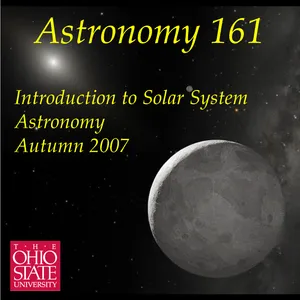
Astronomy 161 - Introduction to Solar System Astronomy - Autumn 2007: Daily Summaries Delivered
by Richard Pogge
Astronomy 161, Introduction to the Solar System, is the first quarter ofa 2-quarter introductory Astronomy for non-science majors taught at TheOhio State University. This podcast presents audio recordings ofProfessor Richard Pogge's lectures from his Autumn Quarter 2007 class.All of the lectures were recorded live in 1000 McPherson Laboratory onthe OSU Main Campus in Columbus, Ohio.
Latest Episodes
The most recent episodes — sign up to get AI-powered summaries of each one.
- Dec 6, 2009
Astronomy 141 Podcast Teaser
A new podcast, Astronomy 141, Life in the Universe, is available for those interested in continuing an exploration of topics in modern astronomy.
- Nov 30, 2007
Lecture 46: Are We Alone? Life in the Universe
Are we alone in the Universe? This lecture explores the question of how we might go about finding life on planets around other stars. Rather than talking about speculative ideas, like the Drake Equation or SETI, I am instead taking the approach of posing it as a problem of what to look for among the exoplanets we have been discovering in huge numbers in the last decade. I describe the basic requirements for life, and how life on Earth is surprisingly tough (extremophiles). I then give a definition of the Habitable Zone around a star, and present the Goldilocks Problem of how a planet must be neither too hot, too cold (for liquid water) or too big or too small to be hospitable to life. From there I then review the problem of how to go about finding Earth-like planets (Pale Blue Dots) around other stars, and if we do find them, what spectroscopic signatures of life, called biomarkers, we can look for to see if they have some form of life like we understand it on them. Recorded on 2007 Nov 30 in 1000 McPherson Lab on the Columbus campus of The Ohio State University. This is the final lecture for Autumn Quarter 2007.
- Nov 29, 2007
Lecture 45: Exoplanets - Planets Around Other Stars
Are there planets around other stars? Are there Earth-like planets around other stars? Do any of those harbor life? Intelligent life? We'd like to know the answers to all of these questions, and in recent years we've made great progress towards at least answering the first. To date, more than 260 planets have been found around more than 200 other stars, most in the interstellar neighborhood of the Sun, but a few at great distance. This lecture reviews the search for ExoPlanets, discussing the successful Radial Velocity, Transit, and Microlensing techniques. What we have found so far are very suprising systems, especially Jupiter-size or bigger planets orbiting very close (few hundredths of an AU) from their parent stars. Recorded 2007 Nov 29 in 1000 McPherson Lab on the Columbus campus of The Ohio State University.
- Nov 28, 2007
Lecture 44: Comets
Comets are chance visitors from the icy reaches of the outer Solar System. In this lecture I describe the properties of comets, their historical importance, and introduce the "dirty snowball" model of a comet nucleus. At the end of class I created a model of a comet nucleus from common household and office materials, unfortunately I could not arrange for a videographer in time. Recorded 2007 Nov 28 in 1000 McPherson Lab on the Columbus campus of The Ohio State University.
- Nov 27, 2007
Lecture 43: Icy Worlds of the Outer Solar System
Beyond the orbit of Neptune lies the realm of the icy worlds, ranging in size from Neptune's giant moon Triton and the dwarf planets Pluto and Eris, all the way down to the nuclei of comets a few kilometers across. This lecture discussed the icy bodies of the Trans-Neptunian regions of the Solar System, discussing the basic properties of Triton (the best studied such object), Pluto, Eris, and the Kuiper Belt, introducing the dynamical families of Trans-Neptunian Objects that record in their orbits the slow migration of Neptune outwards during the early history of the Solar System. The Kuiper Belt is the icy analog of the main Asteroid Belt of the inner Solar System: both are shaped by their gravitational interaction with giant gas planets (Jupiter for the asteroids, Neptune for the KBOs), and are composed of leftover raw materials from the formation of their respective regions of the Solar System. Recorded 2007 Nov 27 in 1000 McPherson Lab on the Columbus campus of The Ohio State University.
- Nov 26, 2007
Lecture 42: Asteroids
Asteroids are the leftover rocky materials from the formation of the Solar System that reside primarily in a broad belt between the orbits of Mars and Jupiter. This lecture reviews the physical and orbital properties of Asteroids, and discusses the role of Jupiter and orbital resonances in dynamically sculpting the Main Belt of Asteroids. Once again, we see how the history of the dynamical evolution of our Solar System is written in the orbits of its members. Recorded 2007 Nov 26 in 1000 McPherson Lab on the Columbus campus of The Ohio State University.
- Nov 21, 2007
Lecture 41: Planetary Rings
All Jovian planets have rings. We are most familiar with the bright, spectacular rings of Saturn, but the other Jovian planets have rings systems around them. This lecture describes the different ring systems and their properties, and discusses their origin, formation, and the gravitational interactions - resonances, perturbations, and shepherd moons - that govern their evolution. Recorded 2007 Nov 21 in 1000 McPherson Lab on the Columbus campus of The Ohio State University.
- Nov 20, 2007
Lecture 40: The Saturn System
Saturn is attended by a system of 60 known moons and bright, beautiful rings. Today we will explore the moons of Saturn. Among the highlights are Saturn's lone giant moon, Titan, the 2nd largest moon in the Solar System and the only one with a heavy atmosphere. The atmosphere of Titan is mostly nitrogen with a little methane, but the temperature and pressure are such that methane plays the same role on Titan that water plays on the Earth: it can be either a solid, gas, or liquid. The Cassini and Huygens probes have recently shown that there is evidence of liquid methane flows and mudflats, and even liquid methane lakes as big as the Great Lakes or Caspian seas on Earth. The other moon of interest is Enceladus. The shiniest object in the Solar System, Enceladus has spectacular fountains - cryovolcanos - that spew water vapor from reservoirs created in its tidally-heated interior. This ice repaves much of the surface of Enceladus, giving it a young, shiny surface, and builds the E ring of Saturn. Recorded 2007 Nov 20 in 1000 McPherson Lab on the Columbus campus of The Ohio State University.
Get Astronomy 161 - Introduction to Solar System Astronomy - Autumn 2007 summaries in your inbox
Free AI-powered daily recaps. Key takeaways, quotes, and mentions — in a 5-minute read.
Get Free Summaries →Free forever for up to 3 podcasts. No credit card required.
You Might Also Like
Listeners also like.

Astronomy 162 - Stars, Galaxies, & the Universe
Lectures from an introductory astronomy course covering stars, galaxies, and the universe for non-science majors.
The 365 Days of Astronomy
A daily podcast featuring diverse voices exploring astronomy and space science topics.
Astrum Space
Explores the Solar System through detailed planetary series, featuring imagery and discoveries from space missions.
Cosmos in a Pod
Explores space, science, philosophy, and technology to reveal the wonders of the universe and humanity's place within it.
Bedtime Astronomy
A calming exploration of cosmic wonders, sharing stories about stars, planets, and celestial phenomena to inspire curiosity before sleep.
Crash Course Pods: The Universe
A theoretical astrophysicist and a bestselling author explore the history and future of the universe.
Planetary Radio: Space Exploration, Astronomy and Science
Explores space exploration, astronomy, and science through conversations with experts and advocates shaping humanity's journey beyond Earth.
Exoplanet Radio
Deep Astronomy, LLC
Hostile Worlds: Exploring Space
A documentary-style podcast exploring extreme alien environments through immersive audio storytelling aboard a fictional exploration vessel.
Through the Telescope
Two hosts explore key astronomy topics in digestible episodes, making the cosmos accessible and engaging for all knowledge levels.
PBS Space Time
An astrophysicist explains cosmic phenomena like black holes and galaxy evolution through accessible, science-driven discussions.
The Orbital Mechanics Podcast
A weekly deep dive into spaceflight news, human spaceflight operations, and robotic missions across the solar system and beyond.
About Astronomy 161 - Introduction to Solar System Astronomy - Autumn 2007
Astronomy 161, Introduction to the Solar System, is the first quarter ofa 2-quarter introductory Astronomy for non-science majors taught at TheOhio State University. This podcast presents audio recordings ofProfessor Richard Pogge's lectures from his Autumn Quarter 2007 class.All of the lectures were recorded live in 1000 McPherson Laboratory onthe OSU Main Campus in Columbus, Ohio.
Customized Recaps
AI-powered recaps with compact key takeaways, quotes, and insights.
Straight to Your Inbox
Get key takeaways from Astronomy 161 - Introduction to Solar System Astronomy - Autumn 2007 in a 5-minute read.
Save Hours Every Week
Stay current on your favorite podcasts without falling behind.
Frequently Asked Questions
What is Podzilla's Astronomy 161 - Introduction to Solar System Astronomy - Autumn 2007 daily summary?
It's a free AI-powered email that summarizes new episodes of Astronomy 161 - Introduction to Solar System Astronomy - Autumn 2007 as soon as they're published. You get the key takeaways, notable quotes, and links & mentions — all in a quick read.
How does the Astronomy 161 - Introduction to Solar System Astronomy - Autumn 2007 podcast summary work?
When a new episode drops, our AI transcribes and analyzes it, then generates a personalized summary tailored to your interests and profession. It's delivered to your inbox every morning.
Is this an official Astronomy 161 - Introduction to Solar System Astronomy - Autumn 2007 product?
No. Podzilla is an independent service that summarizes publicly available podcast content. We're not affiliated with or endorsed by Richard Pogge.
Can I get summaries of other podcasts too?
Absolutely! The free plan covers up to 3 podcasts, any in the catalog. Basic raises that to 15, Pro to 40 and Max to 100. Browse our full catalog at /podcasts.
How often does Astronomy 161 - Introduction to Solar System Astronomy - Autumn 2007 release new episodes?
Astronomy 161 - Introduction to Solar System Astronomy - Autumn 2007 publishes daily. Our AI generates a summary within hours of each new episode.
What topics does Astronomy 161 - Introduction to Solar System Astronomy - Autumn 2007 cover?
Astronomy 161 - Introduction to Solar System Astronomy - Autumn 2007 covers topics including Science, Education, Courses, Astronomy, Natural Sciences. Our AI identifies the specific themes in each episode and highlights what matters most to you.
Start getting Astronomy 161 - Introduction to Solar System Astronomy - Autumn 2007 summaries tomorrow morning.
Free forever for up to 3 podcasts. No credit card required.
Free forever for up to 3 podcasts. No credit card required.