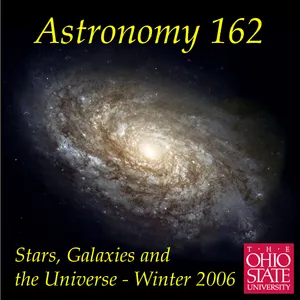
Free Daily Podcast Summary
Astronomy 162 - Stars, Galaxies, & the Universe: Daily Summaries Delivered
by Richard Pogge
Astronomy 162, Stars, Galaxies, and the Universe, is part 2 of a2-quarter introductory Astronomy for non-science majors taught at TheOhio State University. This podcast presents lecture audio fromProfessor Richard Pogge's Winter Quarter 2006 class. All of thelectures were recorded live in 1008 Evans Laboratory on the OSU MainCampus in Columbus, Ohio.
Latest Episodes
The most recent episodes — sign up to get AI-powered summaries of each one.
- Dec 6, 2009
Astronomy 141 Podcast Teaser
A new podcast, Astronomy 141, Life in the Universe, is available for those interested in continuing an exploration of topics in modern astronomy.
- Nov 27, 2006
Lectures 1-4: An Explanation
Where are Lectures 1-4? This is a good question, and one I've gotten from many listeners. Here's the answer. Recorded 2006 Nov 27 on the Columbus campus of The Ohio State University.
- Mar 10, 2006
Welcome to Astronomy 162
Welcome to the Astronomy 162 Lecture Podcasts! This is a brief message from me explaining the podcasts, and welcoming new and old listeners. Recorded 2006 Mar 10 on the Columbus campus of The Ohio State University.
- Mar 10, 2006
Lecture 44: Life, the Universe, and Everything (Life Part II)
How can we search for extraterrestrial intelligence, and what are we looking for? This second part of a 2-part lecture picks up where we left off yesterday by examining SETI, the Search for ExtraTerrestrial Intelligence, and reviews what we might look for and how. We will use this as a point of departure to then briefly review where we have come and what we have learned in Astronomy 162, bringing this course to a close for Winter Quarter 2006. Recorded 2006 Mar 10 in 1008 Evans Laboratory on the Columbus campus of The Ohio State University.
- Mar 9, 2006
Lecture 43: Life in the Universe, Part I
Are we alone in the Universe? This is the first part of a 2-part lecture that will explore the question of life and the Universe. We will look at the conditions needed for life, and address the question of how often we expect those conditions to be satisfied in our own Galaxy. In this part, we introduce the Drake Equation and make some basic estimates. To be honest, it was supposed to be one lecture, but I ran over time and ran into the bell. Oops! Very embarrasing. Tomorrow's lecture will finish up our discussion of life in the Universe, and then wrap up Astronomy 162 for the quarter. Recorded 2006 March 9 in 1008 Evans Laboratory on the Columbus campus of The Ohio State University.
- Mar 8, 2006
Lecture 42: Time Travel
Can we travel through time? This is not a frivilous, science-fiction kind of question. Certain restricted kinds of time travel are in fact allowed by classical General Relativity. This lectures takes up this question, and looks at some of the surprising answers that have been found. Recorded 2006 March 8 in 1008 Evans Laboratory on the Columbus campus of The Ohio State University.
- Mar 7, 2006
Lecture 41: Dark Matter & Dark Energy
We are not made of the same matter as most of the Universe! This surprising conclusion, that the ordinary matter we are made of (protons, neutrons, and electrons) constitute only 13% or so of the total matter in the Universe, the rest being in the form of Dark Matter. Further, this dark matter is only about 30% of the combined matter and energy density of the Universe, the remaining 70% of which appears to be a form of Dark Energy that fills the vacuum of space and acts in the present day to accelerate the expansion of the Universe. This lecture will summarize the state of our understanding of Dark Matter and Dark Energy, and look at the questions remaining to be answered in this active area of current research. Recorded 2006 March 7 in 1008 Evans Laboratory on the Columbus campus of The Ohio State University.
- Mar 6, 2006
Lecture 40: The Once and Future Sun
How will the Sun evolve? The Sun is now a middle-aged, low-mass, Main Sequence star in a state of hydrostatic and thermal equilibrium that has consumed about half of the Hydrogen available for fusion in its core. What will its subsequent evolution be as its core runs out of Hydrogen? This lecture describes our current state of understanding of the expected evolution of the Sun, informed by a combination of state-of-the-art solar models and stellar evolution codes, and data gathered from observations of nearby stars in our Galaxy. We will trace the future history of the Sun from the present until it begins its final phase as a fading White Dwarf some 8 Billion years in the future. Along the way, we'll also ask what will become of Earth. Recorded 2006 March 6 in 1008 Evans Laboratory on the Columbus campus of The Ohio State University.
Get Astronomy 162 - Stars, Galaxies, & the Universe summaries in your inbox
Free AI-powered daily recaps. Key takeaways, quotes, and mentions — in a 5-minute read.
Get Free Summaries →Free forever for up to 3 podcasts. No credit card required.
You Might Also Like
Listeners also like.
Crash Course Pods: The Universe
A theoretical astrophysicist and a bestselling author explore the history and future of the universe.
Cosmos in a Pod
Explores space, science, philosophy, and technology to reveal the wonders of the universe and humanity's place within it.
Through the Telescope
Two hosts explore key astronomy topics in digestible episodes, making the cosmos accessible and engaging for all knowledge levels.
Bedtime Astronomy
A calming exploration of cosmic wonders, sharing stories about stars, planets, and celestial phenomena to inspire curiosity before sleep.
Astronomy Cast
Weekly discussions on astronomy topics from planets to cosmology, exploring what’s known and being discovered about the universe.
Math & Physics Podcast
Two University of Toronto students discuss topics in math and physics.
The Science of Everything Podcast
Explores diverse topics in natural and social sciences through the lens of the scientific method.
SpaceTime with Stuart Gary
Weekly explorations of astronomy, space, and science news with insights from a veteran science journalist and industry experts.
Planetary Radio: Space Exploration, Astronomy and Science
Explores space exploration, astronomy, and science through conversations with experts and advocates shaping humanity's journey beyond Earth.
StarTalk with Neil deGrasse Tyson
Astrophysicist Neil deGrasse Tyson discusses space, physics, and science with comedians and experts in a blend of humor and education.
The Origins Podcast with Lawrence Krauss
Long-form conversations with experts across science, arts, and journalism exploring ideas shaping the 21st century.
Daniel and Kelly’s Extraordinary Universe
Two scientists explore diverse topics across the universe, from particles to ecosystems, with accessible and engaging explanations.
About Astronomy 162 - Stars, Galaxies, & the Universe
Astronomy 162, Stars, Galaxies, and the Universe, is part 2 of a2-quarter introductory Astronomy for non-science majors taught at TheOhio State University. This podcast presents lecture audio fromProfessor Richard Pogge's Winter Quarter 2006 class. All of thelectures were recorded live in 1008 Evans Laboratory on the OSU MainCampus in Columbus, Ohio.
Customized Recaps
AI-powered recaps with compact key takeaways, quotes, and insights.
Straight to Your Inbox
Get key takeaways from Astronomy 162 - Stars, Galaxies, & the Universe in a 5-minute read.
Save Hours Every Week
Stay current on your favorite podcasts without falling behind.
Frequently Asked Questions
What is Podzilla's Astronomy 162 - Stars, Galaxies, & the Universe daily summary?
It's a free AI-powered email that summarizes new episodes of Astronomy 162 - Stars, Galaxies, & the Universe as soon as they're published. You get the key takeaways, notable quotes, and links & mentions — all in a quick read.
How does the Astronomy 162 - Stars, Galaxies, & the Universe podcast summary work?
When a new episode drops, our AI transcribes and analyzes it, then generates a personalized summary tailored to your interests and profession. It's delivered to your inbox every morning.
Is this an official Astronomy 162 - Stars, Galaxies, & the Universe product?
No. Podzilla is an independent service that summarizes publicly available podcast content. We're not affiliated with or endorsed by Richard Pogge.
Can I get summaries of other podcasts too?
Absolutely! The free plan covers up to 3 podcasts. Upgrade to Pro for 15, or Premium for 50. Browse our full catalog at /podcasts.
How often does Astronomy 162 - Stars, Galaxies, & the Universe release new episodes?
Astronomy 162 - Stars, Galaxies, & the Universe publishes daily. Our AI generates a summary within hours of each new episode.
What topics does Astronomy 162 - Stars, Galaxies, & the Universe cover?
Astronomy 162 - Stars, Galaxies, & the Universe covers topics including Science, Education, Courses, Astronomy, Natural Sciences. Our AI identifies the specific themes in each episode and highlights what matters most to you.
Start getting Astronomy 162 - Stars, Galaxies, & the Universe summaries tomorrow morning.
Free forever for up to 3 podcasts. No credit card required.
Free forever for up to 3 podcasts. No credit card required.