Free Daily Podcast Summary
Planetary Radio: Space Exploration, Astronomy and Science: Daily Summaries Delivered
by The Planetary Society
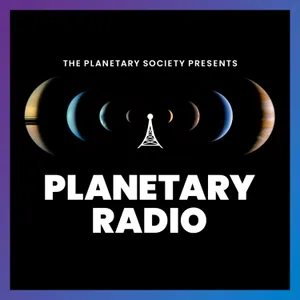
Planetary Radio brings you the human adventure across our Solar System and beyond. We visit each week with the scientists, engineers, leaders, advocates, and astronauts who are taking us across the final frontier. Regular features raise your space IQ while they put a smile on your face. Join host Sarah Al-Ahmed and Planetary Society colleagues including Bill Nye the Science Guy and Bruce Betts as they dive deep into space science and exploration. The monthly Space Policy Edition takes you inside the DC beltway where the future of the US space program hangs in the balance.
Latest Episodes
The most recent episodes — sign up to get AI-powered summaries of each one.
- 2 days ago1h 7m
Book Club Edition: Alien Oceans by Kevin Hand
Where are we most likely to find evidence of life, past or living, in the Solar System? Planetary scientist and author Kevin Hand looks to warm, salty ocean depths beneath protective layers of ice on worlds such as Europa and Enceladus. His enthralling book became a popular selection in The Planetary Society’s member book club. He recently joined the Society’s Mat Kaplan for a deep exploration of the best science. Kevin also shared tales of his own harrowing, revealing journeys through Earth’s undersea world. Discover more at: https://www.planetary.org/planetary-radio/book-club-kevin-handSee omnystudio.com/listener for privacy information.
- 4 days ago1h 7m
Star Trek at 60: What Vulcans and Klingons can teach us about being human (Part 2)
This is part two of our Star Trek 60th anniversary series. Robert Picardo, the Emergency Medical Hologram on Star Trek: Voyager and a member of The Planetary Society's board of directors, reads a vintage letter from Star Trek creator Gene Roddenberry asking fans to join a brand new organization called The Planetary Society. Tim Russ, who played Tuvok on Star Trek: Voyager, Deep Space Nine, Lower Decks, and Picard, joins us to talk about what the Vulcans can teach us about the discipline we'll need to survive in deep space, and shares his own experience as an amateur astronomer who contributed data to NASA's Lucy mission. Karim Diané, Jay-Den Kraag on Star Trek: Starfleet Academy, talks about playing a Klingon who defies everyone's expectations of what it means to be strong. And Bruce Betts, chief scientist of The Planetary Society, is here with What's Up, discussing Star Trek technologies. Discover more at: https://www.planetary.org/planetary-radio/2026-star-trek-at-60-part-2See omnystudio.com/listener for privacy information.
- 1 weeks ago59 min
Star Trek at 60: What do we value the most? (Part 1)
Star Trek turned 60 on Sept. 8, 2026, and to celebrate, we're kicking off a special two-part series exploring the franchise's deep and lasting connection to real-world space exploration. In Part 1, Robert Picardo, the Emergency Medical Hologram from Star Trek: Voyager, now starring in Star Trek: Starfleet Academy and a member of The Planetary Society's Board of Directors, joins Sarah Al-Ahmed to trace the relationship between Star Trek and The Planetary Society all the way back to a 1980 letter from Gene Roddenberry himself. Bob talks about how playing a holographic doctor for 30 years led him to become a real-world space advocate, and what Star Trek's non-human characters can teach us about what it means to be human. Then, Bruce Betts, Planetary Society Chief Scientist, joins for What's Up and a discussion of solar sails in the franchise. Discover more at: https://www.planetary.org/planetary-radio/2026-star-trek-at-60-part-1See omnystudio.com/listener for privacy information.
- 2 weeks ago1h 7m
Space Policy Edition: The Long Space Age with Alex MacDonald
We tend to think of private space exploration as a recent phenomenon. But as Alex MacDonald, former Chief Economist at NASA, argues in his book "The Long Space Age," privately funded space exploration has deep roots in American history, stretching back more than two centuries. In this 2017 conversation with The Planetary Society's Chief of Space Policy Casey Dreier, originally aired on the Space Policy Edition of Planetary Radio, MacDonald traces the economic history of American space exploration from the 1769 transit of Venus all the way to the present day, and makes the case that the government-dominated model we grew up with may actually be the historical anomaly. Discover more at: https://www.planetary.org/planetary-radio/long-space-ageSee omnystudio.com/listener for privacy information.
- 2 weeks ago1h 4m
World Space Week and farewell to Swift
Dennis Stone, president and co-founder of the World Space Week Association, takes us behind the scenes of the largest annual space event on Earth. From its origins as a volunteer effort in Houston to a UN-declared celebration reaching 50,000 events in over 100 countries, Dennis shares how World Space Week inspires the next generation, and how you can get involved this Oct. 4 through 10. Then, Science Editor Asa Stahl breaks down the end of the Neil Gehrels Swift Observatory, the 21-year-old space telescope that's falling out of orbit after a bold rescue mission fell short. Plus, Chief Scientist Bruce Betts looks back at a milestone centennial in this week's What's Up, 100 years since Robert Goddard launched the world's first liquid-fueled rocket. Discover more at: https://www.planetary.org/planetary-radio/2026-world-space-week-and-swiftSee omnystudio.com/listener for privacy information.
- 3 weeks ago56 min
The Nancy Grace Roman Space Telescope is ready to launch
After decades of development, the Nancy Grace Roman Space Telescope is preparing to launch. Once in orbit, Roman will conduct the widest surveys of the universe ever attempted, probing the nature of dark energy, discovering thousands of new exoplanets, and capturing images of billions of galaxies. In this episode, we sit down with Julie McEnery, senior project scientist for Roman at NASA's Goddard Space Flight Center, and Jason Rhodes, project scientist for Roman at NASA’s Jet Propulsion Laboratory, to explore what the telescope will reveal and how scientists around the world will be able to access and work with its data. Plus, in What's Up, we look at Roman's coronagraph and what it will take for the Habitable Worlds Observatory to push that technology far enough to image Earth-like worlds around Sun-like stars. Discover more at: https://www.planetary.org/planetary-radio/2026-nancy-grace-romanSee omnystudio.com/listener for privacy information.
- Aug 21, 20261h 17m
Book Club Edition: Becoming Martian by Scott Solomon
Will we change or terraform Mars to better suit humans? Or are we more likely to change ourselves to better fit the red planet? How far can evolution take us in these new and exotic environments? These and many other fascinating questions are at the heart of Rice University professor Scott Solomon’s great book, “Becoming Martian”. He joins host Mat Kaplan for a far-ranging conversation in this month’s installment of Planetary Radio’s book club edition. Discover more at: https://www.planetary.org/planetary-radio/book-club-scott-solomonSee omnystudio.com/listener for privacy information.
- Aug 19, 20261h 3m
The SpaceX Falcon 9 that crashed into the Moon
A SpaceX Falcon 9 upper stage slammed into the moon on August 5 after spending over a year and a half drifting through the Earth-Moon system. Jared Head, museum facilitator at Columbia Memorial Space Center, producer at TMRO, and co-host of All Space Considered at Griffith Observatory, walks us through how a rocket launched in January 2025 ended up crashing into the lunar surface. Kate Howells, the Planetary Society's public education specialist, shares her experience witnessing Europe's first total solar eclipse in 27 years from a canyon in Spain on her honeymoon. Plus, Jack Kiraly, the Planetary Society's chief of advocacy, gives us an update on the campaign to save NASA science and the proposed changes to OMB's federal grant-making rules. We close with Bruce Betts, our chief scientist, who joins for What's Up, to discuss Point Nemo, the spacecraft graveyard in the South Pacific. Discover more at: https://www.planetary.org/planetary-radio/2026-falcon-9-moon-crashSee omnystudio.com/listener for privacy information.
Get Planetary Radio: Space Exploration, Astronomy and Science summaries in your inbox
Free AI-powered daily recaps. Key takeaways, quotes, and mentions — in a 5-minute read.
Get Free Summaries →Free forever for up to 3 podcasts. No credit card required.
You Might Also Like
Listeners also like.
SpaceTime with Stuart Gary
Weekly explorations of astronomy, space, and science news with insights from a veteran science journalist and industry experts.
StarTalk with Neil deGrasse Tyson
Astrophysicist Neil deGrasse Tyson discusses space, physics, and science with comedians and experts in a blend of humor and education.

Cosmos in a Pod
Explores space, science, philosophy, and technology to reveal the wonders of the universe and humanity's place within it.
Spacewalk with Everyday Astronaut
Answers listener questions and explores space topics with a mix of technical depth and casual conversation.

Hostile Worlds: Exploring Space
A documentary-style podcast exploring extreme alien environments through immersive audio storytelling aboard a fictional exploration vessel.
Houston We Have a Podcast
Explore human spaceflight through interviews with astronauts, scientists, and engineers at NASA’s Johnson Space Center.
Astronomy Cast
Weekly discussions on astronomy topics from planets to cosmology, exploring what’s known and being discovered about the universe.
Through the Telescope
Two hosts explore key astronomy topics in digestible episodes, making the cosmos accessible and engaging for all knowledge levels.
Dear People of Earth Science and Physics- The UFO Podcast - Disclosure - Aliens - UAP
Explores UFO and UAP phenomena through scientific analysis, physics, and expert discussions on credible sightings and cosmic mysteries.
TED Radio Hour
A show that explores profound global questions through curated TED Talks and in-depth conversations with leading thinkers.

Ask a Spaceman!
An astrophysicist answers listener questions about space, time, and the universe.
REACH A Space Podcast for Kids
Kids explore space questions through fun experiments, expert interviews, and engaging segments about astronomy and science.
About Planetary Radio: Space Exploration, Astronomy and Science
Planetary Radio brings you the human adventure across our Solar System and beyond. We visit each week with the scientists, engineers, leaders, advocates, and astronauts who are taking us across the final frontier. Regular features raise your space IQ while they put a smile on your face. Join host Sarah Al-Ahmed and Planetary Society colleagues including Bill Nye the Science Guy and Bruce Betts as they dive deep into space science and exploration. The monthly Space Policy Edition takes you inside the DC beltway where the future of the US space program hangs in the balance.
Customized Recaps
AI-powered recaps with compact key takeaways, quotes, and insights.
Straight to Your Inbox
Get key takeaways from Planetary Radio: Space Exploration, Astronomy and Science in a 5-minute read.
Save Hours Every Week
Stay current on your favorite podcasts without falling behind.
Frequently Asked Questions
What is Podzilla's Planetary Radio: Space Exploration, Astronomy and Science daily summary?
It's a free AI-powered email that summarizes new episodes of Planetary Radio: Space Exploration, Astronomy and Science as soon as they're published. You get the key takeaways, notable quotes, and links & mentions — all in a quick read.
How does the Planetary Radio: Space Exploration, Astronomy and Science podcast summary work?
When a new episode drops, our AI transcribes and analyzes it, then generates a personalized summary tailored to your interests and profession. It's delivered to your inbox every morning.
Is this an official Planetary Radio: Space Exploration, Astronomy and Science product?
No. Podzilla is an independent service that summarizes publicly available podcast content. We're not affiliated with or endorsed by The Planetary Society.
Can I get summaries of other podcasts too?
Absolutely! The free plan covers up to 3 podcasts. Upgrade to Pro for 15, or Premium for 50. Browse our full catalog at /podcasts.
How often does Planetary Radio: Space Exploration, Astronomy and Science release new episodes?
Planetary Radio: Space Exploration, Astronomy and Science publishes 2x weekly. Our AI generates a summary within hours of each new episode.
What topics does Planetary Radio: Space Exploration, Astronomy and Science cover?
Planetary Radio: Space Exploration, Astronomy and Science covers topics including Science, Technology. Our AI identifies the specific themes in each episode and highlights what matters most to you.
Start getting Planetary Radio: Space Exploration, Astronomy and Science summaries tomorrow morning.
Free forever for up to 3 podcasts. No credit card required.
Free forever for up to 3 podcasts. No credit card required.