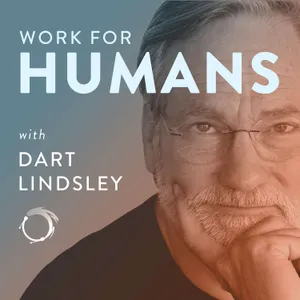
Free Daily Podcast Summary
Work For Humans: Daily Summaries Delivered
by Dart Lindsley
Too often business leaders are forced to choose between the needs of their company and the needs of their employees. It’s a lose/lose scenario leaving managers burned out and workers seeking other opportunities. At Work for Humans, we believe work can be designed differently. When you design work like products people love, your company wins. Work becomes irresistible, employees passionately buy into their roles every day, and your company takes measurable strides towards your vision.
Latest Episodes
The most recent episodes — sign up to get AI-powered summaries of each one.
- 4 days ago1h 14m
The 3 Needs of Self-Determination Theory: What People Really Want from Work | Richard Ryan
In the 1970s, Richard Ryan and Ed Deci ran experiments on what rewards do to motivation. They found that people did what they were asked, but were less motivated by rewards that felt like control. Behaviorists pushed back, but the evidence piled up over time, and today researchers apply self-determination theory in workplaces, classrooms, and sport. In this episode, Dart and Richard discuss what autonomy, competence, and relatedness actually mean, why rewards that feel like control can underm...
- 1 weeks ago43 min
Humanity-Centered Design: Who Is Your Product Really For? | Don Norman, Revisited
At 86, Don Norman decided his life’s work was not enough. While his books made gadgets easier to use, they could not fix a world in crisis. So he looked back on his years as an engineer, psychologist, and designer and asked what he could do that would really matter. The answer became Design for a Better World. It argues that design must move from human-centered, which asks what one person wants, to humanity-centered, which asks what the planet needs. In this revisited episode, Dart and Don di...
- 2 weeks ago1h 6m
200 Episodes of Work for Humans: The Life-Changing ROI of Podcasting | Jason Ames
Dart Lindsley wanted to publish a book, but agent after agent turned him down despite the quality of his work. Finally, one told him why: he wasn't famous. So he climbed into his attic, threw a blanket over his head, and recorded a podcast episode that his wife and his friend both called terrible. Then he found Jason Ames, who spent hours grilling him about what he actually wanted before agreeing to produce the show. 200 episodes later, Dart and Jason sit down to mark the milestone. In this e...
- 3 weeks ago1h 5m
Radical Respect: How to Say What You Mean Without Being a Jerk | Kim Scott, Revisited
In her first job out of college, Kim Scott thought managing Russian diamond cutters would be simple: pay them well and the rest follows. It wasn't. They wanted a picnic, and by the end of a bottle of vodka, she understood what they actually wanted: someone who gave a damn. That instinct, respecting the whole person, not just the employee, became the seed of her book, Radical Respect. In this revisited episode, Dart and Kim discuss how leaders mistake authoritarianism and aggression for domina...
- Oct 6, 20261h 13m
Pay for Performance: How Compensation Becomes a System of Control | James A. Seechurn
James Seechurn spent over a decade building compensation programs on a simple premise: design the incentive right, and you'll get the behavior you want. But his first clue that this was wrong came from watching it fail on him. As a young accountant on billable hours, slowing down to actually understand something cost him money. He kept redesigning bonus plans for clients anyway, until the pattern became impossible to ignore: paid people don't do better work, they just do whatever gets measure...
- Sep 29, 20261h 13m
Dangerously Incompetent: How AI and Robots Are Deskilling the Workforce | Matt Beane, Revisited
In robotic surgery, a device good enough to let the surgeon operate alone makes the resident, the future expert, optional. Matt Beane saw this pattern everywhere technology gets smart enough to make the apprentice unnecessary. Dart calls this one of the episodes he keeps returning to, for how clearly Matt names one of AI's biggest threats to how we learn. In this revisited episode, Dart and Matt explore how technology reshapes workplace learning, whether tech shapes us or we shape it, and the...
- Sep 22, 202648 min
Employees Are Family: How John Chambers Played Hardball at Cisco Without Getting Ruthless
Under John Chambers, Cisco grew from $70 million to $47 billion, completed 180 acquisitions, and became the most valuable company in the world. He built the company on one idea: employees aren't employees, they're family. Then the dot-com crash hit, and John had to lay off 7,854 people, almost all of whom he'd hired himself. He calls it his worst year as a leader. In this episode, Dart and John explore why John calls employees family, how John builds a leadership team, and why playbooks creat...
- Sep 15, 202657 min
7 Rules for Gaining Power and Influence at Work | Jeffrey Pfeffer, Revisited
Jeffrey Pfeffer has spent decades showing that people-first companies outperform, and just as long watching that evidence lose to habit. His answer is blunt: whether you're cautious about power or thirsty for it, there's no denying its role in the workplace, and ideas without power are just ideas. In this revisited episode, Dart and Jeff explore the purpose of power, the knowing-doing gap, and how to build profits by putting people first. Jeffrey Pfeffer is the Thomas D. Dee II Professor of ...
Get Work For Humans summaries in your inbox
Free AI-powered daily recaps. Key takeaways, quotes, and mentions — in a 5-minute read.
Get Free Summaries →Free forever for up to 3 podcasts. No credit card required.
You Might Also Like
Listeners also like.

Right About Now - Legendary Business Advice
Raw business insights from founders and industry leaders, revealing real wins, failures, and actionable strategies without the fluff.

HBR IdeaCast
Features leading thinkers in business and management discussing key ideas and trends.

Your Brand Amplified
Explores the strategies and mindsets of successful entrepreneurs in business growth, marketing, and personal branding.

The Mindful Enterprise: Spirituality and Success for the Modern Leader
Examines how mindfulness and self-awareness can reshape leadership and success in modern corporate environments.
A Bit of Optimism
Conversations with thinkers and doers exploring what drives purpose, growth, and meaning in life.

The Happiness Formula
iHeartPodcasts

User Defenders – UX Design & Personal Growth
A podcast for UX designers focused on personal growth, purpose, and the human side of design to create deeper impact.

Expert Intelligence with Paul Estes
Explores the intersection of human expertise and AI in shaping the future of work through interviews with industry leaders and innovators.

The Modern Manager
A manager shares practical tools and expert insights on leadership, feedback, delegation, and team culture.
The Cal Newport Show
Explores strategies for thriving mentally and professionally in a world saturated with digital technology.
One Part Lion - One Part Lamb with Stephen Scoggins
Leadership advice for founders balancing success, integrity, and faith through interviews with entrepreneurs.

As We Work
Practical career advice and workplace strategies from WSJ reporters and experts.
About Work For Humans
Too often business leaders are forced to choose between the needs of their company and the needs of their employees. It’s a lose/lose scenario leaving managers burned out and workers seeking other opportunities. At Work for Humans, we believe work can be designed differently. When you design work like products people love, your company wins. Work becomes irresistible, employees passionately buy into their roles every day, and your company takes measurable strides towards your vision.
Customized Recaps
AI-powered recaps with compact key takeaways, quotes, and insights.
Straight to Your Inbox
Get key takeaways from Work For Humans in a 5-minute read.
Save Hours Every Week
Stay current on your favorite podcasts without falling behind.
Frequently Asked Questions
What is Podzilla's Work For Humans daily summary?
It's a free AI-powered email that summarizes new episodes of Work For Humans as soon as they're published. You get the key takeaways, notable quotes, and links & mentions — all in a quick read.
How does the Work For Humans podcast summary work?
When a new episode drops, our AI transcribes and analyzes it, then generates a personalized summary tailored to your interests and profession. It's delivered to your inbox every morning.
Is this an official Work For Humans product?
No. Podzilla is an independent service that summarizes publicly available podcast content. We're not affiliated with or endorsed by Dart Lindsley.
Can I get summaries of other podcasts too?
Absolutely! The free plan covers up to 3 podcasts, any in the catalog. Basic raises that to 15, Pro to 40 and Max to 100. Browse our full catalog at /podcasts.
How often does Work For Humans release new episodes?
Work For Humans publishes weekly. Our AI generates a summary within hours of each new episode.
What topics does Work For Humans cover?
Work For Humans covers topics including Business, Management, Careers. Our AI identifies the specific themes in each episode and highlights what matters most to you.
Start getting Work For Humans summaries tomorrow morning.
Free forever for up to 3 podcasts. No credit card required.
Free forever for up to 3 podcasts. No credit card required.