Free Daily Podcast Summary
Who Killed the Starter Home?: Daily Summaries Delivered
by Marina Rubina
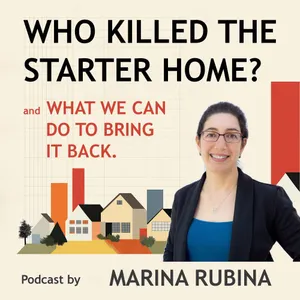
Have you seen any starter homes for sale lately? Neither have we. In this podcast, we speak with experts and try to figure out why this humble first home is going extinct. We’ll be exploring if it is the politicians, wielding zoning laws like a murder weapon who killed the starter home? Or maybe the scaredy-cat planners and designers? Or the developers, armed with cookie-cutter plans and corporate indifference? Is it our convoluted tax policy that subsidies homeownership, but puts every tax penalty in the way of creation of the starter homes. Spoiler alert: it’s probably a little of everything. We’ll be peeling back the layers of bureaucracy, bad faith, and bad planning, with stops along the way for affordable housing scandals, ADU success stories, and a passionate plea for building code updates. Join us for a conversation that’s part policy deep-dive, part therapy session for frustrated builders, and entirely a love letter to cities that deserve better.
Latest Episodes
The most recent episodes — sign up to get AI-powered summaries of each one.
- 3 days ago53 min
Small Lots, Big Difference. Townhomes Work Everywhere. Conversation with Dominic Behrens
In this episode, Dominic Behrens joins us from Sydney, Australia where he is a senior economist with The Centre for International Economics. He is also the co-founder of Sydney YIMBY. Dominic walks us through a real-world experiment most places never get to see. In 2013, a suburban municipality in Australia allowed property owners to subdivide lots down to just 150 square meters, about 1,600 square feet, small enough for townhouses. Construction went up by two-thirds right away. Then in 2019, the required lost size was increased to 250 square meters, about 2,700 square feet, and construction went back down. Dominic and his co-authors got access to incredibly detailed data and were able to analyze who built these homes (mostly small local builders) who moved in, (young families looking to upgrade), and what happened to the homes they left behind. That last part is fascinating. Research traced the ripple effect of these new townhomes across the much wider market. As young families moved to these high-end small homes, their old apartments became available to people of somewhat lower income and so on creating better the housing options further and further down the income ladder. We also discussed into why these reforms got reversed, even though less than one percent of residents objected, and why Dominic believes townhouses, unlike big apartment towers, could and should be allowed everywhere. Read article here: https://e61.in/what-local-land-use-reform-does-and-doesnt-do/
- 1 weeks ago53 min
Homelessness Is Solvable. We Have Proof. Conversation with Raisa Rubin-Stankiewicz
In this episode, Raisa Rubin-Stankiewicz joins us. She is the policy director of the New Jersey Coalition to End Homelessness. And she's here with some hard numbers. Unsheltered homelessness in New Jersey is up 61 percent from last year. For every one person who gets housed, almost three people become homeless. Yet Raisa has good news: in under two years, New Jersey got veterans' homelessness to what's called "functional zero." More veterans are getting housed than are becoming homeless. It took real money and real coordination, but it proves that this crisis isn't inevitable. We talk about what's broken, what's working, and what coalitions we can build and actions we can take to solve this staggering crisis.
- 2 weeks ago1h 8m
Fear of Others Moving In. Conversation with Tara Paxton
In this episode, Tara Paxton joins us at the start of what she calls her "Act Two." She spent nearly thirty years on the municipal side of planning, most recently as planning director in Brick Township here in New Jersey where this past June, she finished working on Brick’s state's fourth round of affordable housing compliance. Now Tara is stepping away from municipal government to create something new: an educational and private practice (https://paxtonplanninggroup.com/) built around the gaps she saw up close for three decades. Tara has a term for the real obstacle she kept running into. It’s not “Not in My Back Yard” movement, but something she calls FOOMI, fear of others moving in and changing the familiar quality of life. Her solutions are not more regulation. It's education. She walks us through her plan to launch a new organization, modeled on Philadelphia's Citizen Planner Institute. The goal: teach residents the actual civics of planning. What a board can and can't legally do. Why "no" isn't always on the table. How to move residents from reflexively objecting to a project, toward contributing to shaping their town's future, one that meets the needs we all have at different stages of life.
- 3 weeks ago1h 5m
The Regulations Are a Smashing Success, Yet New Jersey Is Still Segregated. Conversation with David Kinsey
In this episode, David Kinsey joins us — the planner who, more than almost anyone else in New Jersey, has shaped the math behind the Mount Laurel doctrine and helped determine the numbers of deed-restricted residential units each town is required to build. It was not housing policy, not economics, but a language assignment that set David on his career path when during a study abroad in college he wrote a paper in French about a new town. Decades later, he was the expert witness in court, spending days on the stand defending the housing formula built from census projections, household formation rates, and land-use factors. David calls the five-decade-old Mount Laurel doctrine, especially after the latest amendments, a smashing success, and multifamily construction with an inclusionary deed-restricted component is visible across the state. But David also acknowledges that New Jersey remains one of the most segregated states in the country, a pattern he traces directly to housing itself. In this episode struggle to share his optimism about the rules for realistic opportunity when in some cases, it takes thirty years to deliver homes near a train station. In other cases, monumental efforts of assembling a multi-layered funding scheme and donated municipal land still fail to create homes.
- Aug 21, 202657 min
We Built New Towns Before. Why Not Again? Conversation with Justin Hollander
In this episode, Justin Hollander, professor of urban & environmental policy and planning at Tufts University, joins us — and yes, he's also planned a new town on Mars, underground bike tunnels included. Back on Earth, He shares that planners are usually taught to contain and densify existing places and by any means block expansion. The reality is that economic forces make development ooze out anyway, and it ends up as a sprawling suburbs that delivers somewhat affordable homes while making no real livable places. Justin makes the case that if we acknowledge this reality, we can actually plan new towns that are walkable, transit-friendly, and have community structure that defines a real place people would enjoy and still have starter homes. Maybe we don't need to move to Mars to bike to school after all.
- Aug 14, 202645 min
A Thousand Small Fixes That Might Actually Work. Conversation with Jack Farrell.
In this episode, research attorney with YIMBY Law Jack Farrell came back to the podcast to walk us through the newly passed Road to Housing Act. This sprawling, three hundred eighty-one-page bill is made up of small technical fixes. For Jack, that's a good sign: the sheer number of granular changes suggests that the authors understand how housing programs work on the ground. We cover the highlights: grant programs that now prioritize ADUs, missing middle housing, and single-stair reform; a fix that makes manufactured homes cheaper to build; the unlocking of Community Development Block Grant funds for affordable housing; and a change that cuts duplicate inspections for properties using multiple federal funding sources. We also dig into the bill's attempt to cap how many single-family homes big institutional investors can own — and why the data suggests Wall Street landlords aren't the main cause of high home prices. And, for a complete fun fact — there is a provision inside a housing bill that has nothing to do with housing: a ban on the U.S. ever creating its own central bank digital currency.
- Aug 7, 202650 min
Spanish Colonial Meets State Pro-Housing Laws in Santa Barbara, CA. Conversation with Ellen Bildsten
For decades, local zoning rules kept towns like Santa Barbara completely stuck, resulting in virtually zero new housing production. Then, the state of California stepped in. In this episode, architect and housing advocate Ellen Bildsten joins us to share firsthand insights from the frontlines of California's housing revolution. We walk through how a massive wave of statewide legislation bypassed restrictive local zoning to unlock unprecedented housing opportunities—from the initial accessory dwelling unit (ADU) breakthrough to radical new laws allowing single-family lots to be subdivided into multiple ownership opportunities. We discuss the critical "push-pull" of designing for density in highly traditional communities, the financial realities of infill vs. large-scale multifamily projects, and Ellen's dream of transforming a tourist-centered downtown into a walkable, vibrant, and authentic transit-oriented neighborhood.
- Jul 31, 202658 min
Zoning Is Theft. The Set-Aside Is the Windfall Tax. Conversation with Creigh Rahenkamp
It is a common story of high-demand towns using zoning to keep housing supply from meeting demand with low- and moderate-income families being pushed out. In this episode, New Jersey's preeminent housing planner Creigh Rahenkamp does a deep dive on our state's half-century attempt to overcome exclusionary zoning. After hearing my recent conversation with Jason Sorens, whose research found no measurable increase in overall housing production, Creigh was furious at what he saw as a mischaracterization of the Mount Laurel doctrine. As we dig in, however, something interesting emerges: the two of them agree on far more than it first appears. Both agree that Mount Laurel has increased the number of deed-restricted affordable units, but that New Jersey is nowhere near building enough homes compared to real demand. And both point to the same culprit for why: local rules continue to exclude, and complex requirements and approvals run up against economic constraints, making projects impossible. Where they split is on what the Mount Laurel doctrine is. Sorens evaluates it as a housing production program. Rahenkamp insists it was never that — it's a rezoning doctrine, with deed-restricted units as the mechanism to capture some of the value that zoning had trapped, for the benefit of low- and moderate-income residents.
Get Who Killed the Starter Home? summaries in your inbox
Free AI-powered daily recaps. Key takeaways, quotes, and mentions — in a 5-minute read.
Get Free Summaries →Free forever for up to 3 podcasts. No credit card required.
You Might Also Like
Listeners also like.

The Strong Towns Podcast
Discusses how to financially strengthen American cities and towns through fiscally prudent urban design and community development.

This Old House Radio Hour
Home improvement experts offer practical advice on repairs, renovations, and DIY projects for homeowners and renters.

One Rental At A Time
A guide to achieving financial freedom by building wealth through buying and holding rental properties.

The MORE Show
A real estate investor shares systems and interviews successful peers to help listeners build wealth through property investing.

The Messy City Podcast
Exploring urban development through change, uncertainty, and community-driven initiatives.

The Paul Morris Podcast
Entrepreneurs and investors share strategies for building wealth, scaling businesses, and leading high-performance teams.

BiggerPockets Real Estate Podcast
Real estate investing strategies and wealth-building insights from experienced investors.

Our Town
A Tennessee town faces a clash over identity when far-right Christian settlers with outside backing move in and challenge local heritage.

The Urbanist Agenda
An exploration of urban planning and mobility issues by popular online urbanists.

The Fine Homebuilding Podcast
Answers listener questions on construction, design, and building science using best-practice techniques.

Founder's Story
Real founders share raw stories of building, scaling, and leading companies, revealing the grit and purpose behind entrepreneurial success.

Revisionist History
Re-examines overlooked or misunderstood events, people, and ideas from the past to question accepted narratives.
About Who Killed the Starter Home?
Have you seen any starter homes for sale lately? Neither have we. In this podcast, we speak with experts and try to figure out why this humble first home is going extinct. We’ll be exploring if it is the politicians, wielding zoning laws like a murder weapon who killed the starter home? Or maybe the scaredy-cat planners and designers? Or the developers, armed with cookie-cutter plans and corporate indifference? Is it our convoluted tax policy that subsidies homeownership, but puts every tax penalty in the way of creation of the starter homes. Spoiler alert: it’s probably a little of everything. We’ll be peeling back the layers of bureaucracy, bad faith, and bad planning, with stops along the way for affordable housing scandals, ADU success stories, and a passionate plea for building code updates. Join us for a conversation that’s part policy deep-dive, part therapy session for frustrated builders, and entirely a love letter to cities that deserve better.
Customized Recaps
AI-powered recaps with compact key takeaways, quotes, and insights.
Straight to Your Inbox
Get key takeaways from Who Killed the Starter Home? in a 5-minute read.
Save Hours Every Week
Stay current on your favorite podcasts without falling behind.
Frequently Asked Questions
What is Podzilla's Who Killed the Starter Home? daily summary?
It's a free AI-powered email that summarizes new episodes of Who Killed the Starter Home? as soon as they're published. You get the key takeaways, notable quotes, and links & mentions — all in a quick read.
How does the Who Killed the Starter Home? podcast summary work?
When a new episode drops, our AI transcribes and analyzes it, then generates a personalized summary tailored to your interests and profession. It's delivered to your inbox every morning.
Is this an official Who Killed the Starter Home? product?
No. Podzilla is an independent service that summarizes publicly available podcast content. We're not affiliated with or endorsed by Marina Rubina.
Can I get summaries of other podcasts too?
Absolutely! The free plan covers up to 3 podcasts. Upgrade to Pro for 15, or Premium for 50. Browse our full catalog at /podcasts.
How often does Who Killed the Starter Home? release new episodes?
Who Killed the Starter Home? publishes weekly. Our AI generates a summary within hours of each new episode.
What topics does Who Killed the Starter Home? cover?
Who Killed the Starter Home? covers topics including Arts, Design. Our AI identifies the specific themes in each episode and highlights what matters most to you.
Start getting Who Killed the Starter Home? summaries tomorrow morning.
Free forever for up to 3 podcasts. No credit card required.
Free forever for up to 3 podcasts. No credit card required.