Free Daily Podcast Summary
The Strong Towns Podcast: Daily Summaries Delivered
by Strong Towns
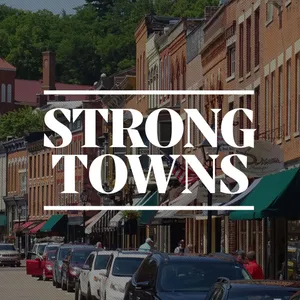
A weekly conversation on the Strong Towns movement hosted by Charles Marohn. The podcast blends fiscal prudence with good urban design to highlight how America can financially strengthen its cities, towns and neighborhoods and, in the process, make them better places to live.
Latest Episodes
The most recent episodes — sign up to get AI-powered summaries of each one.
- 6 days ago54 min
What Comes After Cities Kill Parking Mandates?
Parking reform used to feel like a niche fight. Now North Carolina has eliminated most parking mandates statewide, cities are following one another’s lead, and Tony Jordan says he sometimes finds out about reforms only after they happen. The Parking Reform Network co-founder explains what comes next once cities stop requiring businesses and homes to build parking by formula. That means dealing with crowded curbs, empty downtown lots, pricing, and the fear that removing parking will make access worse. Getting rid of the mandate may be the easy part, but once the mandates disappear, cities still have to answer the question those rules were trying to avoid: when parking really is scarce, who gets the space? Additional Show Notes Tony Jordan (LinkedIn) Parking Reform Network (Site) North Carolina eliminates minimum parking requirements for new developments (Article) Parking Reform Policy Cookbook (Site) Chuck Marohn (Substack) This podcast is made possible by Strong Towns members. Thank you! Join fellow members discussing this episode in The Commons.
- 1 weeks ago1h 4m
Is Homeownership Still Part of the American Dream?
If housing feels impossibly expensive, one answer is that a smaller home, a less in-demand place, or a slower climb may simply be part of starting out and working your way up. But what if getting the house that has long stood at the center of the American Dream also pulls you farther from the jobs, family, community, or daily life you actually value? Continuing the conversation from Kevin Klinkenberg’s Messy City Podcast episode, “Is the Housing ‘Crisis’ Real?”, Chuck Marohn sits down with Kevin, urban designer Camille Cortes, and architectural designer Sheinya Joseph to ask whether younger adults can still follow the path his parents took toward the American Dream. If homeownership is still possible, what are people actually willing to trade to get it? Additional Show Notes Is the Housing "Crisis" Real? (Podcast Episode) Kevin Klinkenberg (LinkedIn) Camille Cortes (LinkedIn) Sheinya Joseph (LinkedIn) Homebuyers and the house price squeeze (Substack) Chuck Marohn (Substack) This podcast is made possible by Strong Towns members. Thank you! Join fellow members discussing this episode in The Commons.
- 2 weeks ago45 min
Chuck’s Engineering Lawsuit Finally Has a Ruling
After six years of legal fights, we finally have a federal court ruling in Chuck’s dispute with Minnesota’s engineering licensing board. Chuck and Strong Towns executive director John Reuter go back to the complaint that started the case, why Chuck’s temporarily lapsed license became the opening for the board’s action, and how a dispute over his public advocacy turned into years of hearings and litigation. Chuck also reflects on reaching the end of a fight that has followed him for years and what the decision could mean for other engineers who have held back from speaking publicly about their profession. Additional Show Notes Confessions of a Recovering Engineer (Site) Can an Engineer Speak Out for Reform? (Article) Chuck Marohn (Substack) This podcast is made possible by Strong Towns members. Thank you! Join fellow members discussing this episode in The Commons.
- 3 weeks ago1h 2m
Chuck on Data Centers, YIMBYs and E-Bikes
Strong Towns members filled the Commons with questions, and Chuck sat down to answer as many as he could. Should cities require data centers to pay for their own eventual cleanup? Has Strong Towns been too wary of the YIMBY movement? Are e-bikes headed toward a backlash before cities have figured out what they’re good for? He also gets into tiny homes, land value taxes, coworking spaces, dream podcast guests, and whether Strong Towns ideas are actually becoming mainstream. Members can join the Commons to submit future questions, read Chuck’s columns before publication, and take part in the discussions that follow. Additional Show Notes Friday News Digest (Site) A Mayor Willing to Tell His City the Truth (Article) Local Conversations (Site) The Commons (Site) Strong Towns Membership (Site) Chuck Marohn (Substack) This podcast is made possible by Strong Towns members. Thank you! Join fellow members discussing this episode in The Commons.
- Aug 10, 20261h 5m
The $1 Trillion Infrastructure Backlog Cities Aren’t Counting
A strong bond rating can tell investors that a city is likely to repay its debt. It says much less about whether that city can afford to replace the roads, pipes, and other infrastructure its residents depend on. Richard Ciccarone, president emeritus of Merit Research Services, developed a new metric using financial statements from nearly 2,000 cities to estimate that burden. When he compared the infrastructure burden with government bond ratings, the correlation was surprisingly weak. Cities can remain attractive to creditors while aging assets accumulate replacement costs that no bondholder can force them to address. Additional Show Notes Richard Ciccarone (LinkedIn) Infrastructure & Capital Assets Commitment Burden: Quantifying the Hidden Fiscal Risk (PDF) 'We Built the Best Interstate System. Now It’s Falling Apart.' (Video) Mission Accomplished Report (Site) Chuck Marohn (Substack) This podcast is made possible by Strong Towns members. Thank you! Join fellow members discussing this episode in The Commons.
- Aug 3, 202649 min
This Atlanta Corridor Makes Walking Normal and Deadly
Atlanta’s Buford Highway supports apartment communities, small businesses, and an international food scene that draws people from across the region. It also carries six to eight lanes of fast traffic, and drivers use it as an alternate route when nearby interstates clog. More than 20% of trips happen outside a car, yet roughly 90% of the corridor’s space is reserved for vehicles. Rebecca Serna, executive director of Propel ATL, and Sagirah Jones, the organization’s program director, hosted walk audits to put residents, planners, and elected officials on the same road and show how people navigate it every day. The audits exposed an unexpected barrier: many people supported bigger changes while remaining convinced that someone else would never allow them. Additional Show Notes Rebecca Serna (LinkedIn) Sagirah Jones (LinkedIn) Propel ATL (Site) Buford Highway Community Walk Audit Summary of Findings (PDF) AARP Walk Audit Tool Kit (Site) 'We Built the Best Interstate System. Now It’s Falling Apart.' (Video) Mission Accomplished Report (Site) Chuck Marohn (Substack) This podcast is made possible by Strong Towns members. Thank you! Join fellow members discussing this episode in The Commons.
- Jul 27, 202652 min
America’s Half-Funded Highway System
The Highway Trust Fund brings in roughly $45 billion a year and spends closer to $80 billion. Congress keeps the system running by borrowing the difference and moving that money into a program still treated as if road users fully fund it. Rebecca Higgins, vice president of policy at the Eno Center for Transportation, explains how the fund reached this point and why the gap keeps growing. She and Chuck examine the choices lawmakers have avoided for decades, including higher taxes, lower spending, new fees, or a smaller federal role, and what happens when highway funding begins competing with other underfunded national priorities. Additional Show Notes Rebecca Higgins (LinkedIn) The Eno Center for Transportation (Site) The Last Exit: Fixing the Highway Trust Fund while Solvency is still Solvable (Report) Mission Accomplished Report (Site) Chuck Marohn (Substack) This podcast is made possible by Strong Towns members. Thank you! Join fellow members discussing this episode in The Commons.
- Jul 20, 202656 min
A Better Block Versus Years of Planning
Cities often spend years studying a street before making a change, only to discover that the public is reacting to plans no one has actually experienced. Krista Nightengale, executive director of Better Block, explains another approach: build a temporary version, invite people into it, gather data, and adjust what does not work. She and Chuck talk about winning over skeptical engineers, learning from residents, and making safer streets without waiting for a perfect plan. The goal is not to prove the first idea was correct, but to learn enough, quickly enough, to make the next decision better. Additional Show Notes Krista Nightengale (LinkedIn) Better Block (Site) Wikiblock (Site) Chuck Marohn (Substack) This podcast is made possible by Strong Towns members. Thank you! Join fellow members discussing this episode in The Commons.
Get The Strong Towns Podcast summaries in your inbox
Free AI-powered daily recaps. Key takeaways, quotes, and mentions — in a 5-minute read.
Get Free Summaries →Free forever for up to 3 podcasts. No credit card required.
You Might Also Like
Listeners also like.
Talking Headways: A Streetsblog Podcast
A weekly podcast exploring sustainable transportation, urban planning, and economic development through expert interviews and analysis.

The Urbanist Agenda
An exploration of urban planning and mobility issues by popular online urbanists.
Our Town
A Tennessee town faces a clash over identity when far-right Christian settlers with outside backing move in and challenge local heritage.

S-Town
A man in rural Alabama asks a journalist to investigate a rumored murder, leading to a deeper exploration of secrets, treasure, and his own life.

The Paul Morris Podcast
Entrepreneurs and investors share strategies for building wealth, scaling businesses, and leading high-performance teams.

The Stronger By Science Podcast
A science-focused fitness podcast that breaks down research, trends, and practical strategies for strength and health.

How To Citizen with Baratunde
Explores civic engagement as an active practice, offering tools and stories to help people collectively shape a better society.

This Old House Radio Hour
Home improvement experts offer practical advice on repairs, renovations, and DIY projects for homeowners and renters.

GovLove - A Podcast About Local Government
Interviews with local government professionals, from city leaders to interns, exploring their work and impact in communities.
Townhall Review | Full Interviews & Monologues
A conservative talk-radio show offering weekly political commentary and analysis from leading voices in U.S. and global news.

The Restless Ones
Executives at the intersection of technology and business discuss innovation, leadership, and driving change in fast-evolving industries.
Charles Payne's Unstoppable Prosperity Podcast
A Wall Street expert shares decades of financial wisdom to help listeners start investing and build long-term prosperity.
About The Strong Towns Podcast
A weekly conversation on the Strong Towns movement hosted by Charles Marohn. The podcast blends fiscal prudence with good urban design to highlight how America can financially strengthen its cities, towns and neighborhoods and, in the process, make them better places to live.
Customized Recaps
AI-powered recaps with compact key takeaways, quotes, and insights.
Straight to Your Inbox
Get key takeaways from The Strong Towns Podcast in a 5-minute read.
Save Hours Every Week
Stay current on your favorite podcasts without falling behind.
Frequently Asked Questions
What is Podzilla's The Strong Towns Podcast daily summary?
It's a free AI-powered email that summarizes new episodes of The Strong Towns Podcast as soon as they're published. You get the key takeaways, notable quotes, and links & mentions — all in a quick read.
How does the The Strong Towns Podcast podcast summary work?
When a new episode drops, our AI transcribes and analyzes it, then generates a personalized summary tailored to your interests and profession. It's delivered to your inbox every morning.
Is this an official The Strong Towns Podcast product?
No. Podzilla is an independent service that summarizes publicly available podcast content. We're not affiliated with or endorsed by Strong Towns.
Can I get summaries of other podcasts too?
Absolutely! The free plan covers up to 3 podcasts. Upgrade to Pro for 15, or Premium for 50. Browse our full catalog at /podcasts.
How often does The Strong Towns Podcast release new episodes?
The Strong Towns Podcast publishes weekly. Our AI generates a summary within hours of each new episode.
What topics does The Strong Towns Podcast cover?
The Strong Towns Podcast covers topics including Government. Our AI identifies the specific themes in each episode and highlights what matters most to you.
Start getting The Strong Towns Podcast summaries tomorrow morning.
Free forever for up to 3 podcasts. No credit card required.
Free forever for up to 3 podcasts. No credit card required.