Free Daily Podcast Summary
Travelers In The Night: Daily Summaries Delivered
by Albert D. Grauer
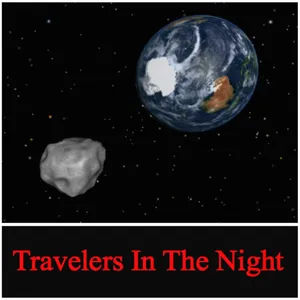
A real "Science Snack" for anyone who is interested in the extraterrestrial. Dr. Al Grauer is a member of the Catalina Sky Survey which has led the world in near Earth asteroid discoveries for 17 of the past 19 years. The music is "Eternity" by John Lyell.
Latest Episodes
The most recent episodes — sign up to get AI-powered summaries of each one.
- 2 days ago2 min
917-Space Dust
As the Earth orbits the Sun at 18.5 mi/s it sweeps up about 100 tons of micrometeorites and space dust every day of which some 14 tons eventually makes it to the ground. You can even find some of these particles of space dust by using a magnet on material in the rain gutters attached to your roof.
- 5 days ago2 min
406E-447-Nuking An Asteroid
Tonight, even though the chances are extremely slim, an asteroid hunter could find a sizable asteroid on a collision course with planet Earth. If we have decades warning, the potential impactor's arrival time could be changed by impacting the dangerous object with a high velocity mass or if we have less time we will need to nuke it which will either blow it to bits or give it a rocket like push.
- 1 weeks ago2 min
916-Past Glory
When accurately recorded historical observations do not agree with what we what we see today it is often very rewarding to find out why. In modern telescopes we see Theta Eridani to a be pair separated by about 425 times our distance from the Sun orbiting a common center of gravity. Detailed observations of the spectrum of one of these show it to be itself a pair of stars orbiting each other every 4.1 days. One of this very close pair, as it is aging, dumps matter onto its companion causing it to brightened significantly. In the past this mass transfer rate was much higher than it is today and the naked eye brightness of Theta Eridani is fainter to us than it was long ago.
- 1 weeks ago2 min
405E-446-Asteroid Homestead
In the future one can envision a space mining family boarding a descendent of the SpaceX Falcon Heavy Launch Vehicle for a trip into low Earth orbit. A few hundred miles above the Earth's surface they would rendezvous with their asteroid mining spacecraft which will be their home for the next five years or so.
- 2 weeks ago2 min
915-Raining Comets
The comets we observe generally start out as icy dirty snowballs of frozen gases like water and frozen carbon dioxide in the Oort cloud. If recent scientific analysis is correct, we are now witnessing a parade of comets produced by the passage of a star when our first ancestors began to roam the Earth in Africa.
- 2 weeks ago2 min
404E-445-Not So Secret
A partnership of humans and computers will help to minimize the damage when asteroid hunters find a space rock with our number on it.
- 3 weeks ago2 min
914-Deep Synoptic Array
Looking into the sky at night with radio eyes you would not see the points of starlight forming the constellations instead you would see a very bright, colorful and wildly changing scene. In a desert valley near the Great Basin National Park Caltech is building the world’s largest radio telescope called the Deep Synoptic Array or DSA for short.
- 3 weeks ago2 min
403E-444-Near Comets
Although no comet nucleus impact on the Earth has been conclusively identified, there is some evidence that suggests the 1908 Tunguska event in Russia, which knocked down trees over a 770 square mile area, could have been caused by a fragment of Comet Encke. However there is no doubt that the Earth's collision with dust and small debris left trailing from comets produces some of the meteor showers we enjoy so much.
Get Travelers In The Night summaries in your inbox
Free AI-powered daily recaps. Key takeaways, quotes, and mentions — in a 5-minute read.
Get Free Summaries →Free forever for up to 3 podcasts. No credit card required.
You Might Also Like
Listeners also like.

Ask a Spaceman!
An astrophysicist answers listener questions about space, time, and the universe.

Bedtime Astronomy
A calming exploration of cosmic wonders, sharing stories about stars, planets, and celestial phenomena to inspire curiosity before sleep.
Planetary Radio: Space Exploration, Astronomy and Science
Explores space exploration, astronomy, and science through conversations with experts and advocates shaping humanity's journey beyond Earth.
SpaceTime with Stuart Gary
Weekly explorations of astronomy, space, and science news with insights from a veteran science journalist and industry experts.

Wanderer Chronicles Radio
A sentient starship's archivist narrates philosophical science fiction parables from across the cosmos.

Wild Thing
A narrative podcast exploring how humanity's quest to uncover scientific mysteries reveals deeper truths about ourselves.

Somewhere in the Skies
A weekly exploration of UFO phenomena and unexplained aerial encounters hosted by an author and investigator.

Dear People of Earth Science and Physics- The UFO Podcast - Disclosure - Aliens - UAP
Explores UFO and UAP phenomena through scientific analysis, physics, and expert discussions on credible sightings and cosmic mysteries.

That UFO Podcast
Covers global UFO, UAP, and related phenomena through news updates and interviews with experts and witnesses.

Hostile Worlds: Exploring Space
A documentary-style podcast exploring extreme alien environments through immersive audio storytelling aboard a fictional exploration vessel.

DUST
Immersive science fiction audio stories exploring AI vengeance, spacetime anomalies, and futuristic anthologies.

Astronomy Cast
Weekly discussions on astronomy topics from planets to cosmology, exploring what’s known and being discovered about the universe.
About Travelers In The Night
A real "Science Snack" for anyone who is interested in the extraterrestrial. Dr. Al Grauer is a member of the Catalina Sky Survey which has led the world in near Earth asteroid discoveries for 17 of the past 19 years. The music is "Eternity" by John Lyell.
Customized Recaps
AI-powered recaps with compact key takeaways, quotes, and insights.
Straight to Your Inbox
Get key takeaways from Travelers In The Night in a 5-minute read.
Save Hours Every Week
Stay current on your favorite podcasts without falling behind.
Frequently Asked Questions
What is Podzilla's Travelers In The Night daily summary?
It's a free AI-powered email that summarizes new episodes of Travelers In The Night as soon as they're published. You get the key takeaways, notable quotes, and links & mentions — all in a quick read.
How does the Travelers In The Night podcast summary work?
When a new episode drops, our AI transcribes and analyzes it, then generates a personalized summary tailored to your interests and profession. It's delivered to your inbox every morning.
Is this an official Travelers In The Night product?
No. Podzilla is an independent service that summarizes publicly available podcast content. We're not affiliated with or endorsed by Albert D. Grauer.
Can I get summaries of other podcasts too?
Absolutely! The free plan covers up to 3 podcasts. Upgrade to Pro for 15, or Premium for 50. Browse our full catalog at /podcasts.
How often does Travelers In The Night release new episodes?
Travelers In The Night publishes 2x weekly. Our AI generates a summary within hours of each new episode.
What topics does Travelers In The Night cover?
Travelers In The Night covers topics including Science, Astronomy. Our AI identifies the specific themes in each episode and highlights what matters most to you.
Start getting Travelers In The Night summaries tomorrow morning.
Free forever for up to 3 podcasts. No credit card required.
Free forever for up to 3 podcasts. No credit card required.