Free Daily Podcast Summary
Tourpreneur Tour Business Podcast: Daily Summaries Delivered
by Tourpreneur
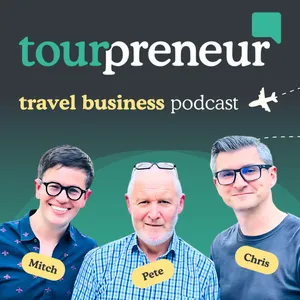
Tourpreneur is a community of passionate tour business owners eager to improve their skills and increase their profits.Our community is passionate about helping each other. As small tour business owners, we understand it’s a lonely job, a daily grind, and easy to become a busy fool… working harder but not smarter.The Tourpreneur community helps you get advice from your peers as well as experts in the areas you need to grow your business and make it more profitable.Whether you explore our hundreds of free articles, podcasts and other resources, or join our Tourpreneur+ community, we’re here to help!
Latest Episodes
The most recent episodes — sign up to get AI-powered summaries of each one.
- Today40 min
Small Operator, Overtouristed Island: How Maria Petrenko Competes in Santorini
Maria Petrenko runs a private guiding business on Santorini, one of the most visited islands in the world. Cruise-ship crowds and a mounting overtourism backlash have turned the destination's own reputation into a liability for anyone selling tours there. Petrenko pitches that same reputation to prospective guests as the reason to book her instead of a mass tour, leading with it rather than avoiding the subject or apologizing for it. She builds every trip around one early conversation instead of a fixed list of stops. She asks a guest open-ended questions until she hears what they actually want to feel: a family reconnecting after a hard year, a stranger rediscovering a late brother's honeymoon. She designs the day around that feeling rather than the postcard shot of the blue domes that floods the island's most photographed corners.Petrenko backs the pitch with something operational. Living on Santorini means she catches problems, a blocked viewpoint, a cable-car delay, a scheduling collision with another guide's group, before they cost a guest their day, in a way a company managing tours from Athens cannot match. She argues that small, local operators absorb this risk constantly, and that they deserve more of the reward for it. Credit for a smooth trip too often goes to distant companies with less on-the-ground involvement. Her case is that local reliability is a real differentiator, one operators should be recognized and rewarded for.
- 1 weeks ago31 min
Ultra Luxury Is Ultra Personalization: How Secret Journeys Grows Through Relationships, Not Ads
Philippe Hertzberg has never bought an advertisement aimed at a traveler.Hertzberg is the CEO of Secret Journeys, a company that designs private access experiences inside landmarks like Notre Dame and the Arc de Triomphe. Most tour businesses expand their bookable services to capture more revenue per client. Hertzberg does the opposite: Secret Journeys turns away hotel, ground transport, and flight bookings, even when clients ask for them, to stay a single, uncategorizable thing. Most tour businesses also try to reach travelers directly. Hertzberg doesn't advertise to travelers at all. He sells exclusively through travel advisors, and a single pitch to Virtuoso's CEO in 2022 put him in front of that network's 20,000 advisors.Three other decisions run the same direction. Hertzberg turns down press coverage that would put Secret Journeys in front of the traveling public, free exposure most businesses would take, because he wants the advisor, not his own company, to stay the one the client trusts. He casts storytellers the way Disney casts characters, and the trait he's actually hiring for is curiosity about the guest, not guiding credentials or destination expertise. Landmark access gets negotiated the same patient way: opening the Arc de Triomphe at night took two years of solving the administrator's actual objections one at a time, including agreeing to cover security staff's cab fare home. The episode also covers how a storyteller turned a five-year-old's obsession with bells into a private treasure hunt through the towers of Notre Dame, and which cities, Amsterdam, Seoul, and Prague among them, Hertzberg is looking to expand into next.Resources:Secret Journeys: secretjourneys.travelPhilippe Hertzberg on LinkedIn
- 2 weeks ago1h 3m
How Culinary Adventure Co. Built a Food Tour Business Nobody in Toronto Can Copy
Kevin Durkee owns Culinary Adventure Co., which runs six food tours in Toronto. Eighty percent of his guests are local, 99.9 percent book direct, and in fifteen years he has never run an ad, fought for SEO, or opened a Google Analytics account. The industry mantra is that locals do not take tours and that the OTAs own the demand, so Mitch spends much of the hour asking how the business actually works. The short answer is that Kevin sells celebration rather than sightseeing: gift cards, Christmas presents, and a birthday program that gives a guest a free seat when three friends book alongside them.Kevin also refuses to discount in either direction. He pays full price at every one of his forty vendor stops and quotes corporate groups higher when they ask for a break, with a setup fee and built-in gratuity, since the food costs the same in front of four people or forty. Private corporate work now runs thirty to thirty-five percent of annual revenue. He explains the retreat in Madrid that finally pushed his best tour from $119 to $199 with less food on it, and it has since sold better than in any prior year. Operators leave with a way to build a local repeat audience, a position to hold when a buyer pushes on price, and the three years and five cities Kevin spent learning what to cut.Resources:culinaryadventureco.comthiscityisdelicious.comInstagram: @culinaryadvco
- Aug 17, 202632 min
The State Of The OTAs Today & What It Means For Tour Operators
Airbnb spent ten years swearing it would never be another OTA. It just started buying its experiences from Viator.For twenty years the industry has argued about whether anybody can build a real marketplace for experiences. Mitch Bach and Pete Syme think the Airbnb deal settles it. The companies with the deepest pockets have looked at the category, done the arithmetic, and decided to rent someone else's supply rather than build their own. The ones still committed to building are running on economics that get worse every year, even while the market underneath them grows. None of that stays inside the marketplaces. A business under margin pressure has only so many places to find money, and the commission operators pay is the one that moves the dial.Pete's answer for operators is not a new tactic, and he says so plainly. What has changed is the price of ignoring the old ones. Discovery sits underneath every other question an operator has, and more money flowing into the platforms meant to solve it has made it harder, not easier. His argument is that operators keep chasing discovery where it costs the most to win while walking past the customers already sitting in their own city, the corporates and schools and universities that book fifteen times instead of once. Mitch pushes on what that leaves for anyone running a general tour for a general audience. They land in the same place: the only bagel tour in New York gets found, and the two hundredth walking tour in Madrid does not.Resources:Peter Syme on LinkedIn, where he posts his breakdowns of the Viator and GetYourGuide numbersTourpreneur business retreats in PortoTourpreneur CONNECT
- Aug 7, 202638 min
Building Tours Around A Single Unforgettable Experience
Mid-America Productions builds five-day tours around one thing: getting a choir on stage at Carnegie Hall.James Redcay and Stephanie Tiboris run Mid-America Productions, a company that takes amateur choirs, church groups, university ensembles, community singers, on tour to perform at major concert halls: Carnegie Hall, Paris's La Madeleine, and venues in Vienna, Stockholm, and soon Reykjavik. Each residency runs about five days, split roughly in half between rehearsal and free time. Hotels and sightseeing are handed off to local partners and travel agents rather than run in-house, because James says the company sticks to what it knows: producing the performance itself.For operators, the transferable move isn't about music. It's about identifying the one thing a trip has to deliver, then building everything else, pacing, free time, what gets outsourced versus kept in-house, around protecting that centerpiece instead of spreading attention evenly across a checklist of activities. James and Stephanie talk through what that discipline produces: choirs return decades later, first-time travelers get their first passport through the company, and revenue has grown every year since the pandemic on repeat and referral business rather than new-customer acquisition. They also cover what it took to keep that formula intact after founder Peter Tiboris passed away in September 2024.Resources:Website: midamerica-music.com
- Jul 17, 202622 min
Mitch and Pete on What Could Change Your Business This Fall
Two five-day retreats in Porto and a conversation-first event in Louisville, and none of the three have a keynote on the agenda.Tourpreneur is running two five-day retreats in Porto, October 21 to 25, in parallel. One is a growth-strategy retreat led by Peter Syme, split into outbound and inbound tracks. The other is a design retreat led by Kyle Campbell and Mitch Bach. Both cap at ten operators and cost $1,499 for PRO members or $1,799 for everyone else, including a year of PRO membership.Tourpreneur CONNECT runs November 16 to 18 in Louisville. It's built around conversation instead of keynotes or breakout sessions, with attendees moving between hosted tables rather than sitting through a fixed schedule. Tickets run $199 for PRO members and $299 for everyone else.Resources:Multi-Day Huddle: tourpreneur.com/retreats/porto-multiday-2026Design Huddle: tourpreneur.com/retreats/porto-design-2026Tourpreneur CONNECT: tourpreneur.com/connect
- Jul 7, 202658 min
How Jeanette Built a Local Tour Business … Only For Locals
Tour operators are told locals won't buy tickets to see their own city. They're usually right. Jeanette Pierce built a twenty-year business by selling the tour to someone else instead: the employer, the university, the city government that already has that local on a list. The product isn't sightseeing. It's attraction and retention.Jeanette Pierce is the founder of Detroit's The City Institute, formerly Inside Detroit, which she launched in January 2006 after leaving a job at United Way, frustrated that outsiders were the only ones talking publicly about her city. Detroit was still years away from bankruptcy when she started and deep in it a few years later, and City Institute grew through that entire arc, not around a single moment of good press. Mitch and Jeanette break down how she built the business almost entirely on private, custom "learning journeys" sold to corporations, universities, and local governments, rather than tickets sold to the public.Jeanette explains her "peanut" method for customizing a single tour into dozens of different themes for different institutional clients, why she deliberately kept her team small after burning out at eight full-time staff and forty part-time, and how she chooses which community partners to feature and pays them for their time. She also lays out why locals discover tours through Eventbrite and HR departments instead of TripAdvisor, and how City Institute turns university orientation and corporate onboarding into recurring annual revenue. This is a full playbook for selling to a market everyone else assumes doesn't exist.Resources:thecityinstitute.com
- Jun 22, 20261h 11m
How 'New Scientist' Turned a Media Brand's Readership Into a Multi-Day Tour Audience
New Scientist Discovery Tours runs 100 tours with a team of four, works with six operator partners worldwide, and has guests putting deposits down on a solar eclipse in Australia in 2028. The entire operation is built around one idea: go to the same places as everyone else, but tell a story nobody else is telling.Kevin Currie, Director of New Scientist Discovery Tours, joined the company in 2019 to build what three journalists had started off the side of their desks. The pitch was simple: curate an itinerary around a science story, not a destination, and put an expert on the tour who can actually tell it. Kevin spent months in due diligence before signing on, looking at guest feedback, partner relationships, and industry data. Experiential travel was growing at 19% annually, roughly double the rate of standard travel. He built a business case, launched 20 tours, sold most of them out, and then lost everything to the pandemic. New Scientist kept him. He's been building since 2022 with a team of four.The episode covers how New Scientist structures tour development from the inside of a media company, what Kevin looks for when he chooses scientists to accompany tours, and how the team manages a supply chain of partner operators, DMCs, and tour leaders without becoming a tour operator themselves. Kevin explains why they work with only six partners and why the pre-departure briefing between the expert and the tour leader is one of the most important things they do. He describes the 4.6-kilometer walk in the Brecon Beacons where every hundred meters represents 100 million years of Earth's history, and the moment a guest looks up and realizes the last 20 centimeters represent all of human existence. The episode is also a case study in how a niche operator competes not by being cheaper, but by doing the thing competitors literally cannot copy: getting the science right.
About Tourpreneur Tour Business Podcast
Tourpreneur is a community of passionate tour business owners eager to improve their skills and increase their profits.Our community is passionate about helping each other. As small tour business owners, we understand it’s a lonely job, a daily grind, and easy to become a busy fool… working harder but not smarter.The Tourpreneur community helps you get advice from your peers as well as experts in the areas you need to grow your business and make it more profitable.Whether you explore our hundreds of free articles, podcasts and other resources, or join our Tourpreneur+ community, we’re here to help!
Customized Recaps
AI-powered recaps with compact key takeaways, quotes, and insights.
Straight to Your Inbox
Get key takeaways from Tourpreneur Tour Business Podcast in a 5-minute read.
Save Hours Every Week
Stay current on your favorite podcasts without falling behind.
Frequently Asked Questions
What is Podzilla's Tourpreneur Tour Business Podcast daily summary?
It's a free AI-powered email that summarizes new episodes of Tourpreneur Tour Business Podcast as soon as they're published. You get the key takeaways, notable quotes, and links & mentions — all in a quick read.
How does the Tourpreneur Tour Business Podcast podcast summary work?
When a new episode drops, our AI transcribes and analyzes it, then generates a personalized summary tailored to your interests and profession. It's delivered to your inbox every morning.
Is this an official Tourpreneur Tour Business Podcast product?
No. Podzilla is an independent service that summarizes publicly available podcast content. We're not affiliated with or endorsed by Tourpreneur.
Can I get summaries of other podcasts too?
Absolutely! The free plan covers up to 3 podcasts. Upgrade to Pro for 15, or Premium for 50. Browse our full catalog at /podcasts.
How often does Tourpreneur Tour Business Podcast release new episodes?
Tourpreneur Tour Business Podcast publishes weekly. Our AI generates a summary within hours of each new episode.
What topics does Tourpreneur Tour Business Podcast cover?
Tourpreneur Tour Business Podcast covers topics including Business, Management, Entrepreneurship, Culture, Society & Culture, Travel, Places & Travel. Our AI identifies the specific themes in each episode and highlights what matters most to you.
Start getting Tourpreneur Tour Business Podcast summaries tomorrow morning.
Free forever for up to 3 podcasts. No credit card required.
Free forever for up to 3 podcasts. No credit card required.