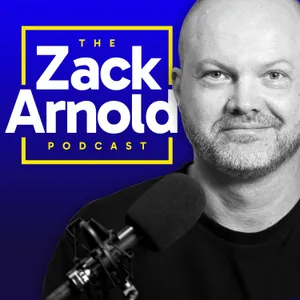
Free Daily Podcast Summary
The Zack Arnold Podcast: Daily Summaries Delivered
by Zack Arnold
Hi I'm Zack! If you want to make things that matter, I want to help you. I’m a former award-winning Hollywood film editor, producer, and documentary director turned writer, podcaster, and creative career coach who loves having deep conversations with interesting, highly creative humans to better understand how we can survive and thrive in this crazy, chaotic world we call reality. I share the hundreds of deep, honest, and vulnerable conversations I’ve had over the years to help you navigate the next act of work and life on your terms, build genuine relationships, better manage your well-being, overcome your fears and limiting beliefs, and build better habits and systems so you can stay focused on creating sh*t that matters. You're in the right place if: You live to create. Your work isn't just a job but an expression of who you are. You create to live. Your livelihood depends on your creativity. You love making cool shit. Whether you identify as introverted or neurodivergent (or both, like me)... No matter if you're a misfit, a rebel, an outlier, or a troublemaker... If you've been called weird, nerdy, dorky, quirky, or awkward... Or if you’re an over-thinker, procrastinator, or perfectionist… You are welcome here. 😊
Latest Episodes
The most recent episodes — sign up to get AI-powered summaries of each one.
- 6 days ago59 min
The ADHD Guide to Building Healthy, Connected Relationships | with Kristen Carder
What if the rejection you fear is less about what’s happening now and more about what your nervous system learned long ago?Kristen Carder is the host of the popular I Have ADHD podcast which has over nine million downloads across mor e than a hundred and twenty countries. She's a multi-certified, trauma-informed coach who has supported thousands of adults with ADHD inside her group program, FOCUSED. She just released her first book You're Not in Trouble: The ADHD Guide to Building Healthy, Connected Relationships.In today's conversation, Kristen and I talk about why ADHD is a disorder of regulation, not a deficit of attention — and how that one reframe can change your approach to the world and your relationships. She'll help us overcome our fear of reaching out and the rejection that comes with connecting (or not connecting) with others, and she'll show us why asking for what we need isn't a burden we put on people — it's an invitation to connect on a more meaningful level.If you've ever written the message that could change your career and then left it sitting in your drafts for weeks — or if you've gone quiet on somebody else you love and couldn't explain why — this one's for you. You're not broken, and you're not too much. You were just never taught how to manage relationships with ADHD.Key TakeawaysLearn to regulate your emotions instead of judging yourself for having them. ADHD can make the emotional volume go from 0 to 100, or leave you feeling completely checked out.Separate actual rejection from the rejection story your brain creates. When there is uncertainty, your brain may fill in the blank with “they don't like you,” even when you don't have all the information yet.Identify your needs and practice asking safe people to help meet them. Needs can become an invitation to connection when you know who sees, understands, and accepts you.Episode HighlightsWhy ADHD relationships became the focus of Kristen's book and the connection between childhood emotional regulation and adult relationshipsADHD as a disorder of self-regulation, not a deficit of attentionThe emotional “switchboard” and what happens when the volume gets stuck at 100Emotional dysregulation and how hypo-arousal and hyper-arousal can become two extremes with little in betweenAttachment styles as an “operating manual” for your emotions and why opposite attachment styles can find each other in relationshipsHow it feels to do the thing that you're meant to do and the vulnerability hangover that comes with being seen and heardThe difference between actual rejection and rejection stories, and how to trust yourself to handle an actual rejectionWhen being afraid of appearing needy can disconnect you from your own needs, and how understanding your needs can improve your relationshipsUsing AI as a “neurodivergent translator” and how to use (or not use) it when struggling with human connectionRecommended Next EpisodeHow to Build ‘Rich Relationships’ (Especially For Introverts) | with Selena SooOn Vulnerability and the Courageous Act of Creating From a Place of Truth | with Allison Sweet GrantUseful ResourcesHow to Be an Adult in Relationships by David RichoADHD & Relationships SurveyThe Connection ConferenceGuest BioKristen Carder is the host of the I Have ADHD podcast and a multi-certified coach who has supported thousands of people with ADHD worldwide. Since beginning her work in 2012, Kristen has become a trusted voice in the ADHD community. She is the founder of FOCUSED, a global coaching program for adults with ADHD. Her work specializes in trauma-informed, evidence-based approaches to executive functioning, emotional regulation, and healthy relationships. Kristen lives outside Philadelphia with her husband and their three sons.Kristen's <a hr
- 1 weeks ago54 min
'Co-Existence': Where AI Belongs in Human Connection (and Where It Doesn't) | with Ethan Mollick
How do you use AI without losing the human connection and effort that make your messages matter?Ethan Mollick is an associate professor at the Wharton School, where he directs the Generative AI Lab and studies the effects of AI on work, entrepreneurship, and education. Named one of Time magazine’s most influential people in artificial intelligence, he’s also the bestselling author of Co-Intelligence and the author of the new book Co-Existence: The Next Phase of AI.In today's conversation, Ethan and I talk about where AI belongs in the process of human connection, and where it absolutely doesn't. You'll get an understanding of how these machines actually work, and why they feel so human. You'll hear what's happening behind the scenes when we let the robots write our emails for us, and why effort is still valuable in our robot-dominated future.If you're a creative or entrepreneur who feels paralyzed by the fear that the robots are coming for your work (or your inbox), or you've been quietly wondering whether it's okay to let AI write the message you're about to send to someone who really matters, this conversation will not only give you practical steps to move forwards, but it might even give you hope.Key TakeawaysThink of an AI tool as a small studio of assistants working under you, not a creative equal. Handing off assignments to it can free up more of your own creative energy.Question what a "personalized" AI message is really signaling. A note polished to sound heartfelt can end up revealing the opposite: a lack of real intent and meaning.Reserve your own effort for the messages that matter most to you personally. Once a shortcut becomes common, leaning on it can turn a gesture of care into an empty habit.Episode HighlightsWhy a book written three years ago about AI still holds up todayUnderstanding GPTs as “general purpose technology” and LLMs as “autocomplete on steroids”“Who’s in charge?” Why nobody fully understands this technology, including the people building itHow AI imitates a population rather than a person, blending the wisdom of the crowdWhy AI is trained to be a helpful assistant and tell people what they want to hearCentaur, cyborg, and conjurer: three ways of working alongside AIWhat the backlash against AI in creative fields has in common with past technology panicsTheory of mind and the jagged frontier: where AI struggles to predict what people wantThe four human advantages: wide knowledge, deep knowledge, agency, and tasteFinding the gray area where AI works best as a tutor rather than a replacement, while preserving human connection and careUseful ResourcesPrediction Machines: The Simple Economics of Artificial IntelligenceAttention Is All You NeedRecommended Next EpisodeIs AI Going To Atrophy Your Ability To Think? | with Nick MiloThe Creative’s Guide to Understanding AI and Leveraging AI to Build Workflows & Optimize Your Creativity | with Rob HowardGuest BioEthan Mollick is a professor at the Wharton School of the University of Pennsylvania, where he holds the Ralph J. Roberts Distinguished Faculty Scholar chair and serves as Academic Director of the Generative AI Labs, studying the effects of artificial intelligence on work, entrepreneurship, and education. He was named one of TIME magazine's Most Influential People in Artificial Intelligence and writes the widely read newsletter One Useful Thing. His first book, Co-Intelligence: Living and Working with AI, was an instant New York Times bestseller and a Best Book of the Year pick from The Economist and the Financial Times. His forthcoming book, Co-Existence: The Next Phase of AI, is due out October 20, 2026.Ethan's Books: Co-Intelligence: Living and Working
- 2 weeks ago1h 11m
Re:Thinking What It Means to "Connect" | with Adam Grant
Before you press play, take the Vibe quiz on Adam's website to discover your connection style and find the gaps in your portfolio of relationships.How do you truly connect with someone you admire when you are afraid of reaching out, bothering them, or even offending them?In this episode, I talk with Adam Grant, an organizational psychologist, Wharton's top-rated professor, and the #1 New York Times bestselling author of multiple books including Give and Take, Originals, Think Again, Hidden Potential, and his latest, Vibe. He is also the keynote conversation for my 5-day virtual event, The Connection Conference . In this long-awaited conversation, Adam and I talk all about what it truly means to connect on a deeper, more human level and how the most meaningful way to succeed is by helping others succeed. We both talk candidly about the fears we have of reaching out, bothering people, or even offending them, and how to truly connect with someone even just through outreach emails. If you're already a fan of Adam Grant, I promise you'll see a more personal side of him you don't often see, and you'll learn how important patience is when reaching out cold to people you admire, knowing your persistence will pay off if you always provide value to others.If you're an artist or creative who struggles with outreach but who's craving more deep, meaningful connections with those you admire, this conversation will change the way you think about networking and building relationships.Key TakeawaysBe thoughtful about when, who, and how you help. Successful givers do not help everyone with every request, and a five-minute favor is a simple way to give without burning out.Put in the effort, because there are no shortcuts when it comes to meaningful connections. You can accelerate connection, but you can’t skip the effort that it takes to show you’re taking a genuine interest in another human.Reach out even if you feel guilty about being a burden. If you’re hesitating because you don’t want a one-sided interaction or to waste their time, you are the person other people are waiting to hear from.Episode HighlightsThe people and experiences that shaped the belief that "The most meaningful way to succeed is to help others succeed"Givers vs. Takers vs. Matchers: The reciprocity styles and the general thesis behind Give and TakeThe five-minute favor in action, and what makes an introduction a true win-win for everyone involvedInside the inbox: what actually goes through the mind of the person you are afraid of botheringHow a parasocial relationship becomes a real one with synchronized brainwaves and heartbeatsWhy naming the fear of being ghosted is a bid for connection, and how to set a kind boundary for too much inboundThe eighth-grade basketball that disappeared (and found), and why there are no shortcuts when it comes to meaningful connectionGetting a psychologist who says he does not help anyone to rethink his own impactThe adverse selection problem: why the people who hesitate to reach out out of guilt are the exact people everyone is waiting to hear fromA gratitude practice built on handwritten notes and wax stampsRecommended Next EpisodeHow to Build ‘Rich Relationships’ (Especially For Introverts) | with Selena SooHow to Build Meaningful Relationships in the ‘Real World’ | with Camille VirginiaUseful ResourcesThe Connection ConferenceVibe QuizThe Curiosity Shop with Brené Brown and Adam Grant<a href="http
- 3 weeks ago1h 0m
Information Is Worthless...Until You Know How to Connect It (With or Without AI) | with Nick Milo
When information is everywhere and costs nothing, what actually makes any of it worth having?Nick Milo is the founder of the wildly popular program and YouTube channel Linking Your Thinking and a former student of mine who is now a leading voice in the world of personal knowledge management. In this conversation, Nick and I talk about why information on its own has never been less valuable, and why the real value comes from your ability to connect ideas and take action on them. We discuss where AI can reduce the bad friction in our lives, but also where handing over your thinking to the robots can lead to what Nick calls "cognitive surrender." You'll also get a first look (or listen) at the mind-bending Obsidian knowledge vault we built for The Connection Conference, so you can see what linked ideas actually look like in practice. And we may even talk you out of letting the robots clean your closet.If you're buried in podcasts, articles, and AI summaries you never do anything with, or if you've started letting the chatbots do your thinking because it's just easier, this conversation will show you that the value of ideas is in the struggle to turn them into action.Key TakeawaysUse linked notes to move from organization into ideation. Connecting ideas gives you a trail you can return to, helping you recall, re-internalize, and build on what matters.Protect your cognition when using AI. AI can save time, but turning to it whenever you are tired can become “cognitive surrender” and sacrifice the ability to cultivate wisdom.Make AI bring ideas to you, then engage with them in your own words. The goal is not to have AI create your thinking, but to use it as scaffolding that helps you interact with and internalize what matters.Episode HighlightsNick’s unexpected journey from engineering to becoming "Mr. Obsidian."Where the real value lies in an abundance of informationThe danger of “cognitive surrender” when we let AI do the thinkingWhat Obsidian actually is, and why "digital sovereignty" mattersThe joy of typing a link and being serendipitously reminded of "cognitive affordances"Embracing the mess: the architect and the gardener in all of usA live tour of an early beta knowledge base of the Connection ConferenceWhy direct quotes from the source can beat AI interpretationHow to turning AI output into your own wordsFinding the sweet spot between ready-made systems and the work that creates real learningRecommended Next EpisodeWhy Books Matter More In the Age of AI (And How to Read Better) | with Alex WieckowskiFrom Information Overload to Getting Better at Anything by Finding the Right Mentors | with Scott YoungUseful ResourcesObsidianAustin Kleon's Book Show Your WorkAs We May Think by Vannevar BushHow to Try Again by Steve KambForgetting Curve (Hermann Ebbinghaus)Flow by Mihaly CsikszentmihalyiThe Art of the Pivot: Going From Freelancer to Entrepreneur | with Nick MiloGuest BioNick Milo is the founder of Linking Your Thinking, the creator of the LYT framework, and a leading voice in personal knowledge management. A former civil engineer, he co-founded an international fitness boxing business, produced independent feature films, and worked as a film and TV editor. Today he guides people to link their thinking, generate value, and rediscover the joy of thinking itself. His upcoming book, Link
- Oct 5, 202658 min
Why Books Matter More In the Age of AI (And How to Read Better) | with Alex Wieckowski
How do you make time to read more books and build a reading habit that lasts in a world full of distractions?Alex Wieckowski, better known online as Alex & Books, has been writing and posting about the importance of reading books to his more than 1 million followers across social media since 2017. He has read over 750 books and he's currently writing the 21st century version of Mortimer Adler's classic text How to Read a Book. In today's conversation, Alex and I talk about why reading real books matters more than ever in the age of AI. We discuss the four different types of reading and how better understanding these different approaches can help you build a more consistent reading habit. We'll help you choose what to read, reclaim the time to read it, and remember what you read long after you've closed the book.If you've got a stack of books you keep meaning to get to, or it's been so long since you read a book you don't even know where to start, Alex and I will show you that Reading is a skill anyone can develop and improve.Key TakeawaysMake reading part of the time you already have instead of waiting to find more time. Use a time journal to see where your hours are actually going, then prioritize reading or build it into an existing routine.Choose books that address what you’re working through right now. Reading when you need the information most makes it easier to remember what you learn and put it into practice.Read the whole book when the ideas matter instead of outsourcing the struggle to a summary. The stories, context, and effort of reading are part of what make the lessons memorable and meaningful.Episode HighlightsOrigin story of loving reading as a kid to losing it, then finding it again.Why books could become more popular in the age of AI as people look for ways to exercise their brains.Why the struggle of reading is part of the learning, and what gets lost when someone else does the work for you.Using the table of contents as a map and the three-chapter rule for knowing when to quit.How syntopical reading turns three to five books on one subject into a “mini PhD”.The simple time journal that reveals where your hours are actually going and helps you reclaim time for reading.Why “read it when you need it” can help you choose books that are relevant enough to remember and apply.How a simple distraction catcher can get intrusive thoughts out of your head without pulling you away from the book.Why reading 100 books a year is not the goal, and why speed reading can sacrifice the very things that make reading valuable.How the Reading Triangle forces you to choose between enjoyment, retention, and speed instead of trying to maximize all three.Recommended Next EpisodeHow Tiny Changes Can Create Remarkable Results | with James ClearHow to Become ‘Indistractable’ | with Nir EyalUseful ResourcesHow to Win Friends and Influence People by Dale Carnegie BooksHow to Read a Book by Mortimer J. AdlerWrite a Must Read by A.J. HarperWrite Useful Books by Rob Fitzpatrick4,000 Weeks by Oliver BurkemanCommunity Made by Jayson GaignardNonviolent Communication by Marshall B. RosenbergThe Elephant in the Brain by Kevin Simler and Robin HansonGuest BioAlex Wieckowski is the creator of Alex & Books, where he
- Oct 1, 20261h 9m
How the Written Word Helps Us Connect (Especially In Our Hardest Moments) | with Allison Sweet Grant
We seldom write for ourselves because we instead want our stories to touch others. Yet we’re often terrified to put our work (and ourselves!) out into the world. How can we walk the line between wanting to make things that matter while also making sure other people know we made these things for them?I discuss this (and so much more), with Allison Sweet Grant, a former psychiatric nurse practitioner turned author whose is the author of the novel I Am the Cage and the new memoir Lump: A Memoir in Ineloquent Reflections, which candidly explores her experience with breast cancer. In this conversation, we talked about the power of the written word to help create emotional connection, why she chose to write about what cancer actually feels like (rather than her “journey”), and how carefully chosen words can help someone feel less alone.If you're going through something hard, or trying to support someone who is, this conversation offers a different way to connect through uncertainty, pain, and shared experience.Key TakeawaysPut your hardest experiences into words instead of keeping them inside. Writing can help you process what happened, get it out of you, and onto something else.Write about what something feels like, not just what someone needs to do. Practical information can tell you what comes next, but emotional truth can help someone feel less alone.Stop apologizing for pain you didn't choose. Fear of being a burden can cause you to swallow your struggles and limit the possibility for connection.Episode HighlightsWhat a memoir looks like when it mirrors the most difficult period of your lifeHow the same chemo room can feel like hell to one patient and like a heaven that is saving someone's lifeWhy a book for people too sick to finish a chapter comes in bite-sized piecesWhy the language of the "cancer journey" never fit, and how they can place an identity on someoneOn Riches: a scene about pancakes that becomes a lesson in noticing the small details you want to rememberFive Letters: the poem about packing a chemo bag and leaving letters on the tableWhy putting real human words and real human experiences on the page matters moreI'm sorry, I'm okay: why we apologize for being an inconvenience and a burdenHow the involuntary combination of colors with letters and numbers has influenced her choicesJust My Luck: a rant against everything people say caused cancerRecommended Next EpisodeFrom Setback to Comeback: Finding Strength in the Hardest Moments | with Bevin FarrandHow to Keep Moving Forwards After You've Lost Everything | with Christina RasmussenUseful ResourcesOn Vulnerability and the Courageous Act of Creating From a Place of Truth | with Allison Sweet GrantGlennon DoyleZingerman'sGuest BioAllison Sweet Grant is an author who has been published in The New York Times and The Atlantic. Previously, she was a psychiatric nurse practitioner; she holds dual master's degrees from the University of Michigan. An introvert, synesthete, and avid poet, Allison can usually be found at home with a cup of hot tea in hand, reading or rewatching a film she has seen sixteen times. She lives outside of Philadelphia with her husband and their three children (and two cats, Pom-Pom and Jasper).Allison's WebsiteAllison's Books: I Am the Cage | <a href="https://w
- Sep 30, 202611 min
The People You Want to Connect With Want to Connect With You
We’re living through a time when meaningful relationships have never been more important, yet reaching out to the people who could help us most can feel harder than ever. In this mini-episode, I explore why we’re lonelier and more disconnected despite being globally hyperconnected, and why so many of us are terrified to reach out. I share why our only path forwards through this confusing next phase of work and life is together, and how kind, thoughtful, and genuinely HUMAN outreach can turn connection into an act of service. Along the way, I pull back the curtain on how I built my entire creative career and my upcoming Connection Conference from the comfort of my pajamas, using hand-crafted, well-researched, and thoughtful cold outreach emails to connect with some of the world’s leading experts in psychology, communication, creativity, and AI.All that in more in my latest Substack → The People You Want to Connect With Want to Connect With YouWhen you're done → I'd love your thoughts here in the comments!If you enjoyed this article and you don't want to miss my future essays, my actionable insights, and my soapbox rants about navigating the world as analog humans in today's digital hellscape, make sure to subscribe at zackarnold.com/substack.
- Sep 14, 202611 min
Have the robots killed cold outreach?
As someone who has built diverse professional networks across three industries, and secured over a decade’s worth of employment through cold outreach, I had to find out whether AI is actually killing one of the most effective and human ways we connect with one another. In this episode, I dig into the rise of AI-generated “personalized” messages, and why thoughtful, human-generated outreach may be more effective than ever in a world desperate for real, imperfect, authentic connections.All that in more in my latest Substack → Have the robots killed cold outreach?When you're done → I'd love your thoughts here in the comments!If you enjoyed this article and you don't want to miss my future essays, my actionable insights, and my soapbox rants about navigating the world as analog humans in today's digital hellscape, make sure to subscribe at zackarnold.com/substack.Not convinced yet that cold outreach can still be effective, even in The Age of AI? Join The Connection Conference, a live virtual event I’m launching in October. The guest list is absolutely BANANAS! Curious how I built my entire guest list? Yup, you guessed it.Kind, thoughtful, and value-driven cold outreach. 😁
Get The Zack Arnold Podcast summaries in your inbox
Free AI-powered daily recaps. Key takeaways, quotes, and mentions — in a 5-minute read.
Get Free Summaries →Free forever for up to 3 podcasts. No credit card required.
You Might Also Like
Listeners also like.
A Bit of Optimism
Conversations with thinkers and doers exploring what drives purpose, growth, and meaning in life.

Your Brand Amplified
Explores the strategies and mindsets of successful entrepreneurs in business growth, marketing, and personal branding.
Creative Pep Talk
A practical guide for creatives to build a sustainable practice through interviews and strategies from artists and makers.

The Super Human Life
Men explore faith, fitness, finance, family, and freedom with expert guidance to unlock their full potential.
The One You Feed | Personal Growth, Emotional Resilience & Purpose
Conversations with thought leaders explore personal growth, emotional resilience, and living with purpose through small, consistent actions.

EPIC Begins With 1 Step Forward
Real people share strategies and stories for overcoming challenges and achieving meaningful personal and professional goals.

The Kevin Rose Show
Conversations with technologists, scientists, and thinkers exploring tech, markets, longevity, and performance.
ReThinking
Adam Grant explores how top thinkers and achievers challenge assumptions and rethink their paths to success.

Your Thoughts Your Reality
A podcast exploring how veterans can overcome psychological challenges like fear and self-doubt through neuroencoding science.

The Sabrina Zohar Show
Explores modern dating, anxious attachment, and personal growth through raw conversations on healing and self-discovery.
Becoming You with Suzy Welch
A podcast exploring personal growth, career choices, and life decisions with candid conversations and practical insights.

Expert Intelligence with Paul Estes
Explores the intersection of human expertise and AI in shaping the future of work through interviews with industry leaders and innovators.
About The Zack Arnold Podcast
Hi I'm Zack! If you want to make things that matter, I want to help you. I’m a former award-winning Hollywood film editor, producer, and documentary director turned writer, podcaster, and creative career coach who loves having deep conversations with interesting, highly creative humans to better understand how we can survive and thrive in this crazy, chaotic world we call reality. I share the hundreds of deep, honest, and vulnerable conversations I’ve had over the years to help you navigate the next act of work and life on your terms, build genuine relationships, better manage your well-being, overcome your fears and limiting beliefs, and build better habits and systems so you can stay focused on creating sh*t that matters. You're in the right place if: You live to create. Your work isn't just a job but an expression of who you are. You create to live. Your livelihood depends on your creativity. You love making cool shit. Whether you identify as introverted or neurodivergent (or both, like me)... No matter if you're a misfit, a rebel, an outlier, or a troublemaker... If you've been called weird, nerdy, dorky, quirky, or awkward... Or if you’re an over-thinker, procrastinator, or perfectionist… You are welcome here. 😊
Customized Recaps
AI-powered recaps with compact key takeaways, quotes, and insights.
Straight to Your Inbox
Get key takeaways from The Zack Arnold Podcast in a 5-minute read.
Save Hours Every Week
Stay current on your favorite podcasts without falling behind.
Frequently Asked Questions
What is Podzilla's The Zack Arnold Podcast daily summary?
It's a free AI-powered email that summarizes new episodes of The Zack Arnold Podcast as soon as they're published. You get the key takeaways, notable quotes, and links & mentions — all in a quick read.
How does the The Zack Arnold Podcast podcast summary work?
When a new episode drops, our AI transcribes and analyzes it, then generates a personalized summary tailored to your interests and profession. It's delivered to your inbox every morning.
Is this an official The Zack Arnold Podcast product?
No. Podzilla is an independent service that summarizes publicly available podcast content. We're not affiliated with or endorsed by Zack Arnold.
Can I get summaries of other podcasts too?
Absolutely! The free plan covers up to 3 podcasts, any in the catalog. Basic raises that to 15, Pro to 40 and Max to 100. Browse our full catalog at /podcasts.
How often does The Zack Arnold Podcast release new episodes?
The Zack Arnold Podcast publishes weekly. Our AI generates a summary within hours of each new episode.
What topics does The Zack Arnold Podcast cover?
The Zack Arnold Podcast covers topics including Education, Business, Arts, Fitness, Health & Fitness, Mental Health. Our AI identifies the specific themes in each episode and highlights what matters most to you.
Start getting The Zack Arnold Podcast summaries tomorrow morning.
Free forever for up to 3 podcasts. No credit card required.
Free forever for up to 3 podcasts. No credit card required.