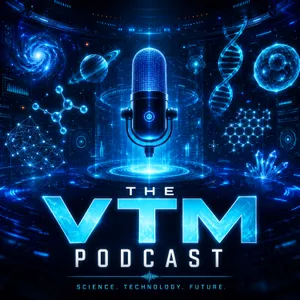
Free Daily Podcast Summary
The VTM Podcast by Dr. Ralph Clayton: Daily Summaries Delivered
by Dr. Ralph Clayton
The VTM Podcast explores the science of time, reality, and the emerging ideas shaping our technological future. At the center of the series is the Volumetric Time Model — a bold framework that reimagines time not as a ticking sequence of moments, but as a structured dimension we move through.Blending physics, complexity science, artificial intelligence, and futurism, the show examines why the future can feel “decided” without being predetermined — and what that means for free will, causality, prediction, and human agency in an age of intelligent systems.Each episode unpacks big ideas in a clear, accessible way while pushing into deep questions about how reality is structured and how much influence we truly have within it.If you’re fascinated by cutting-edge science, the geometry of time, and the forces quietly shaping tomorrow, this podcast is your guide to the frontier.
Latest Episodes
The most recent episodes — sign up to get AI-powered summaries of each one.
- Aug 12, 202644 min
The VTM podcast - Episode 25 - Microbiome Therapeutics, Synthetic Biology & the Age of Engineered Life
VTM Podcast | Episode 25: Microbiome Therapeutics, Synthetic Biology & the Age of Engineered LifeWelcome, everyone.I’m Ralph Clayton, host of the VTM Podcast.In this episode, we move into one of the most profound frontiers in modern medicine and biotechnology:microbiome therapeutics, synthetic biology, engineered microbes, and living medicines.At the intersection of biology, computation, and medicine, a new possibility is emerging:life itself becoming a programmable technology.From Killing Bacteria to Working With ThemFor most of modern medicine, microbes were treated as enemies.PathogensInfectionsContaminationSystems to eliminateBut the human body is not sterile—it is an ecosystem.Inside us, microbial communities:Shape immunityRegulate metabolismInfluence inflammationProduce bioactive moleculesCompete with pathogensSupport gut barrier functionThis reframes everything.Microbes are not only threats.They are also partners in health.And that opens a new idea:microbes as medicine.Microbiome Therapeutics: Medicine as Ecosystem RepairThe microbiome is not a list of organisms.It is a functional system.Therapeutic focus is shifting toward:Restoring metabolic functionRebuilding colonization resistanceModulating immune activityRebalancing microbial ecologyCorrecting disease-linked dysbiosisThis leads to a major conceptual shift:from adding bacteria → to restoring functionClinical Turning Point: Living Microbiome MedicineA major validation of this field came through treatments for recurrent Clostridioides difficile infection.Approved microbiome-based therapies such as:RebyotaVowstrepresent a shift from experimental biology to regulated medicine.These are not probiotics.They are defined biological interventions with clinical endpoints, dosing, and manufacturing standards.From Donor Microbiomes to Engineered ConsortiaThe next stage goes further.Instead of transferring whole donor ecosystems, research is moving toward:Defined microbial consortiaEngineered bacterial strainsFunction-specific communitiesPredictable metabolic outputsThe key question becomes:What does the microbiome do, not just what is in it?Functions include:Short-chain fatty acid productionBile acid transformationPathogen suppressionImmune signaling regulationNutrient metabolismBarrier protectionA microbiome is therefore best understood as:an interacting functional network, not a static population.Synthetic Biology: Programming LifeSynthetic biology pushes this further.Cells become designable systems:DNA as codeMicrobes as platformsMetabolic pathways as engineered circuitsProteins as modular componentsEngineered organisms can be designed to:Sense inflammationProduce therapeutic moleculesTarget disease environmentsAct as biological sensorsFunction as living factoriesBut biology is not software.Cells:MutateCompeteAdaptResist engineered burdenEvolve against constraintsA design that works in vitro may fail in vivo.Living Medicines: Control Is the Core ChallengeEngineered therapeutic microbes must solve simultaneous constraints:Safety in complex environmentsStable gene expressionControlled persistenceReversible activityPredictable metabolismResistance to evolutionary driftContainment and shutdown mechanismsA therapeutic microbe is not just an organism.It is:an organism operating under engineered constraints inside an evolving ecosystem.AI and the Acceleration of BiologyArtificial intelligence is now accelerating biological design:Protein structure predictionGene circuit designMetabolic pathway optimizationMulti-omics analysisBiological system simulationExperimental planningThis transforms synthetic biology from slow iteration into:high-dimensional design space exploration.But AI does not remove the need for vali
- Aug 5, 202643 min
The VTM podcast - Episode 24 - Nanophotonics, Optical AI Computing & the Future of Light-Based Intelligence
VTM Podcast | Episode 24: Nanophotonics, Optical AI Computing & the Future of Light-Based IntelligenceWelcome, everyone.I’m Ralph Clayton, host of the VTM Podcast.In this episode, we move into one of the most critical frontiers in modern technology:nanophotonics, optical AI computing, and quantum dot systems.At the intersection of light, materials science, and computation, a new possibility is emerging:intelligence built not only on electrons—but on controlled light.When Electronics Hit Their LimitsFor decades, computing advanced through smaller transistors and denser chips.But that progression is now constrained by:Heat densityPower consumptionMemory bottlenecksInterconnect bandwidth limitsEnergy cost of data movementAI has intensified every one of these pressures.Modern models are not limited by raw compute alone—but by:moving data efficiently between memory, chips, and systems.The bottleneck is no longer just processing.It is communication.Why Light Is Returning to ComputingLight already powers global communication:Fiber-optic networksUndersea cablesData-center interconnectsTelecom infrastructureNow the goal is to bring photonics closer to computation itself.Why?Because photons can:Carry massive bandwidthTravel with minimal loss over distanceAvoid electrical resistance and heatCoexist in parallel wavelengthsThis makes light a strong candidate for solving AI’s growing energy and bandwidth crisis.Silicon Photonics & Optical AI SystemsThe first wave of change is already here:Optical interconnectsReplacing copper links between chips with light-based communication.Co-packaged opticsBringing photonic systems directly into AI hardware packages.Silicon photonicsIntegrating optical waveguides into semiconductor platforms.These systems do not replace electronics.They reduce bottlenecks between them.Can Light Compute?Beyond communication lies a deeper idea:using light to perform computation itself.Photonic systems can:Split optical signalsInterfere wavesShift phaseModulate intensityPerform analog linear algebra operationsSince AI workloads rely heavily on matrix multiplication, optical systems may execute parts of these operations physically through light propagation.Instead of computing step-by-step electronically, the system allows:wave physics to perform arithmetic.The Challenge of Optical ComputingDespite its promise, optical AI computing faces major constraints:Precision and numerical stabilityThermal drift and noiseLimited programmabilityMemory integration bottlenecksManufacturing complexitySystem-level cost and scalabilityA fast system is meaningless if results are inaccurate.Optical computing must compete on:AccuracyEfficiencyIntegrationReliabilityReal-world workloadsNot just laboratory demonstrations.The Real Future: Hybrid SystemsThe most realistic architecture is not replacement—but combination:Electronics for memory, logic, and controlPhotonics for data movement and high-throughput mathHybrid systems for AI accelerationIn this model:Electrons compute and storePhotons move and accelerateThis division of labor may define next-generation AI hardware.Memory: The Hard BottleneckEven with optical acceleration, AI still depends on memory systems.Challenges include:Parameter storageActivation movementBandwidth limitationsData locality constraintsIf memory cannot keep up, optical speed gains are lost.This is why early adoption of photonics is likely to begin in:data movement before full computation.Quantum Dots: Light at the NanoscaleQuantum dots are nanoscale semiconductor crystals whose properties depend on size itself.They can:Emit tunable colorsServe in high-performance displaysAct as fluorescent biomedical markersFunction as photodetectors or sensorsEnable quantum light sourcesAt the nanoscale, they behave like artificial atoms, with dis
- Jul 29, 202641 min
The VTM podcast - Episode 23 - Medical Micro-Robots, Nanomedicine & the Future of Precision Therapy
VTM Podcast | Episode 23: Medical Micro-Robots, Nanomedicine & the Future of Precision TherapyWelcome, everyone.I’m Ralph Clayton, host of the VTM Podcast.In this episode, we explore one of the most radical frontiers in modern medicine:medical micro-robots, nano-robots, and sensor-driven precision diagnostics.From targeted drug delivery and bubble-based micromachines to carbon nanotube nanosensors and liquid biopsy systems powered by machine learning, medicine is beginning to shift toward a new paradigm:therapies and diagnostics that operate at the scale of disease itself.When Medicine Becomes MobileModern medicine is powerful—but still fundamentally blunt.Most drugs:circulate through the entire bodyaffect healthy and diseased tissue alikerely on probability, not precisionThe core problem remains:How do we deliver the right treatment to the right place at the right time—without harming everything in between?This is where micro- and nanomedicine begins to change the equation.The Rise of Micro- and Nano-RoboticsDespite the term “nanobot,” real systems are far more grounded:They are not intelligent machines inside the body.They are engineered micro-scale systems that can:move under magnetic or acoustic controlrespond to chemical or physical signalscarry therapeutic cargoenable imaging contrastrelease drugs at targeted sitesExamples include:magnetic microcapsulesultrasound-responsive microbubblesenzyme-driven micromotorsbiohybrid algae-based carriershydrogel-based delivery particlesTheir “intelligence” is largely external—driven by physics, design, and imaging systems.Targeted Drug Delivery: Precision Over FloodingOne of the most important goals is reducing systemic toxicity.Instead of flooding the entire body with medication, microrobotic systems aim to:concentrate drugs at disease sitesreduce damage to healthy tissueincrease local therapeutic impactenable treatments previously too toxic systemicallyThis is especially relevant for:cancer therapyinfections in hard-to-reach tissuelocalized inflammation and vascular diseaseMovement is the key innovation.Not just passive diffusion—but guided delivery.The Challenge of BiologyThe body is not a controlled laboratory environment.Any micro-device must survive:blood flow dynamicsimmune system responsemucus and tissue barriersorgan motion and deformationrapid clearance mechanismsA successful system must also:carry a payloadremain stablebe trackable through imagingrelease cargo preciselydegrade or exit safely after usemeet regulatory and safety standardsFunction alone is not enough.Clinical viability requires reliability at scale.Bubble-Based and Biohybrid SystemsSome of the most promising platforms use entirely different physical principles.Microbubbles and acoustic systems can:enhance imaging contrastrespond to ultrasound fieldsoscillate or collapse for controlled releaseimprove local drug penetrationBiohybrid systems go further.In experimental lung treatments, researchers have used algae-based microrobots that:retain motility after inhalationcarry drug-loaded nanoparticlesdistribute therapeutics within lung tissueshow early success in infection modelsThese systems remain preclinical—but demonstrate a shift toward active drug carriers instead of passive aerosols.The Lung as a Testing GroundThe lung is both accessible and complex.It offers:large surface area for therapydirect access via inhalationsensitivity to targeted treatmentBut also:immune defensesmucus barriersconstant motionrapid clearance mechanismsThis makes it a key frontier for active delivery systems capable of navigating biological complexity.Detection: Liquid Biopsy and Nano-BiosensorsTreatment is only half the story.Detection is the other.Liquid biopsy aims to detect disease through:bloodcerebrospinal fluidsaliva or urineInstead of tissue extraction, it searches for:circulating tumor DNAprotein signatures</li
- Jul 22, 202645 min
The VTM podcast - Episode 22 - Europa Clipper, JUICE & the Ocean Worlds of Jupiter
VTM Podcast | Episode 22: Europa Clipper, JUICE & the Ocean Worlds of JupiterWelcome, everyone.I’m Ralph Clayton, host of the VTM Podcast.In this episode, we explore one of the most elegant and ambitious journeys in modern space exploration:Europa Clipper’s return past Earth.JUICE’s long voyage to Jupiter.And the deep question connecting them both:What if the most promising places for life are not Earth-like worlds—but hidden oceans beneath ice?Ocean Worlds Beyond EarthWhen we imagine life in the universe, we often picture Earth-like planets:blue skies, oceans on the surface, sunlight, rain, continents.But the Solar System tells a more complex story.Some of the most promising environments for life may be:Frozen on the outsideLiquid beneath the surfaceHidden under kilometers of iceHeated by gravity, tides, and internal chemistryThese are not planets like Earth.They are ocean worlds disguised as ice moons.And at Jupiter, they are everywhere.Europa: The Fractured Ocean MoonEuropa is one of the most important targets in planetary science.Its surface is:Bright and fracturedCovered in reddish-brown streaksGeologically young and active-lookingBeneath this icy shell, scientists strongly suspect a global subsurface ocean.Europa has three key ingredients for habitability:Liquid waterChemical building blocksEnergy sourcesTogether, they form the basic habitability triangle.But Europa is not a place of comfort.It is cold, irradiated, and deeply hostile on the surface.Yet beneath the ice, something far more interesting may exist.Europa Clipper: A Mission to Understand HabitabilityEuropa Clipper is not designed to find life.It is designed to answer a more fundamental question:Could Europa support life at all?It will not land.It will not drill through ice.Instead, it will:Perform repeated close flybys of EuropaMap the ice shell and surface compositionMeasure magnetic and gravitational signalsStudy potential subsurface interactionsSearch for signs of ocean-surface exchangeThis is habitability science at a distance:careful, systematic, and deeply constrained by physics.The Gravity Assist JourneyEuropa Clipper launched in 2024, but it is not traveling directly to Jupiter.Instead, it uses gravity assists:Mars flyby (2025)Earth flyby (December 2026)Final trajectory toward JupiterThese maneuvers are not shortcuts—they are precision orbital engineering.A spacecraft does not simply travel through space.It negotiates with moving planets, borrowing their momentum to reach destinations otherwise unreachable.The December 2026 Earth flyby is especially significant:a brief return home before continuing into the outer Solar System.JUICE: Europe’s Mission to the Icy MoonsWhile Europa Clipper focuses on Europa, ESA’s JUICE (Jupiter Icy Moons Explorer) takes a broader approach.Its targets include:GanymedeCallistoEuropaJupiter itselfBut its primary destination is Ganymede, the largest moon in the Solar System.Ganymede is:Larger than MercuryStructurally layeredMagnetically activeLikely harboring a subsurface oceanJUICE aims to become the first spacecraft ever to orbit a moon of another planet.A major milestone in space exploration.A Long and Complex Route to JupiterJUICE follows an intricate trajectory through the inner Solar System:Moon–Earth gravity assist (2024)Venus flybyMultiple Earth flybys (including 2026 and 2029)Arrival at Jupiter (2031)This path exists for one reason:energy efficiency.Gravity is not an obstacle—it is a resource.Planetary flybys turn celestial motion into propulsion.Why Icy Moons MatterEuropa, Ganymede, and Callisto are not minor objects.They are planetary worlds in their own right:Ice-covered surfacesHidden oceansComplex internal heatingTidal and magnetic interactions with JupiterThey expand the definition of habitability.A world does not need to be Earth-like.It only needs:
- Jul 15, 202646 min
The VTM podcast - Episode 21 - A.I. is Hyper-Scaling
Artificial intelligence in 2026 is no longer just an app, a chatbot, or a tool you open when you need help writing an email. AI is becoming infrastructure — something built into the foundations of business, government, education, healthcare, science, defense, media, software, and everyday life. In this episode, we explore the rise of AI hyperscalation: the rapid expansion of artificial intelligence from individual models into massive physical, economic, and social systems. The AI revolution is no longer only about smarter software. It is about data centers, chips, power grids, cooling systems, fiber networks, cloud platforms, national strategy, and the race to build enough compute to support a world increasingly shaped by machine intelligence.
- Jul 8, 202653 min
The VTM podcast - Episode 20 - Self-Healing Materials
Self-healing materials are one of the most fascinating technology stories of 2026 because they sound like science fiction, but they are becoming a real engineering strategy. Instead of designing objects that simply resist damage until they fail, researchers and companies are designing materials that respond to cracks, scratches, stress, heat, moisture, or impact—and then repair themselves. In this episode, we explore self-healing and self-repairing materials in 2026: smart polymers that close scratches, coatings that protect cars and aircraft, concrete that can seal its own cracks, composites that detect hidden damage, and experimental materials that could one day make spacecraft, electronics, batteries, bridges, and buildings last much longer.
- Jul 1, 202642 min
The VTM podcast - Episode 19 - ExoPlanets
Exoplanets in 2026 are no longer just distant points in a telescope’s data. They have become one of the most exciting frontiers in science: alien worlds with weather, atmospheres, strange orbits, possible oceans, extreme heat, and clues about whether Earth is rare—or one example among billions. In this episode, we explore the state of exoplanet discovery in 2026, a moment when astronomy is shifting from simply finding planets outside our solar system to asking much deeper questions: What are these worlds made of? Do they have skies, storms, clouds, and seasons? Could any of them support life? And how close are we to detecting a truly Earth-like planet?
- Jun 24, 202643 min
The VTM Podcast - Episode 18 - Regenerative Medicine
Regenerative medicine in 2026 is moving from science-fiction promise toward real clinical impact—but the field is still defined by both breakthrough and caution. At its core, regenerative medicine asks one of the most ambitious questions in healthcare: what if medicine could not only treat disease, but repair, replace, or rebuild the body itself? In this episode, we explore the state of regenerative medicine in 2026, from stem cell therapies and tissue engineering to gene therapy, cell therapy, organoids, exosomes, and 3D bioprinting. The field is no longer limited to the idea of “growing new organs” in a lab. Today, it includes living medicines designed to restore damaged tissue, reprogram immune cells, replace missing or defective cells, and potentially change the course of diseases once considered irreversible.
Get The VTM Podcast by Dr. Ralph Clayton summaries in your inbox
Free AI-powered daily recaps. Key takeaways, quotes, and mentions — in a 5-minute read.
Get Free Summaries →Free forever for up to 3 podcasts. No credit card required.
You Might Also Like
Listeners also like.
SpaceTime Conversations
norekiva

The TWIML AI Podcast (formerly This Week in Machine Learning & Artificial Intelligence)
Explores machine learning and artificial intelligence through interviews with leading researchers, engineers, and industry experts.

TED Tech
Experts examine how technology reshapes society, science, design, and business through TED Talks hosted by Sherrell Dorsey.
Inquiring Minds
Explores the intersection of science and society through critical thinking and in-depth analysis.

The AI XR Podcast
Insightful interviews with tech founders and executives on AI, virtual reality, augmented reality, and the future of spatial computing.
The VPZD Show
Two physicians discuss healthcare, medicine, and policy from a contrarian, middle-ground perspective.
Stuff To Blow Your Mind
Explores the strange edges of science, consciousness, and reality through neuroscience, cosmology, evolution, and emerging technology.
Unobtainium Podcast
A Hollywood writer-producer and an astrophysicist analyze the science behind sci-fi films, separating fact from cinematic fiction.
The World, the Universe and Us
Explores big scientific questions about life, consciousness, climate, and the cosmos with expert scientists and New Scientist journalists.

Huge If True Podcast
Explores emerging scientific and technological innovations with optimism, examining how breakthroughs could shape a better future.

Taking Time
A man uses unreliable time travel to save his lost love while facing corporate threats and personal dangers.

Theories of Everything with Curt Jaimungal
A deep, rigorous exploration of theories uniting physics, consciousness, AI, and metaphysics through analytical and unconventional thinking.
About The VTM Podcast by Dr. Ralph Clayton
The VTM Podcast explores the science of time, reality, and the emerging ideas shaping our technological future. At the center of the series is the Volumetric Time Model — a bold framework that reimagines time not as a ticking sequence of moments, but as a structured dimension we move through.Blending physics, complexity science, artificial intelligence, and futurism, the show examines why the future can feel “decided” without being predetermined — and what that means for free will, causality, prediction, and human agency in an age of intelligent systems.Each episode unpacks big ideas in a clear, accessible way while pushing into deep questions about how reality is structured and how much influence we truly have within it.If you’re fascinated by cutting-edge science, the geometry of time, and the forces quietly shaping tomorrow, this podcast is your guide to the frontier.
Customized Recaps
AI-powered recaps with compact key takeaways, quotes, and insights.
Straight to Your Inbox
Get key takeaways from The VTM Podcast by Dr. Ralph Clayton in a 5-minute read.
Save Hours Every Week
Stay current on your favorite podcasts without falling behind.
Frequently Asked Questions
What is Podzilla's The VTM Podcast by Dr. Ralph Clayton daily summary?
It's a free AI-powered email that summarizes new episodes of The VTM Podcast by Dr. Ralph Clayton as soon as they're published. You get the key takeaways, notable quotes, and links & mentions — all in a quick read.
How does the The VTM Podcast by Dr. Ralph Clayton podcast summary work?
When a new episode drops, our AI transcribes and analyzes it, then generates a personalized summary tailored to your interests and profession. It's delivered to your inbox every morning.
Is this an official The VTM Podcast by Dr. Ralph Clayton product?
No. Podzilla is an independent service that summarizes publicly available podcast content. We're not affiliated with or endorsed by Dr. Ralph Clayton.
Can I get summaries of other podcasts too?
Absolutely! The free plan covers up to 3 podcasts, any in the catalog. Basic raises that to 15, Pro to 40 and Max to 100. Browse our full catalog at /podcasts.
What topics does The VTM Podcast by Dr. Ralph Clayton cover?
The VTM Podcast by Dr. Ralph Clayton covers topics including Science, Technology, Philosophy, Culture, Society & Culture. Our AI identifies the specific themes in each episode and highlights what matters most to you.
Start getting The VTM Podcast by Dr. Ralph Clayton summaries tomorrow morning.
Free forever for up to 3 podcasts. No credit card required.
Free forever for up to 3 podcasts. No credit card required.