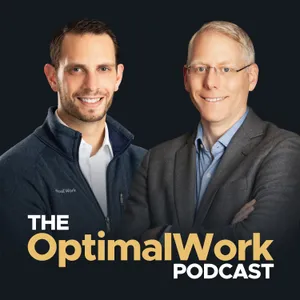
Free Daily Podcast Summary
The OptimalWork Podcast: Daily Summaries Delivered
by OptimalWork
Get key takeaways, quotes, and insights from The OptimalWork Podcast in a 5-minute read. Delivered straight to your inbox.
Latest Episodes
The most recent episodes — sign up to get AI-powered summaries of each one.
- Yesterday34 min
[Rebroadcast] Reviewing Cal Newport’s “Slow Productivity”
#300: In this episode, Sharif and Dr. Kevin Majeres discuss Cal Newport's new book, “Slow Productivity: The Lost Art of Accomplishment Without Burnout.” “Slow Productivity” builds on themes he explores in his previous books: for instance, mastering your craft and focusing on the process of working. Here Newport focuses on three principles for achieving greater long-term productivity: doing fewer things, working at a natural pace, and improving the quality of your work. The conversation highlights the connection between Newport’s principles and the OptimalWork’s ideals of order, intensity, and constancy in work. It also touches on ways that OptimalWork’s approach complements Newport’s. Whereas Newport focuses on how to develop greater mastery, OptimalWork adds the purpose behind mastery: growing according to ideals, and developing bonds with others.Find more at https://OptimalWork.com
- 1 weeks ago33 min
[Rebroadcast] Mindset Mistakes that Sabotage Success
#299: In this episode, Sharif and Dr. Kevin Majeres discuss the theory and science behind reframing, which is a foundational skill of OptimalWork. Reframing is essential to personal growth and overcoming challenges. But it goes beyond many of the techniques espoused by “self-help experts.” It is not just about positive thinking or building habits, but about discovering the meaningful opportunities for growth hidden within the challenges you face. This episode summarizes the theory and science of reframing, with practical examples to help you apply this key skill in your life. Find more at https://OptimalWork.com
- 2 weeks ago32 min
298. When Abstention Becomes the Measure
#298: In this episode, Sharif and Kevin turn their attention to temperance — the most misunderstood of the cardinal virtues in modern culture. While today's wellness conversations obsess over macros, seed oils, and "locking in" on the perfect diet, Kevin argues that classical temperance was never about health at all. It's about protecting bonds. Drawing on Augustine, Aquinas, and Aristotle, Kevin explains why temperance is fundamentally about keeping our love and attention "whole and incorrupt" for the people in front of us — and why food, drink, and even mindful eating can quietly hijack the very meals meant to nourish our deepest relationships. Along the way, Sharif and Kevin explore orthorexia, the etiquette of small bites, the strange inhumanity of intoxication, and how fortitude becomes the secret shortcut from white-knuckled continence to genuine temperance. A thought-provoking reframe for anyone who has ever confused discipline around food with virtue.Find more at https://OptimalWork.com
- 3 weeks ago29 min
[Rebroadcast] Going Beyond Outcomes with Growth Goals
#297: Automaticity, while beneficial in some ways, can also be a danger if it makes everyday actions become rote. Treating each moment of a task as unique allows for growth, meaning, and mastery. One way to do this is frequently setting growth goals to stretch yourself in how you do things. The second half of the episode covers the Reframer tool on OptimalWork.com. The Reframer takes you through a number of steps to set a growth goal that will help you reframe a present challenge from a threat to an opportunity.Find more at https://OptimalWork.com
- 4 weeks ago32 min
[Rebroadcast] How to Help the Anxious Generation Thrive
#296: In this episode, Sharif and Dr. Kevin Majeres review the book “The Anxious Generation” by Jonathan Haidt. “The Anxious Generation” attributes the skyrocketing levels of anxiety among youth, particularly Gen Z, in large part to the widespread use of smartphones and social media. The negative effects of smartphones include social disconnection, sleep deprivation, attentional problems, and addiction. Haidt recommends dramatically restricting kids’ access to the “virtual world,” while also encouraging them to engage more with the real world. Sharif and Dr. Majeres summarize Haidt’s insights and show how they connect to key OptimalWork concepts like challenge and ideals.Find more at https://OptimalWork.com
- Apr 13, 202629 min
295. The Sacrifice Trap
#295: In this episode, Sharif asks Kevin to untangle one of the most common mindsets he encounters when coaching people on work: the urge to "just get things done." Kevin argues that this seemingly reasonable attitude is actually a form of anti-fortitude — an effortful suppression of the cost of a task that quietly taxes performance and squeezes meaning out of what we do. Drawing on the acceptance and commitment literature and the neuroscience of the two striatal systems (the free, flexible dorsomedial system versus the rigid, automated dorsolateral system), Kevin shows how pushing through recruits the wrong circuitry, while willingly bearing the cost for love keeps us available, flexible, and capable of real mastery. Sharif and Kevin explore how to tell which mode you're in, why boring and bureaucratic tasks are precisely where ideals matter most, and how contemplation — being "recollected in love" — transforms even the smallest actions. The conversation closes with a first look at the new Golden Hour tool, redesigned around three questions (Who will benefit? What will be hardest? What does excellence look like?) that light up the meaning, effort, and attention engines before a time of work begins.Find more at https://OptimalWork.com
- Apr 6, 202630 min
294. How Being Right Can Keep You Stuck
#294: In this episode, Sharif and Kevin explore one of the most psychologically subtle traps people fall into after being wronged: resentment. Kevin opens with a bold claim — that a hyperfocus on wounds is actually an inversion of justice, not an expression of it. Drawing on Augustine and Aquinas, they unpack why real justice is fundamentally outward-directed and rooted in love, while resentment collapses attention inward, keeping people locked in a loop of replaying the offense and waiting for the other person to make things right. They also address the fear of becoming a pushover, the difference between tolerating injustice and acting prudently within it, and practical ways to catch yourself when resentment is taking hold — including how the "prudent person test" from their episode on scrupulosity applies here. The episode closes with a compelling case for why the surest path out of resentment is not distance from the offender, but a renewed commitment to the bond itself.Find more at https://OptimalWork.com
- Mar 30, 202629 min
293. How to Conquer Scrupulosity
#293: In this episode, Sharif and Kevin explore scrupulosity — a form of OCD that targets the conscience itself, trapping thoughtful, well-intentioned people in endless loops of moral doubt. Kevin explains how scrupulosity hijacks the machinery of prudence, replacing genuine moral reasoning with what he calls "sham prudence" and "sham guilt" — feelings that are indistinguishable from real guilt but point in entirely the wrong direction. The conversation moves from vivid real-world examples of obsession, compulsion, and avoidance to a genuinely surprising insight: the cure isn't better moral reasoning, it's bypassing moral reasoning altogether — through imagination, empathic simulation, and a willingness to embrace the discomfort of sham guilt for the sake of love. Equal parts clinical and philosophical, this episode offers a framework that will resonate with anyone who has ever wondered whether their conscience is helping them or holding them hostage.Find more at https://OptimalWork.com
Get The OptimalWork Podcast summaries in your inbox
Free AI-powered daily recaps. Key takeaways, quotes, and mentions — in a 5-minute read.
Get Free Summaries →Free forever for up to 3 podcasts. No credit card required.
You Might Also Like
Listeners also like.
Optimal Work Daily - Career, Productivity and Entrepreneurship
Optimal Living Daily | Dan W.

Optimal Performance
Sean McCormick
Optimal Living Daily - Personal Development and Self-Improvement
Justin Malik
Highly Optimized
Ryan Sprague

How to Be Awesome at Your Job
How to be Awesome at Your Job
The Thriving Workplace Podcast
Jason Marshall and Lauren McGee
PRODUCTIVITY
Brandon White
The Greg McKeown Podcast
Greg McKeown

MindHack
Cody McLain
A Productive Conversation
Mike Vardy

The Ready State Podcast
Kelly Starrett, Juliet Starrett

The Productivity Power Hour: Time Management Tips for Busy People
Inception Point Ai
About The OptimalWork Podcast
Hosted by Dr. Kevin Majeres and Sharif Younes, co-founders of OptimalWork, The OptimalWork Podcast will help you learn to challenge yourself in each hour of work according to your highest ideals. We discuss all aspects of Dr. Majeres's approach to work, which he developed in his private practice and teaches at Harvard Medical School, and show how it applies to everyday situations like professional work, study, sleep, and relationships.For personalized plans to help you put the ideas into practice, visit www.OptimalWork.com.Please send questions for discussion to team@optimalwork.com.
Customized Recaps
AI-powered recaps with compact key takeaways, quotes, and insights.
Straight to Your Inbox
Get key takeaways from The OptimalWork Podcast in a 5-minute read.
Save Hours Every Week
Stay current on your favorite podcasts without falling behind.
Frequently Asked Questions
What is Podzilla's The OptimalWork Podcast daily summary?
It's a free AI-powered email that summarizes new episodes of The OptimalWork Podcast as soon as they're published. You get the key takeaways, notable quotes, and links & mentions — all in a quick read.
How does the The OptimalWork Podcast podcast summary work?
When a new episode drops, our AI transcribes and analyzes it, then generates a personalized summary tailored to your interests and profession. It's delivered to your inbox every morning.
Is this an official The OptimalWork Podcast product?
No. Podzilla is an independent service that summarizes publicly available podcast content. We're not affiliated with or endorsed by OptimalWork.
Can I get summaries of other podcasts too?
Absolutely! The free plan covers up to 3 podcasts. Upgrade to Pro for 15, or Premium for 50. Browse our full catalog at /podcasts.
How often does The OptimalWork Podcast release new episodes?
The OptimalWork Podcast publishes weekly. Our AI generates a summary within hours of each new episode.
What topics does The OptimalWork Podcast cover?
The OptimalWork Podcast covers topics including Education, Self-Improvement. Our AI identifies the specific themes in each episode and highlights what matters most to you.
Start getting The OptimalWork Podcast summaries tomorrow morning.
Free forever for up to 3 podcasts. No credit card required.
Free forever for up to 3 podcasts. No credit card required.