Free Daily Podcast Summary
The Last Best Hope?: Daily Summaries Delivered
by Adam Smith
Get key takeaways, quotes, and insights from The Last Best Hope? in a 5-minute read. Delivered straight to your inbox.
Latest Episodes
The most recent episodes — sign up to get AI-powered summaries of each one.
- 5 days ago50 min
The idea of America in British politics
For 250 years, the idea of America and the fact of American power have unsettled British politics. Is America of us, or apart from us? Rival or special friend? In the British political imagination, America has provoked envy, resentment, condescension, and neediness. It has also divided us, because America has so often illuminated or distorted our understanding of ourselves. Since the radical Whigs of the 1770s, one strand of the British left has looked to the United States for democratic inspiration. Another has seen America as a plutocratic, imperialist hegemon. Conservatives, meanwhile, have alternately recoiled from America in horror and embraced its go-getting freedom.In this episode of The Last Best Hope?, Adam discusses the place of the US in the British political imagination with the Guardian columnist Jonathan Freedland. He reported from Washington early in his career and now presents the Guardian’s Politics Weekly America podcast. The Last Best Hope? is a podcast of the Rothermere American Institute at the University of Oxford and is kindly supported by Tom Amraoui. For details of our programming, go to rai.ox.ac.ukIf you would like to support us by making a donation go to https://www.rai.ox.ac.uk/giving Hosted on Acast. See acast.com/privacy for more information.
- 1 weeks ago1 min
New Series Trailer
As the US gears up for the 250th anniversary celebrations of the Declaration of Independence on 4 July, the RAI’s podcast, The Last Best Hope?, returns for our 16th series on 13 May. As always, each episode uses history to explore what makes America different“The must-listen US podcast” Nick Bryant, former BBC Correspondent in New YorkThe Last Best Hope? is a podcast of the Rothermere American Institute at the University of Oxford and is kindly supported by Tom Amraoui. For details of our programming, go to rai.ox.ac.ukIf you would like to support us by making a donation go to https://www.rai.ox.ac.uk/givingProducer: Emily Williams. Presenter: Adam Smith Hosted on Acast. See acast.com/privacy for more information.
- Mar 4, 202642 min
Why the Declaration of Independence said what it did, Episode 2
To its principal author, Thomas Jefferson, it was “an expression of the American mind”; to the English philosopher Jeremy Bentham, it was "absurd and visionary". The Declaration of Independence, written 250 years ago, is so layered in myth, so foundational to the idea of America as the last best hope of earth, that it is a challenge, now, to put it into its gritty historical context -- a document that served to justify an act of rebellion, to garner support for it by listing grievances, but which also embedded, perhaps inintentionally, some powerful emancipatory claims. In this two-part episode of The Last Best Hope, Adam asks why the Declaration of Independence said what it did and why it mattered. Contributors: Professor Lige Gould (University of New Hampshire), author of Among the Powers of the Earth: The American Revolution and the Making of a New World Empire; Professor Steven Sarson (Jean Moulin University Lyon 3) author of The Course of Human Events: The Declaration of Independence and the Historical Origins of the United States; the intellectual historian, biographer of James Harrington, Professor Rachel Hammersley (Newcastle University); Dr Grace Mallon (University of Oxford), Clive Holmes Fellow in History at Lady Margaret Hall; and Bradford Skow, Laurance S. Rockefeller Professor of Philosophy at MIT, author of American Independence in Verse.The Last Best Hope? is a podcast of the Rothermere American Institute at the University of Oxford and is kindly supported by Tom Amraoui. For details of our programming, go to rai.ox.ac.ukIf you would like to support us by making a donation go to https://www.rai.ox.ac.uk/givingProducer: Emily Williams. Presenter: Adam Smith Hosted on Acast. See acast.com/privacy for more information.
- Feb 26, 202646 min
Why the Declaration of Independence said what it did, Episode 1
To its principal author, Thomas Jefferson, it was “an expression of the American mind”; to the English philosopher Jeremy Bentham, it was "absurd and visionary". The Declaration of Independence, written 250 years ago, is so layered in myth, so foundational to the idea of America as the last best hope of earth, that it is a challenge, now, to put it into its gritty historical context -- a document that served to justify an act of rebellion, to garner support for it by listing grievances, but which also embedded, perhaps inintentionally, some powerful emancipatory claims. In this two-part episode of The Last Best Hope, Adam asks why the Declaration of Independence said what it did and why it mattered. Contributors: Professor Lige Gould (University of New Hampshire), author of Among the Powers of the Earth: The American Revolution and the Making of a New World Empire; Professor Steven Sarson (Jean Moulin University Lyon 3) author of The Course of Human Events: The Declaration of Independence and the Historical Origins of the United States; the intellectual historian, biographer of James Harrington, Professor Rachel Hammersley (Newcastle University); Dr Grace Mallon (University of Oxford), Clive Holmes Fellow in History at Lady Margaret Hall; and Bradford Skow, Laurance S. Rockefeller Professor of Philosophy at MIT, author of American Independence in Verse. The Last Best Hope? is a podcast of the Rothermere American Institute at the University of Oxford and is kindly supported by Tom Amraoui. For details of our programming, go to rai.ox.ac.uk Hosted on Acast. See acast.com/privacy for more information.
- Feb 18, 202640 min
Can federalism save American liberalism?
For much of the twentieth century, progressives in America wanted to expand the Federal Government. They created regulation, bureaucracy, and agencies capable of managing a complex industrial society. And often state governments were the obstacles they had to flatten – that was most obviously true of the movement for racial equality: the Civil Rights Act of 1964 and the Voting Rights Act of 1965 empowered the Federal government to step in and override the racist laws and practices that state governments implemented or failed to prevent. The working assumption of liberal politicians was that rights should be equally protected everywhere – from women’s access to abortion, to criminal justice, to the right to vote – and that idea even justified Federal government action in areas like education, which were otherwise clearly the preserve of the states.But today, things look different. The right is in control in Washington; maybe the states and state courts provide alternative pathways for liberals, in the way that they once were for conservatives? Can states not only resist federal power but also pioneer new forms of governance? Adam is joined by Emily Zackin, Associate Professor in the Political Science Department at Johns Hopkins and currently the Winant Professor of American Government at Oxford. And by Judge Daniel Korobkin, who sits on the Michigan Court of Appeals.The Last Best Hope? is a podcast of the Rothermere American Institute at the University of Oxford and is kindly supported by Tom Amraoui. For details of our programming, go to rai.ox.ac.ukIf you would like to support us by making a donation go to https://www.rai.ox.ac.uk/givingProducer: Emily Williams. Presenter: Adam Smith Hosted on Acast. See acast.com/privacy for more information.
- Feb 11, 202633 min
Hillary Rodham Clinton on how America can save itself
Hillary Rodham Clinton has been at the centre of American public life for thirty years. She has exercised more power from more senior positions than any other woman in American history. Clinton has just co-edited a new book Inside the Situation Room: The Theory and Practice of Crisis Decision-making. and in this special episode, she discusses with Adam a key case study in that book -- the raid in which Bin Laden was killed -- and in doing so, reflects on her idea of what America is and can be. The Last Best Hope? is a podcast of the Rothermere American Institute at the University of Oxford and is kindly supported by Tom Amraoui. For details of our programming, go to rai.ox.ac.ukIf you would like to support us by making a donation go to https://www.rai.ox.ac.uk/givingProducer: Emily Williams. Presenter: Adam Smith Hosted on Acast. See acast.com/privacy for more information.
- Nov 19, 202541 min
Why the Gettysburg Address Matters, Part 2
It is one of the most famous speeches in the English language and one of the most consequential. In this special two-part documentary, we explore Abraham Lincoln’s Gettysburg Address – why he gave it, what it meant, and its impact at the time and ever since. From the rolling fields of Pennsylvania to Parliament Square in London and the dust of Havana, Cuba, Adam Smith follows the path of the Gettysburg Address and asks why it is has mattered.Contributors: Steve Scafidi, a poet and the author of To the Bramble and the Briar (University of Arkansas Press, 2014); Richard Carwardine, Rhodes Professor Emeritus at the University of Oxford and author of Righteous Strife: How Warring Religious Nationalists Forged Lincoln’s Union (Knopf, 2024); Elizabeth Varon, Langbourne M. Williams Professor of American History at the University of Virginia and author of Armies of Deliverance: A New History of the Civil War (Oxford University Press, 2019); Martin P. Johnson, Associate Professor of History at Miami University in Ohio and author of Writing the Gettysburg Address (University Press of Kansas, 2013); and Dr Jared Peatman, George Washington University, and author of The Long Shadow of Lincoln’s Gettysburg Address (Illinois University Press, 2013).Adam's latest book is Gettysburg (Oxford University Press, 2025)The Last Best Hope? is a podcast of the Rothermere American Institute at the University of Oxford. For details of our programming go to rai.ox.ac.ukProducer: Emily Williams. Presenter: Adam Smith Hosted on Acast. See acast.com/privacy for more information.
- Nov 12, 202543 min
Why the Gettysburg Address Matters, Part 1
It is one of the most famous speeches in the English language and one of the most consequential. In this special two-part documentary, we explore Abraham Lincoln’s Gettysburg Address – why he gave it, what it meant, and its impact at the time and ever since. From the rolling fields of Pennsylvania to Parliament Square in London and the dust of Havana, Cuba, Adam Smith follows the path of the Gettysburg Address and asks why it is has mattered.Contributors: Steve Scafidi, a poet and the author of To the Bramble and the Briar (University of Arkansas Press, 2014); Richard Carwardine, Rhodes Professor Emeritus at the University of Oxford and author of Righteous Strife: How Warring Religious Nationalists Forged Lincoln’s Union (Knopf, 2024); Elizabeth Varon, Langbourne M. Williams Professor of American History at the University of Virginia and author of Armies of Deliverance: A New History of the Civil War (Oxford University Press, 2019); Martin P. Johnson, Associate Professor of History at Miami University in Ohio and author of Writing the Gettysburg Address (University Press of Kansas, 2013); and Dr Jared Peatman, George Washington University, and author of The Long Shadow of Lincoln’s Gettysburg Address (Illinois University Press, 2013).Adam's latest book is Gettysburg (Oxford University Press, 2025)The Last Best Hope? is a podcast of the Rothermere American Institute at the University of Oxford. For details of our programming go to rai.ox.ac.ukProducer: Emily Williams. Presenter: Adam Smith Hosted on Acast. See acast.com/privacy for more information.
Get The Last Best Hope? summaries in your inbox
Free AI-powered daily recaps. Key takeaways, quotes, and mentions — in a 5-minute read.
Get Free Summaries →Free forever for up to 3 podcasts. No credit card required.
You Might Also Like
Listeners also like.
The American Story
Christopher Flannery
The American Idea
Ashbrook Center
Americano
The Spectator
Listening to America
Listening to America
Understand
BBC Radio 4
A History of the United States
Jamie Redfern
American History Tellers
Audible
Americast
BBC News
America! The Podcast
Shway Media and America! The Podcast Presents
Letters From Our Founding Fathers
Founding Fathers
One American Podcast
Chase Geiser
American Political History
Jacob Edwards-King
About The Last Best Hope?
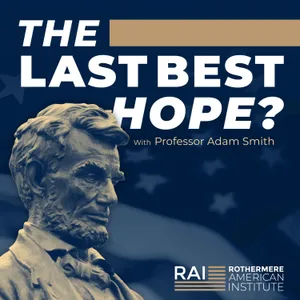
Historian and broadcaster Professor Adam Smith explores the America of today through the lens of the past. Is America - as Abraham Lincoln once claimed - the last best hope of Earth?Produced by Oxford University’s world-leading Rothermere American Institute, each story-filled episode looks at the US from the outside in – delving into the political events, conflicts, speeches and songs that have shaped and embodied the soul of a nation.From the bloody battlefields of Gettysburg to fake news and gun control, Professor Smith takes you back in time (and sometimes on location) to uncover fresh insights and commentary from award-winning academics and prominent public figures.Join us as we ask: what does the US stand for – and what does this mean for us all? Hosted on Acast. See <a style='color:grey;' target='_blank' rel='noopener nore
Customized Recaps
AI-powered recaps with compact key takeaways, quotes, and insights.
Straight to Your Inbox
Get key takeaways from The Last Best Hope? in a 5-minute read.
Save Hours Every Week
Stay current on your favorite podcasts without falling behind.
Frequently Asked Questions
What is Podzilla's The Last Best Hope? daily summary?
It's a free AI-powered email that summarizes new episodes of The Last Best Hope? as soon as they're published. You get the key takeaways, notable quotes, and links & mentions — all in a quick read.
How does the The Last Best Hope? podcast summary work?
When a new episode drops, our AI transcribes and analyzes it, then generates a personalized summary tailored to your interests and profession. It's delivered to your inbox every morning.
Is this an official The Last Best Hope? product?
No. Podzilla is an independent service that summarizes publicly available podcast content. We're not affiliated with or endorsed by Adam Smith.
Can I get summaries of other podcasts too?
Absolutely! The free plan covers up to 3 podcasts. Upgrade to Pro for 15, or Premium for 50. Browse our full catalog at /podcasts.
How often does The Last Best Hope? release new episodes?
The Last Best Hope? publishes weekly. Our AI generates a summary within hours of each new episode.
What topics does The Last Best Hope? cover?
The Last Best Hope? covers topics including History, Arts. Our AI identifies the specific themes in each episode and highlights what matters most to you.
Start getting The Last Best Hope? summaries tomorrow morning.
Free forever for up to 3 podcasts. No credit card required.
Free forever for up to 3 podcasts. No credit card required.