Free Daily Podcast Summary
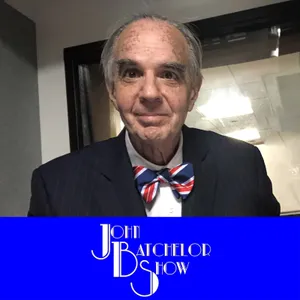
The John Batchelor Show: Daily Summaries Delivered
by John Batchelor
The John Batchelor Show is a hard news-analysis radio program on current events, world history, global politics and natural sciences. Based in New York City for two decades, the show has travelled widely to report, from the Middle East to the South Caucasus to the Arabian Peninsula and East Asia.
Latest Episodes
The most recent episodes — sign up to get AI-powered summaries of each one.
- Today5 min
3. England Reaches Top T20 Cricket Ranking - JEREMY ZAKIS
1920 LEONARD BATESEngland Reaches Top T20 Cricket RankingOld Trafford, securing the number one world ranking. Though pundits expected Sri Lanka to win, England dominated using highly aggressive "Bazball" tactics. Named after coach Brendon McCullum, Bazball emphasizes rapid, high-energy offensive gameplay, hitting balls over boundaries, bowling fast, and applying psychological pressure on opponents to disrupt traditional strategy. While physically demanding over long matches, this strategy has proven highly effective in short-format T20 games. Although Australian T20 performance currently lags behind, England's bold tactical style receives notable praise from local cricket supporters today. (3)
- Today13 min
2. Early Snake Activity Spike Across Australia - JEREMY ZAKIS
AUSTRALIA SNAKES.Early Snake Activity Spike Across AustraliaJeremy Zakis reports venomous snakes have emerged a month earlier than expected, with Brisbane becoming a major epicenter. A young boy notably relocated a python off a public path, illustrating increased public comfort with reptile encounters due to extensive school education and media warnings. Snakes often enter homes seeking dry warmth, squeeze through narrow cracks, and nest near soft plush toys. Because brown snakes live in family units within a one-mile radius, nearby family members usually remain close. Queensland's humid weather encourages indoor sightings compared to Sydney. Meanwhile, intense suburban bird dogfights break out between aggressive local cockatoos, magpies, and miner birds. (2)
- Today9 min
1. Australian EL NINO Forecast Growing Uncertainty - JEREMY ZAKIS
1936 SPAINAustralian Weather Forecast Signals Growing UncertaintyJeremy Zakis reports Australia's Bureau of Meteorology has revised its El Niño forecast from catastrophic to significantly milder. The primary ocean warming is positioned further east toward the Americas, while the Indian Ocean Dipole delivers unexpected moisture from the west. This atmospheric moisture counterbalances dry conditions, potentially bringing heavier spring rainfall across the continent. However, early bushfire alerts remain active, particularly in the Northern Territory. Emerging spring storms may trigger lightning strikes on dry undergrowth, creating heightened fire hazards. Despite unpredictable long-term climate models, current weather in New South Wales remains warm, clear, and ideal for popular local weekend beach outings right now. (1)
- Yesterday37 min
2. Peaceful Bloodless Transfer Creates New York - RUSSELL-SHORTO
Peaceful Bloodless Transfer Creates New YorkRussell Shorto, Part Two: Shorto describes the diplomatic negotiations between Richard Nicolls and Peter Stuyvesantin August 1664. Prioritizing the welfare of the colony and its inhabitants over bloodshed, Stuyvesant agreed to the Articles of Capitulation, resulting in a peaceful merger rather than a violent conquest. The English renamed the settlement New York, retaining control through the 1667 Treaty of Breda. Shorto notes the historical irony that while England captured New Amsterdam, Dutch financial systems, tolerance, and commercial practices deeply influenced the British Empire, culminating in the 1688 Glorious Revolution when Dutch leader William of Orange assumed the English throne. (2)
- Yesterday37 min
1. English Fleet Threatens Dutch New Amsterdam - RUSSELL-SHORTO
1636 NEW AMSTERDAMEnglish Fleet Threatens Dutch New AmsterdamRussell Shorto, Part One: Shorto explores the 1664 confrontation between English forces and Dutch New Netherland. Royalist officer Richard Nicolls was dispatched with four warships by James, Duke of York, to capture the colony and assert royal authority over New England Puritans. Shorto highlights the diverse, polyglot population of New Amsterdam, including freed African landowner Dorothea Angola and early French settlers Catalina Trico and Joris Rapalje. Director-General Peter Stuyvesant rushed back to defend Manhattan upon learning of the approaching English fleet, setting the stage for a tense standoff framed by the legacy of the English Civil War. (1)
- Yesterday37 min
2. ANALYZING Putinism And Preserving Democratic Power - MICHAEL MCFAUL
1800 KREMLINAnalyzing Putinism And Preserving Democratic PowerMichael McFaul, Part Two: McFaul analyzes Vladimir Putin's aggressive, anti-Western ideology, characterizing Putin as a risktaker who expanded conflict through invasions in Georgia, Crimea, and Ukraine. McFaul contends that Western nations made strategic errors by failing to impose sufficient deterrence and expanding NATO earlier. To counter rising global autocracy, he advocates maintaining peace through military strength, upholding human rights, and reinforcing democratic alliances. McFaul emphasizes that democratic nations maintain superior economic, military, and ideational advantages over autocratic regimes, urging domestic political reform, smart immigration policies, and international support to help Ukraine succeed. (2)
- Yesterday37 min
1. Cold War Lessons And Russian Collapse - MICHAEL MCFAUL
1871 FRANCO PRUSSIA WAR Cold War Lessons And Russian CollapseMichael McFaul, author of Autocrats vs. Democrats: China, Russia, America, and the New Global Disorder, Part One: Former ambassador McFaul examines global superpower dynamics, drawing lessons from critical Cold War events like the 1962 Cuban Missile Crisis. He contrasts the capabilities of the Soviet Union with the revolutionary ideological drive of Maoist China. Reflecting on the 1989 Tiananmen Square crackdown, McFaul critiques American policy for prioritizing economic engagement over human rights principles. Having witnessed the street-level democratic revolution in Moscow in 1990 and 1991, McFaul argues that the United States correctly engaged with Boris Yeltsin but failed to make long-term economic and political investments to consolidate Russian democratic institutions. (1)
- Yesterday45 min
French Resistance Operates From Hotel Lutetia - Jane Rogoyska Part 2
French Resistance Operates From Hotel LutetiaJane Rogoyska, Part Two: As Nazi forces occupied France in 1940, refugees in Marseilles sought escape routes across the Pyrenees into neutral Spain. While writer Heinrich Mann successfully escaped with assistance from American Varian Fry, philosopher Walter Benjamin committed suicide after being denied entry at the Spanish border. In Paris, writer Samuel Beckett joined the French Resistance, which faced infiltration from Abwehr officers operating out of the Hôtel Lutetia and double agents like priest Robert Alesch. Following the 1944 liberation of Paris, the Hôtel Lutetia was transformed into a reception center processing returning concentration camp survivors. (2)
Get The John Batchelor Show summaries in your inbox
Free AI-powered daily recaps. Key takeaways, quotes, and mentions — in a 5-minute read.
Get Free Summaries →Free forever for up to 3 podcasts. No credit card required.
You Might Also Like
Listeners also like.

The Real Story
Experts and decision makers analyze and debate major news stories.

One Decision
Former intelligence leaders and journalists examine high-stakes decisions that shaped global events.

In the Room with Peter Bergen
Peter Bergen examines global news stories through interviews with experts and firsthand reporting on national security, technology, and conflict.

Global News Podcast
A twice-daily news podcast delivering global headlines and analysis on politics, economics, climate, business, technology, and health.
Ukrainecast
A BBC podcast investigating the war in Ukraine through on-the-ground stories, expert analysis, and high-level interviews.

The Global Story
A daily look at global politics, business, and foreign policy through the lens of US decisions and their worldwide impact.

NatSec Matters
Former national security officials interview top leaders on critical security challenges and U.S. policy responses.

The Team House
Deep-dive conversations on national security with special operations veterans, intelligence professionals, and frontline reporters.

Global Security Briefing
Experts analyze global security challenges and international defense policies, with a focus on the UK, Indo-Pacific, and Gulf regions.
The History Podcast
Two men from Nottingham find themselves on opposing sides of the conflict in Ukraine.

The Dan Bongino Show
A former Secret Service agent analyzes politics and culture with a focus on constitutional rights and government accountability.

Mo News
Daily news coverage with analysis, interviews, and listener Q&A on global headlines from Mosheh Oinounou and Jill Wagner.
About The John Batchelor Show
The John Batchelor Show is a hard news-analysis radio program on current events, world history, global politics and natural sciences. Based in New York City for two decades, the show has travelled widely to report, from the Middle East to the South Caucasus to the Arabian Peninsula and East Asia.
Customized Recaps
AI-powered recaps with compact key takeaways, quotes, and insights.
Straight to Your Inbox
Get key takeaways from The John Batchelor Show in a 5-minute read.
Save Hours Every Week
Stay current on your favorite podcasts without falling behind.
Frequently Asked Questions
What is Podzilla's The John Batchelor Show daily summary?
It's a free AI-powered email that summarizes new episodes of The John Batchelor Show as soon as they're published. You get the key takeaways, notable quotes, and links & mentions — all in a quick read.
How does the The John Batchelor Show podcast summary work?
When a new episode drops, our AI transcribes and analyzes it, then generates a personalized summary tailored to your interests and profession. It's delivered to your inbox every morning.
Is this an official The John Batchelor Show product?
No. Podzilla is an independent service that summarizes publicly available podcast content. We're not affiliated with or endorsed by John Batchelor.
Can I get summaries of other podcasts too?
Absolutely! The free plan covers up to 3 podcasts. Upgrade to Pro for 15, or Premium for 50. Browse our full catalog at /podcasts.
How often does The John Batchelor Show release new episodes?
The John Batchelor Show publishes daily. Our AI generates a summary within hours of each new episode.
What topics does The John Batchelor Show cover?
The John Batchelor Show covers topics including News, Arts, Books, Culture, Society & Culture. Our AI identifies the specific themes in each episode and highlights what matters most to you.
Start getting The John Batchelor Show summaries tomorrow morning.
Free forever for up to 3 podcasts. No credit card required.
Free forever for up to 3 podcasts. No credit card required.