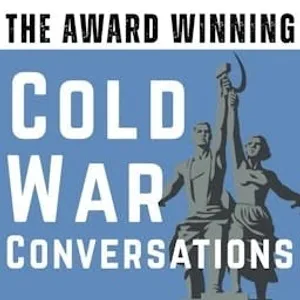
Free Daily Podcast Summary
Cold War Conversations - "vivid & compelling" The NY Times: Daily Summaries Delivered
by Ian Sanders
Experience the Cold War like never before with Cold War Conversations — an award-winning podcast recommended by The New York Times. Each week, host Ian Sanders brings you raw, firsthand accounts from the people who lived through one of history’s most tense and transformative eras — soldiers, spies, civilians, and more. These aren’t stories from textbooks. They’re unfiltered voices from the frontlines of history — emotional, gripping, and deeply human. This is Cold War history, told from the inside out. We cover subjects such as spies, spying, the Iron Curtain, nuclear weapons, warfare, tanks, jet aircraft, fighters, bombers, transport aircraft, aviation, culture, and politics. We also cover personalities such as Fidel Castro, JFK, Ronald Reagan, Nikita Khrushchev, Leonid Brezhnev, Yuri Andropov, Mikhail Gorbachev, Konstantin Chernenko, Margaret Thatcher, John F. Kennedy.
Latest Episodes
The most recent episodes — sign up to get AI-powered summaries of each one.
- 2 days ago1h 8m
Growing Up Under Communism on Cold War Poland’s Baltic Coast (474)
Bogdan was born just a month before the Berlin Wall went up—and left communist Poland a month before it came down. In between lay a childhood shaped by shortages, censorship, compulsory conformity and a growing determination to escape. Raised in Słupsk, a formerly German city near the Baltic coast, Bogdan remembers crowded post-war housing, Saturday school, packed Catholic churches and a world where bananas, meat and even bicycles depended on contacts and barter. His family carried deeper scars: wartime forced labour, a father shot while fleeing captivity, and an uncle whose unexpected return from Britain reunited relatives separated for decades. Yet everyday life also brought football, music lessons, Western films and quiet mockery of a system few truly believed. Convinced that shipbuilding offered a route abroad, Bogdan entered university—and found himself at the Gdańsk shipyard in August 1980, just as Lech Wałęsa and Solidarity changed Poland forever before his eyes. Buy the book and support the podcast here https://amzn.to/4y3dlLC Curated episode extras https://coldwarconversations.com/episode474 Bogdan's website & other book purchase options https://www.bogdanmarzewski.com/book Help me preserve Cold War history via a simple monthly donation, You’ll become part of our community, get ad-free episodes, receive a sought-after CWC coaster as a thank-you, and bask in the warm glow of knowing you are helping to preserve Cold War history. Just go to https://coldwarconversations.com/donate/ If a monthly contribution is not your cup of tea, we also welcome one-off tips via the same link. Find the ideal gift for the Cold War enthusiast in your life! Just go to https://coldwarconversations.com/store/ CONTINUE THE COLD WAR CONVERSATION o BlueSky https://bsky.app/profile/coldwarpod.bsky.social o Threads https://www.threads.net/@coldwarconversations o Twitter/X https://twitter.com/ColdWarPod o Facebook https://www.facebook.com/groups/coldwarpod/ o Instagram https://www.instagram.com/coldwarconversations/ o Youtube https://youtube.com/@ColdWarConversations Learn more about your ad choices. Visit podcastchoices.com/adchoices
- 1 weeks ago47 min
If the Soviets Invaded : Sweden's Secret Underground Resistance Plan (473)
For decades, ordinary Swedes secretly prepared for the day Soviet forces might occupy their country. Farmers, factory workers, gamekeepers and travelling salesmen were recruited into a clandestine resistance network, trained to operate radios, use dead drops, scout escape routes and, if necessary, sabotage an invading army. Historian Johan Wennström joins me to reveal the extraordinary story behind Sweden’s Stay Behind organisation. He explains why officially neutral Sweden quietly collaborated with MI6, the CIA and NATO, how the organisation preserved its secrecy, and why the royal family and government might have fled to Britain. We hear of mysterious Sunday walks, ammunition delivered to railway stations, aerial “elk surveys” concealing reconnaissance missions and the cyanide capsules for use if an operative was captured. It is a gripping account of patriotism, secrecy and sacrifice—and of hundreds of volunteers who carried the burden of a war that, thankfully, never came to Sweden. Buy the book and support the podcast here https://amzn.to/4gJADz2 Curated episode extras https://coldwarconversations.com/episode473/ Swedish Fighter pilot episode https://coldwarconversations.com/episode386/ Help me preserve Cold War history via a simple monthly donation, You’ll become part of our community, get ad-free episodes, receive a sought-after CWC coaster as a thank-you, and bask in the warm glow of knowing you are helping to preserve Cold War history. Just go to https://coldwarconversations.com/donate/ If a monthly contribution is not your cup of tea, we also welcome one-off tips via the same link. Find the ideal gift for the Cold War enthusiast in your life! Just go to https://coldwarconversations.com/store/ CONTINUE THE COLD WAR CONVERSATION o BlueSky https://bsky.app/profile/coldwarpod.bsky.social o Threads https://www.threads.net/@coldwarconversations o Twitter/X https://twitter.com/ColdWarPod o Facebook https://www.facebook.com/groups/coldwarpod/ o Instagram https://www.instagram.com/coldwarconversations/ o Youtube https://youtube.com/@ColdWarConversations Learn more about your ad choices. Visit podcastchoices.com/adchoices
- 2 weeks ago1h 7m
Bandit Country - The IRA and South Armagh (472)
During the Cold War, British soldiers fought a Provisional IRA insurgency in Northern Ireland. Probably the toughest location was South Armagh, where they had to travel by helicopter, while watchtowers scanned the fields, and an IRA sniper could strike without warning. In this episode, journalist and Royal Navy officer Toby Harnden takes us inside his book “Bandit Country”, which describes the borderland of South Armagh where the Provisional IRA fought one of its most formidable campaigns. Harnden recalls arriving during the uneasy peace of 1996, meeting IRA members and security personnel, and learning how family ties, local knowledge and the Irish border made the South Armagh Brigade unusually effective. We explore its sniper teams, homemade mortars, intelligence networks, the massive London & Manchester attacks, Libyan weapons and attempts to bring down British helicopters. Harnden also examines the Kingsmill massacre, the devastating 1979 Warrenpoint ambush, alleged Garda collusion, and the British Army’s deployment of the SAS. Finally, he reveals the brigade’s scepticism towards the Good Friday Agreement—and asks whether the old republican flame still burns beneath South Armagh’s landscape today. Buy the book and support the podcast here https://amzn.to/45GF60h Curated episode extras https://coldwarconversations.com/episode472/ Help me preserve Cold War history via a simple monthly donation, You’ll become part of our community, get ad-free episodes, receive a sought-after CWC coaster as a thank-you, and bask in the warm glow of knowing you are helping to preserve Cold War history. Just go to https://coldwarconversations.com/donate/ If a monthly contribution is not your cup of tea, we also welcome one-off tips via the same link. Find the ideal gift for the Cold War enthusiast in your life! Just go to https://coldwarconversations.com/store/ CONTINUE THE COLD WAR CONVERSATION o BlueSky https://bsky.app/profile/coldwarpod.bsky.social o Threads https://www.threads.net/@coldwarconversations o Twitter/X https://twitter.com/ColdWarPod o Facebook https://www.facebook.com/groups/coldwarpod/ o Instagram https://www.instagram.com/coldwarconversations/ o Youtube https://youtube.com/@ColdWarConversations Learn more about your ad choices. Visit podcastchoices.com/adchoices
- 3 weeks ago1h 23m
A Czech Border Guard’s Daring Escape to the West (471)
What happens when the man guarding the Iron Curtain decides to escape through it himself? In 1975, Jiří Barteček was a Czechoslovak border guard, trained to track fugitives with a German shepherd and ordered to stop anyone attempting to reach Austria. Yet Jiří had no intention of defending the communist system. Haunted by the Soviet-led invasion of 1968 and determined never to shoot an innocent person, he secretly studied the border’s weaknesses and planned an audacious escape. One night, accompanied by two friends and carrying his AK-47, he disabled the alarm, slipped beneath the wire and plunged into a river crossing. His ordeal did not end in the West. After days hiding around Vienna, Jiří entered an Austrian refugee camp—where an unknown gunman twice tried to kill him. This is a story of courage, chance and survival, told by the border guard who turned the Iron Curtain against itself. Curated episode extras https://coldwarconversations.com/episode471 Help me preserve Cold War history via a simple monthly donation, You’ll become part of our community, get ad-free episodes, receive a sought-after CWC coaster as a thank-you, and bask in the warm glow of knowing you are helping to preserve Cold War history. Just go to https://coldwarconversations.com/donate/ If a monthly contribution is not your cup of tea, we also welcome one-off tips via the same link. Find the ideal gift for the Cold War enthusiast in your life! Just go to https://coldwarconversations.com/store/ CONTINUE THE COLD WAR CONVERSATION o BlueSky https://bsky.app/profile/coldwarpod.bsky.social o Threads https://www.threads.net/@coldwarconversations o Twitter/X https://twitter.com/ColdWarPod o Facebook https://www.facebook.com/groups/coldwarpod/ o Instagram https://www.instagram.com/coldwarconversations/ o Youtube https://youtube.com/@ColdWarConversations Learn more about your ad choices. Visit podcastchoices.com/adchoices
- Aug 21, 202654 min
Twenty-Six Years Apart: A Family Reunited Behind the Iron Curtain (470)
For twenty-six years, war, exile and the Iron Curtain kept one Polish family apart. Torn from his homeland and sent into Stalin’s labour camp system, Aleksander Jablonski survived hunger, forced labour and a wartime journey through Russia, Iran and Italy before fighting at Monte Cassino. When the war ended, returning to communist Poland was impossible. He built a new life in Britain, but the family he had left behind remained painfully out of reach. Then, after more than a quarter of a century, came the chance to cross back behind the Iron Curtain. In this moving episode, his daughters tell a story of separation, survival and a reunion in communist Poland. It is also the story of a Polish community in Britain, the children who inherited its memories, and the enduring pull of a homeland that distance, politics and time could never entirely erase. Additional thanks to Stefan Hales-Józefczyk and the Leek Polish Connection for welcoming me into their group and allowing me to record this story. Curated episode extras https://coldwarconversations.com/episode470 Help me preserve Cold War history via a simple monthly donation, You’ll become part of our community, get ad-free episodes, receive a sought-after CWC coaster as a thank-you, and bask in the warm glow of knowing you are helping to preserve Cold War history. Just go to https://coldwarconversations.com/donate/ If a monthly contribution is not your cup of tea, we also welcome one-off tips via the same link. Find the ideal gift for the Cold War enthusiast in your life! Just go to https://coldwarconversations.com/store/ CONTINUE THE COLD WAR CONVERSATION o BlueSky https://bsky.app/profile/coldwarpod.bsky.social o Threads https://www.threads.net/@coldwarconversations o Twitter/X https://twitter.com/ColdWarPod o Facebook https://www.facebook.com/groups/coldwarpod/ o Instagram https://www.instagram.com/coldwarconversations/ o Youtube https://youtube.com/@ColdWarConversations Learn more about your ad choices. Visit podcastchoices.com/adchoices
- Aug 19, 20260 min
Announcing Cold War Conversations History Tours
I’m delighted to tell you about Cold War Conversations History Tours I'm exploring the idea of hosting a Cold War history tour via a specialist tour company, and I'd like your help working out what it should be. There are several directions it could take, and your answers will shape the plan. There’s a short survey which should take about 5 minutes. Here's the link https://survey.chasehistorytours.com/coldwar As a thank you, those who complete the survey will be eligible for a discount if a tour is announced (please provide your email at the end). Thanks for listening and supporting the podcast. Learn more about your ad choices. Visit podcastchoices.com/adchoices
- Aug 14, 202650 min
Between Two Air Forces: From East German Officer to German Captain (469)
After German reunification, former East German Air Force officer Roland faced an extraordinary transformation: joining the military alliance he had once been trained to fight. Roland recounts his difficult passage from the East German military into the Bundeswehr. His experience, qualifications and years of service suddenly counted for less. Having been a member of the Communist Party, he endured intensive screening, as well as a reduction in rank, lower pay than western colleagues and long separations from his family. Some new comrades welcomed him; others regarded him with suspicion, prejudice and open hostility. Yet Roland was determined to prove that professionalism could survive the collapse of the country he had served. From working with Mi-8 helicopters to supporting Germany’s inherited MiG-29 fleet, he rebuilt his career inside a radically different military culture. This is a revealing story of reunification from inside the armed forces—and of one former “enemy” confronting divided loyalties, institutional mistrust and the challenge of beginning again. Special thanks to Witali Gerber, military historian and curator at the Militärhistorisches Museum der Bundeswehr, for his assistance in arranging this interview. Curated episode extras https://coldwarconversations.com/episode469/ Help me preserve Cold War history via a simple monthly donation, You’ll become part of our community, get ad-free episodes, receive a sought-after CWC coaster as a thank-you, and bask in the warm glow of knowing you are helping to preserve Cold War history. Just go to https://coldwarconversations.com/donate/ If a monthly contribution is not your cup of tea, we also welcome one-off tips via the same link. Find the ideal gift for the Cold War enthusiast in your life! Just go to https://coldwarconversations.com/store/ CONTINUE THE COLD WAR CONVERSATION o BlueSky https://bsky.app/profile/coldwarpod.bsky.social o Threads https://www.threads.net/@coldwarconversations o Twitter/X https://twitter.com/ColdWarPod o Facebook https://www.facebook.com/groups/coldwarpod/ o Instagram https://www.instagram.com/coldwarconversations/ o Youtube https://youtube.com/@ColdWarConversations Learn more about your ad choices. Visit podcastchoices.com/adchoices
- Aug 7, 202644 min
MiGs, Helicopters and Ideology: Life as an East German Air Force Officer (468)
What did it mean to train as an officer in the East German Air Force, where technical skill, military discipline and socialist ideology were inseparable? Roland recalls his journey into the air arm of the Nationale Volksarmee, from dreams of flying MiG fighters to the demanding realities of officer training and service with Mi-8 helicopters. He describes the long days, intensive political instruction and constant expectation that war with NATO could erupt at any moment. Behind the impressive aircraft and tightly controlled military routines lay a system shaped by loyalty, surveillance and pressure to conform. Yet everyday life also depended on friendship, professionalism and the determination to keep complex Soviet-built machines flying. Roland offers a rare first-hand view inside one of the Warsaw Pact’s most secretive forces, revealing how young East Germans were prepared to defend the GDR—and what happened when Gorbachev’s reforms and growing unrest began to challenge everything they had been taught. You’ll have to tune in next week for Roland’s experiences as East Germany implodes and his subsequent service in the Bundeswehr. Special thanks to Witali Gerber, military historian and curator at the Militärhistorisches Museum der Bundeswehr, for his assistance in arranging this interview. Curated episode extras https://coldwarconversations.com/episode468/ Help me preserve Cold War history via a simple monthly donation, You’ll become part of our community, get ad-free episodes, receive a sought-after CWC coaster as a thank-you, and bask in the warm glow of knowing you are helping to preserve Cold War history. Just go to https://coldwarconversations.com/donate/ If a monthly contribution is not your cup of tea, we also welcome one-off tips via the same link. Find the ideal gift for the Cold War enthusiast in your life! Just go to https://coldwarconversations.com/store/ CONTINUE THE COLD WAR CONVERSATION o BlueSky https://bsky.app/profile/coldwarpod.bsky.social o Threads https://www.threads.net/@coldwarconversations o Twitter/X https://twitter.com/ColdWarPod o Facebook https://www.facebook.com/groups/coldwarpod/ o Instagram https://www.instagram.com/coldwarconversations/ o Youtube https://youtube.com/@ColdWarConversations Learn more about your ad choices. Visit podcastchoices.com/adchoices
Get Cold War Conversations - "vivid & compelling" The NY Times summaries in your inbox
Free AI-powered daily recaps. Key takeaways, quotes, and mentions — in a 5-minute read.
Get Free Summaries →Free forever for up to 3 podcasts. No credit card required.
You Might Also Like
Listeners also like.
The Rest Is Classified
Former CIA analyst David McCloskey and journalist Gordon Corera examine real espionage cases and intelligence operations from the Cold War to present.

The Bomb
A historical narrative of nuclear weapons' impact, focusing on key figures, espionage, and Cold War crises.

The Spy Who
Real spy stories from intelligence operatives who risked everything in high-stakes missions for national or personal interests.
School of War
Discussions with military leaders, policymakers, and historians on the strategy, history, and consequences of war.

One Decision
Former intelligence leaders and journalists examine high-stakes decisions that shaped global events.

American History Tellers
Pivotal moments in American history are explored through narrative storytelling, revealing their impact on the nation and modern life.
Witness History
First-hand accounts of pivotal historical moments, from global events to cultural milestones, told by those who lived them.
WW2 Pod: We Have Ways of Making You Talk
A comedian and historian explore World War II through detailed analysis, personal stories, and dark humor.

The Real Story
Experts and decision makers analyze and debate major news stories.
Svetlana! Svetlana!
A playwright investigates the bizarre post-defection life of Joseph Stalin’s daughter in America.

In the Room with Peter Bergen
Peter Bergen examines global news stories through interviews with experts and firsthand reporting on national security, technology, and conflict.

Cool People Who Did Cool Stuff
Revolutions, rebellions, and resistance movements throughout history, told through the stories of the people who lived them.
About Cold War Conversations - "vivid & compelling" The NY Times
Experience the Cold War like never before with Cold War Conversations — an award-winning podcast recommended by The New York Times. Each week, host Ian Sanders brings you raw, firsthand accounts from the people who lived through one of history’s most tense and transformative eras — soldiers, spies, civilians, and more. These aren’t stories from textbooks. They’re unfiltered voices from the frontlines of history — emotional, gripping, and deeply human. This is Cold War history, told from the inside out. We cover subjects such as spies, spying, the Iron Curtain, nuclear weapons, warfare, tanks, jet aircraft, fighters, bombers, transport aircraft, aviation, culture, and politics. We also cover personalities such as Fidel Castro, JFK, Ronald Reagan, Nikita Khrushchev, Leonid Brezhnev, Yuri Andropov, Mikhail Gorbachev, Konstantin Chernenko, Margaret Thatcher, John F. Kennedy.
Customized Recaps
AI-powered recaps with compact key takeaways, quotes, and insights.
Straight to Your Inbox
Get key takeaways from Cold War Conversations - "vivid & compelling" The NY Times in a 5-minute read.
Save Hours Every Week
Stay current on your favorite podcasts without falling behind.
Frequently Asked Questions
What is Podzilla's Cold War Conversations - "vivid & compelling" The NY Times daily summary?
It's a free AI-powered email that summarizes new episodes of Cold War Conversations - "vivid & compelling" The NY Times as soon as they're published. You get the key takeaways, notable quotes, and links & mentions — all in a quick read.
How does the Cold War Conversations - "vivid & compelling" The NY Times podcast summary work?
When a new episode drops, our AI transcribes and analyzes it, then generates a personalized summary tailored to your interests and profession. It's delivered to your inbox every morning.
Is this an official Cold War Conversations - "vivid & compelling" The NY Times product?
No. Podzilla is an independent service that summarizes publicly available podcast content. We're not affiliated with or endorsed by Ian Sanders.
Can I get summaries of other podcasts too?
Absolutely! The free plan covers up to 3 podcasts. Upgrade to Pro for 15, or Premium for 50. Browse our full catalog at /podcasts.
How often does Cold War Conversations - "vivid & compelling" The NY Times release new episodes?
Cold War Conversations - "vivid & compelling" The NY Times publishes weekly. Our AI generates a summary within hours of each new episode.
What topics does Cold War Conversations - "vivid & compelling" The NY Times cover?
Cold War Conversations - "vivid & compelling" The NY Times covers topics including History, Documentary, Culture, Society & Culture. Our AI identifies the specific themes in each episode and highlights what matters most to you.
Start getting Cold War Conversations - "vivid & compelling" The NY Times summaries tomorrow morning.
Free forever for up to 3 podcasts. No credit card required.
Free forever for up to 3 podcasts. No credit card required.