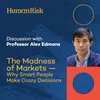
Professor Alex Edmans on the Madness of Markets — Why Smart People Make Crazy Decisions
What can financial markets teach us about human behaviour? Why might the size of a CEO’s signature tell us something useful about the company they run? And why, even when smart investors know something is probably a bubble, might they keep investing anyway?Episode SummaryMy guest on this episode is Professor Alex Edmans, who returns to the show to discuss his new book, The Madness of Markets: Why Smart Investors Make Crazy Decisions and How to Exploit Them. As the title suggests, this is a book about financial markets. But our conversation is really about something much broader: human behaviour.Markets ought to be places where irrationality gets eliminated. They contain millions of participants, huge amounts of data and some of the smartest and best-paid people in the world. Yet people still overreact, follow the herd, become overconfident, refuse to admit mistakes and pay attention to things that shouldn't matter.Alex explains why that happens and what it can teach us about decision-making beyond investing.We explore why seemingly trivial information can move markets, the fine line between conviction and delusion, and why information that's hiding in plain sight can sometimes tell us more than sophisticated financial analysis. Alex share why corporate jets, unusual locations for shareholder meetings and even the size of a CEO's signature can offer clues about how a company is run.We also discuss information overload and our preference for things we can measure, why more disclosure isn't necessarily better disclosure, and how organisations can exploit the limits of human attention — including the strategic release of bad news on Friday afternoons.He also considers the impact of AI; machines can process enormous quantities of quantitative information without some of our human biases, but qualitative judgements about character, culture and trustworthiness may still require people. The future, Alex argues, isn't necessarily human or machine, but human and machine. Along the way, we explore bubbles, loss aversion, sunk costs, incentives in investment banking, financial literacy and regulation. And, ultimately, we return to a simple idea: markets behave irrationally because they're made up of human beings.Guest BiographyAlex Edmans is Professor of Finance at London Business School, an author, speaker and expert on behavioural finance, responsible business and corporate governance. Before entering academia, Alex worked in investment banking at Morgan Stanley. His research has been widely published, and he has won numerous awards for teaching. His previous books include Grow the Pie and May Contain Lies, the latter of which was the subject of his previous appearance on the podcast.LinksAlex Edmans' website: https://alexedmans.com/Alex Edmans on LinkedIn: https://www.linkedin.com/in/aedmans/The Madness of Markets: https://www.penguinrandomhouse.com/books/821903/the-madness-of-markets-by-alex-edmans/Alex's previous appearance on the show — Professor Alex Edmans on Misinformation: https://www.humanriskpodcast.com/professor-alex-edmans-on-misinformation/AI-Generated Timestamped Summary[00:00:00] Introduction — what financial markets can teach us about human behaviour[00:01:45] Why Alex wrote The Madness of Markets and why markets are driven by psychology as well as economics[00:03:15] Markets as a laboratory for human behaviour — if millions of investors can get things wrong, what does that tell us about small groups making decisions?[00:04:40] Three types of mistakes: overreaction, underreaction and focusing on the wrong information[00:06:20] Loss aversion and the sunk cost fallacy — why admitting a previous decision was wrong is so difficult[00:07:20] Combining memorable anecdotes with large-scale evidence, from Isaac Newton to market bubbles[00:08:45] Why highly intelligent and sophisticated investors still make systematic mistakes[00:10:40] Finding signals in unexpected places — why more data isn't necessarily better data[00:12:20] What corporate jets, remote shareholder meetings, CEO photographs and signature sizes might reveal about leadership[00:14:00] Information hiding in plain sight and how Alex's collection of unusual academic research became a book<br
Podzilla Summary coming soon
Sign up to get notified when the full AI-powered summary is ready.
Free forever for up to 3 podcasts. No credit card required.
Listen to This Episode
More from The Human Risk Podcast
Lyndon Nelson & Gavin Stewart on Building Better Regulators
Roger Dooley on The Persuasion Engine

Annie Wagstaff on The Joy of Curiosity
Paul Craven on Living With Uncertainty
Get summaries like this every morning.
Free AI-powered recaps of The Human Risk Podcast and your other favorite podcasts, delivered to your inbox.
Free forever for up to 3 podcasts. No credit card required.