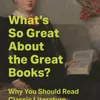
Welcome back to The Honest Broker interview series—also available on our new YouTube channel. You can also find it on Apple Podcasts and other podcasting platforms.Today, I’m pleased to share my conversation with Naomi Kanakia. Please support The Honest Broker by taking out a premium subscription (just $6 per month).Naomi is a writer. She’s published four novels, and her next book, What’s So Great About the Great Books?, will be released in May by Princeton University Press. She also writes the wonderful Woman of Letters newsletter here on Substack, and she is working on a short story collection to be published by Random House. I had the pleasure of reading What’s So Great About the Great Books? last year, and here’s what I wrote for the blurb:If you've ever wanted to read the Great Books, or ever wondered why you should, this is the book for you. Personal, humorous, and intimate, What’s So Great About the Great Books? gives us a great gift: a grounded guide to the classics, and a new standard for introducing these books to modern readers.In our conversation, we covered a range of topics, including why she wanted to write about the Great Books, why she decided to read them in the first place, and her struggles (and occasional triumphs) in the publishing industry. Below are some highlights from our dialogue. For the full conversation, check out the video at the top of the page.Highlights from the Naomi Kanakia InterviewJared: Naomi Kanakia, thank you for joining me. Naomi: Thanks for having me. Jared: You’re writing a book about the classics, which will be published by Princeton University Press. Tell me a little bit about what made you want to dedicate a year or two of your life to writing a book about the classics?Naomi: When I first started wanting to seriously be a writer, I decided that I should read all these great books that people always talk about. I bought a book called The New Lifetime Reading Program, I typed out the list of books recommended by this volume, and I have now spent 15 years reading through many of these books.Then, four or five years ago, I started writing some essays online, and an editor from Princeton reached out to me and asked if I wanted to do a book. At the time, I was between agents and my career prospects seemed pretty dire, and I wanted to work.I really love books about reading classics. I really like the angry polemical books, like Alan Bloom’s Closing of the American Mind, but I do feel that there’s a lot of angry polemic in this space. I felt there was room for more measured opinions, because I do think there are serious critiques to be made of the concept of reading old books. I wanted to write a book that took those concerns seriously and also had a more conversational tone. Jared: What are some of those critiques that you have in mind that you want to respond to?Naomi: A lot of books about reading classics are defenses of the humanities, or the idea that you should think deeply and love nuance. And it’s like, nobody’s against those things. The real question is: why do you have to read Milton instead of reading a modern author? Are we really saying that these old books are the best books and no modern books are good? Really, it’s a defense of a specific canon of books, and I believe that list is good and that people should read those books. Generally, it’s easier to gravitate towards the contemporary, and you have to try a little bit harder to look at these older books. But there are two major concerns. One is that older books are more difficult and more inaccessible. The other major concern is that if you’re reading older books, there will be less diversity. Jared: And despite those criticisms, you’re making an argument that it’s worth reading these old books. Naomi: Yes.Jared: I assume for part of that project, you had to go back and reread a lot of books. Was that part of the research, or was it just drawing on what you’ve been doing for the last fifteen years?Naomi: This was mostly an excuse to mentally return to a lot of my touchstones. These older books have a sense of integrity. This project w
Podzilla Summary coming soon
Sign up to get notified when the full AI-powered summary is ready.
Free forever for up to 3 podcasts. No credit card required.
Listen to This Episode



Get summaries like this every morning.
Free AI-powered recaps of The Honest Broker Podcast and your other favorite podcasts, delivered to your inbox.
Free forever for up to 3 podcasts. No credit card required.