Free Daily Podcast Summary
The History of Chemistry: Daily Summaries Delivered
by Steve Cohen
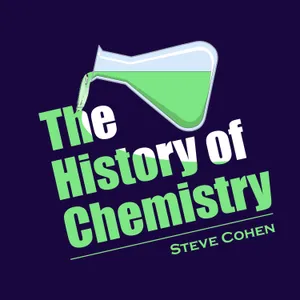
Chemistry is everywhere, and involves everything. But how did chemistry get to be what it is? I'm Steve Cohen, a chemist and writer, bringing you The History of Chemistry. This podcast explores the development of chemistry from prehistoric times to the present, including the people and societies who made chemistry what it is today. The History of Chemistry is for you, whether you hated chemistry in high school, or got a PhD in inorganic chemistry. We'll explore how chemistry affected art, music, language, politics and vice-versa. Whether it's ancient Greek philosophers, medieval alchemists, or modern laboratory apparatus, it's all here. Don't forget to support my series at https://www.patreon.com/thehistoryofchemistry !
Latest Episodes
The most recent episodes — sign up to get AI-powered summaries of each one.
- Sep 9, 202520 min
184: Alles ist Chemie (Conclusion)
I conclude this series, touching on why I ran this podcast. I give eleven overarching goals for the podcast. I also go far back into my own past, and an event which eventually led to me speaking to you about chemistry. Finally I send you off with an announcement about a national award I will accept in 2026. Please continue to support this podcast, because it costs money to keep this series posted on Buzzsprout and Patreon. Without your continued support, this podcast will disappear from the I...
- Sep 1, 202521 min
183: New World Coming
I give a brief history of finding planets around other stars, including discovery by gravitational wobbling, dimming as the planet crosses in front of its star, and even seeing an actual planetary image by blocking the star's glare. I discuss what sort of spectroscopic signals might be present for life in a planet's atmosphere. Finally I offer some planets already detected whose temperatures appear to be in the range of terrestrial life, and what's in their atmospheres. Support the show Suppo...
- Aug 22, 202521 min
182: It's Life, Jim, But Not As We Know It
We take an imaginary trip around our Solar System to hear the history of chemical attempts to find life, starting in the late 1950s. Among our stops on the tour include Venus, Mars, Europa, and Titan. Included in the tour are temperature measurements, spectroscopic views, gas chromatography, radioactive labeling, photographs, electrical conductivity, and more. Support the show Support my podcast at https://www.patreon.com/thehistoryofchemistryTell me how your life relates to chemistry! E...
- Aug 17, 202520 min
181: A Work in Progress
In which we bring research into molecular machines up to date. We discuss fuels, specifically what chemists think are the best kinds of fuels to power these little molecules. We discuss what makes a molecular machine different from a regular-sized machine. We also talk about molecular machines as a subset of "molecular devices." Finally, we mention a poll for researchers that IUPAC has set up to help chemists define what a molecular machine really is. Support the show Support my podcast at&nb...
- Aug 8, 202520 min
180: Farm to Market
Instead of just digging in the ground to extract minerals, over the past half-century scientists have begun to explore agriculture of hyperaccumulating plants to pull elements--including heavy metals--out of the topsoil. We explore the recent history of this topic, its advantages and pitfalls. Support the show Support my podcast at https://www.patreon.com/thehistoryofchemistryTell me how your life relates to chemistry! E-mail me at steve@historyofchem.comGet my book, O Mg! How Chemistry ...
- Aug 1, 202526 min
179: This Episode is Meta
The History of Chemistry is itself an academic discipline, and in this episode we explore the history of chemical history. We start with chemist Thomas Thomson, and work our way forward in time, through the various books on the subject, the founding of the History of Chemistry Section of the American Chemical Society, various chemical-history journals, the Science History Institute, and the Royal Society of Chemistry's Historical Group. Support the show Support my podcast at https://www....
- Jul 25, 202519 min
178: Honors and Awards
In which we explore the various honors and awards available to chemists, starting in high school with the International Chemistry Olympiad, founded during the Cold War; college with Phi Lambda Upsilon; and a variety of awards given to chemists during their professional careers by different chemical societies. Support the show Support my podcast at https://www.patreon.com/thehistoryofchemistryTell me how your life relates to chemistry! E-mail me at steve@historyofchem.comGet my book, O Mg...
- Jul 17, 202519 min
177: Greek Salad
In this episode we run through the Greek alphabet and see the history behind each symbol as used in chemistry, from alpha for alpha particles to omega as in omega-fatty acids. We encounter a couple of Greek letters not used as chemical symbols too. Support the show Support my podcast at https://www.patreon.com/thehistoryofchemistryTell me how your life relates to chemistry! E-mail me at steve@historyofchem.comGet my book, O Mg! How Chemistry Came to Be, from World Scientific Publishin...
Get The History of Chemistry summaries in your inbox
Free AI-powered daily recaps. Key takeaways, quotes, and mentions — in a 5-minute read.
Get Free Summaries →Free forever for up to 3 podcasts. No credit card required.
You Might Also Like
Podcasts in similar categories.
The Rest Is History
Historians Tom Holland and Dominic Sandbrook analyze major historical events and figures with narrative depth and scholarly insight.

Hidden Brain
Explores human behavior and the unconscious patterns that shape our decisions, relationships, and society through science and storytelling.
The Team House
Deep-dive conversations on national security with special operations veterans, intelligence professionals, and frontline reporters.
Something You Should Know
Expert interviews and practical tips to improve your life, career, finances, and relationships.

Inside AsembleAI: DeepTech, AI & Science
Experts discuss AI's impact on business, product development, and leadership with researchers, founders, and executives.
The Bible in a Year (with Fr. Mike Schmitz)
Fr. Mike Schmitz provides daily commentary and prayer while guiding listeners through the entire Bible in a year.
Huberman Lab
Explores neuroscience and science-based tools for understanding and improving brain function, behavior, and health.

Civics 101
Explains how U.S. government institutions and constitutional rights function in everyday life.
American Power
A geopolitical podcast examining the hidden systems—military, energy, and politics—driving global conflicts and decisions.

Big Ideas Lab
Inside Lawrence Livermore National Laboratory, uncover breakthroughs in science and technology shaping the future.
The Great Simplification with Nate Hagens
Discussions with experts on energy, ecology, economics, and human behavior to understand the systemic challenges facing civilization.
The Jordan B. Peterson Podcast
Explores how values, religion, and culture shape individuals and society through interviews and lectures.
About The History of Chemistry
Chemistry is everywhere, and involves everything. But how did chemistry get to be what it is? I'm Steve Cohen, a chemist and writer, bringing you The History of Chemistry. This podcast explores the development of chemistry from prehistoric times to the present, including the people and societies who made chemistry what it is today. The History of Chemistry is for you, whether you hated chemistry in high school, or got a PhD in inorganic chemistry. We'll explore how chemistry affected art, music, language, politics and vice-versa. Whether it's ancient Greek philosophers, medieval alchemists, or modern laboratory apparatus, it's all here. Don't forget to support my series at https://www.patreon.com/thehistoryofchemistry !
Customized Recaps
AI-powered recaps with compact key takeaways, quotes, and insights.
Straight to Your Inbox
Get key takeaways from The History of Chemistry in a 5-minute read.
Save Hours Every Week
Stay current on your favorite podcasts without falling behind.
Frequently Asked Questions
What is Podzilla's The History of Chemistry daily summary?
It's a free AI-powered email that summarizes new episodes of The History of Chemistry as soon as they're published. You get the key takeaways, notable quotes, and links & mentions — all in a quick read.
How does the The History of Chemistry podcast summary work?
When a new episode drops, our AI transcribes and analyzes it, then generates a personalized summary tailored to your interests and profession. It's delivered to your inbox every morning.
Is this an official The History of Chemistry product?
No. Podzilla is an independent service that summarizes publicly available podcast content. We're not affiliated with or endorsed by Steve Cohen.
Can I get summaries of other podcasts too?
Absolutely! The free plan covers up to 3 podcasts, any in the catalog. Basic raises that to 15, Pro to 40 and Max to 100. Browse our full catalog at /podcasts.
How often does The History of Chemistry release new episodes?
The History of Chemistry publishes weekly. Our AI generates a summary within hours of each new episode.
What topics does The History of Chemistry cover?
The History of Chemistry covers topics including Science, History, Chemistry. Our AI identifies the specific themes in each episode and highlights what matters most to you.
Start getting The History of Chemistry summaries tomorrow morning.
Free forever for up to 3 podcasts. No credit card required.
Free forever for up to 3 podcasts. No credit card required.