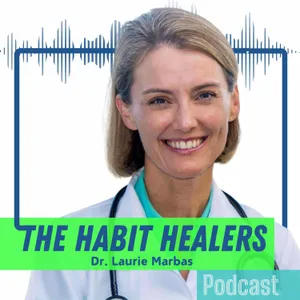
Free Daily Podcast Summary
The Habit Healers: Daily Summaries Delivered
by Laurie Marbas, MD, MBA
Welcome to The Habit Healers Podcast—where transformation starts with a single habit.Hosted by Dr. Laurie Marbas, this podcast is for anyone ready to break free from chronic health struggles, rewire their habits, and create lasting healing. Through powerful stories, science-backed strategies, and real-world tools, we dive deep into the micro shifts that lead to massive health transformations.You’ll learn how to heal beyond prescriptions—how to nourish your body, reprogram your mind, and build the habits that make vibrant health effortless. Whether you’re looking to reverse disease, boost energy, or finally make health a way of life, this podcast will show you how.Because true healing isn’t about willpower—it’s about design. And you’re always just one healing habit away. drlauriemarbas.substack.com
Latest Episodes
The most recent episodes — sign up to get AI-powered summaries of each one.
- Today11 min
Ten Places I've Watched Patients Get Stuck, and How They Got Unstuck
How do you build healthy habits that actually stick, especially if you think you’ve started too late? In this episode of The Habit Healers Podcast, I’m using a story about Julia Child to walk you through ten common habit mistakes and the simple fix for each one.Julia didn’t publish her first cookbook until she was 49. She failed her first final exam at cooking school. Then, on live-to-tape TV, she flipped a potato pancake and missed half the pan. She scooped it up and kept cooking. After more than 20 years as a lifestyle medicine physician, I’ve seen that’s exactly the skill that separates habits that last from habits that fade. You don’t have to get this perfect. You just have to keep going.We’ll talk about why starting small beats starting big, why you don’t need to wait for January, and how a simple if-then plan can carry you through your hardest moment of the day. We’ll also look at the real science on how long it takes to form a habit (spoiler: it’s not 21 days), and how poor sleep can show up as what feels like a willpower problem.What you’ll learn:* Why it’s never too late to build healthy habits, and what changed for adults who took up four of them in midlife* How to start a new habit so small it feels a little silly, and why that works* How to write if-then plans that help you eat healthier, and the one kind that backfires* How long it really takes to form a habit, and why 66 days is closer to the truth than 21* How lack of sleep drives cravings and overeating* How to get back on track after a slip without the all-or-nothing spiralDr. Marbas Substack Article: https://drlauriemarbas.substack.com/p/ten-places-ive-watched-patients-getCheck out the Habit Healers Community: https://www.skool.com/habithealers/about This is a public episode. If you'd like to discuss this with other subscribers or get access to bonus episodes, visit drlauriemarbas.substack.com/subscribe
- Yesterday30 min
How to Check How Well You're Aging in 15 Minutes Without a Lab Test or a Longevity Clinic
Healthspan vs lifespan: are you adding years to your life, or healthy years? I’m Dr. Laurie Marbas, and in this episode of The Habit Healers Podcast, I’m looking at what the science of longevity and healthy aging actually says, and what’s already within your reach.We start with Maria Branyas Morera, who lived to 117 and let scientists study her body at 116. What they found fascinated me: she was old in some places and young in others. From there, we look at biological age tests and the epigenetic clocks behind most “reverse aging” claims. We cover what trials found when people tried calorie restriction, omega-3s and rapamycin, and why nobody has yet shown that a younger test result means more healthy years. I also take an honest look at longevity escape velocity, the Netflix documentary Don’t Die, and the prediction that AI could end disease within a decade.Here’s what I want you to know: the habits with the strongest evidence for a longer healthspan cost very little, and it’s not too late to start. I’ll walk you through a simple 15-minute aging-well check you can do at home.What you’ll learn:* The difference between healthspan and lifespan, and why the U.S. has the biggest gap in the world* What biological age tests and epigenetic clocks can and can’t tell you* What human trials found about anti-aging diets, supplements and rapamycin* Why longevity escape velocity is much further away than the headlines suggest* Five healthy aging habits linked to about 10 more disease-free years for women* How to do the sit-and-rise test and the 10-second one-leg stand at homeDr. Marbas Substack Article: https://drlauriemarbas.substack.com/p/how-to-check-how-well-youre-agingCheck out the Habit Healers Community: https://www.skool.com/habithealers/about This is a public episode. If you'd like to discuss this with other subscribers or get access to bonus episodes, visit drlauriemarbas.substack.com/subscribe
- 4 days ago19 min
How to Get Strong With Push-Ups in 6 Steps, Without Starting on the Floor
Can the number of push-ups you can do say something about your heart health? On this episode of The Habit Healers Podcast, I’m unpacking the well-known firefighter push-up study, what the headlines got wrong, and how to start strength training as a beginner, at any age.I’ll tell you about one of my patients, a woman in her 60s who started with two counter push-ups and worked her way up to sixty in a few months. Her story is a perfect example of how small habits add up. Then we’ll look at what the research actually found when firefighters did push-ups during routine checkups, and why your push-up number is best used as a free, simple check on your overall fitness rather than a guarantee about heart disease risk.You’ll also learn why a push-up works like a wheelbarrow, why a raised surface can be easier than the classic knee push-up, and how bodyweight exercise at home stacks up against the bench press. I’ll walk you through a six-step plan that takes you from the wall to the floor, plus the warning signs that mean you should stop.What you’ll learn:* What the firefighter push-up test revealed about heart health, and its limits* Why strength training is linked to lower risk of heart disease, cancer, and diabetes* How to start push-ups as a beginner, from the wall, a counter, or a stair* How often to do bodyweight exercise at home for healthy aging* Good push-up form and when to stop and call your doctorDr. Marbas Substack Article: https://drlauriemarbas.substack.com/p/how-to-get-strong-with-push-ups-inCheck out the Habit Healers Community: https://www.skool.com/habithealers/about Get full access to The Habit Healers at drlauriemarbas.substack.com/subscribe
- 6 days ago27 min
If Your Fasting Glucose Is Creeping Up and You Can't Figure Out Why, Read This
Can poor sleep raise your blood sugar during menopause? If your fasting glucose is creeping up even though you’re eating well, broken sleep from hot flashes and night sweats may be the hidden driver nobody has asked you about. I’m Dr. Laurie Marbas, and this episode of The Habit Healers Podcast is about treating sleep as metabolic medicine.I start in an unlikely place, the apple storage warehouses of eastern Washington, where fruit stays fresh for nine months on a knife’s edge of oxygen. Your body runs a similar system every night, and perimenopause insomnia can crack the door open for years before anyone notices. I walk you through a randomized trial showing that sleeping about ninety minutes less each night raised insulin resistance in women within six weeks, with no weight gain, and why the effect was stronger after menopause. We also talk about why deep sleep matters as much as total hours, and why the usual over-the-counter sleep aids can work against you.Then I give you the evening-to-morning protocol I use with my patients, from a simple post-dinner walk to the options I discuss when hot flashes are still waking you up.What you’ll learn:* How short or fragmented sleep drives insulin resistance and higher fasting glucose* Why menopause and perimenopause sleep problems raise type 2 diabetes risk* A bedtime routine for better deep sleep, including warm showers, kiwifruit, and cyclic sighing* How to handle hot flashes and night sweats at night without wrecking your sleep* Where hormone therapy, gabapentin, low-dose doxepin, and CBT-I fit for menopause insomnia* Why consistent sleep and wake times and morning light protect your blood sugarDr. Marbas Substack Article: https://drlauriemarbas.substack.com/p/if-your-fasting-glucose-is-creepingCheck out the Habit Healers Community: https://www.skool.com/habithealers/about Get full access to The Habit Healers at drlauriemarbas.substack.com/subscribe
- 1 weeks ago52 min
Hail to the Kale with Chef Martin Oswald
Thank you Helene Broitman, Heather in 🇬🇷, David Hawkins, Afsi, Karen Frye, and many others for tuning into my live video with Chef Martin Oswald! Join me for my next live video in the app. Get full access to The Habit Healers at drlauriemarbas.substack.com/subscribe
- 1 weeks ago11 min
Is a Weighted Vest the Cure for the Modern Body?
Can a weighted vest help prevent osteoporosis and improve insulin resistance? The research says a small amount of added weight, worn while you walk or do everyday chores, may be one of the simplest ways to protect your bones and your metabolism as you age.In this episode of The Habit Healers Podcast, I walk you through the science of putting gravity back into your life. You’ll learn how your body’s internal gravity sensor, called the mechanostat, decides how strong your bones need to be, and why it cares more about load than calcium. I share a five-year study where postmenopausal women wearing light weighted vests kept their hip bone density while women without them lost it, plus an eight-week study where “skinny fat” women who wore a vest during circuit training cut their insulin resistance by 27 percent. Then we talk about the minimal effective dose, why more weight isn’t better, and how to build a weighted vest walking habit without hurting your knees or joints.What you’ll learn:* How a weighted vest supports bone density and may help slow osteoporosis after menopause* Why weighted vest workouts improved insulin resistance and body composition* What “skinny fat” means and why looking thin doesn’t always mean metabolically healthy* The minimal effective dose: why 5 to 10 percent of your body weight is the sweet spot* How weighted vest walking and everyday chores can turn into strength training* Why consistency matters more than intensity for long-term bone healthDr. Marbas Substack Article: https://drlauriemarbas.substack.com/p/is-a-weighted-vest-the-cure-for-theCheck out the Habit Healers Community: https://www.skool.com/habithealers/about Get full access to The Habit Healers at drlauriemarbas.substack.com/subscribe
- 1 weeks ago7 min
How to Enjoy Your Own Imagination Instead of Reaching for Your Phone
Why is it so hard to be alone with your thoughts, and why does your hand reach for your phone the second you’re bored? In one famous study, people chose to give themselves an electric shock rather than sit quietly with their own minds for fifteen minutes.In this episode of The Habit Healers Podcast, I walk you through that research and what it reveals about boredom, distraction, and why we reach for screens. Your phone, a book, and music all do the work for you, like a player piano. Your own mind is more like a regular piano, where every note has to come from you. That takes real effort, and it’s why quiet time feels so uncomfortable. The good news is there’s a simple fix backed by follow-up studies, and it doesn’t require meditation experience or a digital detox. It takes one index card and a few minutes. I’ll show you how to make one, where to keep it, and what to put on it so your quiet moments become something you actually enjoy.What you’ll learn:* Why being alone with your thoughts feels so hard, and why it’s not a sign your mind is broken* How phone habits fill every bored moment, and what to reach for instead* The simple “thinking card” that made quiet time more enjoyable in research studies* Which kinds of thoughts boost enjoyment, and why to leave work off your list* What doesn’t help, including planning your daydream in detail or fidgeting* How to start a screen-free habit tonight in under five minutesDr. Marbas Substack Article: https://drlauriemarbas.substack.com/p/how-to-enjoy-your-own-imaginationCheck out the Habit Healers Community: https://www.skool.com/habithealers/about Get full access to The Habit Healers at drlauriemarbas.substack.com/subscribe
- 1 weeks ago44 min
Can you use hibiscus tea to pickle onions and then use the juice to make a raspberry tahini dressing? Yes, you can.
Thank you to everyone who tuned into my live video! Join me for my next live video in the app. Get full access to The Habit Healers at drlauriemarbas.substack.com/subscribe
Get The Habit Healers summaries in your inbox
Free AI-powered daily recaps. Key takeaways, quotes, and mentions — in a 5-minute read.
Get Free Summaries →Free forever for up to 3 podcasts. No credit card required.
You Might Also Like
Listeners also like.
The Dr. Hyman Show
Explores root causes of chronic disease and promotes functional medicine, nutrition, and preventive health through expert discussions.

Dr. Laurie Marbas Podcast
Explores plant-based nutrition and lifestyle medicine through conversations with experts and inspiring guests.
Get Better Faster
Doctors and researchers discuss functional medicine and root-cause approaches to chronic illness and health optimization.
The Health Continuum
High-performing professionals learn science-based health strategies to sustain energy, focus, and resilience in demanding careers.
Treated with Dr. Sara Szal
Dr. Sara Szal explores holistic health solutions through conversations with experts and patients seeking mind, body, and soul healing.

Made for Health | Peptides | Lyme | Chronic Infections | Long Covid | Insulin Resistance | Hypermobility
A physician explores science-based approaches to treating chronic conditions and restoring health.
The Art of Being Well
Explores holistic wellness through functional medicine, focusing on body, mind, spirit, and relationships as acts of self-respect.
Paul Saladino MD podcast
A physician explores the root causes of chronic disease and optimal health through science and personal experimentation.
Heart Led Wellness
Teaches women to heal their relationship with food through nervous system regulation and somatic practices.
Habits and Hustle
Explores the daily habits and personal routines of successful entrepreneurs and thought leaders through candid interviews.
Live Like a Girl with Dr. Mindy Pelz
Dr. Mindy Pelz explores women's health through hormone science and wellness conversations to help women live in rhythm with their bodies.
DR. GUNDRY PODCAST: GUT HEALTH, WEIGHT LOSS, AND NUTRITION
Explores gut health, nutrition, and chronic illness through the lens of plant-based diets, lectin avoidance, and microbiome science.
About The Habit Healers
Welcome to The Habit Healers Podcast—where transformation starts with a single habit.Hosted by Dr. Laurie Marbas, this podcast is for anyone ready to break free from chronic health struggles, rewire their habits, and create lasting healing. Through powerful stories, science-backed strategies, and real-world tools, we dive deep into the micro shifts that lead to massive health transformations.You’ll learn how to heal beyond prescriptions—how to nourish your body, reprogram your mind, and build the habits that make vibrant health effortless. Whether you’re looking to reverse disease, boost energy, or finally make health a way of life, this podcast will show you how.Because true healing isn’t about willpower—it’s about design. And you’re always just one healing habit away. drlauriemarbas.substack.com
Customized Recaps
AI-powered recaps with compact key takeaways, quotes, and insights.
Straight to Your Inbox
Get key takeaways from The Habit Healers in a 5-minute read.
Save Hours Every Week
Stay current on your favorite podcasts without falling behind.
Frequently Asked Questions
What is Podzilla's The Habit Healers daily summary?
It's a free AI-powered email that summarizes new episodes of The Habit Healers as soon as they're published. You get the key takeaways, notable quotes, and links & mentions — all in a quick read.
How does the The Habit Healers podcast summary work?
When a new episode drops, our AI transcribes and analyzes it, then generates a personalized summary tailored to your interests and profession. It's delivered to your inbox every morning.
Is this an official The Habit Healers product?
No. Podzilla is an independent service that summarizes publicly available podcast content. We're not affiliated with or endorsed by Laurie Marbas, MD, MBA.
Can I get summaries of other podcasts too?
Absolutely! The free plan covers up to 3 podcasts, any in the catalog. Basic raises that to 15, Pro to 40 and Max to 100. Browse our full catalog at /podcasts.
What topics does The Habit Healers cover?
The Habit Healers covers topics including Fitness, Health & Fitness, Alternative. Our AI identifies the specific themes in each episode and highlights what matters most to you.
Start getting The Habit Healers summaries tomorrow morning.
Free forever for up to 3 podcasts. No credit card required.
Free forever for up to 3 podcasts. No credit card required.