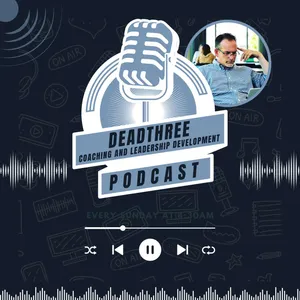
Free Daily Podcast Summary
DeadThree - Coaching and Leadership Development: Daily Summaries Delivered
by George Evjen
Every team plays to the standard its leader holds.The DeadThree Coaching Show gives leaders a working system. No pep talks. Host George Evjen breaks down real team and leadership situations the way he does with clients: set the standard, build the discipline to hold it, then execute.Every episode ties back to the SDE Framework (Standards, Discipline, Execution) or the Nine Principles of high-performing teams. Every episode ends with one move you can make in your next conversation.Built for leaders and managers who already know culture matters and want to know what to do about it on Monday.Take the free SDE Assessment: deadthreecoaching.com/sde-assessment
Latest Episodes
The most recent episodes — sign up to get AI-powered summaries of each one.
- 2 days ago53 min
Don't Take It Personal
A young leader gets called into the president's office after a rough meeting. He's white-knuckled the whole way down the hall. The president listens, gives him a long look and says: you're taking this way too personally. Then one word. Don't.You can build a team full of people who are great at giving a challenge. If nobody on that team can take one, nothing changes.In episode 140, I break down WE 9 from Kyle McDowell's Begin With We: we embrace challenge. Last week was how to give a challenge. This week is the harder half. How you take one. And I'll tell you up front, this is the one I need most.In this episode:The walk down the hallway and the one word that changed McDowell's careerChallenge, conflict and confrontation, and Coach K on meeting the truth head onLencioni: trust first, then healthy conflictThe whiteboard: ten ideas, nine are garbage, one changes the organizationMcDowell: issuing challenges is only half the equationSometimes the catch is more important than the throwIf you remember nothing else: it's not about youWhy a wrong answer in front of 20 people is a giftWithout the first seven WEs, a challenge feels like an attackPeople don't stay quiet because they're cowards. They've done the math"I've been doing this 20 plus years," and nobody raises a hand againSomebody at Blockbuster thought Netflix was a good ideaPeers can be the wall tooThe standard is your referee. Not your ego. Not your titleYour move this week:The next time someone challenges you, say "Tell me more" before you say anything else. Then ask what they need from you.When you feel it get personal, ask one question: does this get us closer to our standard?Think about the last time someone on your team challenged you. How did you react? That's the answer everyone else is working from."Your team decides whether to challenge you based on what happened the last time somebody did."Chapters00:00 Welcome back: WE 9 of the Begin With We series01:34 WE 8 and WE 9 go together03:01 McDowell's walk down the hallway04:24 "You're taking this way too personally"07:00 One word: don't07:58 Challenge, conflict, confrontation08:34 Coach K and Lencioni on healthy conflict10:36 Great at giving a challenge, can't take one11:53 The whiteboard: nine ideas are garbage14:51 Issuing challenges is only half the equation15:13 Get comfortable being uncomfortable17:19 The night two coaches got into it20:17 When your name is at the top of the org chart20:57 The catch matters more than the throw22:38 It's not about you24:57 You can't skip the first seven27:07 The wrong answer in front of 20 people30:35 Be the leader you wish you had31:39 Without trust, a challenge feels like an attack34:13 They've done the math34:30 "I've been doing this 20 plus years"35:34 Tell me more37:55 You don't have to punish someone to shut them down38:36 Somebody at Blockbuster40:21 Embracing challenge is a skill: Rick Majerus42:46 Chris Collins at Northwestern43:50 Does the team still win when you're not there?45:07 Peers can be the wall too47:30 None of this is personal48:54 Resiliency: how fast you get back to baseline50:14 Caring is the price of admission52:13 The standard is your referee52:35 Take the SDE assessmentMentioned in this episode:Begin With We by Kyle McDowellThe Advantage by Patrick LencioniThe Infinite Game by Simon SinekMike Krzyzewski, David Goggins, Ben Newman, Rick Majerus, Chris Collins and Rich DivineyThe SDE PlaybookThis is WE 9 of 10 in the Begin With We series. Catch up with episode 132 (The One Standard That Holds Up Every Other Standard), 133 (Who Sets the Temperature on Your Team?), 134 (Built or Destroyed One Commitment at a Time), 135 (We Take Action), 136 (Tough on the Problem, Easy on the Person), 137 (Sit Back Down, We'll Come Get You), 138 (Busy Isn't a Result) and 139 (You Knew. And You Said Nothing). Next up, the last one: WE 10, we obsess over the details.If this one hit, send it to somebody on your team. Better yet, send it to the last person who challenged you.Find out where your team stands. Take the free 30-question SDE assessment and download the SDE Playbook at https://deadthreecoaching.com/sde-assessment
- 1 weeks ago46 min
You Knew. And You Said Nothing
Think about the last time somebody on your team challenged you. Not criticized you. Challenged you. Did it feel like an attack? Or like somebody who cared about the result?Most teams never find out. Nobody says anything. The thing slides, everybody watches it slide, and in the retro somebody finally says, "I knew from the start that was never going to work."You knew. And you never said anything.In episode 139, I break down WE 8 from Kyle McDowell's Begin With We: we challenge each other diplomatically. McDowell told me the challenge WEs are his favorites. They're also the hardest for a culture to reach and hold. You earn the right to this one by stacking the first seven.In this episode:Why WE 8 can't come first: the standard, the model, the proof, the movement, the honesty, the support and the scoreboard come before the challengeCare about my kid, know what you're talking about, then coach them hardNick Saban kicks a player off the practice field, then tells him whySteve Kerr: the best players want to be told the truthMcDowell challenges everything, and the answer he gets: "Whatever makes us better""If it's your priority, then it's my priority"A challenge is a way to help. It's not a flex of power, position or parking spotsNever personal: point at the work, not the person. Say this plan. Better yet, our plan"I think this is a bad idea" is an opinion. "We said we'd hit X and we're at Y" is a factThree sentences that turn a hunch into a challengeThe seduction of success: Saban's 7:30 a.m. staff meeting after a national championshipYour move this week:Say the thing. Take one "I think" you have about your team's work and rewrite it before your next meeting: Here's the outcome we're after. Here's what I'm seeing. What if we tried this?At your next team meeting, ask: "What are we doing that I should be asking why about?" Then stop talking. Don't defend it. Say, "Tell me more.""It's not about who's right. It's about getting it right."Mentioned in this episode: Begin With We by Kyle McDowell, The Advantage by Patrick Lencioni, Nick Saban, Steve Kerr, Mike Krzyzewski, Tom Izzo, Ben NewmanThis is WE 8 of 10 in the Begin With We series. Catch up with episode 132 (The One Standard That Holds Up Every Other Standard), episode 133 (Who Sets the Temperature on Your Team?), episode 134 (Built or Destroyed One Commitment at a Time), episode 135 (We Take Action), episode 136 (Tough on the Problem, Easy on the Person), episode 137 (Sit Back Down, We'll Come Get You) and episode 138 (Busy Isn't a Result). Next week, WE 9: we embrace challenge.If this one hit, send it to the person on your team who always says "I knew that wasn't going to work" after the fact.Find out where your team stands. Take the free 30-question SDE assessment and download the SDE Playbook at deadthreecoaching.com/sde-assessment
- 2 weeks ago42 min
Busy Isn't a Result
Pull out your calendar. Look at this week. Which of those blocks actually produced something?Not which ones kept you busy. Which ones moved the scoreboard.In episode 138, I break down WE 7 from Kyle McDowell's Begin With We: we measure ourselves by outcomes, not activity.Last week was about picking each other up. So now you have a team with a standard. It moves, it tells the truth and it has each other's back. Here's the danger: a team like that can work incredibly hard on the wrong things. WE 7 aims the effort.In this episode:John Wooden: don't mistake activity for achievementHundreds of reports that nobody readOutcomes are the WHAT. Activities are the HOW. You get paid for the WHATThe line test: if an activity doesn't connect to an outcome, it's in the wayThe busy drug, and the executive who turned his laptop around to prove he was overwhelmedThe meeting numbers: 67% of workers say most meetings keep them from their best workFive questions to ask before any meetingFive moves to shift a team from busy to resultsYour move this week:Audit your calendar. Mark every block O or A: outcome or activity. If you can't draw the line to an outcome, cut it, shorten it or hand it off.Put the outcome in the invite. "By the end of this meeting, we will have ___." If you can't fill in the blank, cancel the meeting."Stop counting hours. Start counting outcomes."Mentioned in this episode: Begin With We by Kyle McDowell, John WoodenThis is WE 7 of 10 in the Begin With We series. Catch up with episode 132 (The One Standard That Holds Up Every Other Standard), episode 133 (Who Sets the Temperature on Your Team?), episode 134 (Built or Destroyed One Commitment at a Time), episode 135 (We Take Action), episode 136 (Tough on the Problem, Easy on the Person) and episode 137 (Sit Back Down, We'll Come Get You). Next week, WE 8: we challenge each other diplomatically.If this one hit, send it to the person on your team with the fullest calendar.Find out where your team stands. Take the free 30-question SDE assessment and download the SDE Playbook at deadthreecoaching.com/sde-assessment
- 3 weeks ago49 min
Sit Back Down, We'll Come Get You
A teammate hits the floor in a preseason game and starts to get up on his own. LeBron tells him: sit back down. We will come get you. That's a standard. That's not a feeling.Somebody on your team is on the ground right now. When they went down, who moved?In episode 137, I break down WE 6 from Kyle McDowell's Begin With We: we pick each other up. This is the one I don't see enough of. Teams talk about it. Very few have it as a standard.Last week was about owning your mistakes. This week is what comes right after. Somebody shows a red. The room goes quiet. Nobody helps. They fix it alone at 11 o'clock at night and learn one thing: don't show a red again.In this episode:- We need to quit calling ourselves a team when we're just a group of people- Stack it up: the standard, the model, the proof, the movement, the honesty, and now the support- What happens when you get WE 5 right and skip WE 6- Tie your shoe with your eyes closed: somebody didn't let you quit- LeBron's standard: nobody gets up alone- When a teammate takes a charge, it's about the other four- What "on the ground" looks like at work, and why most leaders call it a performance problem- The test: who notices first?- McDowell: it's everybody's responsibility, and no one person is more important than the next- The star is the most important person that picks others upYour move this week:1. Go through your team one by one and ask Don Meyer's question: what do they need and how can I help? Find the one who's on the ground.2. Run the test. Somebody's struggling right now. Who noticed first? If it's you every time, you don't have WE 6 yet.3. When a teammate picks somebody up, call it out. That's the behavior you want everyone to see."On this team, nobody gets up alone. When somebody goes down, everybody moves."Chapters00:00 Somebody on your team is on the ground00:40 Who moved?02:13 WE 6 of the Begin With We series03:01 Quit calling yourselves a team05:19 Stack it up: WE 1 through WE 506:15 Nick Saban: how can I trust you?08:43 Why the order matters10:49 Get WE 5 right and skip WE 611:41 The room goes quiet at 11 at night15:40 Encouragement, the first E16:09 Tie your shoe with your eyes closed18:30 LeBron: sit back down, we'll come get you22:29 If everybody had your attitude and body language23:56 When a teammate takes a charge26:55 It's about the other four27:57 Flip the script on the shooter29:45 What "the ground" looks like at work31:11 Not always a performance problem34:14 The test: who notices first?35:45 Purpose stops being a slide37:19 McDowell: it's everybody's responsibility39:48 The star picks others up42:38 Stack it up: the support43:23 Duke and the four guys who sprint over44:45 Next week, WE 7: outcomes, not activity46:54 The free SDE assessmentMentioned in this episode:- Begin With We by Kyle McDowell- The Advantage by Patrick Lencioni- The SDE Playbook- Nick Saban, Ben Newman, Jon Scheyer, Don Meyer, LeBron James, Steve Nash and John Wooden- Simon Sinek with Oprah Winfrey on Barry-WehmillerThis is WE 6 of 10 in the Begin With We series. Catch up with episode 132 (The One Standard That Holds Up Every Other Standard), episode 133 (Who Sets the Temperature on Your Team?), episode 134 (Built or Destroyed One Commitment at a Time), episode 135 (We Take Action) and episode 136 (Tough on the Problem, Easy on the Person).If this one hit, send it to somebody on your team. Better yet, send it to the person who's on the ground right now.Find out where your team stands. Take the free 30-question SDE assessment and download the SDE Playbook at https://deadthreecoaching.com/sde-assessment
- Oct 12, 202646 min
Tough on the Problem, Easy on the Person
Your team will make mistakes the minute you tell them to move. What you do next decides your culture.We are not judged by our mistakes. We're judged by how quickly we fix them and whether we repeat them. In episode 136, I break down WE 5 from Kyle McDowell's Begin With We: we own our mistakes.Last week was about getting your team to take action. This week is what comes right after. Punish the mistake and the movement stops. Make people hide it and trust dies.McDowell tells the Ford story. Every week, every executive status report came in green while the company lost billions. Alan Mulally said: red, yellow or green, I just want the truth. Mark Fields finally showed the first red. Instead of getting hammered, he got help. A few weeks later the reports looked like a bag full of Skittles.Fields later became CEO of Ford.In this episode:- Resiliency: how quickly you get back to your baseline- Why this show is called DeadThree, and what happens to your best shooter when you pull him after one miss- Shout praise, whisper criticism- The program review where every team hit 30 or 40% and everyone clapped- The day I deleted every shoe on shoes.com, and why I still remember how my boss Keith made me feel- McDowell's three kinds of mistakes: careless, malice and good faith. Most leaders respond to all three the same way.- If you treat a good-faith mistake like malice, you'll never see initiative from that person again- Four sentences of ownership, and why your team can't fix a problem they don't know existsYour move this week:1. Show your team a red. One thing you got wrong or one thing that isn't going well. Say it out loud: here's why and how it happened, here's how and when we fix it, here's what we do so it doesn't happen again.2. The next time something breaks, catch yourself before you ask who. Ask what happened. Then ask why five times."You need to be tough on the problem, but you need to be easy on the person." — Kyle McDowellChapters00:00 WE 5 of the Begin With We series00:58 "It's a WE thing"06:46 WE 5: we own our mistakes07:07 Resiliency and your baseline09:57 Recap: WE 1 through WE 410:38 Your team moves, your team makes mistakes12:46 Punish the mistake and the movement stops13:57 Why it's called DeadThree17:13 Shout praise, whisper criticism19:12 Dare to fail greatly20:59 Everything is green24:19 Ford: red, yellow or green27:24 Mark Fields shows the first red27:49 Assess it, own it, fix it, don't repeat it28:39 The day I deleted shoes.com30:30 Talking to one, coaching all34:11 Three kinds of mistakes35:47 Good faith treated like malice37:34 Four sentences of ownership40:25 Two actions for this week41:35 Tough on the problem, easy on the person43:02 Stack it up, and a look at WE 6Mentioned in this episode:- Begin With We by Kyle McDowell- Extreme Ownership by Jocko Willink- The Advantage by Patrick Lencioni- Multipliers by Liz Wiseman- The 4 Disciplines of Execution- Robert F. Kennedy, Alan Mulally, Mark Fields, Don Meyer and John WoodenThis is WE 5 of 10 in the Begin With We series. Catch up with episode 132 (The One Standard That Holds Up Every Other Standard), episode 133 (Who Sets the Temperature on Your Team?), episode 134 (Built or Destroyed One Commitment at a Time) and episode 135 (We Take Action).If this one hit, send it to the leader on your team who still asks "who did this?" first.Find out where your team stands. Take the free 30-question SDE assessment and download the SDE Playbook at https://deadthreecoaching.com/sde-assessment
- Oct 5, 202646 min
WE Take Action
Your team isn't stuck because of bad ideas. It's stuck because everyone is waiting for permission.Taking action and making mistakes is OK. Being idle is not. In episode 135, I break down WE 4 from Kyle McDowell's Begin With We, and I'll be honest: this is the one I struggle with most.You can set great standards. You can lead by example and keep every commitment. If nobody on your team is willing to move, try or risk, everything you've built is a well-organized parking lot. Ideas, strategies and plans, parked and going nowhere.McDowell tells a story about a leader named Bob. Bob heard a talk on culture, loved it and wanted to bring it to his team. First, he said, he'd need to ask permission. Permission to talk culture with his own team.Who's stopping you? Nobody.Bob is in every company, at every level. Senior leaders waiting for permission to do the very thing they were hired to do.In this episode:- Why being idle feels like caution and prudence, and why it's really a choice- The question Jesse Itzler asks his kids every night at dinner: "What did you fail at today?"- The best restaurant in the world, and the man in the back of the room who said, "That looks exhausting"- What happens to people when you ask them to do less than they're capable of- Why nobody pays for average- Why "we've always done it that way" should be considered profane, and what Northwestern basketball teaches about losing cultures- The one question to ask about every process on your team: would I keep doing this if I owned the company?Your move this week:1. Name one thing you've been waiting on permission to address. A process that makes no sense. A conversation you keep putting off. An initiative sitting in the parking lot. Get it done. You are the leadership.2. Have one conversation with your team that gives them permission to act. Not a policy. Not a memo. Tell them: if you see something to improve, go do it."Taking action and making mistakes is OK. Being idle is not." — Kyle McDowellChapters00:00 WE 4 of the Begin With We series03:10 Why this is the WE I struggle with most04:22 Taking action is OK, being idle is not04:48 Ben Newman and stacking days06:30 Recap: WE 1, WE 2 and WE 308:23 A well-organized parking lot08:56 Books, people and the risks you take13:26 The enemy of action is being idle14:09 Shawshank and asking permission15:19 Who's stopping you?17:04 Bob is everywhere21:55 Mistakes are inevitable22:45 What did you fail at today?24:39 Write this down25:15 Being idle is a choice27:09 "That looks exhausting"29:25 Asked to do less than they're capable of30:31 Nobody pays for average32:35 The status quo sandwich33:45 "We've always done it that way" should be profane34:21 Northwestern basketball and a losing culture39:22 If I owned this company42:57 Two actions for this week45:13 The parking lot's fullMentioned in this episode:- Begin With We by Kyle McDowell- The Standard by Ben Newman- Mindset by Carol Dweck- 2 Second Lean by Paul Akers- Don Meyer, Jesse Itzler and Ed MylettThis is WE 4 of 10 in the Begin With We series. Catch up with episode 132 (We Do What Is Right, Always), episode 133 (Who Sets the Temperature on Your Team?) and episode 134 (Built or Destroyed One Commitment at a Time).If this one hit, send it to the leader on your team who's still waiting for permission.Find out where your team stands. Take the free 30-question SDE assessment and download the SDE Playbook at https://deadthreecoaching.com/sde-assessment
- Sep 28, 202646 min
Built or Destroyed One Commitment at a Time
Your team is keeping score. Not on your title. On whether you did what you said you'd do.Your credibility is your brand, and it gets built or destroyed one commitment at a time. In episode 134, I break down WE 3 from Kyle McDowell's Begin With We: we say what we're going to do, and then we do it.This is the principle that decides whether the first two are real. You can do the right thing and lead by example in every meeting. Miss the delivery, and none of it counts. Follow-through is the proof.In this episode:The Friday-at-3 moment every team faces, and the engineer who shut it down with "Ain't nobody going anywhere. We said we would do this."Why your clients are grading your delivery right now, and how a team climbs from a D-minus to an A-plusThe two kinds of trust every team runs on, and what breaks when either one is missingWhy your employees are your first customersWhy most follow-through failures come down to clarity, not characterThe three things every meeting has to end withYour move this week:End every meeting with who's doing what, and by when. Confirm everyone heard it the same way. Put it in writing. Run it for 30 days and watch what changes.Find one commitment you made and didn't keep. A deliverable, a conversation, a check-in you cancelled. Close it this week."Be a leader. Do what you say you're going to do, then demand the same thing from your team." — Kyle McDowellChapters 00:00 The Sunday-afternoon culture test 02:44 Recap: WE 1 and WE 2 04:32 The leader who had integrity and modeled it 07:12 WE 3: we say what we're going to do, and we do it 09:00 Friday, 3 p.m.: "Ain't nobody going anywhere" 10:52 Your credibility is your brand 12:51 "Always delivers" or "seldom delivers"? 15:18 Follow-up and follow-through set you apart 18:08 Confidence is keeping the promises you make to yourself 19:59 How your clients grade your delivery 22:08 The two levels of trust 28:56 High-integrity teams can't deliver bad service 32:37 Your employees are your customers 33:57 Ambiguity is the enemy of execution 35:40 Who's on point, what, and by when 39:46 Two moves for this week 43:25 Three lines to lead by, and what's nextMentioned in this episode:Begin With We by Kyle McDowellThe Athletics of Business podcast with Ed MolitorThe Standard by Ben NewmanThe 4 Disciplines of ExecutionJohn Maxwell and Ed MylettThis is WE 3 of 10. Start with episode 132 (We Do What Is Right, Always) and episode 133 (Who Sets the Temperature on Your Team?). Next up, WE 4: we take action, and the most dangerous word in any organization.
- Sep 21, 202649 min
Who Sets the Temperature on Your Team?
George is back with the second principle from Kyle McDowell's Begin With We: We Lead By Example. Using Einstein's line that example isn't the main way to influence people, it's the only way, he breaks down Michael Jordan and the Chicago Bulls, a software engineer named Z who reset her team's standard on a Friday afternoon, and the question every leader has to answer: are you the thermostat, or are you the thermometer?In this episodeRecap of WE One — we do the right thing always — and why it means nothing on a poster or an email signatureWE Two: we lead by example, opened with Einstein's quote that setting an example is the only means of influencing othersCurrent reality and compelling vision, and the Chris Collins / Northwestern basketball turnaroundMichael Jordan and the Chicago Bulls: the hotel room story from The Last Dance, and the moment Jordan chose not to walk inThermostat versus thermometer — who sets the temperature in your organization, and who just reports itZ, the software engineer who reset her team's sprint standard on a Friday afternoon: "ain't nobody going home"The standard you set is the standard you get — Jordan on why a great player lands on a bad teamSmall standards that are really big standards: punctuality, cameras on in meetings, Danny Hurley's intensity at UConnThe mirror test — your words and actions get replicated by your team whether you like it or notTwo actions for the week: a 48-hour audit, and closing one gap
Get DeadThree - Coaching and Leadership Development summaries in your inbox
Free AI-powered daily recaps. Key takeaways, quotes, and mentions — in a 5-minute read.
Get Free Summaries →Free forever for up to 3 podcasts. No credit card required.
You Might Also Like
Listeners also like.

Coaching for Leaders
Practical leadership advice from experienced experts and proven leaders to help professionals grow through career transitions.

Leading Outward
Leaders tackle culture, accountability, and conflict with real-time coaching and insights from global executives.

The Debrief with Jon Becker
Leadership lessons from military and law enforcement commanders on teamwork, decision-making, and training in high-stakes environments.

Built 4 More
Conversations with elite performers and leaders exploring the intersection of high performance, discipline, and faith.

Leading By Example: Executives Making An Impact
Executives share pivotal moments and personal experiences that shaped their leadership and decision-making in real-world business environments.

Building Champions for Life
Examines how elite performers in sports, business, and education develop character and mindset for lasting success.
Bred To Lead
Leadership is developed through real-world turnarounds, early warning signs, and people-first habits that prevent organizational decline.

Canterbury Rugby's Coaches Corner
A rugby coach discusses training techniques and insights with guests to help improve coaching skills.

3 Takeaways
Features conversations with leading thinkers and experts, distilling each discussion into three actionable insights.

Dissecting High Performance In Tennis
A deep dive into the coaching philosophies and methods that shape elite tennis players’ development and performance.

The TENNIS COACHES Notebook
Paul Dale

Becoming UnDone
Explores how high-achievers rebuild after hitting rock bottom, facing burnout, or losing their identity.
About DeadThree - Coaching and Leadership Development
Every team plays to the standard its leader holds.The DeadThree Coaching Show gives leaders a working system. No pep talks. Host George Evjen breaks down real team and leadership situations the way he does with clients: set the standard, build the discipline to hold it, then execute.Every episode ties back to the SDE Framework (Standards, Discipline, Execution) or the Nine Principles of high-performing teams. Every episode ends with one move you can make in your next conversation.Built for leaders and managers who already know culture matters and want to know what to do about it on Monday.Take the free SDE Assessment: deadthreecoaching.com/sde-assessment
Customized Recaps
AI-powered recaps with compact key takeaways, quotes, and insights.
Straight to Your Inbox
Get key takeaways from DeadThree - Coaching and Leadership Development in a 5-minute read.
Save Hours Every Week
Stay current on your favorite podcasts without falling behind.
Frequently Asked Questions
What is Podzilla's DeadThree - Coaching and Leadership Development daily summary?
It's a free AI-powered email that summarizes new episodes of DeadThree - Coaching and Leadership Development as soon as they're published. You get the key takeaways, notable quotes, and links & mentions — all in a quick read.
How does the DeadThree - Coaching and Leadership Development podcast summary work?
When a new episode drops, our AI transcribes and analyzes it, then generates a personalized summary tailored to your interests and profession. It's delivered to your inbox every morning.
Is this an official DeadThree - Coaching and Leadership Development product?
No. Podzilla is an independent service that summarizes publicly available podcast content. We're not affiliated with or endorsed by George Evjen.
Can I get summaries of other podcasts too?
Absolutely! The free plan covers up to 3 podcasts, any in the catalog. Basic raises that to 15, Pro to 40 and Max to 100. Browse our full catalog at /podcasts.
How often does DeadThree - Coaching and Leadership Development release new episodes?
DeadThree - Coaching and Leadership Development publishes 2x weekly. Our AI generates a summary within hours of each new episode.
What topics does DeadThree - Coaching and Leadership Development cover?
DeadThree - Coaching and Leadership Development covers topics including Education, Business, Management, Self-Improvement. Our AI identifies the specific themes in each episode and highlights what matters most to you.
Start getting DeadThree - Coaching and Leadership Development summaries tomorrow morning.
Free forever for up to 3 podcasts. No credit card required.
Free forever for up to 3 podcasts. No credit card required.