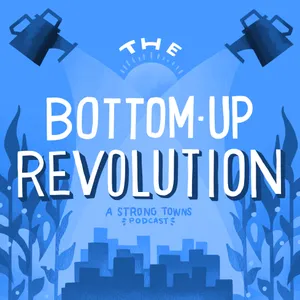
Free Daily Podcast Summary
The Bottom-Up Revolution: Daily Summaries Delivered
by Strong Towns
This podcast features stories of the Strong Towns movement in action. Hosted by Tiffany Owens Reed, it’s all about how regular people have stepped up to make their communities more economically resilient, and how others can implement these ideas in their own places. We’ll talk about taking concrete action steps, connecting with fellow advocates to build power, and surviving the bumps along the way—all in the pursuit of creating stronger towns.
Latest Episodes
The most recent episodes — sign up to get AI-powered summaries of each one.
- Today19 min
New Zealand’s Urban Nerds Start at the Pub
Daniel Basubas thought New Zealand would feel very different from the sprawling Southern California communities where he grew up. Instead, he found many of the same development patterns and many of the same arguments over parking, bike lanes, and who streets are for. In Dunedin, he now helps lead the Urbanerds Ōtepoti Dunedin, a Strong Towns Local Conversation that meets at the local pub. The group gives people a low-pressure way to talk through those issues, meet others who care about the city, and get more comfortable participating in local decisions, whether that means commenting on a council plan or speaking at a public meeting. ADDITIONAL SHOW NOTES Daniel Basubas (LinkedIn) Urbanerds Ōtepoti Dunedin (Site) Find a Local Conversation near you (Site) Norm Van Eeden Petersman (LinkedIn) Do you know someone who would make for a great Bottom-Up Revolution guest? Let us know here. This podcast is made possible by Strong Towns members. Thank you! Join fellow members discussing this episode in The Commons.
- 5 days ago44 min
What If Vacant Lots Became Farms?
A lot in Fairfax, Virginia, sat empty for 25 years, long enough that neighbors barely noticed it anymore. Oren Falkowitz, founder of Area 2 Farms, sees places like that as potential farms. He joins urban planner Jeffery Tompkins to talk about bringing food production back into neighborhoods using vacant lots, overlooked buildings, and other spaces conventional development often passes over. Their Urban Farms Toolkit tackles one of the biggest obstacles: zoning rules written for a very different kind of agriculture. For vacant parcels that may never attract conventional development, a farm can give the land a role in the neighborhood again. ADDITIONAL SHOW NOTES Oren Falkowitz (LinkedIn), Area 2 Farms (Site) Jeffery Tompkins (LinkedIn), Proformus (Site), Thinking Big By Thinking Small (Substack) Urban Farms Toolkit (Site) Local Recommendations: Natural State Provisions Wonderland Books Tiffany Owens Reed (Instagram) Do you know someone who would make for a great Bottom-Up Revolution guest? Let us know here! This podcast is made possible by Strong Towns members. Thank you! Join fellow members discussing this episode in The Commons.
- 1 weeks ago18 min
The Floating Neighborhoods Coming to North America
Floating homes are already common in parts of Europe, and Jeff Kraatz thinks North American cities could use the same idea to create entirely new neighborhoods on the water. The founder of Floating Towns explains what it actually takes to move beyond a few individual houseboats and build a community of 50 or 60 homes. The homes may float, but the harder work still happens on land: planning, approvals, infrastructure, affordability, and getting local leaders on board. With miles of waterfront sitting largely unused, Kraatz sees room for cities to grow in a direction they rarely consider. ADDITIONAL SHOW NOTES Jeff Kraatz (LinkedIn) Floating Town (Site) Norm Van Eeden Petersman (LinkedIn) Do you know someone who would make for a great Bottom-Up Revolution guest? Let us know here. This podcast is made possible by Strong Towns members. Thank you! Join fellow members discussing this episode in The Commons.
- 1 weeks ago42 min
The Missing Ingredient in Great Placemaking
A developer can check every box for parks and shared spaces and still create a place nobody wants to spend time in. Colby Cox has seen stormwater ponds, tiny playgrounds, and generic amenity packages counted as community space even when they do very little to bring different people together or give them a reason to stay. Norm Van Eeden Petersman talks with the Convergence Communities founder about what changes when those spaces are designed around actual human activity: kids playing, teenagers hanging out, people eating, exercising, gathering, and simply being around one another. A park can occupy the right number of acres, but what makes it feel alive enough that people actually choose to be there? ADDITIONAL SHOW NOTES Colby Cox (LinkedIn) Convergence Communities (Site) The Granary (Site) Dogfish Brewery (Site) Norm Van Eeden Petersman (LinkedIn) Do you know someone who would make for a great Bottom-Up Revolution guest? Let us know here. This podcast is made possible by Strong Towns members. Thank you! Join fellow members discussing this episode in The Commons.
- 2 weeks ago16 min
The Goldilocks Problem Behind City Taxes
When Calgary’s main water feeder line broke for the second time in two years, Nathan Hawryluk decided he needed to get more involved. He already had an unusual view of the city’s finances as a planning commissioner, where questions about new neighborhoods and the infrastructure needed to support them regularly cross his desk. Norm talks with Nathan about the “bad Goldilocks spot” behind those numbers, where the city’s obligations and the revenue available to meet them have drifted apart. As Nathan puts it, “Our taxes are too high for people to pay comfortably and too low to actually do the job.” ADDITIONAL SHOW NOTES The Commons (Site) Strong Towns Calgary (Site) Norm Van Eeden Petersman (LinkedIn) Do you know someone who would make for a great Bottom-Up Revolution guest? Let us know here. This podcast is made possible by Strong Towns members. Thank you! Join fellow members discussing this episode in The Commons.
- 2 weeks ago42 min
The Co-Living Exchange Pairing Students and Seniors
What if an extra bedroom could make housing more affordable for a student while helping an older adult stay in their home? Alison Donnally founded Joey Co. to pair students looking for housing with older adults who have space to spare and could use help with everyday tasks. Students pay rent, earn money back through agreed-upon work, and gain a different kind of connection to the community around them. Donnally talks about what makes these matches work, why home sharing is still unusual in the U.S., and what this model reveals about how many housing options we’ve left off the table. ADDITIONAL SHOW NOTES Alison Donnally (LinkedIn) Joey Co (Site) Local Recommendations: Sol Food Pollo Tropical Tiffany Owens Reed (Instagram) Do you know someone who would make for a great Bottom-Up Revolution guest? Let us know here! This podcast is made possible by Strong Towns members. Thank you! Join fellow members discussing this episode in The Commons.
- 3 weeks ago15 min
This Artist Is Secretly Fixing Potholes With Mosaics
After moving to Chattanooga, Lisa hit three potholes in three years and ended up buying five new tires. She knew people elsewhere had taken pothole repairs into their own hands, and as a mosaic artist, she already had the materials to try her own version. Soon, bright smiley faces started appearing in Chattanooga’s streets. They attracted attention from drivers, neighbors, and eventually the city itself, raising questions about safety, public space, and what happens when one resident decides to fix something in her own strange, joyful way. Now Lisa keeps stacks of smileys in her car, ready for the next pothole that could use a little silliness. ADDITIONAL SHOW NOTES Potholes of Chattanooga (Instagram) Chattanooga’s Smiley‑Face Potholes Show Creative Civic Problem‑Solving (Article) Norm Van Eeden Petersman (LinkedIn) Do you know someone who would make for a great Bottom-Up Revolution guest? Let us know here. This podcast is made possible by Strong Towns members. Thank you! Join fellow members discussing this episode in The Commons.
- 3 weeks ago43 min
They Want to Pave Old San Juan for Parking
Near El Morro, one of Puerto Rico’s most recognizable historic sites, a government road project called for cutting down 26 mature trees, widening a road, adding a roundabout, and turning part of a grassy area into parking. Giancarlo Gonzalez, an Old San Juan resident and founding member of a Strong Towns Local Conversation in San Juan, explains how neighbors discovered the plan and began asking why it was needed at all. Their petition has drawn more than 8,000 signatures, pulled the National Park Service into the fight, and forced new scrutiny of a project residents say was moving forward without their input. ADDITIONAL SHOW NOTES Save El Morro (Site) VSJ Peatonal Local Recommendations: Spiga Materia Prima Tiffany Owens Reed (Instagram) Do you know someone who would make for a great Bottom-Up Revolution guest? Let us know here! This podcast is made possible by Strong Towns members. Thank you! Join fellow members discussing this episode in The Commons.
Get The Bottom-Up Revolution summaries in your inbox
Free AI-powered daily recaps. Key takeaways, quotes, and mentions — in a 5-minute read.
Get Free Summaries →Free forever for up to 3 podcasts. No credit card required.
You Might Also Like
Listeners also like.
The Strong Towns Podcast
Discusses how to financially strengthen American cities and towns through fiscally prudent urban design and community development.
The Messy City Podcast
Exploring urban development through change, uncertainty, and community-driven initiatives.
Our Town
A Tennessee town faces a clash over identity when far-right Christian settlers with outside backing move in and challenge local heritage.
How To Citizen with Baratunde
Explores civic engagement as an active practice, offering tools and stories to help people collectively shape a better society.
The Restless Ones
Executives at the intersection of technology and business discuss innovation, leadership, and driving change in fast-evolving industries.
The Urbanist Agenda
An exploration of urban planning and mobility issues by popular online urbanists.
Talking Headways: A Streetsblog Podcast
A weekly podcast exploring sustainable transportation, urban planning, and economic development through expert interviews and analysis.
Cool People Who Did Cool Stuff
Revolutions, rebellions, and resistance movements throughout history, told through the stories of the people who lived them.

Total Disruption Podcast
Entrepreneurs discuss mindset, business growth, and operational frameworks to move beyond hustle culture and build scalable companies.

Blaze Your Own Trail
Entrepreneurs and trailblazers share real stories and strategies for overcoming adversity and building success.
People I (Mostly) Admire
Economist Steve Levitt interviews high achievers across diverse fields, exploring their lives, work, and unconventional paths to success.
S-Town
A man in rural Alabama asks a journalist to investigate a rumored murder, leading to a deeper exploration of secrets, treasure, and his own life.
About The Bottom-Up Revolution
This podcast features stories of the Strong Towns movement in action. Hosted by Tiffany Owens Reed, it’s all about how regular people have stepped up to make their communities more economically resilient, and how others can implement these ideas in their own places. We’ll talk about taking concrete action steps, connecting with fellow advocates to build power, and surviving the bumps along the way—all in the pursuit of creating stronger towns.
Customized Recaps
AI-powered recaps with compact key takeaways, quotes, and insights.
Straight to Your Inbox
Get key takeaways from The Bottom-Up Revolution in a 5-minute read.
Save Hours Every Week
Stay current on your favorite podcasts without falling behind.
Frequently Asked Questions
What is Podzilla's The Bottom-Up Revolution daily summary?
It's a free AI-powered email that summarizes new episodes of The Bottom-Up Revolution as soon as they're published. You get the key takeaways, notable quotes, and links & mentions — all in a quick read.
How does the The Bottom-Up Revolution podcast summary work?
When a new episode drops, our AI transcribes and analyzes it, then generates a personalized summary tailored to your interests and profession. It's delivered to your inbox every morning.
Is this an official The Bottom-Up Revolution product?
No. Podzilla is an independent service that summarizes publicly available podcast content. We're not affiliated with or endorsed by Strong Towns.
Can I get summaries of other podcasts too?
Absolutely! The free plan covers up to 3 podcasts. Upgrade to Pro for 15, or Premium for 50. Browse our full catalog at /podcasts.
What topics does The Bottom-Up Revolution cover?
The Bottom-Up Revolution covers topics including Culture, Society & Culture. Our AI identifies the specific themes in each episode and highlights what matters most to you.
Start getting The Bottom-Up Revolution summaries tomorrow morning.
Free forever for up to 3 podcasts. No credit card required.
Free forever for up to 3 podcasts. No credit card required.