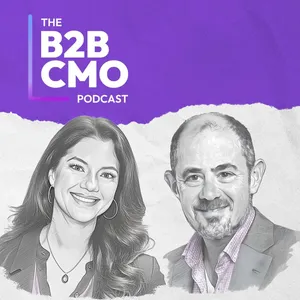
Free Daily Podcast Summary
The B2B CMO Podcast with Jon Miller and Sydney Sloan: Daily Summaries Delivered
by Jon Miller & Sydney Sloan
Welcome to The B2B CMO Podcast, a show for marketing executives who are redefining what it means to be a strategic leader. Join Jon Miller and Sydney Sloan every week as they talk with the very best Chief Marketing Officers who are navigating the modern marketing playbook and positioning themselves as strategic leaders. Each episode, we unpack what it really takes to lead through complexity, earn trust at the strategy table, and shape the future of growth. We’re building the community, research, and frameworks CMOs need to reclaim their strategic role and drive sustainable growth.
Latest Episodes
The most recent episodes — sign up to get AI-powered summaries of each one.
- 4 days ago43 min
Market the Marketing with Maria Pergolino
Maria Pergolino is the Chief Marketing Officer of SPS Commerce, the retail network that connects retailers, suppliers, distributors, and logistics providers. Before SPS, she was CMO at ActiveCampaign, Anaplan, and Conga (formerly Apttus), and held marketing leadership roles at Marketo and Shunra Software. In this episode, Maria joins Sydney Sloan and Jon Miller to share what it means to market the marketing inside your own company, from campaigns her CEO can see himself in to treating investors as an audience. She explains why she treats the ELT as her first team, and the small missed ask from a CEO that taught her to hear the organization before proving her way.Maria also walks through why she bet her next role on the data SPS sits on between retailers and brands, how her team built one brand repository that every AI system at SPS draws from, and why her whole ELT saw the 2027 marketing plan before she presented it.Jump Into the Conversation Introduction How Maria got into marketing What makes a CMO strategic Marketing your marketing internally Hearing the organization and why ELT is your first team Questions to ask before taking a CMO role Why Maria bet on SPS Commerce Making marketing the center of AI Marketing to retailers and suppliers Gratitude and shout-outsEpisode TakeawaysMarket the marketing to your own company. Maria treats her executive team and investors as audiences she’s responsible for. An account-based campaign featuring SPS customers in The Wall Street Journal reached buyers and gave her CEO and peers a campaign they could see themselves in.Hear the organization before you prove your way. At ActiveCampaign, Maria’s CEO asked twice for more creative nurturing and it stayed on her list. The credibility she lost came from him feeling unheard, not from the size of the ask.Socialize your plan before it reaches the room. Every ELT member saw Maria’s 2027 marketing plan before she presented it, and she took their feedback. That kept the meeting on the points she wanted to emphasize.Pick your company the way you’d assess a market. Maria joined SPS Commerce because where there’s data, AI has potential, and SPS sits on the data between retailers and brands. A profitable, well-run business made adding growth on top a believable story.Make marketing the source AI draws from. Maria’s team built one repository of what the brand and product should be, and every AI system at SPS uses it, including the AI SDR and support. The trade-off is that she no longer tracks every individual agent her team builds.Standout Quote"I embraced the idea that my brand was not what I said it was, but what AI says it is." — Maria PergolinoGuest LinksMaria Pergolino LinkedIn: https://www.linkedin.com/in/mariapergolino/SPS Commerce Website: https://www.spscommerce.com/Mentioned in this EpisodePhave: https://phave.com/ActiveCampaign: https://www.activecampaign.com/Anaplan: https://www.anaplan.com/Conga: https://conga.com/DECA: https://www.deca.org/Matt Amundson: https://www.linkedin.com/in/matt-amundson-91657236/Jen Howard: https://www.linkedin.com/in/jenhoward04/Cody Lindley: https://www.linkedin.com/in/cody-lindley-b274579b/ Becky Delorn: https://www.linkedin.com/in/beckydeloryn/More from The B2B CMO ProjectWebsite: https://www.b2bcmoproject.com/ LinkedIn: https://www.linkedin.com/company/b2bcmoproject/ Jon Miller: https://www.linkedin.com/in/jonmiller2/ Sydney Sloan: https://www.linkedin.com/in/sydsloan/ More Episo
- 1 weeks ago13 min
Market Share vs. Mind Share with Kelly Cheng, CMO at Goldcast by Cvent
Kelly Cheng is the Chief Marketing Officer of Goldcast by Cvent, the AI-powered B2B video content platform now part of Cvent’s event marketing and management portfolio. Since joining in 2021, Kelly has built Goldcast’s marketing organization from the ground up, helping scale the company past $10M in ARR, and previously held marketing roles at Wistia, Dynatrace, and PagerDuty.Kelly joins Sydney Sloan to discuss why AI-generated content volume is working against brands instead of for them, the "presence premium" that real, on-camera proof commands, and why the smartest CMOs audit their workflow before buying another AI tool. She also breaks down the shift from market share to mind share, and why the best-performing distribution channel isn't a single channel at all.This episode is part of a partnership between The B2B CMO Project and Goldcast. Jump Into the Conversation Welcoming Kelly Cheng, CMO of Goldcast by Cvent Why AI-generated volume is working against brands The presence premium and what AI can’t fake Explaining market share vs. mind share Why webinars are the strongest distribution channel The value of repurposing AI vs. generating AI from scratch Speed, distribution, and closing thanks to GoldcastEpisode TakeawaysOptimize for evidence, not output. Teams lost trust chasing AI content volume the moment everyone could produce it. Kelly argues the scarcest asset now is a real person with a real reputation standing behind the content.Presence carries a cost AI can’t pay. Kelly introduces the “presence premium” framework: showing up on camera, on a stage, or in a real conversation puts your reputation on the line. That is what earns trust, not a polished AI paragraph.Chase mind share, not just market share. Only 5% of buyers are in-market at any given time. Kelly makes the case for video as the format that builds familiarity with the other 95% before they're ready to buy.Distinguish repurposing AI from generating AI. Teams that use AI to repurpose a real moment, such as a webinar or a customer conversation, keep the human signal. Teams that generate from a blank prompt produce content Kelly calls “no soul.”Audit the workflow before you buy the tool. Kelly cites research that 81% of successful AI rollouts started with a workflow audit, not a purchase. Understand the current state before you try to evolve it.Standout Quote“You can fake a polished paragraph, but you cannot fake a person that’s willing to put their name and their face on a point of view.” — Kelly ChengGuest LinksLinkedIn: https://www.linkedin.com/in/kellyhcheng/Goldcast Website: https://www.goldcast.io/More from The B2B CMO ProjectWebsite: https://www.b2bcmoproject.com/ LinkedIn: https://www.linkedin.com/company/b2bcmoproject/ Jon Miller: https://www.linkedin.com/in/jonmiller2/ Sydney Sloan: https://www.linkedin.com/in/sydsloan/ More Episodes: https://www.b2bcmoproject.com/podcasts
- 2 weeks ago38 min
Making the Case for Brand Spend with Michelle Cooper, CMO at NiCE
NiCE just bet nearly a billion dollars on agentic AI. Its biggest brand campaign doesn’t lead with it.Michelle Cooper has been CMO of NiCE since June 2025, after more than two decades at SAP, where she was EVP of Global Field Marketing and Brand Experiences and earlier CMO for SAP North America and the Americas.In this episode, Michelle joins Jon Miller to explain why the Create a NiCE World campaign with Kristen Bell puts the customer’s problem ahead of the technology, and why it’s beating industry benchmarks. She also shares the stat that won over her CEO and CFO on brand spend: only 5% of buyers are in market, and 95% buy from their day-one shortlist.Jump Into the Conversation Michelle's path into tech marketing How to drive clarity out of complexity What it means to be a strategic CMO Making the brand case to the CEO and CFO The one thing NiCE wants buyers to feel The Kristen Bell campaign How AI-forward your messaging should be Marketing through the Cognigy acquisition Positioning a legacy brand against AI-native startups Building an AI-first marketing organization AI champions, big bets, and new roles Life outside work, gratitude, and key takeawaysEpisode TakeawaysBring data to the brand budget conversation, not opinion. In a budget review with her CEO and CFO, Michelle used outside benchmarks and economics so the case for brand wasn't just her point of view. The stat that landed: only 5% of buyers are in market at any time, and 95% of the time they buy from their day one shortlist.Know who is on today's buying committee. NiCE used to sell mostly to the head of customer care. Now it's the CIO, the CTO, and the chief AI officer, which makes building brand ahead of the shortlist even more important.Lead with the human outcome instead of AI. The Create a NiCE World campaign shows celebrity Kristen Bell getting her problem solved, with NiCE's AI agents doing the work in the background. Michelle says it's performing above industry benchmark on almost every level.Let customers prove it for you. Customers learn from customers, so NiCE leans on communities and case studies, along with Cognigy brands like Lufthansa and Adidas, to show what's already working at scale.Take inventory before you place AI bets. After giving everyone the same tools early in the year, Michelle's team reviewed every AI initiative mid-year, put its weight behind the ones with the most ROI, and set 2030 targets with the board for how much work AI will automate.Standout Quote"Customers learn from customers. It is the best asset that we have in our arsenal today as marketers." — Michelle CooperGuest LinksLinkedIn: https://www.linkedin.com/in/michelleleecooper/NiCE Website: https://www.nice.com/Mentioned in this EpisodeCreate a NiCE World: https://www.nice.com/nice-worldCognigy: https://www.cognigy.com/Alicia Tillman: https://www.linkedin.com/in/altillman/Julia White: https://www.linkedin.com/in/juliawhite2/Alison Biggan: https://www.linkedin.com/in/alisonbiggan/More from The B2B CMO ProjectWebsite: https://www.b2bcmoproject.com/ LinkedIn: https://www.linkedin.com/company/b2bcmoproject/ Jon Miller: https://www.linkedin.com/in/jonmiller2/ Sydney Sloan: https://www.linkedin.com/in/sydsloan/ More Episodes: https://www.b2bcmoproject.com/podcasts
- 3 weeks ago34 min
The Business Hat Every CMO Needs in the Boardroom with Jessica Shapiro, CMO at LiveRamp
Jessica Shapiro is the Chief Marketing Officer of LiveRamp, where she has led the company into the data collaboration category since joining in 2022. Before LiveRamp, she ran marketing at SAP Concur, held marketing leadership roles at Icertis, launched Starbucks VIA at Starbucks, and spent eight years at Microsoft.In this episode, Jessica joins Sydney Sloan and Jon Miller to share how she earned the right to reposition the LiveRamp brand by fixing the demand waterfall first and cutting cost per opportunity in half. She explains what it takes for a new category to stick, and why she sees governance and agent autonomy as additive instead of in conflict.Jessica also walks through the offsite where her whole team built their own AI agents, and how LiveRamp now brings one combined brand number to every board meeting.Jump Into the Conversation Jessica’s path from pre-med to marketing Curiosity and perseverance as marketing superpowers Wearing the business hat as a strategic CMO Why the CRO relationship comes first Earning credibility before repositioning the brand Building the data collaboration category at LiveRamp Setting expectations for category creation with the board Balancing data governance with agent autonomy The ups and downs of LiveRamp’s AI transformation Measuring brand with a composite score What brand metrics to bring into the boardroom Gratitude, mentors, and key takeawaysEpisode TakeawaysEarn the brand conversation with pipeline first. When her CEO told her not to start with a repositioning, Jessica rebuilt the demand waterfall, put attribution on everything, and took cost per opportunity from $6,000 to $3,000. That credibility is what got her back to the brand.Build the category story from what customers actually say. Customer interviews showed people knew the LiveRamp name but each described the company differently, and that gap became the case for the data collaboration story.Tell one category story in different versions. Customers hear time savings and protection, and the board hears a bigger TAM. Every version has to ladder up to the same place.Treat governance as what lets agents move faster. Jessica sees autonomy and governance as additive. When the right data and governance are built in, agents have guardrails and can do their work with less friction.Give the board one brand number they can follow. LiveRamp blends share of voice, message pull-through, AI visibility, web traffic, and AEO/GEO into a single trend line, introduced as a spotlight topic and reported at every board meeting.Standout Quote“I feel like the CRO and CMO need to be locked at the hip. If we do not share the same goals and the same vision, everything falls apart.” — Jessica ShapiroGuest LinksLinkedIn: https://www.linkedin.com/in/jessicamshapiro/LiveRamp Website: https://liveramp.com/Mentioned in this EpisodeRampUp by LiveRamp: https://www.rampedup.us/Play Bigger: https://www.playbigger.com/Icertis: https://www.icertis.com/SAP Concur: https://www.concur.com/Brady Brewer: https://www.linkedin.com/in/brady-brewer-64a2034 Elena Donio: https://www.linkedin.com/in/elenadonio/ Scott Howe: https://www.linkedin.com/in/schowe/ More from The B2B CMO ProjectWebsite: https://www.b2bcmoproject.com/ LinkedIn: https://www.linkedin.com/company/b2bcmoproject/ Jon Miller: https://www.linkedin.com/in/jonmiller2/ Sydney Sloan: https://www.linkedin.com/in/sydsloan/ More Episodes: https://www.b2bcmoproject.com/podcasts
- Oct 26, 202632 min
Building a Movement Instead of Chasing Demand with Katrina Wong, CMO at New Relic
Katrina Wong is the Chief Marketing Officer of New Relic, the intelligent observability platform, where she has led brand, demand, and communications. Before taking on the CMO role, she started her career as a consultant at PwC. She later on became Divisional CMO and VP of Marketing at Twilio Segment and held marketing and go-to-market leadership roles at Hired, Zuora, Salesforce, and SAP. In this episode, Katrina joins Sydney Sloan and Jon Miller to share how New Relic repositioned its category as intelligent observability and turned that into an AI story told chapter by chapter. She explains why she reports new business and post-sale pipeline separately in a consumption business, and why one marketing team owns both.Katrina also walks through how her marketing engineering and AI team rebuilt reporting on Gemini, the 85 agents running competitive intel every morning, and what happened when an agency sent her team 200 variations to review.Jump Into the Conversation Katrina’s path from consulting to marketing Being a strategic CMO and redefining observability for AI Telling the AI story like chapters of a book How marketing proved AI modernization to the board Separating new business and post-sale pipeline Customer hackathons and the link between engagement and revenue Building a trusted BI layer with vibe coding Humans in the loop and the problem of too much AI content Gemini gems for sales and 85 daily competitive agents The pillars of a superhuman marketing team Gratitude, mentors, and key takeawaysEpisode TakeawaysTake a bold stance on your category before someone else sets it for you. New Relic repositioned observability as intelligent observability, was first to claim it, and Gartner recognized the company for its AI vision the following year.Tell your AI story in chapters. Chapter one explained why AI matters in observability. Chapter two named the problem: code volume growing beyond human scale. That led to the brand campaign, Welcome to the Superhuman Era.Measure pipeline the way your business makes money. In a consumption business, new business pipeline is a leading indicator, but revenue comes from usage. New Relic tracks both, and one marketing team owns both.Keep humans in the loop, even when AI can produce more. When an agentic agency sent back 200 variations, Katrina's team realized more output wasn't the answer if no one could review it.Remove the bottlenecks between marketing and the field. Gemini gems for competitive and value selling replaced last-minute Slack asks, and 85 daily agents now draft most competitive updates before a human fact-checks them.Standout Quote"Sometimes the move to be strategic is to take a bold stance and see if it pays off." – Katrina WongGuest LinksLinkedIn: https://www.linkedin.com/in/katrinawong11/ New Relic Website: https://newrelic.com/ Mentioned in this EpisodeZuora: https://www.zuora.com/Gartner: https://www.gartner.com/Klaviyo: https://www.klaviyo.com/Tien Tzuo: https://www.linkedin.com/in/tientzuo/ Sue Barsamian: https://www.linkedin.com/in/suebarsamian/Carilu Dietrich: https://www.linkedin.com/in/carilu/ Tom Hartman: https://www.linkedin.com/in/tom-hartman/Jennifer Covington: https://www.linkedin.com/in/covingtonjennifer/ More from The B2B CMO ProjectWebsite: https://www.b2bcmoproject.com/ LinkedIn: https://www.linkedin.com/company/b2bcmoproject/ Jon Miller: https://www.linkedin.com/in/jonmiller2/ Sydney Sloan: https://www.linkedin.com/in/syds
- Oct 19, 202640 min
Snowflake’s CMO Reinvents Her Playbook Every Year. Here’s How.
Denise Persson is the Chief Marketing Officer of Snowflake, the AI Data Cloud company. With over 10 years in the role, one of the longest CMO tenures in enterprise tech, she has helped take Snowflake from roughly $1 million in revenue to more than $4 billion. She now leads a marketing team of about 700 people responsible for 40 to 50% of the company's growth, and this year marks her 30th in tech marketing.Denise shares why a new CMO's first team is the leadership team, not the marketing org, and why she throws out her own playbook every year. She also walks through how Snowflake's brand team became its most AI-forward function, how her morning brief replaced waiting on dashboards, why Snowflake moved its SDRs back into sales, and why her team is already working next quarter's pipeline two quarters out. Denise shares the one thing she says builds brand trust above all else: consistency.Jump Into the Conversation Welcoming Denise Persson, CMO of Snowflake From Commodore to 30 years in tech marketing Why the CMO's first team is the leadership team Throwing out the playbook every year Moving marketing from AI fluency to agentic workflows Growing 40 to 50% without adding headcount Replacing dashboards with a daily AI brief Why Snowflake moved SDRs back into sales Fixing a soft quarter two quarters out How AI adoption differs across regions Why consistency builds brand trust Closing gratitude and the leaders who see potential firstEpisode TakeawaysTreat the leadership team as your first team. Denise says the day you become CMO, you are a business leader. That means understanding finance, having empathy for the sales craft, partnering with product, and bringing data and customer proof, not opinion, when you push a point of view.Rebuild your playbook every year and hire for your gaps. Over 10 years at Snowflake, Denise has thrown out her playbook annually. Her survival tactic is self-awareness: know your strengths, then hire people with the superpowers you don't have.Move AI from individual experiments to your top three workflows. Snowflake's top marketing AI user sits on the brand team, which is now building an agentic workflow so regional marketers can self-serve campaign assets instead of waiting 5-10 days.Work pipeline two quarters out. There is no magic campaign that fixes a soft quarter in a long sales cycle. Denise's team uses signals to see a weak quarter six months early, then drills down to territories as small as eight reps to find what's in the red.Build brand trust through consistency. Denise points to McDonald's and Coke as proof that trust comes from never delivering surprises. Her challenge now: keeping the brand consistent when anyone in the company can generate their own branded content.Standout Quote"When you get that CMO role, you need to understand that that’s the day you are a business leader." — Denise PerssonGuest LinksLinkedIn: https://www.linkedin.com/in/denisepersson/ Snowflake Website: https://www.snowflake.com/ Mentioned in this EpisodeThe Five Dysfunctions of a Team by Patrick Lencioni: https://www.tablegroup.com/topics-and-resources/teamwork-5-dysfunctions/ Frank Slootman: linkedin.com/in/frankslootman Maria Pergolino: https://www.linkedin.com/in/mariapergolino/ Latané Conant: https://www.linkedin.com/in/latane-conant/ Demandbase: https://www.demandbase.com/ More from The B2B CMO ProjectWebsite: https://www.b2bcmoproject.com/ LinkedIn: https://www.linkedin.com/company/b2bcmoproject/ Jon Miller: https://www.linkedin.com/in/jonmiller2/ Sydney Sloan: https://www.linkedin.com/in/sydsloan/ More Episodes: <a hr
- Oct 12, 202627 min
Leading the Market Through AI Disruption with Demandbase CMO Rachel Truair
Rachel Truair is the Chief Marketing Officer of Demandbase, the pipeline engine for AI go-to-market trusted by some of the world's leading B2B enterprise brands. Rachel joined Demandbase in January 2026 after more than two decades in B2B marketing leadership, including CMO roles at Simpro Group and Cart.com and senior roles at Adobe, Confluent, Oracle, and 3M.In this episode, Rachel chats with Sydney Sloan to look at AI disruption from the customer's side of the table. She shares what Labs by Demandbase is seeing in ChatGPT-referred traffic to B2B websites, why the real opportunity sits with the 95% of buyers who aren't in market yet, and why she may be the first Demandbase CMO to actually run her team on Demandbase. Rachel also makes the case that software should prove its own ROI, and explains how thinking like an investor helps CMOs split their AI bets into separate efficiency and growth stories for the board.This episode is part of a partnership between The B2B CMO Project and Demandbase, the pipeline engine for AI go-to-market. Episode TakeawaysAssume your buyers are researching somewhere you can't see. Labs by Demandbase found a roughly 300% increase in ChatGPT-referred traffic to B2B websites over the last year, which means a big share of discovery now happens before a prospect ever lands on your owned properties.Get the data foundation right before you scale anything with AI. Rachel's version: you avoid running off a cliff by standing on a flat surface. If your data isn't unified and you don't know which signals actually matter, AI just helps you scale the wrong things faster.Market to the 95%, not just the 5%. When everyone has access to the same in-market data, the advantage goes to the teams that use signals, buying groups, and context to reach buyers before they start an evaluation.Point AI at the spreadsheets, not the storytelling. Rachel saw AI-generated creative fall flat, and believes the better use is taking reporting, attribution debates, and campaign friction off marketing's plate so teams have more time for creative work.Bring AI to the board as an investor would. Rachel splits her AI initiatives into an efficiency story (time savings, headcount savings, program spend) and a growth story (pipeline and revenue), measures each on its own terms, and reinvests savings from one into the other.Standout Quote"The work that marketing does that's really valuable is the creative, it is the content, it is the storytelling. It's the reason we all got into this to begin with." — Rachel TruairGuest LinksLinkedIn: https://www.linkedin.com/in/racheltruair/Demandbase Website: https://www.demandbase.com/Mentioned in this EpisodeMojo by Demandbase: https://trymojo.aiLabs by Demandbase: https://www.demandbase.com/resources/labs/The Prompt, Rachel Truair's podcast: https://podcasts.apple.com/us/podcast/the-prompt/id1372690438Kelvin Gee, Forrester: https://www.linkedin.com/in/kelvingeeForrester: https://www.forrester.com/More from The B2B CMO ProjectWebsite: https://www.b2bcmoproject.com/ LinkedIn: https://www.linkedin.com/company/b2bcmoproject/ Jon Miller: https://www.linkedin.com/in/jonmiller2/ Sydney Sloan: https://www.linkedin.com/in/sydsloan/ More Episodes: https://www.b2bcmoproject.com/podcasts
- Oct 5, 202638 min
Turning Customer Pain Into Strategic Marketing with Cindy Zhou, CMO at Imprivata
Cindy Zhou is the Chief Marketing Officer of Imprivata, the simple and secure access management platform used by roughly 90% of U.S. hospitals. Before Imprivata, Cindy built her CMO track record at KnowBe4, LogRhythm, and in senior marketing roles at IBM and Verizon, making this her fourth cybersecurity company as a marketing leader.Cindy chats with Jon Miller and Sydney Sloan about her new role to unpack how she built her 30-60-100-day plan, why she believes CMOs need to operate as business executives first, and why she has already told her team to stop talking about MQLs. Cindy also walks through how she prioritizes with her CEO and CRO, why she is tying her customer marketing team's KPIs to retention and churn instead of lead volume, and how KnowBe4's InfoSec team tried to break her first AI SDR before she would let it near a real customer.Jump Into the Conversation Welcoming Cindy Zhou, CMO of Imprivata How Cindy went from product management to marketing What it means to be a strategic CMO What she brought from past roles into Imprivata's C-suite Seeing the market beyond industry silos How to earn the strategic CMO seat Moving beyond MQLs and tying priorities to strategic metrics Investing in retention and customer marketing How to build brand in an AI-disintermediated world AI SDRs and AI teammates, governance, and human-in-the-loop Closing gratitude, mentors and board members who shaped her careerEpisode TakeawaysTreat marketing as a business-executive function, not a departmental one. When Cindy evaluates a new opportunity, she starts with market dynamics and the financials (NRR, GRR, growth rate) before she gets to a marketing plan, because 'chief market officer' only works as a title if you actually understand the market.Look past the vertical to find the universal pain underneath it. Imprivata's brand is deeply rooted in healthcare, but Cindy makes the case for expanding into manufacturing and public safety by pointing to a pain point every industry shares: nobody wants to deal with passwords. She backs this up with real customer stories, like a casino cage worker locked out of a login for 45 minutes, to show how the same root problem shows up everywhere, just wearing a different industry's clothes.Use your CEO's and CRO's own words to build your first 90 days. Cindy's tip for new CMOs: go back and listen to the sales kickoff keynote, then build your plan around the problems leadership already said out loud they want solved. Parroting it back makes the plan easier to align on.Replace MQLs with metrics tied to retention and growth. Cindy has moved her customer marketing team's KPIs away from lead volume and toward NRR, GRR, and churn signals, arguing that in a private-equity-backed business, those numbers matter more to the board than marketing-sourced pipeline.Stress-test AI SDRs before they ever talk to a real customer. At KnowBe4, Cindy had her InfoSec team try to break the AI SDR with off-topic and legal questions before launch, and the program is still built to route uncertain questions to a live human rather than risk a wrong answer.Standout Quote"We’re business executives first, that’s the way to really think about it. We just happen to have responsibility over marketing.” — Cindy ZhouGuest LinksLinkedIn: https://www.linkedin.com/in/cindyzhou/Imprivata Website: https://www.imprivata.com/Mentioned in this EpisodeMark Logan: https://www.linkedin.com/in/mark-logan-894977/Betsy Atkins: https://www.linkedin.com/in/betsy-atkins-a36b114/Shanti Atkins: https://www.linkedin.com/in/shanti-atkins-602b493/Brian Jack: https://www.linkedin.com/in/privacy-policy/Penn Entertainment: https://www.pennentertainment.comMore from The B2B CMO ProjectWebsite: https://www.b2bcmoproject.com/ LinkedIn: https
Get The B2B CMO Podcast with Jon Miller and Sydney Sloan summaries in your inbox
Free AI-powered daily recaps. Key takeaways, quotes, and mentions — in a 5-minute read.
Get Free Summaries →Free forever for up to 3 podcasts. No credit card required.
You Might Also Like
Listeners also like.
Fractional CMO Show
Casey Stanton

Everyone Hates Marketers | No-BS Marketing & Brand Strategy Podcast
A marketing podcast offering practical insights on branding, strategy, and customer research from industry professionals.
Marketing Made Simple
Strategies for crafting clear marketing messages that connect with customers and grow businesses.

Right About Now - Legendary Business Advice
Raw business insights from founders and industry leaders, revealing real wins, failures, and actionable strategies without the fluff.

Coaching Inc with Tom Krol
Teaches coaches and consultants how to generate consistent leads and increase income using proven, efficient marketing strategies.
Create or Destroy: Reimagining Marketing with Seth Matlins
Discusses how business, culture, and technology decisions create or destroy value in marketing and customer relationships.

The Revenue House
Examines ethical marketing and business growth for purpose-driven companies through expert interviews and real-world strategies.
Leading By Example: Executives Making An Impact
Executives share pivotal moments and personal experiences that shaped their leadership and decision-making in real-world business environments.

Masters of Scale
Business leaders share real-world strategies and experiences scaling innovative companies, from startup to global success.
Consulting Success Podcast
Strategies for building a profitable, scalable consulting business, from client acquisition to team management and marketing that works.
Unbossing
Conversations with business and tech leaders about redefining leadership by unlearning outdated rules in times of change.

UI Breakfast: UI/UX Design and Product Strategy
Discussions with UI/UX and product strategy experts on applying practical insights to design and SaaS businesses.
About The B2B CMO Podcast with Jon Miller and Sydney Sloan
Welcome to The B2B CMO Podcast, a show for marketing executives who are redefining what it means to be a strategic leader. Join Jon Miller and Sydney Sloan every week as they talk with the very best Chief Marketing Officers who are navigating the modern marketing playbook and positioning themselves as strategic leaders. Each episode, we unpack what it really takes to lead through complexity, earn trust at the strategy table, and shape the future of growth. We’re building the community, research, and frameworks CMOs need to reclaim their strategic role and drive sustainable growth.
Customized Recaps
AI-powered recaps with compact key takeaways, quotes, and insights.
Straight to Your Inbox
Get key takeaways from The B2B CMO Podcast with Jon Miller and Sydney Sloan in a 5-minute read.
Save Hours Every Week
Stay current on your favorite podcasts without falling behind.
Frequently Asked Questions
What is Podzilla's The B2B CMO Podcast with Jon Miller and Sydney Sloan daily summary?
It's a free AI-powered email that summarizes new episodes of The B2B CMO Podcast with Jon Miller and Sydney Sloan as soon as they're published. You get the key takeaways, notable quotes, and links & mentions — all in a quick read.
How does the The B2B CMO Podcast with Jon Miller and Sydney Sloan podcast summary work?
When a new episode drops, our AI transcribes and analyzes it, then generates a personalized summary tailored to your interests and profession. It's delivered to your inbox every morning.
Is this an official The B2B CMO Podcast with Jon Miller and Sydney Sloan product?
No. Podzilla is an independent service that summarizes publicly available podcast content. We're not affiliated with or endorsed by Jon Miller & Sydney Sloan.
Can I get summaries of other podcasts too?
Absolutely! The free plan covers up to 3 podcasts, any in the catalog. Basic raises that to 15, Pro to 40 and Max to 100. Browse our full catalog at /podcasts.
How often does The B2B CMO Podcast with Jon Miller and Sydney Sloan release new episodes?
The B2B CMO Podcast with Jon Miller and Sydney Sloan publishes weekly. Our AI generates a summary within hours of each new episode.
What topics does The B2B CMO Podcast with Jon Miller and Sydney Sloan cover?
The B2B CMO Podcast with Jon Miller and Sydney Sloan covers topics including Business, Marketing. Our AI identifies the specific themes in each episode and highlights what matters most to you.
Start getting The B2B CMO Podcast with Jon Miller and Sydney Sloan summaries tomorrow morning.
Free forever for up to 3 podcasts. No credit card required.
Free forever for up to 3 podcasts. No credit card required.