Free Daily Podcast Summary
Strange Health: Daily Summaries Delivered
by The Conversation
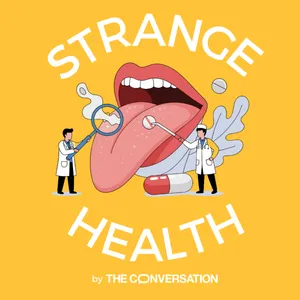
Strange Health dives into the science behind the most bizarre, viral, and sometimes questionable health trends dominating social media from period scooping and menstrual masking to stroboscopic light therapy, demodex mites, vagus nerve hacks and liver detox myths. Expect honest, engaging, and sometimes stomach-turning discussions. Hosted by Katie Edwards from The Conversation and Dan Baumgardt, a GP and lecturer at the University of Bristol.
Latest Episodes
The most recent episodes — sign up to get AI-powered summaries of each one.
- 4 days ago39 min
The science of sunscreen – and the myths to watch out for
Some people are so worried about sunscreen that they're swapping factor 50 for beef tallow. Coconut oil and olive oil also have their supporters in the world of homemade sunscreen. Meanwhile, other social media creators warn that conventional sunscreens contain dangerous chemicals, interfere with our hormones or prevent us from making vitamin D.So what does the science say? And what happens to your skin when you swap a tested sunscreen for something from the kitchen cupboard?Hosts Katie Edwards and Dan Baumgardt are joined by Charareh Pourzand, a pharmacologist at the University of Bath and an expert in sunscreen. She explains what different types of ultraviolet radiation do to our skin, and how much sunscreen you really need.Watch Strange Health on YouTube or follow us wherever you get your podcasts.Strange Health is a podcast from The Conversation, an independent, not-for-profit news organisation. If you've got a question about a viral trend or video you've seen and you'd like us to delve into the science behind it in a future episode, please email us at strangehealth@theconversation.com. If you like the show, please consider donating to support our work. You can sign up here for a free daily newsletter from The Conversation here.Hosts: Katie Edwards and Dan BaumgardtExecutive Producer: Gemma WareEditing and mixing: Anouk MilletArtwork: Alice Mason
- 1 weeks ago45 min
Migraine hacks: do eyebrow clips, cold spoons or fries actually work?
Social media offers plenty of tips how to relieve a migraine. Some people swear by a large Coke and McDonald’s fries, which has gained the nickname of a "McMigraine". Others recommend hairclips on your eyebrows, or putting your feet in hot water while cooling the back of your head with spoons.But how much science is there behind these remedies? And why can migraine make you feel so dreadful long before your head starts hurting?In this episode, our guest is Amanda Ellison, a professor of neuroscience at Durham University to explore what happens in your brain during a migraine and if any of the internet's migraine hacks could actually work. Watch Strange Health on YouTube or follow us wherever you get your podcasts.Strange Health is a podcast from The Conversation, an independent, not-for-profit news organisation. If you've got a question about a viral trend or video you've seen and you'd like us to delve into the science behind it in a future episode, please email us at strangehealth@theconversation.com. If you like the show, please consider donating to support our work. You can sign up here for a free daily newsletter from The Conversation here.Hosts: Katie Edwards and Dan BaumgardtExecutive Producer: Gemma WareEditing and mixing: Anouk MilletArtwork: Alice Mason
- 2 weeks ago31 min
Cottage cheese: protein superfood or fitness myth?
Cottage cheese is a TikTok sensation. Social media creators are blending the curdy, clumpy white stuff into everything from cookie dough and chocolate brownies to flatbreads and even slapping it onto hot dogs. All in the name of protein.Naturally high in protein and relatively low in fat, cottage cheese has been embraced by fitness influencers who claim it can help build muscle and burn fat. But does the science support these claims?In this episode, we hear from Dominic Farsi, a researcher at King's College London and at Teagasc in Ireland, to get the facts about cottage cheese – and understand how much protein we really need.Watch Strange Health on YouTube or follow us wherever you get your podcasts.Strange Health is a podcast from The Conversation, an independent, not-for-profit news organisation. If you've got a question about a viral trend or video you've seen and you'd like us to delve into the science behind it in a future episode, please email us at strangehealth@theconversation.com. If you like the show, please consider donating to support our work. You can sign up here for a free daily newsletter from The Conversation here.Hosts: Katie Edwards and Dan BaumgardtExecutive Producer: Gemma WareEditing and mixing: Anouk MilletArtwork: Alice Mason
- 3 weeks ago2 min
Trailer: season 2 coming soon!
We're back with a new season of Strange Health, the podcast from The Conversation, that investigates the odd, awkward and occasionally disgusting questions raised by our bodies and the health trends surrounding them.This season we’ll be looking at cottage cheese, which seems to have escaped from the back of the fridge and become one of the internet’s favourite foods, investigate some of the alarming claims circulating about sunscreen, and look at whether migraine hacks online really will alleviate your headache.Hosts Katie Edwards, a health editor at The Conversation, and Dan Baumgardt, a practising GP and lecturer in health and life sciences at the University of Bristol, tackle a new batch of questions that have been fascinating them or sending them down unexpectedly strange research rabbit holes.Episode 1 of season two arrives on October 13. Watch Strange Health on YouTube or follow us wherever you get your podcasts.The Conversation is an independent, not-for-profit news organisation. If you like the show, please consider donating to support our work. You can sign up here for a free daily newsletter from The Conversation here.Hosts: Katie Edwards and Dan BaumgardtExecutive Producer: Gemma WareEditing and mixing: Anouk MilletArtwork: Alice Mason
- Mar 10, 202638 min
What is period scooping? And other menstrual hacks you should think twice about
Period scooping sounds like something you would only hear in a biology lab, not while doom-scrolling TikTok. Yet earlier this year, videos claiming you can “scoop out” your period to avoid the mess and shorten the whole thing racked up millions of views. In this episode, we hear from Sally King, a visiting fellow at King’s College London, about why you can't shorten your period, and why you need to be careful about upsetting the pH balance of your body. She also gives us her perspective as a menstrual physiologist on other period hacks, including menstrual blood face masks, and drinks that some influencers say can shorten your period. Strange Health is a podcast from The Conversation, an independent, not-for-profit news organisation. If you've got a question about a viral trend or video you've seen and you'd like us to delve into the science behind it in a future episode, please email us at strangehealth@theconversation.com. Full credits for this episode available here. If you like the show, please consider donating to support our work. You can sign up here for a free daily newsletter from The Conversation here. If you've got a questeion Hosts: Katie Edwards from The Conversation and Dan Baumgardt, University of Bristol Executive Producer: Gemma Ware Editing and mixing: Anouk Millet Artwork: Alice Mason Menstrual health literacy is alarmingly low – what you don’t know can harm you Would you put period blood on your face? What science says about ‘menstrual masking’ Your vagina cleans itself: why vagina cleaning fads are unnecessary and harmful
- Mar 3, 202639 min
Does light therapy work? The science of stroboscopic stimulation
Light therapy sounds wholesome. Sit in front of a lamp. Feel better. But nowadays, it can also mean strapping on a flashing mask and watching your own brain generate kaleidoscopic hallucinations behind closed eyelids. In this episode, host Katie Edwards tries on a stroboscopic light mask being promoted by celebrities including Jennifer Aniston and Rosamund Pike to find out what happens. And David Schwartzman, a research fellow at the Sussex Centre for Consciousness Science at the University of Sussex, explains how stroboscopic light produces hallucinations in the brain, and how it's currently being trialled to treat conditions like depression. Strange Health is a podcast from The Conversation, an independent, not-for-profit news organisation. Full credits for this episode available here. If you like the show, please consider donating to support our work. You can sign up here for a free daily newsletter from The Conversation here. Hosts: Katie Edwards from The Conversation and Dan Baumgardt, University of Bristol Executive Producer: Gemma Ware Editing and mixing: Anouk Millet Artwork: Alice Mason Can a psychedelic-induced mystical experience really improve your mental health? SAD lamps: do they work? Experts explain how they help the winter blues
- Feb 24, 202641 min
What your body odour says about you
Body odour has a reputation problem. It is often treated as a hygiene failure or a social offence. In reality, it is biology at work, plus a big helping of culture. And yet people online are trying chlorophyll shots to make their BO smell better. Hosts Katie Edwards and Dan Baumgardt discuss what evidence there is behind this, plus some of the health conditions that can affect body odour. And we talk to Mats Olsson, a professor of experimental psychology at the Karolinska Institutet in Stockholm, who studies how humans perceive body odour. Strange Health is a podcast from The Conversation is an independent, not-for-profit news organisation. Full credits for this episode available here. If you like the show, please consider donating to support our work. You can sign up here for a free daily newsletter from The Conversation here. Hosts: Katie Edwards from The Conversation and Dan Baumgardt, University of Bristol Executive Producer: Gemma Ware Editing and mixing: Anouk Millet Artwork: Alice Mason
- Feb 17, 202635 min
Meet the mites that live on you: from demodex to dust mites and scabies
You are not alone in your own skin. Millions of microscopic creatures live there too. Our skin is home to entire ecosystems of microscopic life. Bacteria and fungi get most of the attention, but mites are there too. Among the most common are demodex mites, tiny eight-legged relatives of spiders that live inside hair follicles and pores, especially on the face. Almost all adults carry them. In this episode we explore what these microscopic housemates are actually doing on our bodies and why the idea of them can feel so unsettling. While demodex may be harmless, there are plenty of other mites that can cause problems, from dust mites, to scabies. Hosts Katie Edwards and Dan Baumgardt turn this week to Alejandra Perotti, professor of invertebrate biology at the University of Reading, who studies the relationship between mites and humans. Strange Health is a podcast from The Conversation is an independent, not-for-profit news organisation. Full credits for this episode available here. If you like the show, please consider donating to support our work. You can sign up here for a free daily newsletter from The Conversation here. Hosts: Katie Edwards from The Conversation and Dan Baumgardt, University of Bristol Executive Producer: Gemma Ware Editing and mixing: Sikander Khan Artwork: Alice Mason Invisible skin mites called Demodex almost certainly live on your face – but what about your mascara? How often should you really be washing your bedding? A microbiologist explains Scabies outbreak in UK and Europe – what you need to know
Get Strange Health summaries in your inbox
Free AI-powered daily recaps. Key takeaways, quotes, and mentions — in a 5-minute read.
Get Free Summaries →Free forever for up to 3 podcasts. No credit card required.
You Might Also Like
Listeners also like.

Health vs Hype with the American Medical Association
A medical expert debunks viral health trends and misinformation with science-backed insights from physicians.

The Antisocial Doctors Podcast
Sonia Singh MD & Rebecca Berens MD

Health Discovered
Doctors explore surprising stories to uncover insights about health and well-being.

Red Pill Your Healthcast
Two healthcare providers discuss overlooked health issues and empower listeners to make informed decisions for their families.

Made for Health | Peptides | Lyme | Chronic Infections | Long Covid | Insulin Resistance | Hypermobility
A physician explores science-based approaches to treating chronic conditions and restoring health.

ZOE Science & Nutrition
Experts break down cutting-edge health and nutrition science to help you make better choices for your body and gut.

What's Up Docs?
Doctors Chris and Xand van Tulleken examine health science and medical advice to help listeners navigate conflicting wellness claims.

Health Check
BBC World Service

The Food Medic
Dr. Hazel Wallace
The Pulse
Explores surprising stories in health and science, from operating rooms and labs to breakthrough innovations.

Science Vs
A show that investigates popular topics and myths by analyzing scientific evidence to determine what’s fact, fiction, or uncertain.

Unbiased Science
Dr. Jess Steier and guests analyze viral health claims using scientific evidence and explain key findings for everyday conversations.
About Strange Health
Strange Health dives into the science behind the most bizarre, viral, and sometimes questionable health trends dominating social media from period scooping and menstrual masking to stroboscopic light therapy, demodex mites, vagus nerve hacks and liver detox myths. Expect honest, engaging, and sometimes stomach-turning discussions. Hosted by Katie Edwards from The Conversation and Dan Baumgardt, a GP and lecturer at the University of Bristol.
Customized Recaps
AI-powered recaps with compact key takeaways, quotes, and insights.
Straight to Your Inbox
Get key takeaways from Strange Health in a 5-minute read.
Save Hours Every Week
Stay current on your favorite podcasts without falling behind.
Frequently Asked Questions
What is Podzilla's Strange Health daily summary?
It's a free AI-powered email that summarizes new episodes of Strange Health as soon as they're published. You get the key takeaways, notable quotes, and links & mentions — all in a quick read.
How does the Strange Health podcast summary work?
When a new episode drops, our AI transcribes and analyzes it, then generates a personalized summary tailored to your interests and profession. It's delivered to your inbox every morning.
Is this an official Strange Health product?
No. Podzilla is an independent service that summarizes publicly available podcast content. We're not affiliated with or endorsed by The Conversation.
Can I get summaries of other podcasts too?
Absolutely! The free plan covers up to 3 podcasts, any in the catalog. Basic raises that to 15, Pro to 40 and Max to 100. Browse our full catalog at /podcasts.
How often does Strange Health release new episodes?
Strange Health publishes weekly. Our AI generates a summary within hours of each new episode.
What topics does Strange Health cover?
Strange Health covers topics including Medicine, Nutrition, Fitness, Health & Fitness. Our AI identifies the specific themes in each episode and highlights what matters most to you.
Start getting Strange Health summaries tomorrow morning.
Free forever for up to 3 podcasts. No credit card required.
Free forever for up to 3 podcasts. No credit card required.