Free Daily Podcast Summary
Straight Talking Sustainability: Daily Summaries Delivered
by Emma Burlow
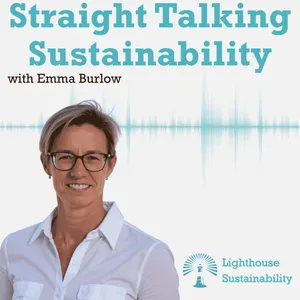
Welcome to Straight Talking Sustainability! I'm your host, Emma Burlow. If you're feeling lost in all the sustainability talk or struggling to see real results in your business, this podcast is for you. We’ll clear up the confusion and focus on practical, straightforward actions that actually work. Join me as I talk with experts, share real-world stories, and tackle the common roadblocks that stop businesses from making progress. This is all about making sustainability easier and sharing what truly makes a difference. Let’s keep it simple, effective, and make sustainability stick!
Latest Episodes
The most recent episodes — sign up to get AI-powered summaries of each one.
- Today20 min
What 100 Episodes Have Taught Me
Emma Berlow marks 100 episodes of Straight Talking Sustainability by reflecting on why she started the podcast, what has surprised her, and where the show goes next.In this episodeWhy a podcast felt more achievable than writing a book after nearly 30 years in sustainability 03:07The need for more female voices in sustainability podcasting 03:59How the podcast helps Emma Berlow share experience, connect with others, and create more impact 05:06Reaching 12,000 downloads, with an average of 128 downloads a week 01:57The importance of process, even for people who prefer to wing it 08:40Why podcasting is a “dark art” and why authenticity matters more than polished production 09:30The slow growth of podcast numbers and the danger of fixating on them 11:15Creating conversations that feel more like the valuable, informal discussions after a conference 12:29A sharper focus on practical questions, useful experiences, and getting “to the nub of the issue” 13:29Plans for more book reviews, a resource Padlet, and video episodes 15:47Episodes recommendedThe 52 Sustainability Hacks series, including spring, summer, autumn, and winter editions 17:42Getting Past “Yes in Principle” 18:41Is Climate Anxiety Actually Healthy? 19:07Early episodes on working in communities and sustainability leadership 18:18Key quote“Winging it is great until it isn’t great.” 08:54Emma Berlow invites listeners to share feedback, suggest future topics and books, and recommend the podcast to a friend or colleague. 19:52Book a Power Hour with Emma https://calendly.com/emma-lighthouse/power-hourConnect with EmmaWebsiteEmailEmma Burlow | LinkedIn
- 1 weeks ago49 min
Can Sex Sell Climate Change? With Jessica Riches, OnlyFans Content Creator
Emma Burlow talks with Jessica Riches, independent filmmaker and existential crisis communication strategist, about using sex, entertainment, humour, and trusted creators to make climate communication cut through.In this episodeWhy climate communicators need to “jump off the cliff of the norm” rather than take small steps, as Jessica Riches explains at 02:57.The three reasons people shut down when confronted with existential risks: unfamiliar unknowns, exponential risk, and the feeling that they have no agency 06:42.How parasocial relationships and trusted voices can communicate complex ideas more effectively than distant institutions or experts 09:29.Why Jessica Riches turned to OnlyFans as a space for reaching audiences who are often overlooked by climate campaigns 14:51.The thinking behind Headline Newds, a campaign delivering climate news through adult-content creators 24:24.How the project worked with creators as co-creators rather than handing them a rigid communications brief 23:38.Why facts alone haven’t shifted public understanding of climate change, and why the messenger matters as much as the message 29:56.The campaign’s reach, including hundreds of thousands of views and strong levels of shares and saves despite widespread shadow banning 32:28.Why climate communicators should stop treating people as corporate audiences and start recognising them as humans with existing interests, relationships, and communities 44:55.Jessica Riches’ advice to take bigger creative risks, challenge conventional impact metrics, and consider a “little mini revolution” 45:48.Memorable moments“Better facts are not going to make this better.” Jessica Riches argues that climate communication has focused too heavily on accuracy, while overlooking story, trust, and cultural relevance at 30:00.Jessica Riches describes Headline Newds as a way to combine climate facts with “a few puns and some sexual innuendo” while reaching communities that climate campaigns rarely prioritise 43:15.The central challenge for sustainability professionals: being boring is rarely safer than being unexpected, especially when the goal is to reach people beyond the usual sustainability audience 45:07.Content warningThis episode includes sexual content, strong language, discussions of pornography and sex work, and references to climate-related death and societal collapse.Jessica Riches | LinkedInJessica Riches (@notpeterthiel_) • Instagram photos and videosJessica Riches – Jessica Riches is the world's first existential crisis comms strategist – working in climate change and AI riskBook a Power Hour with Emma https://calendly.com/emma-lighthouse/power-hourConnect with EmmaWebsiteEmailEmma Burlow | LinkedIn
- 2 weeks ago19 min
Should We Be Talking About 1.8°C?
The conversation focused on the implications of the UNEP report Limiting Overshoot, which warns that global warming could reach 1.8°C even under the best-case pathway, with current policies potentially leading to 2.6°C.The discussion explored whether sustainability professionals should replace the 1.5°C message with 1.8°C, or stay focused on the existing target. The answer depends on the audience. People who already understand the science may be ready to discuss overshoot in more depth. For others, introducing another number could create confusion, weaken existing targets, or encourage a “what’s the point?” response.Key takeawaysThe UNEP report says overshoot is unavoidable, but warming can still be brought back down through a “peak and decline” strategy.Current policies could lead to 2.6°C of warming 04:18.Every fraction of a degree above 1.5°C increases the risks 04:40.The required actions include immediate emissions cuts, methane reductions, a rapid transition to net zero, carbon dioxide removal, and adaptation 05:15.Don’t add complexity before people understand the basics of climate change, urgency, and agency 07:21.If an organisation already has a 1.5°C target, introducing 1.8°C without context could muddy the waters 10:00.Sustainability messaging should reflect the audience’s level of awareness and readiness 10:52.If the basics aren’t in place, focus on carbon literacy training, lunch and learns, e-learning supported by real engagement, or showing the National Emergency Briefing 14:08.If the basics are in place, identify what’s preventing faster emissions reductions, stronger advocacy, supply-chain transformation, or industry leadership 15:46.Overwhelm can be reduced by finding the “nugget of truth,” breaking the issue down, and acting on what’s achievable 12:19.Supporting sustainability teams matters, even when sustainability isn’t part of the job title 13:43.Ask honestly:Do the climate basics exist across the organisation?Is the current target driving real progress?What’s stopping faster and bigger carbon reductions?Is there a rock in the way that needs to be identified and removed?The episode’s central message is clear: 1.8°C is a warning, not a reason to stop. There’s still a great deal to do 18:47.Yes, we’re heading towards 1.8 degrees of warming, but there’s still a damn lot we can do in the meantime. Don’t stay in overwhelm. Get the basics in place, support each other, and take action.Limiting Overshoot UNEP ReportBook a Power Hour with Emma https://calendly.com/emma-lighthouse/power-hourConnect with EmmaWebsiteEmailEmma Burlow | LinkedIn
- 3 weeks ago42 min
From Collecting Data to Successful Net Zero Strategy – with Louise Rehbinder, COO Exponential Roadmap Initiative
This episode explores how businesses can bridge the gap between setting net zero targets and actually achieving them, moving from data collection to actionable strategies. Emma Burlow is joined by Louise Rehbinder, who delves into the Exponential Roadmap Initiative’s Five Pillars framework and its essential role in forming resilient, actionable net zero strategies for businesses of all sizes.The Target-Action Gap:Many companies have ambitious net zero goals, but employees are often unclear on how to achieve them. This episode discusses concrete ways to close that gap (Emma Burlow 00:01:19).Intro to Exponential Roadmap Initiative:Louise Rehbinder explains the organization’s mission, straddling think-tank and consultancy, and how they support corporates with up-to-date climate action guidance (Louise Rehbinder 00:02:16).The Five Pillars Explained:The Exponential Business Playbook is structured around five key pillars:Reducing a company’s own emissions (Scope 1 and 2)Value chain emissions (Scope 3: upstream, downstream, suppliers, customers, products)Providing solutions that replace high-emission practicesEnabling mechanisms: finances and investmentPolicy and social narrative for systemic change(Louise Rehbinder 00:07:59 – 00:10:22)Applicability to Small Businesses:The playbook isn’t just for big corporates; it is designed to be accessible, with free tools like SME Climate Hub for smaller organizations (Louise Rehbinder 00:04:42).Moving Beyond Data Collection:The importance of balancing effort between getting accurate carbon accounting and actually implementing actions. Companies can make significant progress with available data without waiting for perfection (Louise Rehbinder 00:19:18).Strategic vs. Operational Approaches:How the playbook helps elevate climate action from operational and compliance-driven steps to integral parts of business strategy (Louise Rehbinder 00:33:18; Emma Burlow 00:33:25).Practical Examples & Industry Leadership:Some members use the playbook as the basis for company-wide strategy, particularly advanced IT, finance, or sustainability-led firms. Case studies include companies enabling broader systemic change, such as Stegra (Green Steel) and Unilever’s policy engagement (Louise Rehbinder 00:34:43–00:37:05).Memorable Quotes“Knowing your numbers does not reduce your emissions. …You need to also actually do the activities.” – Louise Rehbinder 00:17:52“Climate is just one aspect that comes into play—something that will happen eventually. And it is about competitiveness for the companies.” – Louise Rehbinder 00:32:38Resources MentionedExponential Business PlaybookSME Climate HubTakeawaysThe Five Pillars approach helps businesses systematically move from targets to tangible climate action.Action and influence (Pillars 3, 4, and 5) are as crucial as accurate reporting (Pillars 1 and 2).Tools and frameworks are freely available and can serve as “handholders” for sustainability teams at any stage.Download the Exponential Roadmap Playbook: Exponential Roadmap WebsiteConnect with Louise Rebinder via LinkedIn or through the Roadmap Initiative.More about the podcast and previous episodes: lighthouse-sustainability.co.ukSubscribe and leave a review to help others find Straight Talking Sustainability!Book a Power Hour with Emma https://calendly.com/emma-lighthouse/power-hourConnect with EmmaWebsiteEmailEmma Burlow | LinkedIn
- 3 weeks ago16 min
Are you a Lurker?… plus an Update from STS & Lighthouse
Emma returns post-surgery with updates on Straight Talking Sustainability (STS) and Lighthouse Sustainability. She addresses current sustainability fatigue and the importance of moving beyond passive "lurking" online to taking action. The episode previews upcoming guests, reflects on the impact of community support and trainer development at Lighthouse, and shares ways listeners can get involved and stay motivated.Sustainability Fatigue & The Need for ActionMany feel despair and fatigue about climate discourse right now .Emma Berlow calls out the issue of “lurking” on social media instead of participating and emphasizes that wars are not won by lurking .Upcoming episodes will tackle climate denial and focus on building resilience and collective action (03:05, 03:28).Exciting Guest Line-UpLouise Rehbinder (COO, Exponential Roadmap Initiative) to discuss the revised 5 Pillars model (episode 68 referenced) .Sarah Mukherjee (CEO, ISEP, formerly IEMA) shares results from the State of the Environment Survey and job market trends .Jo Alexander, who transitioned from fossil fuels to sustainability .Rob Hopkins to discuss his book How to Fall in Love with the Future and potential for a podcast book list .Jessica Riches, aka the OnlyFans climate change creator, on reaching new audiences with climate messaging .Stay tuned for the 100th episode and more inspiring guest conversations!Links:Upcoming Carbon Literacy and Train the Trainer CoursesRemember use Code STS50 for 50% off at checkout on Carbon Literacy Open Courses. Follow - Lighthouse Sustainability InstagramFollow - Olabode Afurewaju Instagram Bode our first sponsored Carbon Literacy Trainer describes his journey and his gratitude! The Beacon Newsletter - LinkedIn VersionThe Beacon Newsletter - Email VersionBook a Power Hour with Emma https://calendly.com/emma-lighthouse/power-hourConnect with EmmaWebsiteEmailEmma Burlow | LinkedIn
- Aug 16, 202653 min
The Net Zero Pushback
This week is a special compilation episode as Emma recovers from surgery. The focus: recent political and media pushback on net zero and why system-based, foundational shifts are still crucial for meaningful progress.Emma shares her own “pushback” against negative and misleading coverage, then compiles highlights from three recent solo episodes:Mind the Gap: How to Close the Target Action Gap and Turn Your Workforce into Net Zero ChampionsHow Does System Change Actually Work? 3 Rules to Accelerate Net ZeroWhat Are the 5 Pillars of Net Zero? A Simple Maturity FrameworkMedia & Political PushbackFrustration about misleading headlines and negative news regarding net zero progress .Example: Criticism of public contract net zero rules, misleading stories on solar panel damage, and "gravy train" rhetoric .The 5 Pillars of Net Zero (00:03:28 – 00:18:29)Cutting Operational Emissions:Focus on Scope 1 & 2 emissions—what you can control immediately; “start with what you know” .Decarbonising the Value Chain:Scope 3 is where the big emissions are—requires supplier and customer engagement .Building & Scaling Solutions:Pivot business models, promote climate-efficient solutions, and embrace new opportunities .Mobilising Finance & Investment:“Money will drive the transition”; shift towards low-carbon investment .Shaping Policy and the Narrative:Don’t underestimate your influence, whether internally (staff) or across sectors ; leading and leaving groups as signals for change .Systems Change & “Ambition Loops” (00:19:17 – 00:32:45)Three rules for system change:Harness ambition loops: Cycles where industry, policy, and public align for progress .Set exponential goals: Avoid linear target setting—plan for rapid, doubling adoption .Shared pathways: Collaborate across sectors to speed up change and reduce costs .Closing the Target-Action Gap (00:32:38 – 00:51:13)Many organizations have strong net zero targets, but little action outside sustainability teams.Importance of carbon literacy, empowering “foot soldiers,” and moving from isolated action to company-wide engagement .Practical task for listeners: Ask different roles in your business how confident they feel discussing net zero, to locate and bridge the confidence/action gap .Book a Power Hour with Emma https://calendly.com/emma-lighthouse/power-hourConnect with EmmaWebsiteEmailEmma Burlow | LinkedIn
- Aug 9, 202622 min
Turn your Out of Office into a Secret Sustainability Weapon
In this summer episode, Emma Burlow reflects on how to communicate about sustainability in everyday work and life, inspired by an out-of-office response from Abby Chicken. Rather than overt activism, Emma Burlow suggests six subtle but powerful strategies for integrating sustainability into your communication and encouraging cultural change—without shouting from the rooftops.The 6 Significant Shifts for SummerUpdate Your Out-of-Office:Instead of a generic auto-reply, use out-of-office messages to share sustainability stories, highlight your travel choices, or express climate concerns. Abby Chicken's thoughtful message offered a great example at 01:23.Use Climate Stripes:The climate stripes graphic (from the University of Reading) visually tells the story of rising temperatures without words. Add them to your LinkedIn banner, email footer, or as a background in meetings .LINK #ShowYourStripesHost a National Emergency Briefing Screening:Organize a viewing, either subtly for interested colleagues or as a bigger event. The National Emergency Briefing now offers workplace screenings .LINK National Emergency BriefingGet Carbon Literate:Take the “carbon literacy” training—even for sustainability professionals—to refresh knowledge and direction . Emma Burlow offers a special discount for listeners (see episode audio for details).Carbon Literacy Training - Lighthouse SustainabilityUse Code STS50 for 50% off individual Carbon Literacy training places on our Open courses in 2026.Role Modelling:Share and normalize sustainable habits like walking, cycling, taking the train, or eating vegan—even just mentioning them helps shift culture .Share Your Everyday Actions:Highlight any sustainable or community-oriented activities such as repairing items, using a tool library, or swapping clothes . Small “Trojan mice” nudges can be more powerful than grand gestures.Key Quotes“Small “Trojan mice” nudges can be more powerful than grand gestures."“Facts and evidence don't move people. Peer pressure and feeling part of a tribe is what moves people.” — Emma Burlow 16:04Call to ActionTry one (or more) of the six shifts above in your workplace or community.Rate and review the podcast on Spotify/Apple to help more people find it .Connect with Emma Burlow on LinkedIn, visit lighthouse-sustainability.co.uk, and subscribe to the newsletter “The Beacon.”Book a Power Hour with Emma https://calendly.com/emma-lighthouse/power-hourConnect with EmmaWebsiteEmailEmma Burlow | LinkedIn
- Aug 2, 202639 min
Change is the only constant with Elise Foster Vander Elst, The Design Museum
In this episode, Emma sits down with Elise Foster Vander Elst from the Design Museum to discuss the significant role museums can play in driving sustainability and tackling the climate emergency. The conversation reveals how museums leverage their trusted status, how collective action sparks innovation, and how every job can contribute to meaningful environmental change.Key Topics & HighlightsRole of Environmental Impact LeadElise Foster Vander Elst shares her dual role at the Design Museum, overseeing exhibitions and leading sustainability practices from material reduction to influencing departmental decarbonisation 01:14.Staff Numbers & AgilityThe Design Museum, with around 100 staff and many volunteers, is described as a “mini speedboat” able to act swiftly, unlike larger institutions 01:51.Public Expectations vs. AwarenessInsights from the Act Green Survey: 77% of respondents think museums should influence on climate, but only 17% believe museums are prioritising it—highlighting a disconnect 02:58.Museums as Trusted MessengersMuseums (and curators) are amongst the UK’s most trusted professions, behind only nurses, librarians, doctors, and teachers .The Power of Community and NetworksElise Foster Vander Elst describes collaborative initiatives among museums and cultural institutions, such as the South Ken Zen Network and shared sustainability programmes 08:11.Local and Sector-wide Collective ActionDiscussion about how locality and sector-specific approaches can accelerate change and foster information sharing 10:09.Design’s Critical Role in Climate ActionExamples of museum exhibitions (e.g., Waste Age, How to Build a Low Carbon Home) and research programmes (e.g., Future Observatory, projects on eliminating single-use plastics in the NHS) 13:40.Change as a ConstantBoth speakers challenge the narrative that “people don’t like change” and instead frame historical and societal progress as evidence that humans continuously adapt 20:21.Addressing Imperfection and Green HushingElise Foster-Van der Elst introduces the concept of “green hushing,” the danger of staying silent about progress for fear of criticism, and the value of sharing both successes and mistakes for collective learning 35:12.Empowering Staff and Sharing ToolsHighlights from carbon literacy training at the museum, empowering every department to engage in sustainability efforts , and the use of carbon calculators to inform decision-making 31:23.Design Museum: designmuseum.orgGallery Climate Coalition: galleryclimatecoalition.orgFuture Observatory programme: (via Design Museum)Carbon Literacy Project: carbonliteracy.comConnect & Continue the ConversationVisit the Design Museum and explore their exhibitions.Engage with your local museum on sustainability programming and events.Reach out to Emma Burlow and Elise Foster Vander Elst on LinkedIn.Share your questions and ideas for future episodes.For more insights and upcoming episodes, subscribe to Straight Talking Sustainability and sign up for the Lighthouse Sustainability newsletter, The Beacon.Book a Power Hour with Emma https://calendly.com/emma-lighthouse/power-hourConnect with EmmaWebsiteEmailEmma Burlow | LinkedIn
Get Straight Talking Sustainability summaries in your inbox
Free AI-powered daily recaps. Key takeaways, quotes, and mentions — in a 5-minute read.
Get Free Summaries →Free forever for up to 3 podcasts. No credit card required.
You Might Also Like
Listeners also like.

Working Hard with Grace Beverley
Conversations with diverse achievers reveal raw insights on redefining success, balancing ambition, and learning from failure.

Intelligence Squared: Business
Discusses the future of capitalism and major economic trends with business leaders, authors, and economists.
Unf*cking the Future
A scientist explores environmental crises and practical solutions to secure a sustainable future.
The Balanced, Beautiful and Abundant Show - Rebecca Whitman
A coach helps high-achieving women overcome burnout using a framework centered on spiritual, emotional, physical, and financial well-being.

Sustainable World Radio- Ecology and Permaculture Podcast
Experts discuss ecology, permaculture, organic gardening, and sustainable living through interviews and commentary.
Between Both Cheeks
Four women share candid, unfiltered conversations about beauty, business, and taboo topics with humor and honesty.

A Matter of Degrees
Experts explore the systems driving climate change and highlight solutions, leadership, and movements shaping the path to a livable future.

Aspire with Emma Grede
Conversations with top achievers explore habits, mindset, and strategies for success in business, well-being, and life.

Think Fast Talk Smart: Communication Techniques
Practical communication strategies from a Stanford lecturer to improve clarity, confidence, and impact in everyday professional situations.
A Bit of Optimism
Conversations with thinkers and doers exploring what drives purpose, growth, and meaning in life.

Makes Sense - with Dr. JC Doornick
Explores everyday mysteries and thought-provoking questions about human behavior and reality.

The Great Simplification with Nate Hagens
Discussions with experts on energy, ecology, economics, and human behavior to understand the systemic challenges facing civilization.
About Straight Talking Sustainability
Welcome to Straight Talking Sustainability! I'm your host, Emma Burlow. If you're feeling lost in all the sustainability talk or struggling to see real results in your business, this podcast is for you. We’ll clear up the confusion and focus on practical, straightforward actions that actually work. Join me as I talk with experts, share real-world stories, and tackle the common roadblocks that stop businesses from making progress. This is all about making sustainability easier and sharing what truly makes a difference. Let’s keep it simple, effective, and make sustainability stick!
Customized Recaps
AI-powered recaps with compact key takeaways, quotes, and insights.
Straight to Your Inbox
Get key takeaways from Straight Talking Sustainability in a 5-minute read.
Save Hours Every Week
Stay current on your favorite podcasts without falling behind.
Frequently Asked Questions
What is Podzilla's Straight Talking Sustainability daily summary?
It's a free AI-powered email that summarizes new episodes of Straight Talking Sustainability as soon as they're published. You get the key takeaways, notable quotes, and links & mentions — all in a quick read.
How does the Straight Talking Sustainability podcast summary work?
When a new episode drops, our AI transcribes and analyzes it, then generates a personalized summary tailored to your interests and profession. It's delivered to your inbox every morning.
Is this an official Straight Talking Sustainability product?
No. Podzilla is an independent service that summarizes publicly available podcast content. We're not affiliated with or endorsed by Emma Burlow.
Can I get summaries of other podcasts too?
Absolutely! The free plan covers up to 3 podcasts. Upgrade to Pro for 15, or Premium for 50. Browse our full catalog at /podcasts.
How often does Straight Talking Sustainability release new episodes?
Straight Talking Sustainability publishes weekly. Our AI generates a summary within hours of each new episode.
What topics does Straight Talking Sustainability cover?
Straight Talking Sustainability covers topics including Education, Business, Management, Culture, Society & Culture. Our AI identifies the specific themes in each episode and highlights what matters most to you.
Start getting Straight Talking Sustainability summaries tomorrow morning.
Free forever for up to 3 podcasts. No credit card required.
Free forever for up to 3 podcasts. No credit card required.