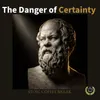
Certainty and hubris have always been part of being human. It feels good to be certain, to believe that your opinion is the right one. We like leaders who sound certain and shun those that don’t. But sounding right isn’t the same thing as having the truth. What if the actual way to truth is not through being certain, but by embracing uncertainty? “It is impossible for a man to learn what he thinks he already knows.” ― Epictetus The Problem We live in an age of certainty. Open any social media app and within seconds you’ll be hit with confident declarations on politics, relationships, health, ethics, all delivered with the kind of conviction that leaves no room for doubt. Hot takes are presented and settled truth. The more confident the claim, the more it spread. Certainty is the currency of attention. But here’s the problem: certainty is is a trap. It’s one of the more dangerous traps that we can fall into. Not just personally, but as a society. When we’re certain, we stop questioning. We stop listening. We lose our ability to sit with complexity and nuance. To consider that we may not be seeing the whole picture. We trade wisdom for the comfort of feeling right. That comfort is seductive. We like certainty because it feels safe. Ambiguity triggers the same neurological response as physical danger. Your brain would rather have a wrong answer than no answer at all. Uncertainty feels like we’re in the dark. Certainty feels like turning the light on, even if what we see is distorted. But the cost is enormous. Certainty damages relationships because if you already believe you have the truth, you can’t hear anyone who sees things differently. It damages communities because it turns disagreements into threats. And it damages your own capacity for growth. As Benjamin Franklin reminds us: “The doorstep to the temple of wisdom is a knowledge of our own ignorance.” — Benjamin Franklin Being able to sit in uncertainty, to acknowledge your ignorance, is where wisdom starts. Wisdom only comes to someone who is willing to be wrong. We don’t live in a black and white world, but certainty insists that we do. This isn’t a new problem. The ancient world wrestled with it too, and in one of Athens most cautionary tales, certainty brought down one of the world’s greatest civilizations. The Philosophy To understand the danger of certainty, we need to got back to 5th century BCE Athens. What happened there maps almost perfectly to what we’re going through right now. Like us, Athens was a democracy, which meant that political power belonged to whoever could best persuade the crowd. In this environment were a group of professional teachers called the Sophist. The Sophists were the original political spin doctors. They traveled from city to city teach rhetoric, the art of persuasion. But here’s the critical distinction: the didn’t teach people to discover the truth. They taught how to win arguments. How to make the weaker case appear stronger. How to use language to emotionally manipulate people, regardless if what was being spoken was true. In one of Plato’s dialogues, Socrates confronts the Sophist Grogias. Gorgias claims rhetoric is the greatest of all arts because it can convince anyone of anything. Socrates’ response is brutal: rhetoric without truth is flattery. It’s the difference between a doctor and pastry chef. One tells you what you need to hear. The other tells you what you want to hear. One of the more famous Sophist, Protagoras, said, “man is the measure of all things.” In other words, the truth is relative. There is no objective truth. Only what you can convince others to believe. That idea, weaponized by skilled rhetoricians and handed to skilled politicians, was extremely dangerous. And the politicians lined up to learn it. This was the environment that Socrates lived in, and he found it repugnant. Socrates had an entirely different starting point. When the Oracle at Delphi declared him the wisest man in Athens, he was genuinely baffled. So he went out to test it. He spoke with politicians, poets, craftsmen — anyone with a reputation for wisdom. And what he found was consistent: they all believed they knew things they didn't. They had mistaken confidence for knowledge. His conclusion was humble: his advantage was knowing that he didn't know. To Socrates, that awareness, that gap between what we think we know and what we actually know, is the beginning of all genuine wisdom. He even stated: “I know that I am wise because I know that I know nothing.” This is the practice we now call the Socratic method. Not debate. Not rhetoric. Disciplined questioning, that is designed to expose false certainty, including his own. The Sophists hated it. Because Socrates wasn't playing the same game. He didn't care about winning. He cared a
Podzilla Summary coming soon
Sign up to get notified when the full AI-powered summary is ready.
Free forever for up to 3 podcasts. No credit card required.
More from Stoic Coffee Break
Why Socrates Would Hate AI | 391
Inner Critic vs. Inner Coach | 390

The Pressure Code: Interview with Performance Coach Jason Stacy | 388
The Game You Didn't Know You Were Playing | 388
Get summaries like this every morning.
Free AI-powered recaps of Stoic Coffee Break and your other favorite podcasts, delivered to your inbox.
Free forever for up to 3 podcasts. No credit card required.