Free Daily Podcast Summary
Stock Talk: Daily Summaries Delivered
by Oak Harvest Financial Group
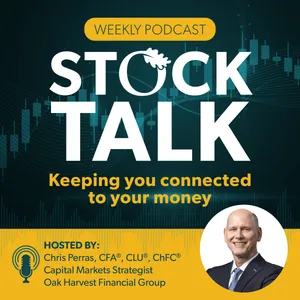
Retirement Focused Investment Stock Talk with Chris Perras, CFA®, CLU®, ChFC® Chief Investment Officer of Oak Harvest Financial Group. Advisory services are provided through Oak Harvest Investment Services, LLC, a registered investment adviser. Insurance services are provided through Oak Harvest Insurance Services, LLC, a licensed insurance agency.
Latest Episodes
The most recent episodes — sign up to get AI-powered summaries of each one.
- 6 days ago16 min
Dot-Com vs. AI Stock Cycles: “The Optimist” Stock Talk Update September 11, 2026
The AI boom keeps getting compared to the dot-com bubble. But what if the comparison is right—and the timing is wrong? A Bespoke Investment Group chart compares the Nasdaq after the launch of Netscape in 1994 with the Nasdaq after the launch of ChatGPT in 2022. At a comparable point in the two cycles, today lines up closer to September 1998 than the March 2000 dot-com peak. That doesn’t mean history will repeat. Historical comparisons aren’t forecasts. But it raises an important question: What evidence would tell us this AI cycle is nearing the end—and what evidence would suggest it may still be developing? In this episode of Stock Talk, we examine four major pieces of the argument: The historical Netscape-versus-ChatGPT market comparison, the spread of AI adoption and productivity, corporate earnings momentum, and today’s valuation and interest-rate risks. We also look at the massive increase in data-center construction, the difference between FOMO and what Ed Yardeni calls “Fabulous Earnings Momentum,” and evidence that market leadership has broadened beyond the Magnificent Seven. The goal isn’t to predict where stocks go next. It’s to ask a better question about where we may be in this technology and market cycle—and what evidence investors should watch from here. If you enjoy market analysis that looks at both the opportunity and the risk, subscribe to the channel and turn on notifications for future episodes of Stock Talk. If you’re approaching retirement and want to understand how markets, income needs, taxes, Social Security, withdrawal decisions, and risk fit into your personal retirement strategy, contact Oak Harvest Financial Group to start a conversation about your retirement plan. Important Disclosure: This content is for general informational and educational purposes only. It is not individualized investment advice or a recommendation to buy or sell any security or pursue any investment strategy. Investing involves risk, including possible loss of principal. Historical performance and historical comparisons do not guarantee or predict future results. Estimates and market data discussed in this video may change. YouTube Chapters These timestamps follow the actual uploaded cut. 00:00 AI vs. the Dot-Com Bubble 00:18 What If We’re Comparing It to the Wrong Year? 01:03 Four Tests for the AI Boom 01:33 The Netscape vs. ChatGPT Nasdaq Chart 02:45 Why the September 1998 Comparison Matters 03:07 Subscribe to Stock Talk 03:17 What Happened After 1998? 04:05 AI’s Real Economic Test: Productivity 04:52 AI Adoption Is Surging 05:47 The Data-Center Construction Boom 07:25 FOMO vs. Fabulous Earnings Momentum 08:07 What Earnings Are Telling Us 09:25 The Biggest Problem: Valuation 09:51 Stocks vs. 10-Year Treasury Yields 11:03 Is the Rally Broader Than AI? 11:47 The “Impressive 493” vs. Magnificent Seven 12:30 So Is This Another Dot-Com Bubble? 13:10 The Four Tests That Matter From Here 14:00 The Real Lesson From 1998 vs. 2000 14:36 The One Question Investors Should Ask 15:03 What This Means for Your Retirement
- 2 weeks ago15 min
Dotcom Bubble vs. AI Investment: Could the Federal Reserve “Family Fight” End Today’s Enthusiasm?
What if artificial intelligence changes the world—but some of today’s leading AI stocks still turn out to be the wrong investments at the wrong prices? In this episode of Stock Talk, Chris Perras looks back at the Dotcom era to explore an important distinction for investors: a technology can transform the economy without every stock connected to that technology delivering great investment returns. The Internet didn’t fail after the Dotcom crash. It went on to reshape commerce, communication, advertising and entertainment. But many technology investors still suffered enormous losses as valuations changed, interest rates rose and market leadership shifted. Could something similar happen during the AI boom? Rather than trying to predict an AI crash, Chris focuses on three signals that may help investors recognize whether market leadership is beginning to change: • STOCKS — Is technology continuing to dominate, or is leadership spreading into financials, industrials, energy, materials and international markets? • INTEREST RATES — What are the Federal Reserve, the 2-Year Treasury and the 10-Year Treasury telling us about the cost of money? • THE U.S. DOLLAR — Is the dollar strengthening and tightening global financial conditions, or weakening as commodities and international markets gain strength? Chris also explores a fascinating possibility: the massive infrastructure required to build artificial intelligence may eventually benefit businesses far outside traditional technology. AI data centers require electricity, copper, steel, cooling systems, transformers, natural gas, nuclear power, grid equipment and other physical infrastructure. Could the AI boom itself help create the next generation of market leaders? History doesn’t tell us exactly what happens next. But it can help investors recognize the conditions that have accompanied major changes in market leadership before. The important question may not be whether AI succeeds. It may be whether today’s investors are paying the right price for that future. If changing interest rates, inflation, market leadership or a different investment cycle has you wondering how your retirement plan could be affected, contact Oak Harvest Financial Group to schedule a conversation about your financial plan. Subscribe to Stock Talk for more conversations connecting market history with what’s happening in the economy and financial markets today. This material is for general education and information only. It isn’t individualized investment, tax or legal advice. Any mention of stocks, sectors, commodities or asset classes is for discussion only and shouldn’t be seen as a recommendation to buy or sell any investment. Investing involves risk, including the possible loss of principal. Past performance doesn’t guarantee future results. Advisory services are offered through Oak Harvest Investment Services, LLC, an SEC-registered investment adviser. SEC registration doesn’t mean the SEC or any other regulator endorses the firm, and it doesn’t mean a certain level of skill or training. #ArtificialIntelligence #StockMarket #Investing #AIStocks #MarketOutlook Chapters: 0:00 AI Can Win While AI Stocks Lose 1:44 Is AI a Bubble—or the Wrong Question? 2:44 What the Dotcom Era Can Teach Us 4:59 Signal #1: Watch Market Leadership 6:30 Could AI Create the Next Hard-Asset Boom? 7:13 Signal #2: Watch Interest Rates 9:09 Signal #3: Watch the U.S. Dollar 10:57 How Similar Is Today to the Dotcom Era? 12:06 The Biggest Lesson From the Dotcom Crash 12:58 Three Signals Investors Should Watch Now
- 2 weeks ago18 min
Living in a Material World: After AI (Dot-Com), What Might Be Next? Stock Talk Update August 28, 2026
Artificial intelligence may be the biggest technology story in the market — but the next major investment opportunity connected to AI may not be another AI stock. As companies like Microsoft, Amazon, Google and Meta spend hundreds of billions of dollars building AI infrastructure and data centers, they're also creating enormous demand for something much more physical: electricity, copper, steel, transformers, natural gas, uranium, electrical equipment and the infrastructure needed to connect it all. So what happens if the AI boom eventually creates a materials boom? In this episode of Stock Talk, we look back at what happened after technology stopped dominating the market around the dot-com era and examine whether investors could be seeing the early stages of another major shift in market leadership. After the Nasdaq peaked in 2000, some of the strongest investments of the following years weren't technology companies. Copper, gold, mining companies, materials and commodity-producing countries experienced enormous gains as China's rapid industrialization created a massive new source of global demand. Today's situation is different — but there may be an important similarity. AI data centers require enormous amounts of electricity. That means additional power generation, transmission lines, transformers, copper, steel and other physical infrastructure. According to the International Energy Agency, global data-center electricity consumption was approximately 415 terawatt-hours in 2024 and could reach roughly 945 terawatt-hours by 2030 under its Base Case. In this video, we explore: Why market leadership changed dramatically after the dot-com boom What created the commodity supercycle of the 2000s Why copper prices rose dramatically during that period How AI data centers are changing global electricity demand Why copper, power infrastructure, uranium, natural gas and electrical equipment could become increasingly important Why materials have historically underperformed the broader market for years What the XLB Materials ETF may be telling investors How limited mining investment could affect future commodity supply Why AI could eventually become as much an infrastructure story as a technology story What investors should watch for if market leadership begins to change The important takeaway isn't that technology stocks have to collapse or that commodities are guaranteed to enter another supercycle. It's that market leadership changes. The companies and sectors that dominated one investment cycle don't necessarily dominate the next. And if artificial intelligence continues growing, the next major investment story may not simply be the companies building AI. It may be the companies supplying the materials, electricity and infrastructure required to build the AI economy. If you're approaching retirement or you're already retired and you'd like someone to review your investments, income needs, risk, and how those pieces fit together with your retirement strategy, contact Oak Harvest Financial Group. There’s no obligation. We’ll learn more about your goals, income needs, and concerns and help you understand whether there may be opportunities to improve your retirement plan. https://click2retire.com/lets-connect And if you enjoy videos that make markets, investing, and retirement easier to understand, subscribe to the channel: https://www.youtube.com/@OakHarvestStockTalk?sub_confirmation=1 This content is for educational and informational purposes only and should not be considered individualized investment, tax or financial advice. Investing involves risk, including the possible loss of principal.
- 3 weeks ago15 min
Earnings Up, Rates Up: Who Wins the Tug-of-War? Stock Talk Update Aug 21, 2026
The S&P 500 has climbed sharply since the market lows of April 2025—but something unusual has happened at the same time: interest rates have also moved higher. So why haven't higher rates stopped the stock market? In this episode of Stock Talk, we break down the tug-of-war between corporate earnings and interest rates and explain why earnings growth has been powerful enough, so far, to overcome the pressure of higher Treasury yields. We also look at what could happen next. Using S&P 500 earnings estimates and different P/E assumptions, we'll walk through several illustrative scenarios for 2027—including what could potentially support an S&P 500 around 8,500, what could bring it closer to 7,200, and how a combination of falling earnings estimates and higher interest rates could create a much more difficult 6,500 scenario. In this video you'll learn: ✔ Why stocks and interest rates have both been rising ✔ Why earnings have been such an important driver of the market ✔ How higher Treasury yields can pressure stock valuations ✔ Why the S&P 500 can rise even while its P/E ratio falls ✔ How earnings and P/E multiples work together to determine market valuations ✔ What could support an S&P 500 around 8,500 ✔ What could push valuations toward 7,200 or lower ✔ The two numbers investors should be watching through 2026 and into 2027 The key isn't trying to predict exactly where the market will go. It's understanding what's driving it. If you're approaching retirement or you're already retired and you'd like someone to review your investments, income needs, risk, and how those pieces fit together with your retirement strategy, contact Oak Harvest Financial Group. There’s no obligation. We’ll learn more about your goals, income needs, and concerns and help you understand whether there may be opportunities to improve your retirement plan. https://click2retire.com/lets-connect And if you enjoy videos that make markets, investing, and retirement easier to understand, subscribe to the channel: https://www.youtube.com/@OakHarvestStockTalk?sub_confirmation=1 Sources discussed: FactSet Earnings Insight S&P 500 earnings estimates 10-Year U.S. Treasury Yield Important Disclosure: This content is for educational and informational purposes only and isn't intended as individualized investment advice. Market scenarios discussed are illustrative and aren't predictions or guarantees of future results. Investing involves risk, including the possible loss of principal. 00:00 Something Strange Is Happening in the Stock Market 01:10 Earnings vs. Interest Rates: The Tug-of-War 02:08 Point 1: Earnings Are Winning 03:21 Where Earnings Could Go Next 04:51 Why Hasn't the Market Gone Even Higher? 05:00 Point 2: Interest Rates Are Fighting Back 05:38 How Stocks Can Rise While the P/E Falls 06:24 Why the 10-Year Treasury Matters 07:31 What Happens Next? 08:23 The Bull Case: S&P 500 Around 8,500 09:11 The Higher-Rate Case: Around 7,200 10:12 The Bear Case: Around 6,500 11:07 The Two Numbers Investors Should Watch 12:05 The Number That Explains This Market 13:00 The Biggest Risk to Stocks 13:38 What This Means for Your Retirement
- Aug 14, 202616 min
Did Warsh Just “Light this Candle”? Stock Talk Update August 14, 2026
Is the AI boom beginning to rhyme with the late 1990s? Strong earnings, record market highs, massive semiconductor investment, and an unusual shift in global currency conditions are creating a market setup investors should be watching closely. In this video, we examine the growing comparison between today’s AI-driven market and the final stages of the dot-com boom. The comparison became even more interesting after the United States and Japan stepped in to support the Japanese yen—an unusual development that raises an important question: could changing global financial conditions provide another source of liquidity at the same time earnings and AI investment remain strong? That doesn’t mean 2026 has to repeat 1999. Today’s largest AI companies are generating substantial revenue, profits, margins, and cash flow. But history shows that strong businesses, strong earnings, improving liquidity, and increasing investor enthusiasm can sometimes combine to produce powerful—and increasingly speculative—late-cycle markets. In this video, we break down: ✔ Why the 1999 dot-com comparison is becoming more interesting ✔ What strong corporate earnings are telling us about the market ✔ Why semiconductor earnings remain critical to the AI investment cycle ✔ How massive AI infrastructure spending could affect future returns ✔ Why the U.S.-Japan yen intervention matters ✔ What happened during the Y2K liquidity window in 1999 ✔ How interest rates and inflation expectations affect stock valuations ✔ Why liquidity could become an important market driver ✔ Four indicators investors should be watching from here ✔ What this environment could mean for retirees and people approaching retirement The goal isn’t to predict exactly what the market will do next. Instead, we believe investors should focus on the forces underneath the market: earnings, interest rates, AI investment, liquidity, and the dollar—and make investment decisions within the context of their own financial plan, income needs, time horizon, and ability to tolerate risk. If you’re retired or getting close to retirement and would like a second opinion on your investment and retirement plan, use the link below to schedule a free consultation with Oak Harvest Financial Group. There’s no obligation. We’ll learn more about your goals, income needs, and concerns and help you understand whether there may be opportunities to improve your retirement plan. https://click2retire.com/lets-connect 00:00 Is the AI Boom Starting to Look Like 1999? 00:42 The New Yen Intervention Signal 01:26 This Is Bigger Than AI 02:20 The Market Framework We’ve Been Using 03:10 What We Expected for the Second Half of 2026 03:52 Earnings Are Still the Engine 05:21 Are Stocks Too Expensive? 06:49 AI’s Massive Physical Buildout 07:45 The Biggest AI Spending Risk 09:02 Why Liquidity Changes the Story 09:23 What Happened in 1999 10:25 The 2026 Yen Intervention 11:12 The Interest-Rate Risk 11:58 The Real Question Investors Should Ask 12:18 What 1999 Can—and Can’t—Tell Us 13:23 Confidence and Caution 14:16 Four Things to Watch Now 15:34 Free Retirement Plan Consultation #StockMarket #ArtificialIntelligence #RetirementPlanning
- Aug 7, 202620 min
From Dot-Com Bubble to AI, “Situationally UnAware” Stock Talk Update August 7, 2026
An investor can be completely right about the future—and still lose money in the present. That happened during the dot-com boom. The internet really did change the world, but concentrated portfolios, extreme valuations, leverage, and tighter financial conditions still caused enormous investment losses. Now, a similar lesson is emerging from the AI investment cycle. In this video, we compare the dot-com bubble of 1998–2000 with today’s massive AI infrastructure buildout. We examine how a highly successful AI-focused investment strategy reportedly suffered a severe short-term decline, despite being built around a technology trend that may continue growing for years. You’ll learn: • How a smart investment idea can become a crowded and leveraged trade • Why being right about a technology doesn’t guarantee investment success • How leverage can force investors to sell at the worst possible moment • Why the AI data-center and semiconductor buildout resembles the internet infrastructure boom • How interest rates, inflation, energy prices, and tighter liquidity can affect growth investments • Why retirees face greater consequences from concentration and major portfolio declines • Four warning signs investors may want to monitor during the AI investment cycle AI may change the world just as the internet did. But great technology doesn’t cancel the basic rules of investing. Price still matters. Cash flow still matters. Debt still matters. Diversification still matters. And the amount of time you have to recover still matters. If you’re retired or approaching retirement, your financial plan shouldn’t depend on one company, one technology, or one market trend working perfectly. To speak with the team at Oak Harvest Financial Group about building a retirement plan around your income needs, goals, time horizon, and risk tolerance, contact us today. Visit: https://oakharvestfg.com/ This video is provided for educational purposes only and is not intended as personalized investment, tax, or legal advice. All investments involve risk, including the possible loss of principal. Information and performance figures discussed in this video were obtained from third-party public reporting and have not been independently verified by Oak Harvest Financial Group. 00:00 The “Smartest Investor” Trade 01:09 Important Investment Disclaimer 01:20 Right About the Future, Wrong About the Investment 01:55 Three Dot-Com and AI Comparisons 02:23 Living Through the Dot-Com Bubble 03:43 The Recent AI Fund Warning 04:05 When a Great Idea Becomes Dangerous 04:33 Comparison #1: Concentration and Leverage 05:28 The New AI Investment Hero 06:20 How Leverage Magnifies Losses 06:43 The Reported 67% Decline 07:16 The Real Lesson for Retirees 08:09 Comparison #2: The Physical Buildout 08:37 What “Dark Fiber” Taught Investors 09:16 The Massive AI Infrastructure Boom 10:16 Why Semiconductor Cycles Turn 11:01 The Question Every AI Investor Should Ask 11:17 AI Is Making Big Tech More Asset-Heavy 11:52 Comparison #3: How the Dot-Com Bubble Broke 12:09 Liquidity, Y2K and Higher Interest Rates 12:43 When Valuations Lost Support 13:12 Why 2026 May Rhyme With 2000 14:14 How Today’s AI Boom Is Different 14:45 The New Risk Facing Profitable Tech Companies 15:43 The Problem Wasn’t the Technology 16:18 Why This Matters More in Retirement 17:00 Four AI Warning Signs to Watch 18:24 How to Invest Without Betting Your Retirement 19:10 Build a More Resilient Retirement Plan
- Aug 5, 20267 min
Inflation, and Two Other Threats to Your Retirement Savings: Stock Talk Update July 31, 2026
Inflation, interest rates, and energy prices may look like three separate financial risks—but they are deeply connected. In this episode, Chris Perras of Oak Harvest Financial Group explains how rising energy costs can contribute to inflation, how inflation influences Federal Reserve policy, and how higher interest rates can affect stocks, bonds, cash, and the long-term purchasing power of retirees. For retirees and those approaching retirement, the biggest danger may not be short-term market volatility. It may be the gradual loss of purchasing power as groceries, prescriptions, insurance premiums, utilities, transportation, and other living expenses continue to rise. Chris also explains: ✔ Why inflation is often called the silent wealth killer ✔ How higher interest rates can help savers but pressure bond prices and stock valuations ✔ Why energy costs affect far more than gasoline prices ✔ How oil, inflation, and interest rates create a financial chain reaction ✔ Why predicting every Federal Reserve decision is not a retirement strategy ✔ How diversification, liquidity, discipline, and quality investments can help build a more resilient retirement portfolio ✔ Why retirement planning should focus on meeting your needs before chasing your greed You cannot control inflation, interest rates, or oil prices—but you can control how your retirement portfolio is positioned and how you respond to changing conditions. Which of these risks concerns you most: inflation, interest rates, or energy prices? Share your thoughts in the comments. To speak with the Oak Harvest Financial Group team about building a retirement plan around your income needs, investments, taxes, healthcare, and long-term goals, contact us today. 00:00 The 3 biggest retirement risks right now 00:55 Risk #1: Inflation 01:27 Why inflation hits retirees differently 01:49 How inflation influences the Federal Reserve 01:57 Risk #2: Interest rates 02:07 The benefit of higher rates for savers 02:31 The trade-off of higher interest rates 02:36 The 100-year Austrian bond example 03:07 Interest rates and investment valuations 03:21 Risk #3: Energy prices 03:30 How energy raises costs throughout the economy 03:56 Cost-push inflation explained 04:05 Why energy may be the first domino 04:19 How the three risks are connected 04:43 Building a portfolio that can withstand all three 05:22 The biggest lesson for retirees 05:34 What investors can actually control 05:59 Final thoughts #RetirementPlanning #Inflation #InterestRates #RetirementInvesting #EnergyPrices #RetirementIncome #FinancialPlanning #Investing Stock Talk is a weekly vlog/podcast dedicated to discussing the Oak Harvest Financial Group Investment Team's perspective on what's happening in the market. Hosted by Chief Investment Officer Chris Perras, each episode brings you our views on stocks, the market, and the economy with a little education thrown in for good measure. Listen each week and help stay connected to your money! Do you need a retirement plan that goes beyond allocating funds to truly fit your needs? We can help you create a retirement life plan customized for your retirement vision and legacy. Call us at 877-896-0040 or fill out this form for a free visit: https://click2retire.com/lets-connect Important disclosures: Content of Oak Harvest podcasts expresses the views of the speaker and is for informational purposes only. Oak Harvest believes that any data, articles, or information cited are reliable at the time of creation, but does not warrant any information contained herein to be correct, complete, accurate, or timely. References to third-party analysts should not be seen as an endorsement of their views or recommendations, and you should do your own research before investing. The views and opinions expressed herein may change without notice. Strategies and ideas discussed may not be right for you, and nothing in this podcast constitutes personalized investment, tax or legal advice, or an offer or solicitation to buy or sell securities. Indexes such as the S&P 500 are not available for direct investment and your investment results may differ when compared to an index. Any specific portfolio actions or strategies discussed will not apply to all client portfolios. Investing involves the risk of loss, and past performance is not indicative of future results.
- Aug 5, 202610 min
SpaceX IPO: What We Learned. The Real Story is Investor Expectations
What if one of the greatest companies ever built turns out to be a disappointing investment? In this video, I explain why this isn’t really a story about SpaceX—it’s a story about investor expectations, IPO hype, and the price you pay for even the most extraordinary businesses. Drawing on more than 35 years of investment experience, I compare today’s excitement around SpaceX to past market favorites like Amazon, Tesla, and the dot-com era, and show why great companies don't always make great stocks. If you're considering investing in high-profile IPOs or simply want to become a more disciplined long-term investor, this is a lesson you won't want to miss. Stock Talk is a weekly vlog/podcast dedicated to discussing the Oak Harvest Financial Group Investment Team's perspective on what's happening in the market. Hosted by Chief Investment Officer Chris Perras, each episode brings you our views on stocks, the market, and the economy with a little education thrown in for good measure. Listen each week and help stay connected to your money! Do you need a retirement plan that goes beyond allocating funds to truly fit your needs? We can help you create a retirement life plan customized for your retirement vision and legacy. Call us at 877-896-0040 or fill out this form for a free visit: https://click2retire.com/lets-connect Important disclosures: Content of Oak Harvest podcasts expresses the views of the speaker and is for informational purposes only. Oak Harvest believes that any data, articles, or information cited are reliable at the time of creation, but does not warrant any information contained herein to be correct, complete, accurate, or timely. References to third-party analysts should not be seen as an endorsement of their views or recommendations, and you should do your own research before investing. The views and opinions expressed herein may change without notice. Strategies and ideas discussed may not be right for you, and nothing in this podcast constitutes personalized investment, tax or legal advice, or an offer or solicitation to buy or sell securities. Indexes such as the S&P 500 are not available for direct investment and your investment results may differ when compared to an index. Any specific portfolio actions or strategies discussed will not apply to all client portfolios. Investing involves the risk of loss, and past performance is not indicative of future results.
Get Stock Talk summaries in your inbox
Free AI-powered daily recaps. Key takeaways, quotes, and mentions — in a 5-minute read.
Get Free Summaries →Free forever for up to 3 podcasts. No credit card required.
You Might Also Like
Listeners also like.
InvestTalk
Weekday discussions on investing, financial planning, and market trends with advisers Justin Klein and Luke Guerrero.

The Rundown
A daily breakdown of major stock market movements and economic news to help investors stay informed.
Thoughts on the Market
Analysis of current market events from Morgan Stanley experts.

The Compound and Friends
A weekly discussion on business and investing with rotating guests offering expert analysis and opinions.

The Investor's Podcast (We Study Billionaires) - The Investor’s Podcast Network
Analyzes the investment strategies of billionaire investors and explores lessons from legendary financiers on wealth, wisdom, and life.
Investing Experts
Market analysis and stock insights from top analysts and industry experts.

Stock Movers
Daily analysis of top-performing and struggling stocks across global markets, covering major sectors and breaking investment news.

Animal Spirits Podcast
Discussions on markets, investing, and life through the lens of current reads, media, and financial trends.

Excess Returns
Discusses long-term investing strategies with finance experts, focusing on macroeconomics, value investing, and factor-based approaches.

The Best One Yet
Daily business news explained through sharp analysis and witty commentary, delivered in concise 20-minute episodes.

The Real Eisman Playbook
A legendary investor analyzes markets, economic trends, and financial crises with candid, no-nonsense commentary.
Invest Like the Best with Patrick O'Shaughnessy
Interviews with top investors and business leaders reveal strategies and insights for smarter investing and decision-making.
About Stock Talk
Retirement Focused Investment Stock Talk with Chris Perras, CFA®, CLU®, ChFC® Chief Investment Officer of Oak Harvest Financial Group. Advisory services are provided through Oak Harvest Investment Services, LLC, a registered investment adviser. Insurance services are provided through Oak Harvest Insurance Services, LLC, a licensed insurance agency.
Customized Recaps
AI-powered recaps with compact key takeaways, quotes, and insights.
Straight to Your Inbox
Get key takeaways from Stock Talk in a 5-minute read.
Save Hours Every Week
Stay current on your favorite podcasts without falling behind.
Frequently Asked Questions
What is Podzilla's Stock Talk daily summary?
It's a free AI-powered email that summarizes new episodes of Stock Talk as soon as they're published. You get the key takeaways, notable quotes, and links & mentions — all in a quick read.
How does the Stock Talk podcast summary work?
When a new episode drops, our AI transcribes and analyzes it, then generates a personalized summary tailored to your interests and profession. It's delivered to your inbox every morning.
Is this an official Stock Talk product?
No. Podzilla is an independent service that summarizes publicly available podcast content. We're not affiliated with or endorsed by Oak Harvest Financial Group.
Can I get summaries of other podcasts too?
Absolutely! The free plan covers up to 3 podcasts. Upgrade to Pro for 15, or Premium for 50. Browse our full catalog at /podcasts.
How often does Stock Talk release new episodes?
Stock Talk publishes weekly. Our AI generates a summary within hours of each new episode.
What topics does Stock Talk cover?
Stock Talk covers topics including Business, Investing. Our AI identifies the specific themes in each episode and highlights what matters most to you.
Start getting Stock Talk summaries tomorrow morning.
Free forever for up to 3 podcasts. No credit card required.
Free forever for up to 3 podcasts. No credit card required.