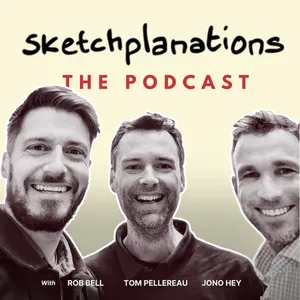
Free Daily Podcast Summary
Sketchplanations - The Podcast: Daily Summaries Delivered
by Bell Boy Productions
Get key takeaways, quotes, and insights from Sketchplanations - The Podcast in a 5-minute read. Delivered straight to your inbox.
Latest Episodes
The most recent episodes — sign up to get AI-powered summaries of each one.
- Today31 min
Is Your Country Double Landlocked? It's Highly Unlikely!
Double Landlocked countries are places you must cross at least two national borders to reach a coastline connected to the world’s oceans. In this episode we talk about the nuances of landlocked definitions (including why the Caspian Sea doesn’t count) and identify the only two double landlocked countries: Liechtenstein, surrounded by Switzerland and Austria, and Uzbekistan, surrounded by landlocked “stans.” The conversation expands into why ports and sea access matter for trade and geopolitics. We also explore controversial definitions for landlocked US states (including Nebraska as “triple landlocked”), distances from the sea in Britain and China, disputed borders, recursive islands, and a Google Maps oddity between the Shetlands and Faroe Islands. It's definitely one for maps and geography nerds!References: Tom mentions Tim Marshall's book, Prisoners of GeographyJono also references some of his other sketches: Recursive Islands and Triple Landlocked StatesWe also reference the previous podcast episode on Antipodes for how so much of the Earth is water. Episode Summary:00:00 What Double Landlocked Means04:17 The Only Two Countries05:45 Caspian Sea and Definitions06:53 Recursive Borders in UAE08:33 Why Ports Matter12:13 Bolivia and Africa Surprise13:52 Distance From the Sea18:02 Landlocked US States Debate25:23 More Geography Oddities28:48 Shetlands to Faroes Map Quirk30:06 Closing Thoughts Hosted on Acast. See acast.com/privacy for more information.
- 2 weeks ago35 min
How To Become An Overnight Success.
This discussion centres on “overnight success” as an illusion; prompted by Jono’s sketch of Twitter Cofounder, Biz Stone’s quote: “Timing, perseverance, and 10 years of trying will eventually make you seem like an overnight success.”Using an iceberg metaphor (most work hidden below the surface), we explore how Twitter, Uber, Airbnb, GoPro, Pinterest and other “sudden” hits were built through long periods of effort, failed attempts, near-bankruptcies and luck-driven timing.Tom shares his own journey from inventing the curved nail file in 2004 to major success after winning The Apprentice, plus later product launches, illustrating visible turning points built on years of groundwork. We also look at creative fields and sport, survivorship bias, and belief, persistence, readiness, and timing.External LinksIn the conversation, we referenced these items which you can find more information on here:Our Listener SurveyBiz Stone's book: Things A little Bird Told MeJono's sketches on Iceberg Orientation & Survivorship BiasOur previous episode on Optimism BiasEpisode Summary00:00 Introduction01:13 Biz Stone Quote03:10 Iceberg Metaphor04:09 Biz Stone Backstory04:36 From Blogger to Twitter07:37 Myth of Viral Success09:59 Tom's Real World Examples12:31 Sketchplanations Slow Burn16:06 Perseverance and Belief18:52 Timing and Viral Moments20:59 The Turning Point21:35 Apprentice Timing Advantage24:43 Jono on Luck and Timing26:34 Sports Overnight Success28:42 Survivorship Bias Reality29:47 Do Overnight Successes Exist32:15 Advice Perseverance Mindset34:29 Wrap Up and Credits Hosted on Acast. See acast.com/privacy for more information.
- 4 weeks ago22 min
Play Until Something Gets Broken
In this fun and nostalgic conversation, we discuss Jono's observation that with indoor games especially, as the momentum builds, you keep playing until something gets broken!There's a cheeky inevitability to it. It's a situation we've almost all certainly been in - whether you were the protagonist or not!We share our childhood and adult stories of hallway ball games, broken lamps and mirrors, a university corridor culture of improvised sports, Nerf-gun firing ranges ending with a foam dart to the eye, and a school-trip pillow fight that took out a light fitting. The conversation expands to similar “stop conditions” in outdoor games and with sports injuries, and connects the idea to the Generalised Peter Principle: anything that works is pushed into progressively more challenging situations until it fails. What are you experiences with this?Links to items we discussed:Jono's impossible "lamp thru TV" sketch has connotations of Escher's Impossible StaircaseJono's sketch and our past podcast episode about The Peter PrincipleJono's sketch on The Generalised Peter PrincipleRob referenced a visit to the Belleek Pottery factory whilst filming in Northern Ireland.Episode Summary: 00:00 Podcast popularity in USA01:12 The Indoor Games Rule02:48 Ball Games Banned04:40 Injuries End The Game08:09 Uni Corridor Games08:58 Sketch Breakdown10:37 Why Indoor Play Matters11:00 Messy Space Dreams14:02 Adult Injuries End Games14:58 Pillow Fight Lamp Smash16:05 Hide Underwater Tactic16:40 Generalized Peter Principle17:32 Sacrificial Breakables21:11 Anger Smashing Question21:44 Closing Hosted on Acast. See acast.com/privacy for more information.
- Apr 7, 202652 min
Submarine Lessons for Business Leadership
US Navy submarine captain and author David Marquet discusses leadership lessons from turning the USS Santa Fe from worst to best, focusing on “pushing authority to information” rather than pushing information up a hierarchy. Marquet critiques industrial-age leadership language that seeks obedience and creates “bobblehead” agreement, arguing that real engagement comes from giving people decision-making authority,He also explains “distancing,” as a leadership and decision-making tool: viewing oneself from a third-person, from a different time, and/or from a different place to reduce ego and defensiveness over previous decisions. A thoroughly fascinating chat with a very talented and fun individual. External Links for items referenced in the conversation:David’s 3 books can be found here: Turn the Ship Around (+ workbook), Leadership is Language, and DistancingHere are two of many of David's talks to be found on YouTube: What is leadership? and Turn the Ship Around at the World Web ForumHere's the YouTube video of David rating submarine movies for how realistic they portray life under the waves.David talks about advice given to him by Simon SinekSome of Jono's other skecthes references in this podcast include: Solvitor Ambulando (it is solved by walking); 9 windows (problem solving tool); Anchors and Tugboats (self-talk)David talks about ultra-runner extraordinaire Courtney DauwalterSummary00:00 From Cold War Kid to Submariner03:02 Life Aboard a High-Performing Sub03:53 The Arbitrary Officer Divide04:40 Student Not "Expert"05:51 Words That Kill Curiosity08:44 What Leadership Was Taught12:37 Pushing Authority to Information16:03 Submarine Leave Approval Hack20:02 Authority in Everyday Workplaces21:59 Bias for Action and Excellence22:46 Distancing to Decide Better25:41 Put Them In Your Chair26:12 Distancing In Space & Time27:45 Inviting Feedback Culture28:52 Nine Windows Thinking Tool30:25 You Can Do It Self Talk32:28 Regret Proof Decisions38:04 Journaling Into A Book39:41 Be Your Own Coach45:50 Team Reviews Without Defensiveness47:19 Live Big Bold Lives48:14 Submarine Movies And Ambiguity50:55 Wrap Up Hosted on Acast. See acast.com/privacy for more information.
- Mar 24, 202629 min
Hitting the Target: Accuracy vs. Precision
Using Jono’s sketch of four archery targets, we discuss why and how accuracy and precision differ.Using many different examples, we frame the distinction as “accuracy being true to intention and precision being true to itself,” also phrased as doing the right thing versus doing it right.The sketch is inspired by Simon Winchester's book, Exactly, where precision and accuracy are connected to the industrial revolution via Henry Maudsley’s innovative screw-cutting lathe, micrometer, and the concept of interchangeable parts. The conversation broadens to explore examples in food (McDonald’s vs artisan meals), recipes, recruiting, IQ tests (validity vs reliability), indoctrinated beliefs, gut feelings, culture’s return to individual craftsmanship, AI’s variable answers, LED mask wavelength tolerances, and targeting weapons.External linksAlso referenced in this episode:Jono's sketch that describes the difference between Reliability and Validity.Jono's sketch inspired by Roger Martin's Knowledge Funnel.Jono's sketch outlining The Beard Cycle.Episode Outline00:00 Accuracy vs Precision: the Four Target Sketch03:23 True to Intention04:11 Ball Through Window05:44 Precision Built World09:45 Food and Recipes13:27 Calibration and Scales14:47 Manufacturing Tolerances16:51 Hiring and Testing19:16 Beliefs and Education23:01 Culture and Craft26:09 Doctors Robots and AI29:03 Wrap Up and CreditsAll music on this podcast series is provided by the very talented Franc Cinelli and you can find more tracks at franccinelli.com Hosted on Acast. See acast.com/privacy for more information.
- Mar 10, 202633 min
Do you Know Your Dashes?
If you like the finer details of grammar and punctuation, then you're gonna love this episode.We geek out on the subtle, but incredibly important and occasionally crucial differences between three little horizontal lines: the hyphen - the En Dash – and the Em Dash —Jono explains hyphens for line breaks and compound terms, how usage can evolve into single words (e.g., wildlife, wellbeing), and why hyphen placement can change meaning (e.g., five-dollar bills). The en dash is described as linking ranges and relationships (pages, dates, times, scores, routes, debates, partnerships, negotiations), with notes on how to type it. The em dash is framed as a stronger-than-comma interruption for added thoughts, with style cautions and typing methods. They discuss underscore origins from typewriters, punctuation differences across countries, and how AI popularized em dashes as a telltale sign of machine-written text.Most importantly though, we discuss why this matters and that if used correctly, they can help avoid misunderstandings.Episode Summary00:00 Welcome to Sketchplanations00:40 What Are Dashes03:09 Hyphen Basics04:32 Hyphenated Words05:35 Language Evolves07:00 Hyphen Pitfalls07:31 Tom on Hyphens10:38 Meet the En Dash11:41 Typing En Dashes12:32 En Dash Use Cases14:47 Spacing and Style15:30 Introducing Em Dash15:33 Em Dash Basics16:15 Style Guide Rules18:08 Brackets vs Speech18:57 Where Names Come From20:32 Underscore Origins22:05 Reading Dashes Aloud24:39 Does It Matter26:04 Oxford Comma Stakes28:36 AI Em Dash Tell29:59 Typing Em Dashes30:32 Punctuation By Country31:41 Morse Code And Minus32:43 Final Sign OffExternal LinkThere's only one link this week:Jono referenced the book Strunk and White : The Elements of StyleAll music on this podcast is provided by the very talented Franc Cinelli. Hosted on Acast. See acast.com/privacy for more information.
- Feb 24, 202617 min
Digging Through the Planet: The Geography of Antipodes
Have you ever wondered what's happening on the exact opposite side of the world to you?Wherever you are on our planet, there's a good chance you'd need a snorkel.In this episode, we explore the concept of antipodes—the exact point on the opposite side of Earth from wherever you're standing. We discover why most antipodes end up in the ocean rather than on land and cover a whole host of fascinating geographic facts, including how the Northern Hemisphere contains the vast majority of Earth's land and population, how map projections distort our view of the planet, and why Earth's oblate spheroid shape means some antipode distances are longer than others.Along the way, we also raise the big questions like how deep have humans ever dug into Earth and how long it would take to fall through a frictionless tunnel to your antipode.External Links and mentions on the show:Jono's sketch that explains the Mercator Map Projection Jono references the Antipodal Map in the book Marvellous Maps by Simon KuestenmacherThe 7.6 mile deep hole Jono talks about is the Kola Superdeep Borehole in Russia, initiated by Soviet scientists in 1970, primarily to better understand the earth’s crust. Here's Jono's sketch about the thickness of the earth's crust being proportionally similar to the thickness of an apple's skin. And finally, if you want to know your exact antipode, you can look here on AntipodeMap.comEpisode Summary00:00 What Are Antipodes03:23 Land Distribution on Earth04:14 Map Projections and Perspectives07:19 Antipodal Map Overlay08:56 Cultural References Worldwide10:15 Etymology of Antipode10:41 Digging Through Earth12:44 UK Antipodes13:29 Great Circle Routes14:20 Earth's Oblate Shape15:25 Tunnel Through Earth16:34 Closing RemarksAll music on this podcast series is provided by the very talented Franc Cinelli Hosted on Acast. See acast.com/privacy for more information.
- Feb 10, 202626 min
The closer you look, the longer it gets: The Coastline Paradox
When you want to measure something you take your ruler or tape measure and read off the length right?But when it comes to measuring the length of a coastline, things get a bit tricky and totally counter intuitive. 🌊The science and maths of measuring wiggly coastlines reveal that the smaller the unit of measure, the longer the coastline becomes. Jono recounts the origins of this phenomenon from polymath, Lewis Fry Richardson and its further exploration by Benoit B. Mandelbrot. The trio also relate the concept to various other real-world examples, including the surfaces of the brain and lungs, Romanesco cauliflower, and stock market patterns. Additionally, they touch on the philosophical implications of measurement and delve into the concept of infinity.Episode Summary:00:00 Introduction the Coastline Paradox04:12 Historical Context and Discovery14:10 Fractals and Natural World Applications17:26 Modern Implications and Analogies24:36 Conclusion and Final ThoughtsExternal Links and mentions on the show:Jono refers to and leans heavily on the writing of Geoffrey West in his book "Scale" to tell the story of how this was discovered.Rob's half-baked fact about The Standardised Meter can be expanded on here.This is what the self-similarity of a Romanesco Cauliflower looks likeHere is the avenue of trees in Bushy Park, in Southwest London that Jono slalomed.Here are more facts on who originally defined the number 'zero' as we know it today.All music on this podcast series is provided by the very talented Franc Cinelli Hosted on Acast. See acast.com/privacy for more information.
Get Sketchplanations - The Podcast summaries in your inbox
Free AI-powered daily recaps. Key takeaways, quotes, and mentions — in a 5-minute read.
Get Free Summaries →Free forever for up to 3 podcasts. No credit card required.
You Might Also Like
Listeners also like.
Blinkist Podcast - Interviews | Personal Development | Productivity | Business | Psychology
Ben Schuman-Stoler. Making big ideas personal. Get personal growth and business lessons from thought leaders and entrepreneurs.
SpaceTomatoes
SpaceTomatoes-podcast
Design Talk (dot IE)
Allen Higgins
Creator Science with Jay Clouse
Jay Clouse
Audience of One
Spencer Kier
not a straight line
Peter Daly-Dickson
Software Misadventures
Ronak Nathani, Guang Yang

TomorrowScale Podcast
Justin Briggs
The Good Ship Illustration
The Good Ship Illustration
The Jordan Harbinger Show
Jordan Harbinger
MindHack
Cody McLain
Design Principles Pod
Sam Brown, Ben Sutherland and Gerard Dombroski
About Sketchplanations - The Podcast
Big Ideas explored through Little Pictures. We offer up great conversations about ideas based on simple and insightful sketches in the Sketchplanations online collection, with the aim of giving listeners something fun and interesting to have their own conversations about.This is an explainer podcast for the curious-minded. Topics covered include science, behavioural economics, wellbeing, nature, psychology frameworks, business models, cognitive biases, and even domestic life-hacks. It's certainly not a self-help podcast, but you might take something away that helps you notice or even enjoy the world around you a little more.Sketchplanations illustrator and author Jono Hey joins lifelong friends Tom Pellereau (2011 Apprentice Winner) and Rob Bell (Engineer & Broadcaster) to share ideas and stories catalysed by each week's
Customized Recaps
AI-powered recaps with compact key takeaways, quotes, and insights.
Straight to Your Inbox
Get key takeaways from Sketchplanations - The Podcast in a 5-minute read.
Save Hours Every Week
Stay current on your favorite podcasts without falling behind.
Frequently Asked Questions
What is Podzilla's Sketchplanations - The Podcast daily summary?
It's a free AI-powered email that summarizes new episodes of Sketchplanations - The Podcast as soon as they're published. You get the key takeaways, notable quotes, and links & mentions — all in a quick read.
How does the Sketchplanations - The Podcast podcast summary work?
When a new episode drops, our AI transcribes and analyzes it, then generates a personalized summary tailored to your interests and profession. It's delivered to your inbox every morning.
Is this an official Sketchplanations - The Podcast product?
No. Podzilla is an independent service that summarizes publicly available podcast content. We're not affiliated with or endorsed by Bell Boy Productions.
Can I get summaries of other podcasts too?
Absolutely! The free plan covers up to 3 podcasts. Upgrade to Pro for 15, or Premium for 50. Browse our full catalog at /podcasts.
How often does Sketchplanations - The Podcast release new episodes?
Sketchplanations - The Podcast publishes biweekly. Our AI generates a summary within hours of each new episode.
What topics does Sketchplanations - The Podcast cover?
Sketchplanations - The Podcast covers topics including Science, Education, Self-Improvement. Our AI identifies the specific themes in each episode and highlights what matters most to you.
Start getting Sketchplanations - The Podcast summaries tomorrow morning.
Free forever for up to 3 podcasts. No credit card required.
Free forever for up to 3 podcasts. No credit card required.