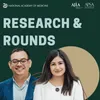
How does a clinician-scientist become known for their own ideas without leaving behind the mentors and relationships that helped shape their career?In “Stepping Out from a Mentor’s Shadow,” host Evan Noch, MD, PhD, talks with Reshma Jagsi, MD, DPhil, Lawrence W. Davis Professor and Chair of the Department of Radiation Oncology at Emory University School of Medicine, and Sagar P. Bapat, MD, PhD, assistant professor of Laboratory Medicine at the University of California, San Francisco.Bapat shares his experience moving from training with several prominent scientists to leading his own laboratory, including how he built on his background in immunology and metabolism to develop a research program focused on how nutrition and other environmental factors influence immune function and disease. Jagsi, whose research examines mentorship and sponsorship in academic medicine, offers the perspective of an experienced mentor to help junior investigators develop their own expertise, networks, and scientific direction.Together, they discuss what scientific independence looks like in practice, how to navigate conversations about research ownership and authorship, and why building a network of mentors with complementary expertise can be more effective than relying on a single advisor.Press play to learn how mentor-mentee relationships can evolve into lasting collegial collaboration.Quotes of the Episode“Mentorship is not only scientific guidance; it’s about cultivating personal growth for one’s mentee...Your mentees will eventually mentor you, and it does create this incredibly satisfying environment to build one's career.”— Reshma Jagsi, MD, DPhil “Independence doesn’t necessarily mean no longer needing advice or moving away from your mentors or doing something completely different, but rather taking full ownership of your work. The ‘scientific buck’ in your lab stops with you, and that's a new feeling.”— Sagar P. Bapat, MD, PhD Key TakeawaysIndependence means taking ownership of the work. Bapat explains that becoming an independent investigator does not necessarily mean abandoning a mentor’s research area or no longer seeking advice. Instead, it means taking responsibility for the direction of the science, the decisions made in the laboratory, and the people and projects under one’s leadership.Build on existing expertise while developing a distinct perspective. Bapat describes how he identified research questions at the intersection of his mentors’ fields and applied methods developed in his postdoctoral laboratory to his own research interests. Jagsi emphasizes the value of developing complementary skills that allow investigators to make contributions distinct from those of their mentors.Mentorship works best as a network. Jagsi discusses research showing that a network of mentors with different areas of expertise can better support an investigator’s development than a single mentor-mentee relationship. She recommends cultivating a group that includes institutional and external advisors, experts within and beyond the investigator’s primary research area, and individuals who can provide career guidance and sponsorship.Have difficult conversations before conflicts arise. Questions about research ownership, project leadership, grant applications, and authorship can complicate the transition to independence. Bapat recommends direct, honest conversations to resolve misunderstandings, while Jagsi stresses the importance of establishing expectations about authorship and project roles before the work is complete.Mentorship and sponsorship serve different purposes. Mentors provide guidance and help develop an investigator’s skills, while sponsors use their influence to connect junior colleagues with opportunities and recognition. Jagsi encourages senior investigators to create opportunities for mentees to be seen and recognized in their own right, stepping back from the spotlight when appropriate.Build a professional identity beyond the laboratory. Bapat describes how conference participation, professional organizations, and connections with researchers outside his immediate field have helped create opportunities for future collaborations. Jagsi also emphasizes that service to the broader scientific community should be valued in its own right, not only for its potential career benefits.Successful mentor-mentee relationships continue to evolve. Both guests emphasize that becoming independent should not end a mentor-mentee relationship. Over time, these relationships can become more collaborative and collegial, with former mentees eventually becoming mentors themselves.About the GuestsReshma Jagsi, MD, DPhil, is the Lawrence W. Da
Podzilla Summary coming soon
Sign up to get notified when the full AI-powered summary is ready.
Free forever for up to 3 podcasts. No credit card required.
Listen to This Episode
More from Research & Rounds
Making Protected Research Time Real
Choosing a Research-Track Residency

Why the Physician Scientist Career Pathway Still Matters
Introducing Research & Rounds: The Physician-Scientist Career Podcast
Get summaries like this every morning.
Free AI-powered recaps of Research & Rounds and your other favorite podcasts, delivered to your inbox.
Free forever for up to 3 podcasts. No credit card required.