Free Daily Podcast Summary
Research & Rounds: Daily Summaries Delivered
by National Academy of Medicine
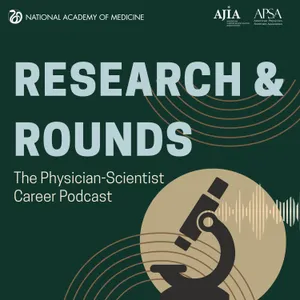
Hosted by Evan Noch, MD, PhD, Research & Rounds explores the opportunities, challenges, and decisions that shape a physician-scientist’s career. Through interviews with physician-scientists, program leaders, and funders, along with shorter episodes addressing common career questions, the podcast offers practical guidance for navigating the physician-scientist pathway. Produced by the National Academy of Medicine in collaboration with the American Physician Scientists Association and the American Junior Investigator Association as part of NAM’s Sustaining the Physician-Scientist Workforce initiative.
Latest Episodes
The most recent episodes — sign up to get AI-powered summaries of each one.
- 1 weeks ago51 min
Why the Physician Scientist Career Pathway Still Matters
What happens when a bedside question sparks a career that reaches from the lab to public health leadership?In “Why the Physician-Scientist Career Pathway Still Matters,” host Evan Noch, MD, PhD, talks with Elizabeth “Betsy” Nabel, MD, chair of the Lasker Foundation Board of Directors and advisor to ModeX Therapeutics/OPKO Health, and Rochelle P. Walensky, MD, MPH, professor of medicine at Harvard Medical School and former director of the Centers for Disease Control and Prevention.Their careers began with very different questions. For Nabel, it was why patients experienced recurrent narrowing of their arteries after angioplasty. For Walensky, it was why lifesaving HIV treatments remained financially out of reach for so many patients. Those questions would lead them into laboratory research, health economics, biotechnology, and leadership at some of the nation's most influential health institutions.Together, they discuss the mentors and unexpected opportunities that shaped their careers, what it means to be a physician-scientist beyond the traditional academic model, and how to navigate an increasingly uncertain research environment. They also offer candid advice about finding support, reconsidering how physician-scientists are trained, and recognizing the small victories along the way.Quote of the Episode“Seek the advice of your mentors, but don't be limited by that.”— Elizabeth “Betsy” Nabel, MDKey TakeawaysLet clinical questions guide your research. Nabel recalls how observing high rates of restenosis after coronary angioplasty inspired her to investigate the underlying molecular mechanisms. With support from her department chair, she established a small research laboratory and secured her first NIH R01 grant within 18 months. Walensky's experiences treating patients with HIV similarly led her to study the costs and accessibility of lifesaving therapies.There's more than one way to be a physician-scientist. Neither Nabel nor Walensky followed the traditional MD-PhD pathway. Their experiences demonstrate how research careers can extend beyond the laboratory into decision science, public health, government, biotechnology, and health care leadership. Nabel encourages early-career investigators to explore opportunities in biopharma and other settings, even when their mentors' careers have remained entirely in academia.Research training prepares you to navigate uncertainty. Walensky explains how her background in mathematical modeling and decision science became invaluable during her leadership of the CDC, particularly when making consequential public health decisions with incomplete information. The ability to evaluate risk, anticipate outcomes, and revise decisions as evidence changes is a skill that extends far beyond research.The physician-scientist pathway needs to become more sustainable. Both guests question the length of traditional training programs and the institutional structures that make it difficult to pursue research careers. Nabel advocates for shorter training pathways and stronger institutional support, while Walensky emphasizes the need to account for family responsibilities, financial pressures, and the personal demands of prolonged training.Be willing to explore unconventional opportunities. With research funding increasingly uncertain, Nabel encourages physician-scientists to broaden their networks and consider collaborations, patient advocacy organizations, philanthropy, and industry partnerships. An unexpected opportunity or temporary shift in research direction may provide the support needed to continue pursuing longer-term goals.Celebrate progress, not just major achievements. Walensky recalls applying for eight small grants during her first postdoctoral research year, hoping someone would recognize the potential of her work. She reminds listeners that CVs capture successes but rarely show the rejected papers, unsuccessful applications, and uncertainty behind them. Both guests encourage early-career researchers to recognize smaller milestones and find satisfaction throughout the different chapters of their careers.About the GuestsElizabeth “Betsy” Nabel, MDElizabeth “Betsy” Nabel, MD, is a cardiologist, physician-scientist, and leader in biomedical research and academic medicine. She serves as chair of the Lasker Foundation Board of Directors and advisor to ModeX Therapeutics/OPKO Health. Previously, she served as president of Brigham Health and Brigham and Women's Hospital from 2010 to 2021 and director of the National Heart, Lung, and Blood Institute at the National Institutes of Health from 2005 to 2009. Her research on the molecular genetics of cardiovascular disease has result
- 1 weeks ago23 min
Choosing a Research-Track Residency
Choosing a research-focused residency is about more than finding the right track or acronym. It's about finding an environment where your clinical and scientific ambitions can grow together.In this episode of Research & Rounds, host Evan Noch, MD, PhD, shares five practical questions to help medical students and future physician-scientists look beyond program promises, assess mentorship and protected research time, and find a training pathway that fits the career—and life—they want to build.From understanding the differences between physician-scientist training programs (PSTPs) and research-intensive categorical residencies to knowing what to ask current trainees, Evan offers advice for making a more informed decision.Press play before your next residency interview.Quote of the Episode“You are choosing an ecosystem, not an acronym.”— Evan Noch, MD, PhDKey TakeawaysDefine the career you want to build. Before comparing residency programs, consider your research interests, long-term goals, specialty, and how much structure or flexibility you need. A formal research track isn't necessarily the best or only route to a successful physician-scientist career.Understand what the pathway actually offers. PSTPs, research-in-residency programs, and other research-focused pathways vary considerably. Ask about training length, research requirements, funding, board-certification requirements, and whether fellowship opportunities are guaranteed or simply anticipated.Find out whether research time is truly protected. A promise of protected time means little without a clear plan. Ask when research blocks occur, which clinical responsibilities continue, and who ensures that research time remains protected when clinical demands increase.Evaluate the people and culture, not just the program's reputation. Look for accessible mentors, a supportive research community, and leadership that values physician-scientist training. Consider whether mentors understand the demands of residency and whether trainees receive the resources and flexibility they need to succeed.Talk to trainees and look for evidence of outcomes. Ask current residents, fellows, and graduates about their experiences. Established programs should be able to describe where trainees went next, while newer pathways should demonstrate concrete commitments to funding, mentorship, and support. Remember that location, family responsibilities, finances, and quality of life also matter when choosing a sustainable career path.Five Questions to Ask During Residency InterviewsAs you evaluate residency programs, ask program leadership, current trainees, and recent graduates these questions to better understand what each pathway offers in practice.What happens to graduates of the pathway? If this is an established pathway, can you walk me through what happened to the last two or three residents who completed it? If it is new, what time, funding, mentors, and leadership commitments are already in place, and how will trainee feedback lead to changes?Is research time truly protected? When does protected research time occur, which clinical responsibilities continue, and what happens if service needs increase?How does mentorship work? How are residents connected with mentors, and what support is available if the first match is not a good fit?What are the expectations for fellowship? If residency and fellowship are linked, what is guaranteed, what is expected, and how much flexibility is there if my interests change?What challenges do trainees actually face? What do current or recent trainees say is the hardest part of making this pathway work?Sources & ResourcesResources for Residency ApplicantsAAMC Physician-Scientist Training Program Resources — An overview of physician-scientist training pathways, including research-in-residency programs and specialty-specific options.AAMC Physician-Scientist Training Program Webinars — Recorded discussions with program directors and trainees covering training pathways, applications, and interviews.APSA Residency and
- 1 weeks ago0 min
Introducing Research & Rounds: The Physician-Scientist Career Podcast
Introducing Research & Rounds: The Physician-Scientist Career, a new podcast from the National Academy of Medicine hosted by Evan Noch, MD, PhD.Through conversations with physician-scientists, program leaders, and funders, along with shorter episodes addressing common career questions, the podcast offers practical guidance on the opportunities, challenges, and decisions that shape a physician-scientist's career.The first two episodes launch October 29, 2026, with new episodes every other week.Follow Research & Rounds on your favorite podcast platform so you don't miss an episode.Created by the National Academy of Medicine in collaboration with the American Physician Scientists Association and the American Junior Investigator Association as part of NAM's Sustaining the Physician-Scientist Workforce initiative.
About Research & Rounds
Hosted by Evan Noch, MD, PhD, Research & Rounds explores the opportunities, challenges, and decisions that shape a physician-scientist’s career. Through interviews with physician-scientists, program leaders, and funders, along with shorter episodes addressing common career questions, the podcast offers practical guidance for navigating the physician-scientist pathway. Produced by the National Academy of Medicine in collaboration with the American Physician Scientists Association and the American Junior Investigator Association as part of NAM’s Sustaining the Physician-Scientist Workforce initiative.
Customized Recaps
AI-powered recaps with compact key takeaways, quotes, and insights.
Straight to Your Inbox
Get key takeaways from Research & Rounds in a 5-minute read.
Save Hours Every Week
Stay current on your favorite podcasts without falling behind.
Frequently Asked Questions
What is Podzilla's Research & Rounds daily summary?
It's a free AI-powered email that summarizes new episodes of Research & Rounds as soon as they're published. You get the key takeaways, notable quotes, and links & mentions — all in a quick read.
How does the Research & Rounds podcast summary work?
When a new episode drops, our AI transcribes and analyzes it, then generates a personalized summary tailored to your interests and profession. It's delivered to your inbox every morning.
Is this an official Research & Rounds product?
No. Podzilla is an independent service that summarizes publicly available podcast content. We're not affiliated with or endorsed by National Academy of Medicine.
Can I get summaries of other podcasts too?
Absolutely! The free plan covers up to 3 podcasts, any in the catalog. Basic raises that to 15, Pro to 40 and Max to 100. Browse our full catalog at /podcasts.
What topics does Research & Rounds cover?
Research & Rounds covers topics including Science, Business, Careers, Medicine, Fitness, Health & Fitness. Our AI identifies the specific themes in each episode and highlights what matters most to you.
Start getting Research & Rounds summaries tomorrow morning.
Free forever for up to 3 podcasts. No credit card required.
Free forever for up to 3 podcasts. No credit card required.