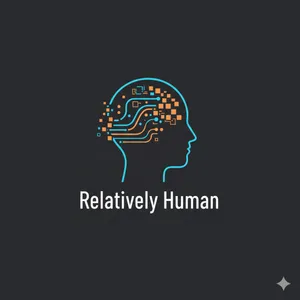
Free Daily Podcast Summary
Relatively Human: Fundamental Laws of Biology and Physics: Daily Summaries Delivered
by Finglas Media | Physics and Biology
Explore the vast intersection where the fundamental laws of physics meet the messy reality of being alive. Discover why our perception of time and space is entirely relative to the biology that defines us.This is a Prototype Podcast Endeavor, I acknowledge the use of AI to produce the audio but I am singularly responsible for the synthesis and contents of this podcast, Please rate and review!If you can get past the AI voices and listen to the contents I know you will find real science and eye opening storiesYou can also reach out to me directly at iand25@gmail.com if you have questions or want to collaborate!
Latest Episodes
The most recent episodes — sign up to get AI-powered summaries of each one.
- 1 weeks ago40 min
Every Ping Gives You Away
The loudest animal on Earth shouts while it hunts. Killer whales that hunt seals stay silent. Why would one hunter shout and another hold its tongue?It comes down to one fact about sound: a call goes one way to the listener, but its echo has to make the round trip back. So every ping you send to find your prey also tells your prey about you, and how loud you can afford to be depends on who's listening. We start with bats that turned out to be shouting, and a moth that hears a loud bat long before the bat can find it, then see engineers hit the same wall with radar, and German U-boats that switched off their own detectors. We test the rule on a sperm whale whose prey is barely listening, a bat that whispers, killer whales that go silent, submarines that mostly listen, beaked whales that rise without a sound, and Hawaiian crickets that went quiet in about five years once a fly started hunting them by ear. Then the chase: moths that swerve, bats that steer, and a desert tiger moth that jams bat sonar. Moths had ears long before there were bats to hear, and on bat-free islands they kept the ears but lost the flinch. Last, the noise that's ours: traffic, shipping that fills the low range right whales call in, and navy sonar, which sets off the beaked whales' escape plan for killer whales. Noise stops when we stop, and in the Canary Islands, turning it down seems to have worked.Chapters00:00 Cold open01:58 Welcome02:38 Part one: bats that shout04:41 Part one: the listener hears first06:49 Part one: radar and U-boats09:04 Part two: shout when nobody is listening12:27 Part two: whisper14:09 Part two: go silent17:02 Part two: submarines and quiet radar18:25 Part two: beaked whales go quiet19:29 Part two: the cricket that went quiet22:45 Part three: the chase25:42 Part three: talking back27:12 Where the ears came from28:43 The flinch: take the bats away29:54 Slow and fast30:37 Part four: when the noise is ours34:00 Part four: our ping37:37 CloseSounds- Sperm whale clicks and creak: NOAA (public domain)- Bat calls and feeding buzz, slowed ten times: "Bat feeding buzz" by Kaldari (CC0)- Fish-eating killer whales, Glacier Bay, Alaska: National Park Service (public domain)- Pacific field cricket: Natural History Museum, London, recordist W. J. Reynolds (CC BY 3.0)- Large ship underwater: NOAA Fisheries (public domain)- Sonar ping: re-created for this episodeMusic- "Warm Fingers" and "One Little Triumph" (Piano Mover) and "Dibbled" (Thimble Rider) by Blue Dot Sessions (CC BY-NC 4.0), sessions.blue- Theme: royalty-free intro trackKey sourcesGriffin 1944 Science; Goerlitz et al. 2010 Curr Biol; Skolnik 2001; NSA SRH-025; Fais et al. 2016 Sci Rep; Watwood et al. 2006 J Anim Ecol; Mooney et al. 2010 J Exp Biol; Barrett-Lennard et al. 1996 and Deecke et al. 2005 Anim Behav; Deecke et al. 2002 Nature; Aguilar de Soto et al. 2020 Sci Rep; Zuk et al. 2006 Biol Lett; Tinghitella et al. 2018 Am Nat; Hartley 1992 JASA; Ghose et al. 2006 PLoS Biol; Corcoran & Conner 2016 J Exp Biol; Corcoran et al. 2009 Science; Kawahara et al. 2019 PNAS; Fullard et al. 2004 J Evol Biol; Siemers & Schaub 2011 Proc R Soc B; Tennessen et al. 2024 Glob Change Biol; McDonald et al. 2006 JASA; Hatch et al. 2012 Conserv Biol; Rolland et al. 2012 Proc R Soc B; Tyack et al. 2011 PLoS ONE; NOAA/Navy Bahamas report 2001; Bernaldo de Quirós et al. 2019 Proc R Soc B; Fernández et al. 2013 Nature.
- 2 weeks ago40 min
The Way Back Isn't the Way In
In 2014 a marine heatwave wiped out more than ninety percent of the bull kelp canopy along more than 350 kilometres of northern California's coast. The water started to recover, and a model built on ocean data expected the kelp to come partway back. It didn't. We start with why we blame the last push: a basketball bet, the loss of the shuttle Columbia, and a fish kill on Australia's Darling River. Then we look past the push, at what keeps a system broken. Ecologists treat a reef as a complex adaptive system, and systems like that can show hysteresis: the way back isn't the way in. Across thirteen reef systems worldwide, kelp forests collapse at about 700 grams of urchin per square metre and return only below about 70, ten times lower. We follow the loops that keep a bare reef bare, what it takes to bring one back, and the two numbers that would show whether this coast is stuck or just missing its predators. Then the counterexample, the ozone hole, which is recovering down the same path it came, because nothing holds it open. Last, where else to look: shallow lakes, the ice sheets, jobs after a recession, a cow-sized poverty line, antibiotic resistance and insomnia, each tested against three questions. Are there two states? Is the way back further than the way in? Can you name what keeps the bad state going? Where all three hold, prevention is far less work than repair.Chapters00:00 Cold open: bare rock and a big question04:03 Welcome, and the map of the episode05:31 Part one: why the last push gets the blame09:49 Part one: three losses, and the only one that left11:48 Part two: what hysteresis is13:35 Part two: the gap, in numbers15:40 Part two: why a reef does it17:59 Part three: what it takes to come back20:40 What would settle it24:26 The counterexample: a hole in the sky28:18 Where else to look: lakes and ice32:24 Where else to look: work and money35:34 Where else to look: health, and you38:53 Close
- Oct 26, 202641 min
Wrong Parts Right Answer
Relatively HumanSeason 3, Episode 2: Wrong Parts, Right AnswerWhy do some of the most important readings we take barely depend on what's inside a thing?A living cell runs on a tangle of chemical reactions, yet a model whose 48 rate settings couldn't be pinned down to better than a factor of fifty still predicted what the cells would do, and beat the biologists' own guess. Stranger still, simulations showed that measuring those settings one by one wouldn't have helped. We follow that puzzle through three cases, each harder than the last. A boiling fluid and an iron-fluoride magnet, which share nothing at the level of atoms, come out with the same critical number, 0.327 against 0.325, and we hear how Kenneth Wilson worked out why, one scale at a time. Then Grenoble, two in the morning, 1980: Klaus von Klitzing finds a resistance in an imperfect silicon chip set only by constants of nature and a whole number. Chips of different materials now agree to within about one part in ten billion, and the impurities help make the plateaus. We ask where the claim breaks, when sharper experiments expose what a model left out. Then we follow what that chip changed: the ohm went from a coil of wire sold in a box, and later from cans of wire that slowly drifted, to a recipe the world's standards labs can follow, and in 2019 the kilogram followed. Averaging, stepping up in scale, counting and smoothness each explain part of the pattern, and nobody yet knows whether they are one reason or several. But where a reading doesn't depend on what's inside, you can stop trusting objects and start trusting nature.Chapters00:00 Cold open: one claim02:32 Welcome, and the map of the episode04:18 Part one: forty-eight settings nobody knew13:20 Part two: boiling water and a magnet20:31 Part three: a chip full of flaws26:44 Where the claim breaks29:46 From objects to recipes: the ohm and the kilogram37:48 Why, and what's still openKeywords: sloppy models, systems biology, renormalization group, critical phenomena, Kenneth Wilson, quantum Hall effect, Klaus von Klitzing, metrology, the ohm, kilogram redefinition
- Oct 23, 202646 min
Right for the wrong reasons
Relatively HumanSeason 3, Episode 1: Right for the Wrong ReasonsWhen a prediction gets the right answer, how do you know why?Season 3 starts here, with new voices and a new format from the same show creator: each episode takes an open question in science and works through what's known, how sure we are, and what would settle it. We open with an AI that seemed to read chest X-rays but was partly reading the word PORTABLE stamped in the corner. From there, we look at how right answers can be hollow: a Google flu tracker that learned winter as well as flu, research papers where the answer had leaked into the question, and a hospital sepsis alert that was partly predicting what doctors already suspected. Then we ask how you catch it. The answer is to change the conditions and see what breaks, and we meet a cat with elephant skin, a team that rebuilt a famous exam and found they'd been wrong, and the same chatbot entered twice on a leaderboard. Finally, the twist: by the old textbook rule, the biggest AI systems should be the worst offenders, yet they pass these tests better than expected, and the people who build them can't yet fully say why. We end where even they break, with a hurricane stronger than anything the model had ever seen, and on what's still open.Chapters00:00 Cold open: what was it looking at?02:45 Welcome, and the map of the episode04:37 Part one: a right answer can be hollow18:03 Part two: how you catch it30:01 Part three: better than the textbook said41:28 Same math, or same mechanism?44:07 What's still openNothing in this episode is medical or investment advice.
- Mar 9, 202637 min
Your Genome Is Not A Blueprint
Relatively Human | Season 2, Episode 6: The Cell That DecidesEvery cell in your body carries the exact same genome, so if the blueprint is the identical, why aren’t all cells the same?In this episode of Relatively Human, we dismantle the intuitive but fundamentally incomplete metaphor of the genome as a recipe book. A cell doesn't read a blueprint; instead, it falls into a valley on a topographical landscape that nobody designed. Join our Host and Expert as they explore the underlying mathematical architecture of life, revealing how development, evolution, and cancer are ultimately three operations on a single dynamic system.We trace the history of this framework from a 1957 sketch by embryologist Conrad Hal Waddington to modern single-cell RNA sequencing that proved his hand-drawn picture was actually a mathematically precise phase portrait. Discover why Shinya Yamanaka's Nobel Prize-winning stem cell reprogramming is less about pushing a marble uphill and more about "picking molecular locks". We also dive into how the exact same epigenetic padlocks that keep a cell committed to its fate do double duty: they hide genetic variation to fuel evolution, and they wall off "forbidden valleys"—ancient, unicellular gene programs that, when accessed, manifest as cancer.In this episode, we cover:The Blueprint Myth: Why development is not about building a specialist, but pruning its possibilities by closing one-way epigenetic doors.The Mathematical Landscape: How network dynamics provide an attractor landscape for free, leaving evolution to act as a "library of winning moves" that catalogs which valleys sustain life.Navigating the Topography: The 2,773-dimensional gene expression space, and why reverting a cell's fate to pluripotency has a 99% failure rate.Cryptic Variation: How molecular buffers like the Hsp90 chaperone protein absorb and hide mutations, safely storing them until environmental stress releases them to drive evolution.The Dark Mirror of Cancer: Provocative evidence suggesting cancer isn't just a randomly broken cell, but a reversion to a 2-billion-year-old attractor state that multicellularity spent eons trying to lock away.The cell doesn't decide. It falls.Top Citations :Waddington, C.H. (1957). The Strategy of the Genes. Drew the original epigenetic landscape, introducing the concept of canalization where valleys represent distinct cell fates.Huang, S. et al. (2005). "Cell fates as high-dimensional attractor states..." First experimental evidence showing human cells converging to the same attractor in a 2,773-dimensional gene expression space.Takahashi, K. & Yamanaka, S. (2006). "Induction of pluripotent stem cells..." The landmark paper proving four specific transcription factors can reprogram adult cells, acting as molecular keys to pick epigenetic locks.Samuelsson, B. & Troein, C. (2003). "Superpolynomial growth in the number of attractors..." Mathematical proof that complex generic networks organically produce an attractor landscape.Rutherford, S.L. & Lindquist, S. (1998). "Hsp90 as a capacitor for morphological evolution." Demonstrated how canalization silently stores structured genetic variation behind molecular buffers.Huang, S., Ernberg, I. & Kauffman, S. (2009). "Cancer attractors..." Proposed the framework that cancer cells occupy unused mathematical attractors walled off by multicellularity.
- Mar 8, 202650 min
The Precise Symmetry of Natural Chaos
Relatively Human — Season 2, Episode 5: The Precise Symmetry of Natural ChaosWhat looks like chaos is order you haven't zoomed out far enough to see.A coastline from an airplane. A lightning bolt. A bare winter tree. None look ordered — not like a crystal or a grid. But they share a geometry, and that geometry has a precise mathematical name.This episode explores the critical point — the exact boundary between two phases of matter. At the critical point, every measure of disorder peaks: fluctuations at every scale, correlations stretching to infinity, variance climbing. It looks like the most turbulent state a system can be in.It is the most precisely described state in all of physics. To eight decimal places. From symmetry alone.The episode traces how approaching the critical point strips away parameters. Edward Guggenheim showed in 1945 that eight chemically unrelated substances — neon, argon, methane, and five others — draw a single curve when rescaled by their critical values. The details that distinguish one substance from another wash out. What remains is geometry.At the critical point itself, that geometry is fractal — self-similar at every magnification, with a scaling dimension determined by pure mathematics. The fractal dimension of the critical percolation cluster is 91/48, proven rigorously. The critical exponents of the three-dimensional Ising universality class have been computed to eight decimal places by the conformal bootstrap — starting from nothing but dimension and symmetry.Water at 374°C. Iron at 770°C. A forest at its percolation threshold. Same critical exponents. Same numbers. Different physics, same fractal geometry. Nobody designed this. It's what's left after the cascade strips away everything except dimension and symmetry.The episode also honestly calibrates the limits: the fractal order machinery applies only to continuous phase transitions, not first-order ones. And whether ecological regime shifts share genuine universality with equilibrium physics — or merely resemble it — remains an open question.Top CitationsAndrews, T. (1869). "On the continuity of the gaseous and liquid states of matter." Phil. Trans. R. Soc., 159, 575–590.Onsager, L. (1944). "Crystal Statistics. I." Phys. Rev., 65, 117–149.Guggenheim, E.A. (1945). "The Principle of Corresponding States." J. Chem. Phys., 13(7), 253–261.Machta, B.B. et al. (2013). "Parameter space compression underlies emergent theories and predictive models." Science, 342(6158), 604–607.Polyakov, A.M. (1970). "Conformal symmetry of critical fluctuations." JETP Lett., 12, 381–383.Belavin, A.A., Polyakov, A.M. & Zamolodchikov, A.B. (1984). "Infinite conformal symmetry in two-dimensional quantum field theory." Nucl. Phys. B, 241(2), 333–380.Smirnov, S. (2001). "Critical percolation in the plane: conformal invariance, Cardy's formula, scaling limits." C. R. Acad. Sci. Paris, 333(3), 239–244.El-Showk, S. et al. (2014). "Solving the 3d Ising Model with the Conformal Bootstrap II." J. Stat. Phys., 157, 869–914.Chang, C.-H. et al. (2025). "Bootstrapping the 3d Ising stress tensor." JHEP, 2025(3), 136.Scheffer, M. et al. (2012). "Anticipating Critical Transitions." Science, 338(6105), 344–348.
- Mar 7, 202644 min
The Map That Makes the Territory
Relatively Human, Season 2 Episode 4: The Map That Makes the TerritoryJohn Snow built a correct theory of cholera transmission without knowing what a bacterium was. Charles Darwin formulated natural selection while actively believing in an incorrect theory of heredity. Sadi Carnot derived the exact maximum efficiency of a heat engine while believing heat was a weightless fluid called caloric.How is it possible to be completely wrong about the microscopic details but perfectly right about the macroscopic laws?This episode explores the physics of effective field theories and the concept of "separation of scales". Physicist Kenneth Wilson mathematically proved that when the gap between scales is large enough, irrelevant microscopic details wash out exponentially. What survives this "blurring" is a complete, structurally autonomous set of laws.From Fermi's beta decay to contested trophic cascades in Yellowstone, to the turbulent cascade of a river, we explore why emergent descriptions aren't just convenient approximations. The universe guarantees that you don't need to know about atoms to understand everything else. At its own scale, the map doesn't approximate the territory—the map is the territory.Top CitationsSnow (1855). On the Mode of Communication of Cholera. (Waterborne transmission)Darwin (1859). On the Origin of Species. (Natural selection)Carnot (1824). Réflexions sur la puissance motrice du feu. (Heat engine efficiency)Wilson (1971). Renormalization Group and Critical Phenomena. I. (Proof of coarse-graining)Fermi (1934). Versuch einer Theorie der β-Strahlen. I. (Beta decay contact interaction)Paine (1966). Food Web Complexity and Species Diversity. (Ecosystem cascade experiments)Estes et al. (2011). Trophic Downgrading of Planet Earth. (Global trophic cascades)Kolmogorov (1941). Local Structure of Turbulence. (Universal minus five-thirds power law)Anderson (1972). More is Different. (Emergence of new laws at complex levels)Laughlin & Pines (2000). The Theory of Everything. (Reductionism is explanatorily incomplete)Batterman (2001). The Devil in the Details. (Structural autonomy of emergent laws)
- Mar 4, 202655 min
Why Your Heart Isn't a Clock and Why a Healthy Heart Needs Chaos
Episode DescriptionSeason Two, Episode Three of Relatively Human explores a profound medical paradox: a healthy heartbeat is irregular, fractal, and complex, while a dying heartbeat is regular, a pattern observed in over eight hundred heart attack survivors (Kleiger et al., 1987). The episode explains this phenomenon through a seventy-year-old cybernetics theorem never formally connected to cardiology until now. The exploration spans three structural layers: the clinical observation, the mathematical explanation, and the biological mechanism.First, the clinical pattern: physiological signals universally lose complexity with aging and disease (Lipsitz & Goldberger, 1992), a degradation measured through multi-scale entropy (Costa et al., 2002). This framework applies primarily to resting-state dynamics, as some task-dependent systems increase complexity with aging (Vaillancourt & Newell, 2002).Second, the mathematical explanation: Ashby's requisite variety theorem dictates that a regulator must match the variety of its environment (Ashby, 1956). Fractal variability is the minimum information-theoretic cost of multi-scale regulation. Every good regulator must be a model of its system (Conant & Ashby, 1970). Stability is maintained through motion, much like a gyroscope, rather than rigidity.Third, the biological mechanism: multifractal complexity requires multiple interacting mechanisms (Ivanov et al., 1999). Coupled organ networks generate this complexity. As individuals age, a silence emerges between organ systems, driving an approximately forty percent decline in cardiorespiratory coupling measured across one hundred eighty-nine subjects, ages twenty to ninety-five (Bartsch et al., 2012).Structurally, the episode reconciles the geometric concept of attractor dimensions with the information-theoretic concept of requisite variety, proving they measure the same quantity. The attractor is the shape of all the physiological conversations happening at once. When complexity disappears—whether observed in a metronomic heartbeat or the smoothed flow of the Mississippi River caused by land use changes and soil conservation practices over one hundred thirty-one years of daily flow data (Li & Zhang, 2008)—the system loses regulatory capacity. The episode concludes by crossing into Tier Two science to explore how biological systems may operate near-criticality, noting that conscious brain states are supported by near-critical dynamics, as reviewed across one hundred forty datasets in seventy-three studies (Hengen & Shew, 2025).Important CitationsAshby, W.R. (1956). An Introduction to Cybernetics.Bartsch, R.P. et al. (2012). Phase transitions in physiologic coupling. PNAS.Conant, R.C. & Ashby, W.R. (1970). Every good regulator of a system must be a model of that system. Int J Systems Science.Costa, M. et al. (2002). Multiscale entropy analysis of complex physiologic time series. Phys Rev Lett.Hengen, K.B. & Shew, W.L. (2025). Is criticality a unified setpoint of brain function? Neuron.Ivanov, P.Ch. et al. (1999). Multifractality in human heartbeat dynamics. Nature.Kleiger, R.E. et al. (1987). Decreased heart rate variability and its association with increased mortality. Am J Cardiol.Li, Z. & Zhang, Y.K. (2008). Multi-scale entropy analysis of Mississippi River flow. Stoch Environ Res Risk Assess.Lipsitz, L.A. & Goldberger, A.L. (1992). Loss of 'complexity' and aging. JAMA.Vaillancourt, D.E. & Newell, K.M. (2002). Changing complexity in human behavior and physiology. Neurobiol Aging.
Get Relatively Human: Fundamental Laws of Biology and Physics summaries in your inbox
Free AI-powered daily recaps. Key takeaways, quotes, and mentions — in a 5-minute read.
Get Free Summaries →Free forever for up to 3 podcasts. No credit card required.
You Might Also Like
Listeners also like.
From First Principles
Breaks down major science stories weekly, explaining the mechanics behind physics, space, AI, and biotech developments.
From First Principles
Breaks down major science stories weekly, explaining the mechanics behind physics, space, AI, and biotech developments.
Inquiring Minds
Explores the intersection of science and society through critical thinking and in-depth analysis.
How We're Wired
Explores how the human brain shapes experiences from birth to death through neuroscience, personal stories, and cutting-edge research.

Theories of Everything with Curt Jaimungal
A deep, rigorous exploration of theories uniting physics, consciousness, AI, and metaphysics through analytical and unconventional thinking.
Physics Frontiers
Two physicists explore topics ranging from subatomic particles to the far reaches of the universe.

COMPLEXITY
Santa Fe Institute
Human Potential Lab
Explores the science and philosophy of human potential, consciousness, and the impact of emerging technologies on what it means to be human.
On Humans
Conversations with experts explore human origins, evolution, and the forces shaping our species across history and science.
Physics to God
Explores the intersection of modern physics and theology, examining fine tuning, the multiverse, and the concept of God.
Stuff To Blow Your Mind
Explores the strange edges of science, consciousness, and reality through neuroscience, cosmology, evolution, and emerging technology.
Body Electric
Explores how technology affects the human body and ways to address its impact.
About Relatively Human: Fundamental Laws of Biology and Physics
Explore the vast intersection where the fundamental laws of physics meet the messy reality of being alive. Discover why our perception of time and space is entirely relative to the biology that defines us.This is a Prototype Podcast Endeavor, I acknowledge the use of AI to produce the audio but I am singularly responsible for the synthesis and contents of this podcast, Please rate and review!If you can get past the AI voices and listen to the contents I know you will find real science and eye opening storiesYou can also reach out to me directly at iand25@gmail.com if you have questions or want to collaborate!
Customized Recaps
AI-powered recaps with compact key takeaways, quotes, and insights.
Straight to Your Inbox
Get key takeaways from Relatively Human: Fundamental Laws of Biology and Physics in a 5-minute read.
Save Hours Every Week
Stay current on your favorite podcasts without falling behind.
Frequently Asked Questions
What is Podzilla's Relatively Human: Fundamental Laws of Biology and Physics daily summary?
It's a free AI-powered email that summarizes new episodes of Relatively Human: Fundamental Laws of Biology and Physics as soon as they're published. You get the key takeaways, notable quotes, and links & mentions — all in a quick read.
How does the Relatively Human: Fundamental Laws of Biology and Physics podcast summary work?
When a new episode drops, our AI transcribes and analyzes it, then generates a personalized summary tailored to your interests and profession. It's delivered to your inbox every morning.
Is this an official Relatively Human: Fundamental Laws of Biology and Physics product?
No. Podzilla is an independent service that summarizes publicly available podcast content. We're not affiliated with or endorsed by Finglas Media | Physics and Biology.
Can I get summaries of other podcasts too?
Absolutely! The free plan covers up to 3 podcasts, any in the catalog. Basic raises that to 15, Pro to 40 and Max to 100. Browse our full catalog at /podcasts.
How often does Relatively Human: Fundamental Laws of Biology and Physics release new episodes?
Relatively Human: Fundamental Laws of Biology and Physics publishes daily. Our AI generates a summary within hours of each new episode.
What topics does Relatively Human: Fundamental Laws of Biology and Physics cover?
Relatively Human: Fundamental Laws of Biology and Physics covers topics including Science. Our AI identifies the specific themes in each episode and highlights what matters most to you.
Start getting Relatively Human: Fundamental Laws of Biology and Physics summaries tomorrow morning.
Free forever for up to 3 podcasts. No credit card required.
Free forever for up to 3 podcasts. No credit card required.