Free Daily Podcast Summary
Practical Stoicism: Daily Summaries Delivered
by Tanner Campbell
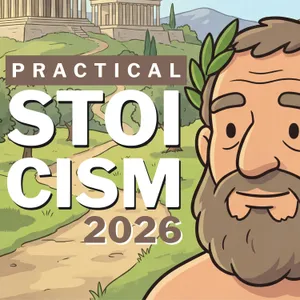
Stoicism is the pursuit of Virtue (Aretê), which was defined by the Ancient Greeks as "the knowledge of how to live excellently," Stoicism is a holistic life philosophy meant to guide us towards the attainment of this knowledge through the development of our character. While many other Stoicism podcasts focus on explaining Ancient Stoicism in an academic or historical context, Practical Stoicism strives to port the ancient wisdom of this 2300-plus-year-old Greek Philosophy into contemporary times to provide practical advice for living today, not two millennia ago. Join American philosopher of Stoicism Tanner Campbell for new episodes.
Latest Episodes
The most recent episodes — sign up to get AI-powered summaries of each one.
- 1 weeks ago5 min
How To Live Forever
Most of my listeners are somewhere between 35 and 45, which means quite a few of us are reaching the age when mortality starts feeling a little less theoretical. In this episode, I explore one reason the idea of death can trouble us that has less to do with fear and more to do with something deeply human: the desire not to feel disposable.Apply for private coaching: https://stoicismpod.com/applyJoin my free community: https://stoicismpod.com/joinI begin with a conversation I recently had with a private coaching client about why believing in something after death can be comforting. My suggestion was that the comfort may not necessarily come from imagining rewards, avoiding punishment, or even continuing our conscious existence. It may come from believing that we remain important to something beyond ourselves, that we continue to have a place.Stoicism offers an interesting answer to this without requiring a supernatural afterlife. The Stoics understood the Cosmos itself as God: the complete, contained system of Nature of which every one of us is presently a part.Within that system, nothing simply disappears. The matter and energy that presently constitute us return to the Cosmos and continue participating in it. The individual person, with their name, memories, career, possessions, and personality, may not continue indefinitely, but that from which the individual is constituted remains part of the whole.In that limited but meaningful sense, I suggest there is something resembling immortality available within the Stoic worldview. Stoicism doesn't promise a celestial city, an eternity spent with deceased relatives, or reincarnation as some other creature. Instead, it offers the idea that we were never separate from the Cosmos in the first place, and that what constitutes us continues to belong to and participate in that same whole.If what troubles you about death is the thought of becoming irrelevant or disposable, perhaps there's some comfort in that. You aren't something the Cosmos eventually throws away. You are part of it now, and what constitutes you remains part of it after the particular arrangement presently called "you" is gone.Mentioned in this episode:Equanimity TalkAttend the equanimity talk by visiting the link below. I want to make it clear that this was very last minute, that I don't know this organiser particularly well, and that there's no financial incentive involved here. I was simply presented an opportunity to speak on equanimity and thought it might be worthwhile. Cheers.Equanimity Talk
- 2 weeks ago8 min
A Reflection on "Inner Peace"
Marcus Aurelius famously reminds himself that we don't need to retreat to the countryside or the seashore to find peace. In this episode, recorded from my new office in an old textile mill in Dundee, I reflect on why I think Marcus was theoretically right but practically wrong, at least for those of us who aren't sages.Apply for private coaching: https://stoicismpod.com/applySupport this podcast financially: https://stoicismpod.com/membersJoin my free community: https://stoicismpod.com/joinCheck the LinkedIn post: https://lnkd.in/p/emRAsNbzGet alerted when the book goes on sale: https://livingstoicism.tannerocampbell.comInner peace may ultimately be a state of mind, but we're not perfect practitioners. Our surroundings affect us. Sometimes getting away from the noise, finding somewhere that feels comfortable, familiar, and peaceful, genuinely makes practicing Stoicism easier.Since moving to Dundee, I've noticed a quieting in myself that I can't really attribute to anything else. Life hasn't become less demanding. I'm currently cramming roughly 40 hours of work into Monday through Wednesday, then spending Thursday and Friday as a full-time dad while protecting my weekends for my family. If anything, I'm doing more than ever.Yet something about this place feels different. My little office overlooking Dundee, the seagulls and church bells outside the window, our flat beside a park, the city's working-class character, and even the coastal air remind me of places and people from my childhood. After several enormously busy years of marriage, fatherhood, building a business, raising investment, working full-time, and moving repeatedly, I feel unexpectedly at home here.So this episode isn't really a lesson. It's a reflection on the role our environment can play in our ability to find some peace. Theoretically, Marcus was right: the perfect Stoic shouldn't need a particular place in order to achieve tranquility. But none of us are perfect Stoics, and sometimes finding the right place can make the work of becoming better considerably easier.I also share a few updates at the end of the episode, including a request for help choosing the subject of a TED talk I'm working on, some early details about my forthcoming book Living Stoicism, and an invitation to a free community Q&A.
- 3 weeks ago13 min
How to have healthy self-esteem
A healthy Stoic practice requires an accurate view of yourself. Think too little of yourself and you misunderstand your capacities; think too much of yourself and you do the same. In this episode, I explore self-esteem through a Stoic lens and explain why accurate self-knowledge matters to our pursuit of eudaimonia and sagehood.Apply for private coaching: https://stoicismpod.com/apply Support this podcast financially: https://stoicismpod.com/members Join my free community: https://stoicismpod.com/joinI begin by separating self-esteem from the popular idea that “ego is the enemy.” Rather than treating a positive view of ourselves as something inherently suspect, I argue that Stoic practice requires us to understand ourselves accurately: our capacities, our roles, our duties, our individual nature, and the ways we are positioned to contribute to the world.That means avoiding two extremes. A depressive view of ourselves causes us to underestimate what we are capable of and what our duties require. A grandiose view causes us to overestimate our importance and abilities. Neither gives reason an accurate picture of the person whose life it is trying to direct.I also look at criticism and the effect other people's judgments can have on our self-understanding. Marcus Aurelius reminds himself in Meditations 2.1 that we will encounter difficult, arrogant, ungrateful, and mistaken people because they misunderstand good and evil. Criticism can contain useful information, and we should examine it when it does, but another person's judgment of our value is not automatically authoritative simply because they have expressed it.Finally, I offer a practical Stoic basis for healthy self-esteem using four areas of reflection: our shared nature as human beings, our individual nature, the circumstances and contexts we have been given, and the roles and paths we have deliberately chosen.The goal is neither humility for its own sake nor inflated confidence. It is accuracy. Understand what you are, understand what is appropriate for you, and then work seriously to fulfil those roles and duties well.
- Aug 19, 202616 min
How to explain your why without sounding condescending
In today's episode I discuss whether pursuing a dream is a Stoic thing to do, and how to talk about your ambitions without accidentally insulting the people who don't share them. Before digging in please be aware of all the ways this podcast is able to exist without ads or formal sponsorship:Private Stoic Life Coaching Practice: https://stoicismpod.com/coachingStoic Journaling Program: https://stoicjournaling.comCourses: https://stoicismpod.com/coursesElective Listener Support: https://stoicismpod.com/membersFirst, some genuinely wonderful news. 134 Labs Limited, the company I started in December of 2025 to buy back my intellectual property from Front Porch Media, has closed a pre-seed round of 74,000 US dollars. That means I get to do philosophy full-time for the next 12 months. It took 5 years to get here and 7 months of chasing venture capital to close, and I'm honest in this episode about how ugly it got along the way (including a couple of months where my family had to be on Universal Credit to bridge the gap). Nothing about the podcast changes. No third-party ads, no unaligned sponsors, same content. But this next year is make or break: either I find a morally just way to make a living in philosophy or I walk away.Then we get into the episode proper, which is about the pursuit of dreams. When you tell a friend that a regular life wouldn't be enough for you, they often hear "so my life isn't enough either," and that misunderstanding can wreck relationships. I use my sister as an example of someone wise enough to hear "your life wouldn't make me content" as a statement about alignment rather than a criticism of her choices.To unpack why, I reintroduce the Stoic Daimon. I walk through how logos permeates everything, how different degrees of tonos produce different manifestations, and how in beings like us that becomes rational cognition (I use an electricity-in-a-building analogy to make this digestible). The daimon can incline us toward certain pursuits, but here's the catch: an inclination doesn't guarantee our interpretation of it is correct, and it doesn't guarantee success. An inclination toward music doesn't mean your role is professional musician, and measuring daimon-alignment by material success is measuring poorly.I also talk about how a poorly trained rational faculty confuses things all the time (lust for love being the classic example), and how "follow your heart" guru advice can lead people into neglecting real duties. I share that I have two coaching clients right now whose husbands have been chasing startups for years with nothing to show for it, and I own the awkward fact that my own funding chase could look exactly like that from the outside. The difference, I argue, isn't outcomes. Stoics decide based on role ethics: reasoning about duties, roles, justified risks, and what we're asking others to bear.The episode lands on this: the Stoic answer is neither "follow your heart" nor "settle for whatever falls into your lap." Take your inclinations seriously without treating them as commands, bring them before a properly trained rational faculty, and pursue what is appropriate without making your happiness depend on how the world responds.And, one more thing: if you haven't already, please join my free Stoicism community on Skool: https://skool.com/tannerocampbell
- Aug 10, 202613 min
How to find your own Stoic path
Apply for private coaching: https://stoicismpod.com/applySupport this podcast financially: https://stoicismpod.com/membersJoin my free community: https://stoicismpod.com/joinIn this episode, I explore why there is not always a single answer to the question, “What would a Stoic do?” Stoicism gives us a shared ethical framework, but it also takes seriously the particular roles, relationships, capacities, dispositions, and circumstances of each individual.I begin with the common search for “the Stoic position” on a given issue. Sometimes a general answer is appropriate, such as returning a lost wallet. But more complex situations, such as war, require us to consider what our particular roles and circumstances demand of us.I turn to Epictetus and his discussion of preserving our proper character, or prosōpon, in Discourses 1.2. His examples of Agrippinus and another man facing the same pressure under Nero show how two people can reason well and still arrive at different actions because their characters, roles, and circumstances differ.From there, I explain how to begin identifying your own path toward sagehood. Start with your roles: parent, employee, neighbour, citizen, friend, carer, and so on. Then consider your individual nature, including your dispositions, strengths, weaknesses, resources, limitations, and circumstances.I also discuss Hierocles' circles of concern and the Stoic responsibility we all share toward the cosmopolis. Everyone has that responsibility, but nobody will fulfil it in exactly the same way.The goal, then, is not to ask, “What would a sage do?” as though there were one universal answer waiting to be discovered. The better question is: “What would I do if I were the sage version of myself, given my roles, capacities, dispositions, circumstances, and context?”Stoicism gives us the same philosophy to guide us, but the path toward sagehood is necessarily particular to each person.
- Aug 7, 20262 min
New book announcement: Living Stoicism
Pre-order today to get the audiobook and the paperback upon release in December. Pre-order here: https://livingstoicism.tannerocampbell.comCheers!
- Jul 31, 20268 min
Do outcomes really not matter?
I'm responding to a thoughtful question from listener Alex Stevenson: if good decisions require us to learn from outcomes, then which outcomes should we actually value?Apply for private coaching: https://stoicismpod.com/apply Support this podcast financially: https://stoicismpod.com/members Join my free community: https://stoicismpod.com/joinI begin by revisiting a LinkedIn post about decision-making and the common mistake of judging the quality of our choices by the outcomes they produce. Using the example of helping an elderly woman across the street only for an unforeseeable accident to occur, I explain why outcomes alone can never determine whether a choice was right or wrong.From there, I address Alex's question by drawing an important distinction in Stoic ethics. The Stoics never argued that outcomes are meaningless. Rather, they argued that outcomes cannot determine our moral character because they are never fully within our control.To illustrate this, I use the example of parenting. We cannot guarantee that our children will become good people, yet their flourishing is still something worth pursuing. Their eventual character also provides valuable information that helps us become wiser parents in the future. Outcomes therefore matter in two important ways: they are often preferred indifferents worth aiming toward, and they provide feedback that strengthens our future reasoning.What outcomes cannot do is tell us whether we acted virtuously. Moral worth belongs to the reasoning behind our choices, not to events that unfold long after those choices leave our hands.This episode explores one of the most commonly misunderstood aspects of Stoicism: how to value outcomes without allowing them to become the measure of your character. It's a more theoretical discussion than usual, but an important one if you want to understand how Stoic ethics approaches decision-making.
- Jul 20, 202610 min
How to become more confident
Join the free community: https://skool.com/tannerocampbellApply for private coaching: https://stoicismpod.com/applySupport this podcast financially: https://stoicismpod.com/membersDesktop Wallpaper: https://canva.link/bl4qrgp1mb1w65uPhone Wallpaper: https://canva.link/eqpekigl4ga1ctrIn this episode, I explore one of the most valuable—and most misunderstood—benefits of practicing Stoicism: genuine confidence. Not the kind that's built on ego, status, or pretending to know everything, but the quiet confidence that comes from knowing you're living according to a standard you can defend.I argue that a lack of confidence is almost always rooted in uncertainty. We seek the approval of friends, family, colleagues, or society because we haven't yet established ourselves as the primary authority over our own choices. Stoicism asks us to reverse that order. While other perspectives can be valuable, no one else has direct access to the reasoning behind our decisions. They can judge only our actions and their outcomes, never the full context in which those choices were made.To explain why our own rational faculty deserves the highest regard, I present a simple syllogism showing that the only authority capable of judging our choices completely is the one with access to our complete reasoning. Confidence begins when we genuinely internalize that idea and stop outsourcing our self-worth to people who can never possess all the relevant evidence.From there, I discuss the importance of building a personal standard—a set of principles that defines the boundaries of what you're willing and unwilling to do. Rather than offering an exhaustive ethical framework, I provide three practical questions you can use to begin constructing that standard for yourself. These questions are designed to help you identify your non-negotiables, decide what you'll do when every available option seems compromised, and determine how you'll remain steadfast when doing the right thing comes at a personal cost.Ultimately, confidence isn't something you discover. It's something you build. The more consistently your choices align with a carefully reasoned standard that you've freely adopted, the less dependent you become on the approval, praise, or condemnation of others. That's the kind of confidence Stoicism offers, and it's available to anyone willing to do the work.
Get Practical Stoicism summaries in your inbox
Free AI-powered daily recaps. Key takeaways, quotes, and mentions — in a 5-minute read.
Get Free Summaries →Free forever for up to 3 podcasts. No credit card required.
You Might Also Like
Listeners also like.

The Daily Stoic
Daily lessons on Stoic philosophy from Ryan Holiday, with insights from Marcus Aurelius and Seneca, plus listener questions and expert interviews.

Stoic Coffee Break
A weekly reflection on applying Stoic philosophy to live with purpose and integrity.

The Street Stoic
Blends hip hop lyrics and Stoic philosophy to offer practical wisdom for living a more fulfilled life.

El Estoico | Estoicismo en español
Un podcast sobre estoicismo en español que explica sus principios y ofrece ejercicios prácticos para desarrollar resiliencia.

Growth Mindset Psychology: The Science of Self-Improvement
Explores the science behind lasting self-improvement through psychology, neuroscience, and timeless wisdom traditions.
Philosophize This!
Explores the history of philosophy by breaking down key thinkers and ideas in chronological order for a general audience.
The Art of Manliness
Explores practical advice and insights on fitness, relationships, philosophy, and productivity for men seeking self-improvement.

Modern Wisdom
Discussions with experts on psychology, philosophy, and self-improvement to help navigate life’s challenges.

The One You Feed | Personal Growth, Emotional Resilience & Purpose
Insightful conversations with leading thinkers on personal growth, emotional resilience, and living with purpose.
Being Well with Forrest Hanson and Dr. Rick Hanson
Explores the science of lasting well-being through psychology, neuroscience, and mindfulness with expert guests.

The Jordan B. Peterson Podcast
Explores how values, religion, and culture shape individuals and society through interviews and lectures.

Catholic Classics
A priest-guided exploration of Catholic spiritual writings, focusing on St. Thérèse’s "Little Way" in season three.
About Practical Stoicism
Stoicism is the pursuit of Virtue (Aretê), which was defined by the Ancient Greeks as "the knowledge of how to live excellently," Stoicism is a holistic life philosophy meant to guide us towards the attainment of this knowledge through the development of our character. While many other Stoicism podcasts focus on explaining Ancient Stoicism in an academic or historical context, Practical Stoicism strives to port the ancient wisdom of this 2300-plus-year-old Greek Philosophy into contemporary times to provide practical advice for living today, not two millennia ago. Join American philosopher of Stoicism Tanner Campbell for new episodes.
Customized Recaps
AI-powered recaps with compact key takeaways, quotes, and insights.
Straight to Your Inbox
Get key takeaways from Practical Stoicism in a 5-minute read.
Save Hours Every Week
Stay current on your favorite podcasts without falling behind.
Frequently Asked Questions
What is Podzilla's Practical Stoicism daily summary?
It's a free AI-powered email that summarizes new episodes of Practical Stoicism as soon as they're published. You get the key takeaways, notable quotes, and links & mentions — all in a quick read.
How does the Practical Stoicism podcast summary work?
When a new episode drops, our AI transcribes and analyzes it, then generates a personalized summary tailored to your interests and profession. It's delivered to your inbox every morning.
Is this an official Practical Stoicism product?
No. Podzilla is an independent service that summarizes publicly available podcast content. We're not affiliated with or endorsed by Tanner Campbell.
Can I get summaries of other podcasts too?
Absolutely! The free plan covers up to 3 podcasts. Upgrade to Pro for 15, or Premium for 50. Browse our full catalog at /podcasts.
How often does Practical Stoicism release new episodes?
Practical Stoicism publishes weekly. Our AI generates a summary within hours of each new episode.
What topics does Practical Stoicism cover?
Practical Stoicism covers topics including Philosophy, Culture, Society & Culture. Our AI identifies the specific themes in each episode and highlights what matters most to you.
Start getting Practical Stoicism summaries tomorrow morning.
Free forever for up to 3 podcasts. No credit card required.
Free forever for up to 3 podcasts. No credit card required.