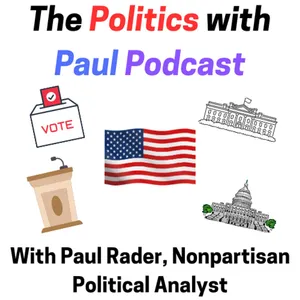
Free Daily Podcast Summary
Politics with Paul: Daily Summaries Delivered
by Paul Rader
Approachable, nonpartisan, and nonideological analysis of various political topics by nonpartisan political analyst, writer, researcher, and speaker Paul Rader.
Latest Episodes
The most recent episodes — sign up to get AI-powered summaries of each one.
- 6 days ago37 min
How Predictable are Election Results? | Politics with Paul #117
Something that gets lost in the election noise is that a lot of contests are foregone conclusions. Many of the results and the way many voters behave can be seen from a mile away. But have you wondered why so many elections are easily predictable?Today's episode of Politics with Paul explores what is predictable in elections and the implications. Listen in to see which aspects of politics and voter behavior are easily foreseeable and which are harder to forecast, where the fluctuations are that lead to unexpected results, and most importantly why this level of predictability poses trouble for democracy and holding government accountable.0:00 The Predictability of Elections1:33 Predicting Individuals vs. Groups7:46 Common Data Points Used to Forecast Elections16:26 Other Election Aspects That are Predictable24:57 Outside Factors That Can Impact an Election’s Predictability30:48 Predictability Poses Problems for Accountability, Democracy36:36 ClosingOther WorksFREE 5-day educational email course on how to fight polarization: https://detoxifyamericanpolitics.com/Buy my book about political independents: https://www.amazon.com/Why-Independents-Rarely-Win-Elections-ebook/dp/B09K8PYM5J/Medium articles on elections and political science: https://paulrader-42650.medium.com/MediaLinkedIn: https://www.linkedin.com/in/paulrader352/My website: https://paulrader.org/Facebook: https://www.facebook.com/PaulRaderWritesEmail: paulraderwrites@gmail.com
- 1 weeks ago37 min
Do Winning Candidates Have a Voter "Mandate"? | Politics with Paul #116
You often hear election winners claim they have a voter "mandate" - because they won, the public has entrusted that candidate to implement all their policy views. But does the idea of the voter mandate really hold up to scrutiny?Today's episode dives into the logic (or lack thereof) of the voter mandate, its implications, and why it's so often claimed by winning candidates. While it may not sound like a big deal to some observers, the mindset can have some important ramifications for government accountability, how well elected officials represent us, and whether we have sufficient choices in elections.0:00 The Voter "Mandate" Myth and Why it Matters2:01 The Faulty Logic of the Voter "Mandate"10:17 When the Voter Mandate Runs Into Reality15:03 Voter Mandates and Representation of the People20:04 Voter Mandates and Whether We Have Sufficient Choices23:38 Voter Mandates and Whether We Hold Officials Accountable31:15 What's the Big Deal About Claiming a "Voter Mandate"?34:09 Final Thoughts: Words, Actions Matter More as Elected OfficialsOther Works* FREE 5-day educational email course on how to fight polarization: https://detoxifyamericanpolitics.com/* Buy my book about political independents: https://www.amazon.com/Why-Independents-Rarely-Win-Elections-ebook/dp/B09K8PYM5J/* Medium articles on elections and political science: https://paulrader-42650.medium.com/Media* LinkedIn: https://www.linkedin.com/in/paulrader352/* My website: https://paulrader.org/* Facebook: https://www.facebook.com/PaulRaderWrites* Email: paulraderwrites@gmail.com
- 2 weeks ago44 min
Think About These Things Before You Vote | Politics with Paul #115
Informed voting is about more than mulling over who the “right” candidates are or how you should vote on ballot measures. It’s about understanding fundamentals of American governance and well-rounded decision-making.Whether you are a regular election participant, a first-time voter, or anything in between, this episode of Politics with Paul seeks to provide advice on how to make your vote decision-making easier and clearer, with 6 principles you may or may not have considered previously. Before you vote, I ask that you think these ideas over, including how to evaluate candidates, weighing how much a candidate might keep their promises, and how often (if ever) you should vote AGAINST somebody rather for another.0:00 Navigating Election Season: An Introduction2:14 Do Not Vote Rashly or Immediately6:20 Campaigns are Trying to Influence Your Vote, Not Inform You12:28 The Reality of Candidate Promises17:48 How Much Should Candidates Do Exactly What Voters Want?21:26 Heuristics: What Candidate Aspects Should Impact Your Vote?29:22 Should You Ever Vote Against Someone Instead of for Another?36:18 Deciding What to Vote On: The Ballot Breakdown40:50 Closing Thoughts and My Other MediaOther WorksFREE 5-day educational email course on how to fight polarization: https://detoxifyamericanpolitics.com/Buy my book about political independents: https://www.amazon.com/Why-Independents-Rarely-Win-Elections-ebook/dp/B09K8PYM5J/Medium articles on elections and political science: https://paulrader-42650.medium.com/MediaLinkedIn: https://www.linkedin.com/in/paulrader352/My website: https://paulrader.org/Facebook: https://www.facebook.com/PaulRaderWritesEmail: paulraderwrites@gmail.com
- 3 weeks ago39 min
Is Negative Campaigning Effective? | Politics with Paul #114
Negativity reigns in political ads — from assailing of candidate records to personal attacks. Despite candidate pledges to be positive and voters’ insistence that they hate negative campaigning, combative and adversarial ads become only more ubiquitous in the final weeks before an election.With the harmful impacts to democracy and dialogue that negative ads can bring, there are some questions we need to ask ourselves as voters, candidates, and political observers. Is negative campaigning really that effective? Do we truly hate negative campaigning like we say we do? Can it still sometimes serve a good purpose? And lastly, what can we do about it? Today’s episode of Politics with Paul explores these questions and more.0:00 What We Should Ask Ourselves About Negative Campaigning1:35 What is "Negative" Campaigning?6:26 The Blurred Line Between "Informative" and "Misleading"9:21 Why Negative Campaign Ads are So Common14:46 Do We Truly Hate Negative Campaigning?19:06 How Effective is Negative Campaigning?26:41 Why it's Hard to Legally Limit Negative Campaign Ads30:52 How We Can Push Back Against Excessive Negative Campaigning38:06 Closing and My Other LinksOther WorksFREE 5-day educational email course on how to fight polarization: https://detoxifyamericanpolitics.com/Buy my book about political independents: https://www.amazon.com/Why-Independents-Rarely-Win-Elections-ebook/dp/B09K8PYM5J/Medium articles on elections and political science: https://paulrader-42650.medium.com/MediaLinkedIn: https://www.linkedin.com/in/paulrader352/My website: https://paulrader.org/Facebook: https://www.facebook.com/PaulRaderWritesEmail: paulraderwrites@gmail.com
- Oct 6, 202624 min
Why Do We Vote? Why SHOULD We Vote? | Politics with Paul #113
Voting is often treated as a simple civic duty, but the reasons people vote are more varied than that. In this episode of Politics with Paul, we look at why we vote in the first place, whether voting can be considered rational, and five common motives that shape turnout. The discussion evaluates those motives and explores the blurry lines between altruism and self-interest, as well as between duty, belonging, and social approval. It closes by asking why understanding our motives for voting matters at all.
- Sep 29, 202637 min
Are We Truly Rational When We Vote? | Politics with Paul #112
Voting is often treated as a straightforward act of reason, but the reality is more complicated. In this episode of Politics with Paul, we examine what it means to vote rationally, how heuristics shape political choices, and 4 major models of voting behavior: rational vote theory, party-line voting, retrospective voting, and prospective voting. The discussion also looks at what influences our ballots beyond pure reasoning and asks a central question: how rational are we, really, when we vote?
- Sep 22, 202634 min
Is There Really a "Wasted" Vote? | Politics with Paul #111
In elections, many voters worry about "wasting" votes on perceived uncompetitive candidates - but is there such a thing as a wasted vote? Or perhaps this is the better question: Is the logic behind "not wasting votes" flawed? Today's episode of Politics with Paul dives into this common thought process that affects countless votes - and therefore, countless election results. The discussion cuts to the heart of some of the most important questions in politics: why we even vote in the first place, how logical voters' thinking is, and whether we are truly holding politicians, interest groups, and media accountable.
- Sep 15, 202643 min
When is it Appropriate to "Talk About Politics"? | Politics with Paul #110
Growing up and even as adults, we're often told that we should avoid talking politics because it is too divisive. That's understandable given how toxic the subject is, but that's not always good advice. Yet how do we know when we should and shouldn't discuss it? There's a time and place for everything, and today's episode of Politics with Paul explores when and where that is for elections and policy talk. Included in the discussion are the factors that influence the appropriateness of talking politics, why it's not just about when and where we discuss it, and whether that old advice to avoid political conversation may be contributing to today's divisiveness and polarization.
Get Politics with Paul summaries in your inbox
Free AI-powered daily recaps. Key takeaways, quotes, and mentions — in a 5-minute read.
Get Free Summaries →Free forever for up to 3 podcasts. No credit card required.
You Might Also Like
Listeners also like.
Spolitics
Explores how sports intersect with race, gender, sexuality, and culture through narrative storytelling and in-depth conversations.
GD POLITICS
Analyzes politics and global events with curiosity, rigor, and humor.
Not Another Politics Podcast
Political scientists analyze major political issues using data, theory, and research to explain the forces shaping American politics.
The NPR Politics Podcast
Daily political reporting from NPR journalists explaining major developments in Washington and on the campaign trail.

Breaking News from Pod Save America
Political news and analysis from former Obama administration insiders, covering breaking stories, speeches, and underreported issues.

Independent Americans with Paul Rieckhoff
A daily news podcast breaking down key U.S. issues and interviewing influential figures from an independent political perspective.
It's Just Politics
Zoe Clark and Rick Pluta break down the latest developments in Michigan politics with clarity and insight.
Brian Lehrer: A Daily Politics Podcast
Daily discussions on current events and political developments.

The David Pakman Show
A progressive talk show offering fact-based analysis and interviews on politics, current events, and social issues.
What A Day
A daily news podcast offering concise, thoughtful analysis of major stories and cultural trends, hosted by Jane Coaston.

Runaway Country with Alex Wagner
Alex Wagner explores America’s political divisions through conversations with people living through the nation’s most urgent conflicts.
Political Thinking with Nick Robinson
In-depth conversations with political figures and influencers about their lives and the experiences that shaped their worldviews.
About Politics with Paul
Approachable, nonpartisan, and nonideological analysis of various political topics by nonpartisan political analyst, writer, researcher, and speaker Paul Rader.
Customized Recaps
AI-powered recaps with compact key takeaways, quotes, and insights.
Straight to Your Inbox
Get key takeaways from Politics with Paul in a 5-minute read.
Save Hours Every Week
Stay current on your favorite podcasts without falling behind.
Frequently Asked Questions
What is Podzilla's Politics with Paul daily summary?
It's a free AI-powered email that summarizes new episodes of Politics with Paul as soon as they're published. You get the key takeaways, notable quotes, and links & mentions — all in a quick read.
How does the Politics with Paul podcast summary work?
When a new episode drops, our AI transcribes and analyzes it, then generates a personalized summary tailored to your interests and profession. It's delivered to your inbox every morning.
Is this an official Politics with Paul product?
No. Podzilla is an independent service that summarizes publicly available podcast content. We're not affiliated with or endorsed by Paul Rader.
Can I get summaries of other podcasts too?
Absolutely! The free plan covers up to 3 podcasts, any in the catalog. Basic raises that to 15, Pro to 40 and Max to 100. Browse our full catalog at /podcasts.
What topics does Politics with Paul cover?
Politics with Paul covers topics including News, Government, Politics. Our AI identifies the specific themes in each episode and highlights what matters most to you.
Start getting Politics with Paul summaries tomorrow morning.
Free forever for up to 3 podcasts. No credit card required.
Free forever for up to 3 podcasts. No credit card required.