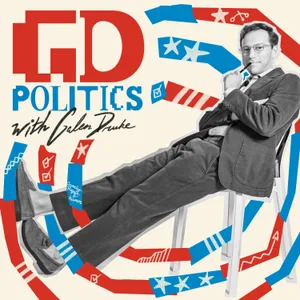
Free Daily Podcast Summary
GD POLITICS: Daily Summaries Delivered
by Galen Druke
Making sense of politics and the world with curiosity, rigor, and a sense of humor.
Latest Episodes
The most recent episodes — sign up to get AI-powered summaries of each one.
- Yesterday58 min
Is This Time Different In Texas?
Today we’re zooming in on the midterm races in Texas. We started our 2026 tour of the states in Georgia. If you haven’t listened to that episode yet, go check it out!If Georgia has become a secondary concern for the parties this cycle, it’s because redder states have upstaged it and Texas is the star of the whole show.In the race for Senate, Democrat James Talarico and Republican Ken Paxton aren’t just making Texas look like a highly competitive state. They’re making it look like Democrats are favored. Talarico currently leads in the polling averages by three points, and Paxton hasn’t led in the average since the conclusion of the primary in May.In the race for governor, Republican Greg Abbott is favored and leads Democrat Gina Hinojosa by three points on average, though it’s certainly a closer race than Republicans would have imagined two years ago, when Trump won the state by 14 points and Abbott was sitting at a net approval rating of plus 20 percentage points.In the House, Texas steals the show again. It was ground zero for the redistricting wars, with Republicans redrawing the map to give themselves five pickup opportunities. That now looks overly optimistic.Even downballot races are attracting national attention. The Republican nominee for railroad commissioner, Bo French, prompted Karl Rove to endorse his Democratic opponent after his racist posts on Twitter, bemoaning the presence of South Asian students celebrating at a UT Austin Longhorns game.With me to talk about it all are Gabby Birenbaum, Washington correspondent for The Texas Tribune, and James Henson, director of the Texas Politics Project at UT Austin, where he directs the project’s polling. This is a public episode. If you'd like to discuss this with other subscribers or get access to bonus episodes, visit www.gdpolitics.com/subscribe
- 5 days ago12 min
Georgia’s 2026 Election Is Already About 2028
This is a free preview of a paid episode. To hear more, visit www.gdpolitics.comThe full episode is available to paid subscribers. Once you become a paid subscriber, you can connect your account to your preferred podcast player here.As Election Day approaches, we’re zooming in on some of the states shaping this cycle with the reporters who know them best. First up: Georgia. The Senate race has slipped somewhat from the national spotlight, but there’s still plenty of action in the races for governor and the state House.Jon Ossoff began the cycle as the only Democratic senator seeking reelection in a state Trump won in 2024. He now leads Republican Mike Collins in current polling averages, while Collins’s campaign has faced an ethics investigation and other controversies. We look at how the race got here and why Ossoff’s growing national profile has stirred talk about 2028, even though he says he isn’t running.Then there’s the governor’s race, which pits former Atlanta Mayor Keisha Lance Bottoms against Republican healthcare executive Rick Jackson. Bottoms is emphasizing affordability and her Georgia roots, while Jackson is presenting himself as a political outsider after spending more than $108 million of his own money during the primary.There’s plenty happening down the ballot, too. Democrats hope to flip the state House, while the fight over Georgia’s political maps is far from settled. Republican leaders shelved a redistricting push this summer, but Democrats warn that it could return after the election.To sort through it all, I’m joined by the hosts of the Politically Georgia podcast: Tia Mitchell, The Atlanta Journal-Constitution’s Washington bureau chief, and Greg Bluestein, the newspaper’s chief political reporter.
- 1 weeks ago52 min
The AI Apocalypse Comes To Washington
A dam of pent-up concern over AI safety burst this past week. It started with a warning from AI researcher Jacob Coxon, who resigned from Anthropic and wrote on X: “Do not underestimate the power of this technology. These will soon be superhuman systems that can hack anything, revolutionize any field overnight, and acquire real power and resources.”He continued: “The people building AI earnestly believe that it could kill us all by the end of the decade.”Since then, Anthropic CEO Dario Amodei has outlined a plan to slow the technology’s development and give safety measures time to catch up. He also warned that, within six months to a year, swarms of AI agents could take over the entire internet. Sam Altman and Elon Musk both expressed support for Amodei’s warning and proposed approach.Politicians are also taking notice and calling for regulation. The most forceful proposals have come from Democrats, though not exclusively. Sens. John Thune, Amy Klobuchar and Ted Cruz are reportedly working on AI-safety legislation that could be introduced as soon as this week.Bernie Sanders has called on President Trump to pursue an AI agreement with China modeled on the nuclear arms agreements reached by Ronald Reagan and Mikhail Gorbachev. At a fundraiser, former President Barack Obama urged Democrats to “aggressively develop political and governing agendas to prioritize the issue in the coming years,” according to The New York Times.For his part, Trump wrote Monday on Truth Social: “The only control or ‘guardrails’ that AI needs is a STRONG AND SMART (High IQ!) PRESIDENT.” He continued: “There is a SICK conspiracy going on against AI and Data Centers, and the only one that is happy about it is China. WHOEVER WINS AI, WINS!”Joining me today to discuss whether AI is going to kill us all — or, at the very least, how the threat that it could is ricocheting through American politics — are two sharp thinkers on AI. David Byler is a pollster and vice president at National Research Group. He writes the newsletter “Real Research on Artificial Intelligence.” Mary Radcliffe is head of research at FiftyPlusOne. This is a public episode. If you'd like to discuss this with other subscribers or get access to bonus episodes, visit www.gdpolitics.com/subscribe
- 1 weeks ago22 min
‘Still Counting’ After All These Years
This is a free preview of a paid episode. To hear more, visit www.gdpolitics.comAs you’ve likely heard, Nate Silver, Clare Malone and I have a new podcast going over at Crooked Media called Still Counting. We released our first official episode on Wednesday, and that is what you’re going to hear in the feed today.(It’s this thing we do in the podcasting world called a “feed drop.” The hope is that you will like what you hear and subscribe to the new podcast. So please, dear listener, go subscribe!)To pull the curtain back a little, starting this new podcast is something Nate, Clare and I have been talking about doing since around February or March of this year. We really enjoyed taping live shows at the Comedy Cellar, and audience members would frequently ask us after the shows if we’d consider getting back together.We all have our own projects going – Clare at the New Yorker, Nate at Silver Bulletin, and me here at GD – but the stars aligned just so that it felt like reassembling the band made sense.We got to work reaching out to different podcast shops that we thought might be interested in a FiveThirtyEight sequel, and we had a lot of conversations. One of the things that attracted us to Crooked was that they were familiar with FiveThirtyEight, knew what we were about, and wanted to let us do our thing. That included not aligning with a political party.We set a goal to launch as election season was picking up after Labor Day, and voilà, here we are.In this first episode, we dive into the most competitive Senate races in the midterms according to the polls: Texas, Michigan, Iowa, Maine, Alaska, North Carolina, New Hampshire, Kansas, and Ohio. We also weigh whether the Republican midterm convention is a “good use of convention or a bad use of convention.” And, on a more somber note, we take stock of the year in American politics since Charlie Kirk’s assassination.It was nice to get the crew back together, and we’re still just getting warmed up. So, once again, make sure to subscribe to join us on our new adventure!
- 2 weeks ago45 min
How Far Can The Redistricting Arms Race Go?
Quick note: The mid-decade redistricting wars have been so chaotic that the maps changed again between when I recorded this podcast on Thursday and when you’re hearing it.Hours after I spoke with Dave Wasserman of the Cook Political Report, the Missouri Supreme Court blocked Republicans’ new congressional map from being used this November and ordered the state to move forward with a referendum on it. Missouri is appealing to the U.S. Supreme Court, but if the decision stands, Republicans will have one fewer potential pickup from redistricting this cycle. Consider that an asterisk on some of the numbers you’ll hear in this episode.The bigger story remains the same: The fight over congressional maps has transformed the battle for the House. Ten states have redrawn their maps since 2024, and according to Cook’s Partisan Voter Index, the median House district has moved from roughly one point more Republican than the country to about three points more Republican.At the same time, competitive districts are disappearing. In 2000, 164 House districts fell between R+5 and D+5 in Cook’s PVI. Today, Wasserman says there are just 78 — fewer than one in five House districts. And the redistricting wars aren’t necessarily over. Both parties could still try to squeeze additional seats out of states they control in the years ahead.Dave and I first dug into gerrymandering together nearly a decade ago for FiveThirtyEight’s Gerrymandering Project. Back then, redistricting was largely something that happened once every ten years. As Dave puts it today, we’ve gone from redistricting every ten years to what feels like “every 10 seconds.” This is a public episode. If you'd like to discuss this with other subscribers or get access to bonus episodes, visit www.gdpolitics.com/subscribe
- 2 weeks ago18 min
You Can’t Poll Away Uncertainty
This is a free preview of a paid episode. To hear more, visit www.gdpolitics.comThe full episode is available to paid subscribers. Once you become a paid subscriber, you can connect your account to your preferred podcast player here.We are exactly two months away from Election Day and just days away from the official start of election season. It’s going to be two months of new polls, forecast gyrations and, in a word, uncertainty.At this point in an election cycle, back at FiveThirtyEight, I’d sometimes feel that a therapist might be better suited to hosting the podcast, because the job became, to some extent, helping people reckon with the unknown.One way we did that was by trying to quantify uncertainty and put it in historical context — looking at, for example, the average error or the largest error in past elections. And I think that’s plenty useful.But after more than a decade in the data journalism trenches, I can tell you that numbers will soothe the soul only so much. At a certain point, we just have to get comfortable with not knowing.And that’s what we’re doing on today’s podcast, in the final calm before the storm. My guest is journalist Simone Stolzoff, author of How to Not Know: The Value of Uncertainty in a World That Demands Answers.
- 3 weeks ago44 min
This Is What A Blue Wave Looks Like
We’re a week away from the official start of election season — Labor Day — but the polls are not waiting. New Senate surveys in Texas, Michigan and Iowa are sharpening the picture of the battle for Congress. And polls from South Carolina, Nebraska and Kansas have made Democrats optimistic about competitive races on decidedly red turf.So is this silly season, when Democrats get their hopes up in states they won’t actually win? Or is a blue wave putting much more of the map in play? Lakshya Jain, founder of Split Ticket and head of political data at The Argument, and Zach Donnini, head of data science at VoteHub, join today’s episode to sort through the evidence.We discuss why Texas looks different from Democrats’ previous attempts to turn it blue, how much candidate quality could matter in Michigan, and why a favorable national environment likely isn’t enough for Democrats in South Carolina.We also check in on Zach and Lakshya’s forecasts and the Democratic primary between Ed Markey and Seth Moulton in Massachusetts. (Yes, we are still talking about primaries. Those don’t wrap up until mid-September!) This is a public episode. If you'd like to discuss this with other subscribers or get access to bonus episodes, visit www.gdpolitics.com/subscribe
- 3 weeks ago18 min
Are Data Centers The ‘Sleeper Issue’ Of 2026?
This is a free preview of a paid episode. To hear more, visit www.gdpolitics.comThe full episode is available to paid subscribers. Once you become a paid subscriber, you can connect your account to your preferred podcast player here.I want to give listeners a heads-up about some exciting news: Nate Silver, Clare Malone, and I are starting a weekly podcast with Crooked Media called Still Counting! We’re getting the gang back together every Wednesday to talk politics and numbers starting September 9, and you can subscribe now on YouTube or wherever you get your podcasts. There’s already a trailer in the feed to give you a taste of what’s to come.To be clear, GD POLITICS isn’t going anywhere. I’ve loved making this podcast for you all over the past year and a half, and I’ll continue chatting with friends, experts, authors, and others every Monday and Thursday. Now you can also hear from Clare, Nate, and me on Wednesdays!-----We’ve been talking for a while on this podcast about how AI is liable to disrupt American politics, whether through joblessness or a bursting stock market bubble. We’re not ruling any of those out, but the most immediate disruption appears to be data centers.According to a recent Fox News poll, American voters oppose building a data center in their area to support artificial intelligence technology by 40 percentage points.Politicians are taking note. Both Democrats and Republicans who championed new data centers in their states just last year have since taken sharp turns on the issue.Last week, the Senate GOP campaign arm released a memo warning that the issue could sink Ohio Senator Jon Husted, writing, “If he loses and data centers get the blame, politicians across the country will take notice — and they will not go near the next one.” The memo goes on to say, “This has become a sleeper issue for the entire election cycle.”Today, Mary Radcliffe, head of research at FiftyPlusOne, and Nathaniel Rakich, managing editor at Votebeat, help me unpack that conclusion. We also dig into questions about whether the primary vote in Alaska is predictive of the midterm results this fall. Plus, after a fake pollster caught our attention last week, we’re digging deeper into the Wild West of startup pollsters and how they shape public perceptions of political races.
Get GD POLITICS summaries in your inbox
Free AI-powered daily recaps. Key takeaways, quotes, and mentions — in a 5-minute read.
Get Free Summaries →Free forever for up to 3 podcasts. No credit card required.
You Might Also Like
Listeners also like.

Assembly Required with Stacey Abrams
Assembly Required with Stacey Abrams

Steve Deace Show
Daily commentary on principled conservatism with a snarky tone.

The Dispatch Podcast
A political and cultural discussion featuring Steve Hayes, Jonah Goldberg, Megan McArdle, and guests exploring policy and current events.

Law and Chaos
Legal journalists analyze pivotal courtroom cases and their impact on American democracy.

It's A Numbers Game with Ryan Girdusky
Analyzes sports betting through advanced metrics and interviews with professional gamblers and contest players.

Battleground America Podcast
Examines the forces shaping American politics and culture through daily analysis of current events and underlying power dynamics.

Not Another Politics Podcast
Political scientists analyze major political issues using data, theory, and research to explain the forces shaping American politics.

Brian Lehrer: A Daily Politics Podcast
Daily discussions on current events and political developments.

UNBIASED Politics
A lawyer-hosted recap of U.S. political news, elections, and legal developments explained clearly and without opinion.

Breaking Points with Krystal and Saagar
Political analysis and interviews challenging mainstream narratives and holding power to account.
Left, Right & Center
A political podcast that examines ideological differences through balanced, in-depth conversations between left and right perspectives.

Part Of The Problem
A Libertarian commentator discusses current events, government, and foreign policy while advocating for a free nation.
About GD POLITICS
Making sense of politics and the world with curiosity, rigor, and a sense of humor.
Customized Recaps
AI-powered recaps with compact key takeaways, quotes, and insights.
Straight to Your Inbox
Get key takeaways from GD POLITICS in a 5-minute read.
Save Hours Every Week
Stay current on your favorite podcasts without falling behind.
Frequently Asked Questions
What is Podzilla's GD POLITICS daily summary?
It's a free AI-powered email that summarizes new episodes of GD POLITICS as soon as they're published. You get the key takeaways, notable quotes, and links & mentions — all in a quick read.
How does the GD POLITICS podcast summary work?
When a new episode drops, our AI transcribes and analyzes it, then generates a personalized summary tailored to your interests and profession. It's delivered to your inbox every morning.
Is this an official GD POLITICS product?
No. Podzilla is an independent service that summarizes publicly available podcast content. We're not affiliated with or endorsed by Galen Druke.
Can I get summaries of other podcasts too?
Absolutely! The free plan covers up to 3 podcasts. Upgrade to Pro for 15, or Premium for 50. Browse our full catalog at /podcasts.
How often does GD POLITICS release new episodes?
GD POLITICS publishes 2x weekly. Our AI generates a summary within hours of each new episode.
What topics does GD POLITICS cover?
GD POLITICS covers topics including News. Our AI identifies the specific themes in each episode and highlights what matters most to you.
Start getting GD POLITICS summaries tomorrow morning.
Free forever for up to 3 podcasts. No credit card required.
Free forever for up to 3 podcasts. No credit card required.