Free Daily Podcast Summary
Not Another Politics Podcast: Daily Summaries Delivered
by University of Chicago Podcast Network
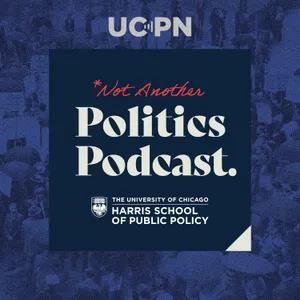
With all the noise created by a 24/7 news cycle, it can be hard to really grasp what's going on in politics today. We provide a fresh perspective on the biggest political stories not through opinion and anecdotes, but rigorous scholarship, massive data sets and a deep knowledge of theory. Understand the political science beyond the headlines with Harris School of Public Policy Professors William Howell, Anthony Fowler and Wioletta Dziuda.
Latest Episodes
The most recent episodes — sign up to get AI-powered summaries of each one.
- 3 weeks ago1h 2m
Does Congress Actually Have Power of the Purse?
The "power of the purse"—Congress’s constitutional authority to control public spending—is often cited as the ultimate check on executive power. But how effectively does legislative funding actually translate into policy influence in modern Washington? In this episode, we sit down with UChicago Ph.D. candidate Kevin Angell to dive into his latest paper on legislative spending power and appropriations. Moving beyond political rhetoric, Angell shares rigorous empirical research examining how federal budget allocations shape agency behavior, where Congressional leverage succeeds, and where executive discretion chips away at legislative control. Hosted by Simplecast, an AdsWizz company. See pcm.adswizz.com for information about our collection and use of personal data for advertising.
- Aug 6, 20261h 6m
Are Easy A’s Too Widespread in Academia?
Across universities today, raw GPAs treat an A in advanced econometrics the same as an A in introductory film studies. Standard grading systems inadvertently penalize students who challenge themselves and reward those who course-shop. In this episode, we speak with Harvard Business School Professor Scott Kominers about his recent paper that looks at how mathematical market design and "eigengrades" can strip out course difficulty to measure actual student performance. The paper proposes a fixed-effects model—using student overlap across courses—to isolate true academic capability. We explore how this simple structural fix could end the strategic game of course-shopping. Hosted by Simplecast, an AdsWizz company. See pcm.adswizz.com for information about our collection and use of personal data for advertising.
- Jul 17, 202654 min
Do We Understand Members Of The Other Party?
Do Democrats and Republicans really misunderstand each other as much as we think? This week, we dive into a surprising new experiment that puts that idea to the test — literally. Psychologist and researcher Adam Mastriani created a kind of “political Turing test,” asking people to write persuasive statements from the perspective of the opposite political party. Then, he tested whether others could tell the real from the fake. The results? Most people couldn’t. We unpack what this means for our understanding of polarization, partisan animosity, and political identity. Is the problem really misunderstanding — or something deeper? Are partisans more empathetic than we give them credit for? Or are they just really good at writing what they think others want to hear? We also explore the experiment’s implications for political science research, theory-building, and the broader sociology of science. Hosted by Simplecast, an AdsWizz company. See pcm.adswizz.com for information about our collection and use of personal data for advertising.
- Jul 2, 20261h 16m
The Economic Cost of Populism
While we take a quick summer break, we wanted to re-release an episode that felt timely, given the rise of right-wing populism around the world. More than 25 percent of countries around the world are currently governed by populists, from Recep Tayyip Erdogan in Turkey, to Donald Trump in the United States. Based on these findings, populism is at an all-time high, and taking a significant economic toll, according to a recent paper by Christoph Trebesch and his co-authors. Trebesch is Professor of Economics at Kiel University. He and his co-authors find that populism leads to slower economic growth, undermines democratic institutions, and can leave the country more vulnerable to future populist governments. Hosted by Simplecast, an AdsWizz company. See pcm.adswizz.com for information about our collection and use of personal data for advertising.
- Jun 11, 202653 min
Is Abortion Policy Out Of Step With Public Opinion?
Since the fall of Roe v. Wade, we've been told a simple story: red states are radically out of step with public opinion. But what if that's not actually the reality? On this episode, we speak with Natalie Hernandez, Yale PhD candidate in Political Science, about her upcoming APSR paper, "Asymmetric Representation: Post-Roe Abortion Policy and Public Opinion in the U.S. States." Using a massive dataset of 155,000 respondents, Hernandez finds policies in Democratic-controlled states are actually furthest from the average voter, and what happens when Democratic lawmakers prioritize wealthy donors and national activists over the median citizen. Hosted by Simplecast, an AdsWizz company. See pcm.adswizz.com for information about our collection and use of personal data for advertising.
- May 14, 20261h 5m
The Political Effects of the Opioid Crisis
In this episode, we speak with Victoria Barone, Assistant Professor at the University of Notre Dame, to discuss her recent NBER paper that examines the possible relationship between the opioid epidemic and the political realignment between the Republican and Democratic parties. While the public health consequences of the crisis are well-documented, Barone’s research uncovers a startling political fallout. We explore how the rise in opioid-related deaths and addiction has altered voting patterns, shifted party leanings, and influenced electoral outcomes in the hardest-hit communities. Hosted by Simplecast, an AdsWizz company. See pcm.adswizz.com for information about our collection and use of personal data for advertising.
- Apr 24, 20261h 9m
Is the Median Justice Running the Supreme Court?
In debates about the Supreme Court, we tend to focus on the justice who writes the opinion. But what if that’s not where the real power lies? In this episode, we speak to Jonathan P. Kastellec, Professor at Princeton University, about his new paper that challenges how we think about decision-making on the Court. Instead of opinion authors driving the law, Kastellec argues that power often rests with the median justice within the majority coalition—the key vote needed to hold five justices together. So how does bargaining actually work behind the scenes? Why do some precedents erode gradually while others collapse all at once? And what does this tell us about major decisions—from long-standing rulings to sudden reversals? Hosted by Simplecast, an AdsWizz company. See pcm.adswizz.com for information about our collection and use of personal data for advertising.
- Mar 26, 202650 min
Why Does America Pay More For Infrastructure?
We're off this week for a much-needed spring break, but we wanted to re-share this episode that feels more relevant than ever. Infrastructure in the U.S. now costs dramatically more than in countries like Germany or Croatia—without clear signs of higher quality or better environmental outcomes. Why has infrastructure spending spiraled out of control? Could democracy itself—through litigation, regulations, and empowered citizen voices—be driving costs sky-high? George Washington University Professor of Public Policy Leah Brooks investigates why the U.S. pays so much more per mile of highway compared to other nations in her paper “Infrastructure Costs”. Brooks reveals shocking findings: from the late 1960s onward, the cost to build highways in America surged dramatically, not because of higher wages or materials, but because of legal battles, environmental reviews, and citizen demands. Hosted by Simplecast, an AdsWizz company. See pcm.adswizz.com for information about our collection and use of personal data for advertising.
Get Not Another Politics Podcast summaries in your inbox
Free AI-powered daily recaps. Key takeaways, quotes, and mentions — in a 5-minute read.
Get Free Summaries →Free forever for up to 3 podcasts. No credit card required.
You Might Also Like
Listeners also like.
Brian Lehrer: A Daily Politics Podcast
Daily discussions on current events and political developments.
The NPR Politics Podcast
Daily political reporting from NPR journalists explaining major developments in Washington and on the campaign trail.
Spolitics
Explores how sports intersect with race, gender, sexuality, and culture through narrative storytelling and in-depth conversations.
CNN Politics
A roundup of CNN's political podcasts covering breaking news, elections, and policy debates.
Impolitic with John Heilemann
Candid interviews with figures in politics, media, tech, and culture exploring power, influence, and societal change.
CSPI Podcast
Conversations with CSPI scholars and experts on topics in science, technology, and politics.

Perino on Politics
Dana Perino discusses current political headlines with insiders and experts to provide insight and context for the week ahead.

Breaking News from Pod Save America
Political news and analysis from former Obama administration insiders, covering breaking stories, speeches, and underreported issues.
American Friction
A UK-based podcast analyzing US politics with expert interviews and commentary on current events and major issues.

Normally
Political commentators discuss serious issues with humor and irreverence while focusing on what matters.
Capitalisn't
Examines the flaws in modern capitalism and explores solutions to make it work better for society.

The Rest Is Politics: US
Insightful analysis of U.S. politics and policy from a former White House official and a veteran BBC correspondent.
About Not Another Politics Podcast
With all the noise created by a 24/7 news cycle, it can be hard to really grasp what's going on in politics today. We provide a fresh perspective on the biggest political stories not through opinion and anecdotes, but rigorous scholarship, massive data sets and a deep knowledge of theory. Understand the political science beyond the headlines with Harris School of Public Policy Professors William Howell, Anthony Fowler and Wioletta Dziuda.
Customized Recaps
AI-powered recaps with compact key takeaways, quotes, and insights.
Straight to Your Inbox
Get key takeaways from Not Another Politics Podcast in a 5-minute read.
Save Hours Every Week
Stay current on your favorite podcasts without falling behind.
Frequently Asked Questions
What is Podzilla's Not Another Politics Podcast daily summary?
It's a free AI-powered email that summarizes new episodes of Not Another Politics Podcast as soon as they're published. You get the key takeaways, notable quotes, and links & mentions — all in a quick read.
How does the Not Another Politics Podcast podcast summary work?
When a new episode drops, our AI transcribes and analyzes it, then generates a personalized summary tailored to your interests and profession. It's delivered to your inbox every morning.
Is this an official Not Another Politics Podcast product?
No. Podzilla is an independent service that summarizes publicly available podcast content. We're not affiliated with or endorsed by University of Chicago Podcast Network.
Can I get summaries of other podcasts too?
Absolutely! The free plan covers up to 3 podcasts. Upgrade to Pro for 15, or Premium for 50. Browse our full catalog at /podcasts.
How often does Not Another Politics Podcast release new episodes?
Not Another Politics Podcast publishes monthly. Our AI generates a summary within hours of each new episode.
What topics does Not Another Politics Podcast cover?
Not Another Politics Podcast covers topics including News, Education, Government, Courses, Politics. Our AI identifies the specific themes in each episode and highlights what matters most to you.
Start getting Not Another Politics Podcast summaries tomorrow morning.
Free forever for up to 3 podcasts. No credit card required.
Free forever for up to 3 podcasts. No credit card required.