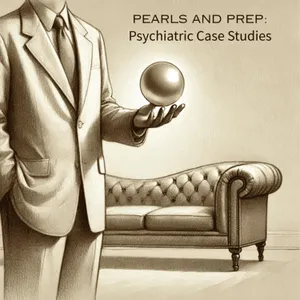
Free Daily Podcast Summary
Pearls and Prep: Daily Summaries Delivered
by NP Z | PMHNP Boards Prep
There are two kinds of clinicians — the ones who follow algorithms, and the ones who understand the "why."Be the second: https://www.patreon.com/PearlsandPrep — study guides, psychopharm deep dives & practice questions.📚 Get the 100 Psychiatric Interview Tips For Your 1st Eval E-Book — $39.99 in the shop (free for Boss Pearl members): https://www.patreon.com/c/pearlsandprep/shopPearls and Prep: Psychiatric Case Studies helps you get the why and build clinical confidence. Each episode walks you through a real-world psychiatric case — from chart review to treatment plan — covering psychopharmacology (SSRIs, SNRIs, SGAs, mood stabilizers), DSM-5-TR differential diagnosis, and evidence-based prescribing.💊 Psychopharmacology breakdowns: mechanisms, half-lives, side-effect pearls🧠 DSM-5-TR differential diagnosis deep-dives📌 Memory hooks, screening questions & documentation phrases🎯 Built for PMHNP students prepping for ANCC/AANP boards — and clinicians sharpening their edgeNew episod
Latest Episodes
The most recent episodes — sign up to get AI-powered summaries of each one.
- Yesterday13 min
The Top Residual Symptoms That Predict Relapse — and How to Map an SSRI or SGA to Each One
💎 Try Boss Pearl FREE for 7 days — the full library: every deep dive, the Diagnosing curriculum, and both books free the moment you're in — so you're ready for that first patient, not just studied for it. Then $20/month, cancel anytime:https://www.patreon.com/checkout/pearlsandprep?rid=29362056🎁 Join as a free member to access 50 Pearls from Pearls & Prep — 50 super high-yield pearls to sharpen your practice.📚 Members get both books free — Board Bombs: PMHNP 250 Questions ($49.99) and the 100 Psychiatric Interview Tips E-Book ($39.99). Not a member yet? Both are in the shop: https://www.patreon.com/c/pearlsandprep/shop⭐ Enjoying the show? Please rate and review Pearls and Prep on Apple Podcasts or Spotify — it really helps!🌐 PearlsandPrep.com — scan this episode's Street Takes card, read the deep-dive articles, and unlock the full clinical library: https://pearlsandprep.com✉️ Questions or a case you want covered? Write to NP Z: pearlsandpreppodcast@gmail.comYour patient "remitted." The suicidal thoughts are gone, the mood is up, they're back at pickleball — and all that remains is a little insomnia and a little fatigue. Harmless leftovers? In the classic follow-up data, that patient relapses at roughly three times the rate of the patient who remitted clean: 76% versus 25%. In this bonus episode NP Z makes the case that "almost better" is the most dangerous address in depression care — and gives you the checklist for telling a true residual symptom from the dozen impostors that imitate one, plus the symptom-by-symptom map for putting the last embers out.🔥 Pearl 1 — The number that should change how you chart. Paykel's cohort followed patients to remission and beyond: those who carried residual symptoms relapsed at 76%, those who remitted clean at 25% — about three times the risk, and they relapsed faster. Layer on the STAR*D reality that only about a third of patients remit on the first antidepressant, and the clinical posture writes itself: response is a waypoint, remission is the job, and a symptom-free remission is the finish line.😴 Pearl 2 — Sleep is the number-one leftover. Across cohorts, sleep disturbance is the most common and most persistent residual symptom — in the STAR*D remitter analysis, mid-nocturnal insomnia (the 3 a.m. wide-awake) led the list at roughly six in ten, ahead of sleep-onset and early-morning insomnia. Residual insomnia and residual anxiety are also the leftovers most consistently tied to relapse. So the rule: never pick an antidepressant without a sleep plan — CBT-I, a sleep-targeting agent (trazodone, low-dose doxepin, mirtazapine where its profile fits), or a deliberate reason you don't need one.🧾 Pearl 3 — Know the whole leftover list, including the one that isn't in the DSM. Behind sleep come fatigue, anxiety, poor concentration, appetite and GI complaints, psychomotor change, lingering sad mood and anhedonia — and, strikingly, headaches and somatic aches, which aren't depressive criteria at all yet show up constantly among residual complaints (in Paykel's series, somatic symptoms appeared in nearly every patient with residual symptoms). The patient who "can't get going," can't focus enough to hold the job, and aches everywhere is not done, whatever the total score says.🕵️ Pearl 4 — Before you treat a residual symptom, interrogate it. The episode's differential, in order: Is the diagnosis wrong — bipolar spectrum cycling under an antidepressant, an unrecognised personality disorder, untreated ADHD wearing a "brain fog" costume? Is the trial even adequate — six to twelve weeks at a real dose, or still parked at sertraline 25 mg? Are they actually taking it? Is this the drug, not the disease — SSRI apathy and emotional blunting, 5-HT2A-driven restlessness, REM disruption with vivid dreams? And the impostors nobody asks about: sleep apnea (snoring, morning headaches, the unused CPAP in the closet), hypothyroidism, anaemia, low B12 or folate, chronic pain, substances and their withdrawals, and the divorce happening in the background. Polypharmacy aimed at an impostor just muddies the water.🎯 Pearl 5 — When it IS residual, match the drug to the ember. Anhedonia, apathy, dead motivation: an FDA-approved adjunct SGA — aripiprazole, brexpiprazole, or cariprazine, whose D3 preference is the mechanistic bet for the reward-circuit symptoms; their 5-HT2A antagonism releases serotonin's brake on dopamine in the circuits where that helps. Residual insomnia: quetiapine in its 150–300 mg adjunct range will put them to sleep — with an honest metabolic conversation — and its metabolite norquetiapine adds noradrenergic and 5-HT1A activity NP Z also leans on for residual anxiety. Fatigue and poor concentration: bupropion. Sexual dysfunction: bupropion again. The classic bench is still real: lithium, T3 (with endocrine or primary-care partnership), and off
- 4 days ago14 min
Prozac vs Paxil: My Verdict — and the Exact Patient I'd Give Each One
💎 Try Boss Pearl FREE for 7 days — the full library: every deep dive, the Diagnosing curriculum, and both books free the moment you're in — so you're ready for that first patient, not just studied for it. Then $20/month, cancel anytime:https://www.patreon.com/checkout/pearlsandprep?rid=29362056🎁 Join as a free member to access 50 Pearls from Pearls & Prep — 50 super high-yield pearls to sharpen your practice.📚 Members get both books free — Board Bombs: PMHNP 250 Questions ($49.99) and the 100 Psychiatric Interview Tips E-Book ($39.99). Not a member yet? Both are in the shop: https://www.patreon.com/c/pearlsandprep/shop⭐ Enjoying the show? Please rate and review Pearls and Prep on Apple Podcasts or Spotify — it really helps!🌐 PearlsandPrep.com — scan this episode's Street Takes card, read the deep-dive articles, and unlock the full clinical library: https://pearlsandprep.com✉️ Questions or a case you want covered? Write to NP Z: pearlsandpreppodcast@gmail.comSchool teaches you that all SSRIs are more or less equal for depression — and on efficacy, that's roughly true. It will not get you to the finish line. In this bonus episode, NP Z puts the two most opposite SSRIs in the class head to head: Prozac, the activating marathon runner with a half-life measured in days, and Paxil, the sedating sprinter gone from the body in about a day. Same class, same dragon — radically different patients. This is the prescriber's verdict on which one earns which chair, and why "equally efficacious" never means "prescribe them equally."⚡ Pearl 1 — Prozac is the activator, and that's a receptor story. Fluoxetine's 5-HT2C antagonism disinhibits frontal dopamine and norepinephrine release, which is why it so often lifts the flat, slowed, oversleeping, overeating depression that can't get out of bed. That profile is why NP Z reaches for it over bupropion when anxiety rides along — the energizing SSRI that still treats the anxiety. It also carries an FDA approval for bulimia nervosa at 60 mg/day, and pediatric approvals Paxil doesn't have (depression ages 8–18, OCD ages 7–17). Versatility is the brand.⏳ Pearl 2 — Half-life is destiny. Fluoxetine's half-life is 4–6 days, and its active metabolite norfluoxetine runs longer still — miss a dose, miss three, and the drug forgives you; it is the SSRI that protects imperfect adherers from discontinuation symptoms. Paroxetine's half-life is about 21 hours: one pharmacy hiccup can put a patient in withdrawal. The paradox you'll see in clinic — Paxil patients are often your most religiously adherent, because they know exactly what missing feels like.🌙 Pearl 3 — Paxil is the sedating outlier of the class. It is the most potent serotonin reuptake blocker of the SSRIs and the most anticholinergic — structurally the closest thing the class has to a tricyclic: sleepiness, dry mouth, constipation, sweating, and the heaviest sexual dysfunction of any SSRI, an effect strong enough that the literature has used it deliberately for paraphilic disorders. For the very anxious, agitated patient whose chief demand is "fix my sleep," that sedation is a feature — one drug doing two jobs, instead of starting something activating and then adding a second agent for the insomnia it stirred up.🗂️ Pearl 4 — Count the FDA indications and Paxil wins on breadth: major depression, OCD, panic disorder, social anxiety disorder, GAD, PTSD, PMDD, and — in a low-dose formulation — menopausal hot flashes. Fluoxetine is effective in anxiety and PTSD but was never FDA-approved for GAD or PTSD; the trials simply weren't run for those labels. Prozac answers with its own unique territory: the olanzapine–fluoxetine combination (Symbyax) is FDA-approved for bipolar I depression and treatment-resistant depression. If NP Z could stock only one antidepressant on a desert island, it would be Prozac — children and adults, an eating-disorder approval, and a bipolar-depression door no other SSRI opens alone.🧪 Pearl 5 — Both are strong CYP2D6 inhibitors, so both can raise levels of tricyclics, metoprolol, and antipsychotics — mind the akathisia when levels climb. The difference is duration: stop Paxil and the inhibition fades in days; stop Prozac and norfluoxetine keeps inhibiting 2D6 for weeks after the last dose. The drug that forgives missed doses also lingers in every interaction — plan switches and washouts around it.🚫 Pearl 6 — Know who never gets Paxil. Pregnancy: paroxetine carries a first-trimester cardiac malformation signal that makes it the SSRI to steer around in anyone who could conceive. The elderly: its anticholinergic load — confusion, constipation, urinary retention, falls — makes it a no-go in older adults. And the poorly adherent, per Pearl 2. Both drugs carry the class boxed warning for suicidality under age 25. The verdict, in one breath: the low-energy, forgetful
- 6 days ago16 min
Trazodone vs Remeron for Sleep: My Verdict — and the Exact Patient I'd Give Each One
💎 Try Boss Pearl FREE for 7 days — the full library: every deep dive, the Diagnosing curriculum, and both books free the moment you're in — so you're ready for that first patient, not just studied for it. Then $20/month, cancel anytime:https://www.patreon.com/checkout/pearlsandprep?rid=29362056🎁 Join as a free member to access 50 Pearls from Pearls & Prep — 50 super high-yield pearls to sharpen your practice.📚 Members get both books free — Board Bombs: PMHNP 250 Questions ($49.99) and the 100 Psychiatric Interview Tips E-Book ($39.99). Not a member yet? Both are in the shop: https://www.patreon.com/c/pearlsandprep/shop⭐ Enjoying the show? Please rate and review Pearls and Prep on Apple Podcasts or Spotify — it really helps!🌐 PearlsandPrep.com — scan this episode's Street Takes card, read the deep-dive articles, and unlock the full clinical library: https://pearlsandprep.com✉️ Questions or a case you want covered? Write to NP Z: pearlsandpreppodcast@gmail.com"I heard about trazodone and Remeron for sleep. Which one should I take — and why?" Sooner or later a patient asks you exactly that, and "they're both sedating antidepressants" is not an answer. In this bonus episode, NP Z gives his prescriber's verdict: why he reaches for Remeron first, the exact patient trazodone beats it for, and the dose paradoxes that make these two drugs behave like different medications at different doses. CBT-I stays the gold standard for chronic insomnia — this is the honest street guide to the two pills everyone reaches for when sleep, mood, and anxiety all arrive in the same patient.🛏️ Pearl 1 — They're not two sleep meds. Remeron (mirtazapine) is a full antidepressant that also sleeps you — FDA-approved for major depression, working on mood and anxiety around the clock. Trazodone at the 50–100 mg doses everyone actually prescribes is a sleep tool wearing an antidepressant's label: it IS FDA-approved for depression, but at far higher doses that sedation rarely lets patients reach. Know which job you're hiring each drug to do.🎯 Pearl 2 — The Remeron patient. Depressed, anxious, up all night ruminating — and losing weight because they can't eat. Remeron treats the whole picture at once, and it works on sleep from day one, which buys you rapport no taper schedule can. It's also the escape hatch from SSRI sexual side effects and a GI-friendly option (5-HT3 blockade) for the patient whose anxiety lives in their stomach. Screen hard for the deal-breaker: weight gain. And have the honest conversation — is regaining weight that depression stole a side effect, or is it recovery?⚖️ Pearl 3 — The trazodone patient. Needs sleep, refuses weight gain — full stop. Classic case: insomnia that arrived WITH the SSRI or SNRI, where a low-dose add-on steadies the night while the primary antidepressant settles in. Say it out loud in the visit: trazodone for insomnia is off-label. Patients deserve to know which of their prescriptions are proven for what they're taking them for.🔄 Pearl 4 — Both drugs change personalities with dose. Mirtazapine is often MORE sedating at 15 mg than at 30–45 mg: as the dose climbs, noradrenergic effects rise and the fog can paradoxically lift — patients report more energy, not less. Trazodone runs the opposite trap: its antidepressant range sits behind a sedation ceiling most patients never push through. Dose is not a detail with these two; dose is the drug.🌙 Pearl 5 — Protect the architecture. Both agents block 5-HT2A, which deepens slow-wave sleep without the REM suppression SSRIs and SNRIs can cause. That matters most in trauma: REM sleep is where emotional memory processing happens, and a medication plan that crushes it is working against the patient's recovery. When a trauma patient can't sleep, reach for the agents that guard the cycle, not the ones that flatten it.⚠️ Pearl 6 — The safety screens are different, so ask different questions. Remeron: weight and sedation screen patients out fast — ask about both at every visit. Trazodone: orthostatic hypotension and falls, especially in older patients; a small QTc signal; and priapism — rare, but a true emergency every male patient should hear about once, in plain language. Both drugs carry the class boxed warning for suicidality under age 25, and both deserve bipolar-switch caution before you start.📖 Sources & further reading:• American College of Physicians. Management of Chronic Insomnia Disorder in Adults: A Clinical Practice Guideline From the American College of Physicians (Qaseem A, et al.). Ann Intern Med. 2016;165(2):125-133. (Cognitive behavioral therapy for insomnia as the first-line treatment for chronic insomnia disorder.)• U.S. Food and Drug Administration. Remeron (mirtazapine) prescribing information. (Alpha-2 antagonism, 5-HT2/5-HT3 antagonism, histamine H1 sedation
- 1 weeks ago14 min
ADHD vs Bipolar Disorder: 6 Pearls That Separate Traits from States — Plus Why Mood Gets Treated First
💎 Try Boss Pearl FREE for 7 days — the full library: every deep dive, the Diagnosing curriculum, and both books free the moment you're in — so you're ready for that first patient, not just studied for it. Then $20/month, cancel anytime:https://www.patreon.com/checkout/pearlsandprep?rid=29362056🎁 Join as a free member to access 50 Pearls from Pearls & Prep — 50 super high-yield pearls to sharpen your practice.📚 Members get both books free — Board Bombs: PMHNP 250 Questions ($49.99) and the 100 Psychiatric Interview Tips E-Book ($39.99). Not a member yet? Both are in the shop: https://www.patreon.com/c/pearlsandprep/shop⭐ Enjoying the show? Please rate and review Pearls and Prep on Apple Podcasts or Spotify — it really helps!🌐 PearlsandPrep.com — scan this episode's Street Takes card, read the deep-dive articles, and unlock the full clinical library: https://pearlsandprep.com✉️ Questions or a case you want covered? Write to NP Z: pearlsandpreppodcast@gmail.comRestless, talking fast, can't focus, barely sleeping — in a 45-minute eval, is that ADHD, or the front edge of mania? The overlap is real, the treatments pull in opposite directions, and getting it backwards has consequences. In this bonus episode, NP Z lays out six pearls that separate ADHD from bipolar disorder cleanly: one master question (trait or state?), the sleep clue that settles arguments, how to read distractibility and impulsivity by their timelines, the DSM-5 duration rules that anchor both diagnoses, and why mood always gets treated first.🧭 Pearl 1 — Trait vs state: the master question. ADHD is the patient's baseline — "I've always been this way," threaded back through childhood, report cards, and IEPs. Bipolar is a marked departure from baseline: the reserved patient who suddenly talks nonstop for a month, sleeps a few hours, and spends thousands is describing a state, not a personality. The bipolar patient often disowns the episode ("I'm not someone who buys $9,000 worth of makeup at 3 AM"); the ADHD patient owns their pattern completely. When you're stuck, ask: is this a trait, or is this a state?😴 Pearl 2 — Sleep is your best clue. The patient with ADHD usually WANTS to sleep — they get distracted away from it (the phone, nine open tabs, one more video), they feel tired the next day, and their mood is unchanged. Mania is the opposite physiology: a decreased NEED for sleep. A few hours, no fatigue, energy to spare, and grandiose plans at 3 AM. Wanting sleep and failing to get it is ADHD's story; not needing sleep at all is bipolar's.🎯 Pearl 3 — Distractibility is in both; read its company. Distractibility alone separates nothing — both patients lose the thread. In ADHD it is lifelong, all-day, and drifts toward ordinary, benign things; the patient zones out or checks their phone. In mania the distractibility rides with elevated or irritable mood, racing thoughts, and ideas that are grandiose, poorly linked, and out of character. When distractibility confuses you, loop in the rest of the picture: mood, sleep, hypersexuality, grandiosity.⚡ Pearl 4 — Impulsivity: check the timeline and the scale. ADHD impulsivity is chronic and small — interrupting, not waiting a turn, spending a bit too much, leaping before looking, for as long as anyone can remember. Bipolar impulsivity is sudden and large: spending sprees, abrupt hypersexuality, decisions that alarm the patient themselves once the episode passes. That aftermath is diagnostic gold — bipolar impulsivity is usually ego-dystonic, remembered with regret ("that's not me"); ADHD impulsivity is just Tuesday.📏 Pearl 5 — Know the DSM-5 clock rules cold. ADHD: several symptoms present before age 12, a pattern lasting at least six months, five or more symptoms for patients 17 and older, showing up in two or more settings. Mania: at least one week of abnormally elevated, expansive, or irritable mood AND increased energy or activity, present most of the day, nearly every day. One diagnosis is written across years; the other is measured in a single unmistakable week.💊 Pearl 6 — Treat mood first. This is where the differential stops being academic. When bipolar disorder is in the room, stabilize mood before treating ADHD — an ADHD agent started on its own in an unstabilized bipolar patient carries a real risk of precipitating mania and making the bipolar illness harder to treat from there. The mood stabilizer is the safety net; whatever ADHD symptoms remain once mood is controlled get addressed next, stimulant or non-stimulant. And expect this collision often: the two are heavily comorbid in both directions — roughly 1 in 13 adults with ADHD also have bipolar disorder, and roughly 1 in 6 adults with bipolar disorder also have ADHD.📖 Sources & further reading:• American Psychiatric Association. Diagnostic and Statistical Manua
- 1 weeks ago12 min
Bipolar I vs II Made Easy: Psychosis, Hospitalization & the Rules Students Mix Up
There are two kinds of clinicians—the ones who follow algorithms, and the ones who understand the “why.”Patients know the difference. Know the WHY!Join our clinical library today on PATREON!👉 https://www.patreon.com/PearlsandPrepBipolar I vs Bipolar II can get confusing fast. Does psychosis automatically mean Bipolar I? Can someone with Bipolar II experience psychosis? Does psychiatric hospitalization automatically qualify as mania? And do you really need seven days of symptoms to diagnose a manic episode?In this episode of Pearls and Prep, NPZ breaks down mania vs hypomania and the key diagnostic distinctions between Bipolar I and Bipolar II. We cover how hospitalization affects the duration requirement for mania, why a major depressive episode is not required for Bipolar I, how psychosis during an elevated mood episode changes the diagnosis, and why psychosis during a depressive episode is a different story.If you’re a psychiatric nurse practitioner student, PMHNP, psychiatry student, or mental health clinician trying to finally understand Bipolar I vs Bipolar II, mania, hypomania, psychotic features, and DSM-5-TR diagnostic criteria, this episode makes the distinctions easy to remember.37Bipolar I vs II Made Easy: Psychosis, Hospitalization & the Rules Students Mix UpPearls and Preppearlsandprep@mail.comhttps://patreon.com/PearlsandPrep?utm_medium=unknown&utm_source=join_link&utm_campaign=creatorshare_creator&utm_content=copyLinkhttps://patreon.com/PearlsandPrep?utm_medium=unknown&utm_source=join_link&utm_campaign=creatorshare_creator&utm_content=copyLinkhttps://patreon.com/PearlsandPrep?utm_medium=unknown&utm_source=join_link&utm_campaign=creatorshare_creator&utm_content=copyLinkhttps://patreon.com/PearlsandPrep?utm_medium=unknown&utm_source=join_link&utm_campaign=creatorshare_creator&utm_content=copyLinkhttps://patreon.com/PearlsandPrep?utm_medium=unknown&utm_source=join_link&utm_campaign=creatorshare_creator&utm_content=copyLinkhttps://patreon.com/PearlsandPrep?utm_medium=unknown&utm_source=join_link&utm_campaign=creatorshare_creator&utm_content=copyLink
- 2 weeks ago17 min
Strattera (Atomoxetine) vs Wellbutrin (Bupropion): Non-Stimulant Uses | PMHNP Boards
💎 Go beyond the episode — study guides, psychopharm deep dives & practice questions:https://www.patreon.com/PearlsandPrep🎁 Join as a free member to access 50 Pearls from Pearls & Prep — 50 super high-yield pearls to sharpen your practice.Both atomoxetine (Strattera) and bupropion (Wellbutrin) influence norepinephrine, help attention difficulties, and aren't controlled substances — yet they serve very different purposes. This episode compares the two through real clinical reasoning so you understand the why behind each choice.🎧 Pearls & Prep — new episodes every Tuesday. Hosted by NP Z, Duke-trained Psychiatric Nurse Practitioner.This podcast uses the following third-party services for analysis: Podcorn - https://podcorn.com/privacy
- 3 weeks ago15 min
Saphris (Asenapine): Bipolar Mania & Schizophrenia Prescribing | PMHNP Boards
💎 Go beyond the episode — study guides, psychopharm deep dives & practice questions:https://www.patreon.com/PearlsandPrep🎁 Join as a free member to access 50 Pearls from Pearls & Prep — 50 super high-yield pearls to sharpen your practice.Asenapine (Saphris) is one of the most overlooked second-generation antipsychotics — this episode breaks down where it fits in bipolar I disorder, acute mania, mixed episodes, and schizophrenia. You'll learn why Saphris is given sublingually and what makes its receptor profile unusual.🎧 Pearls & Prep — new episodes every Tuesday. Hosted by NP Z, Duke-trained Psychiatric Nurse Practitioner.This podcast uses the following third-party services for analysis: Podcorn - https://podcorn.com/privacy
- 3 weeks ago17 min
Wellbutrin (Bupropion) vs Trintellix (Vortioxetine) After SSRI Failure | PMHNP Boards
💎 Go beyond the episode — study guides, psychopharm deep dives & practice questions:https://www.patreon.com/PearlsandPrep🎁 Join as a free member to access 50 Pearls from Pearls & Prep — 50 super high-yield pearls to sharpen your practice.When depression improves on an SSRI but joy, motivation, and emotional range stay flat — is it residual depression or SSRI-induced emotional blunting? This episode compares bupropion (Wellbutrin) vs vortioxetine (Trintellix) for exactly that stuck moment in practice.🎧 Pearls & Prep — new episodes every Tuesday. Hosted by NP Z, Duke-trained Psychiatric Nurse Practitioner.This podcast uses the following third-party services for analysis: Podcorn - https://podcorn.com/privacy
Get Pearls and Prep summaries in your inbox
Free AI-powered daily recaps. Key takeaways, quotes, and mentions — in a 5-minute read.
Get Free Summaries →Free forever for up to 3 podcasts. No credit card required.
You Might Also Like
Listeners also like.
Psychiatry & Psychotherapy Podcast
Explores psychiatry and psychotherapy through interviews with experts, trainees, and individuals sharing lived mental health experiences.

Nursing School Week by Week
A nursing student shares weekly tips on studying, passing exams, mastering clinicals, and landing a first nursing job.

Invictus Reviews
Emergency medicine board exam prep with Mel Herbert and team, covering core topics for all levels.
In the Interim...
Explores Bayesian statistics and adaptive clinical trial designs in medical research with insights from industry experts.
Previa Alliance Podcast
Discusses perinatal mental health through conversations with survivors and professionals.

The Curbsiders Internal Medicine Podcast
Expert-led internal medicine discussions with clinical insights and humor for primary care and hospital medicine providers.

The Middle School Mary Poppins Podcast
Practical strategies for supporting kids ages 10–15 through the challenges of early adolescence.

Growth Mindset Psychology: The Science of Self-Improvement
Explores the science behind lasting self-improvement through psychology, neuroscience, and timeless wisdom traditions.

Dysregulated Kids: Science-Backed Parenting Help for Behavior, Anxiety, ADHD and More
A therapist explains the brain science behind children's behavioral and emotional challenges and offers research-based parenting strategies.
Parenting With Psychology
A clinical psychologist offers practical parenting advice based on psychological research to help families manage challenges and strengthen relationships.
Peak Performance Life Podcast
Covers health, energy, and mental performance optimization through biohacking, nutrition, and lifestyle strategies.

The Antisocial Doctors Podcast
Sonia Singh MD & Rebecca Berens MD
About Pearls and Prep
There are two kinds of clinicians — the ones who follow algorithms, and the ones who understand the "why."Be the second: https://www.patreon.com/PearlsandPrep — study guides, psychopharm deep dives & practice questions.📚 Get the 100 Psychiatric Interview Tips For Your 1st Eval E-Book — $39.99 in the shop (free for Boss Pearl members): https://www.patreon.com/c/pearlsandprep/shopPearls and Prep: Psychiatric Case Studies helps you get the why and build clinical confidence. Each episode walks you through a real-world psychiatric case — from chart review to treatment plan — covering psychopharmacology (SSRIs, SNRIs, SGAs, mood stabilizers), DSM-5-TR differential diagnosis, and evidence-based prescribing.💊 Psychopharmacology breakdowns: mechanisms, half-lives, side-effect pearls🧠 DSM-5-TR differential diagnosis deep-dives📌 Memory hooks, screening questions & documentation phrases🎯 Built for PMHNP students prepping for ANCC/AANP boards — and clinicians sharpening their edgeNew episod
Customized Recaps
AI-powered recaps with compact key takeaways, quotes, and insights.
Straight to Your Inbox
Get key takeaways from Pearls and Prep in a 5-minute read.
Save Hours Every Week
Stay current on your favorite podcasts without falling behind.
Frequently Asked Questions
What is Podzilla's Pearls and Prep daily summary?
It's a free AI-powered email that summarizes new episodes of Pearls and Prep as soon as they're published. You get the key takeaways, notable quotes, and links & mentions — all in a quick read.
How does the Pearls and Prep podcast summary work?
When a new episode drops, our AI transcribes and analyzes it, then generates a personalized summary tailored to your interests and profession. It's delivered to your inbox every morning.
Is this an official Pearls and Prep product?
No. Podzilla is an independent service that summarizes publicly available podcast content. We're not affiliated with or endorsed by NP Z | PMHNP Boards Prep.
Can I get summaries of other podcasts too?
Absolutely! The free plan covers up to 3 podcasts, any in the catalog. Basic raises that to 15, Pro to 40 and Max to 100. Browse our full catalog at /podcasts.
How often does Pearls and Prep release new episodes?
Pearls and Prep publishes weekly. Our AI generates a summary within hours of each new episode.
What topics does Pearls and Prep cover?
Pearls and Prep covers topics including Science, Education, Medicine, Fitness, Health & Fitness, Mental Health. Our AI identifies the specific themes in each episode and highlights what matters most to you.
Start getting Pearls and Prep summaries tomorrow morning.
Free forever for up to 3 podcasts. No credit card required.
Free forever for up to 3 podcasts. No credit card required.