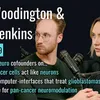
Youtube:https://youtu.be/JAxkqb-nBWsSpotify: https://open.spotify.com/episode/6BLZph2uGGUVphbNQ8NGPd?si=SVBSKJM8RdO4AhYzDa-ZfQApple Podcast: https://apple.co/3OU5Zse Transcript: https://www.owlposting.com/i/189602943/transcriptThis is an episode with Ben Woodington and Elise Jenkins, who are the cofounders of Coherence Neuro. The pitch for Coherence is as follows: a brain implant that treats cancer with electricity. When I first learned of the company in mid-2025, it was such an alien thesis that I instinctively wrote it off entirely. This surely isn’t clinically plausible at all, maybe it will be one day, but certainly not today.Then, while I was in San Francisco, I met up with Nicole, Coherence’s chief of staff. After that, I was far more convinced that there was something real here, especially after she told me that the electricity ←→ cancer thesis already has some merit: Optune, an FDA-approved medical device developed by Novocure. This has been on the market for over a decade, and uses externally delivered alternating electric fields to treat glioblastoma. And it works! If Optune is consistently used, glioblastoma patients can live up to twice as long compared to chemotherapy alone. How does it work? Simple: the alternating electrical fields prevent fast-dividing cells from replicating by interfering with the physical process of cell division (specifically, mitotic spindle formation).After this, Nicole connected me with Ben and Elise, the cofounders of the company. It was an incredible conversation. During it, I was informed that cancer cells behave eerily similar to neurons: hijacking neural pathways, attracting nerves into their microenvironment, and forming synaptic connections with surrounding tissue. Given this set of evidence, none of which felt particularly controversial, an easy logical leap is to ask the question: why can’t you throw neuromodulation at the tumor? Maybe not even just for treatment, but monitoring as well? Optune was a step in the right direction, yes, but surely it can be pushed even further.So Coherence was born, the only (neurotechnology x oncology) company in existence. Ben and Elise met during their PhD’s at Cambridge, spinning up the startup with the belief that a modality long assumed to be exclusively for neurological conditions like Parkinson’s, epilepsy, and chronic pain, may have a profound role to play in cancer. And perhaps even conditions outside of it.And during my last trip to San Francisco for JPM 2026, I had the honor to sit down with Ben and Elise to talk about it all.This conversation covers how Coherence’s first neurotech device (SOMA) works, the molecular reasons behind why neuromodulation affects cancer at all, what the biomarker readouts look like, the obvious Michael Levin comparison, and a lot more. Coincidentally, Ben helped me out a fair bit for my neurotechnology piece awhile back, and that article may be helpful reading material for this episode.Enjoy!Timestamps:00:00:00 Introduction00:01:42 How is SOMA different from Novocure’s Optune?00:08:57 Why does neuromodulation affect cancer at all?00:13:28 How was cancer-nervous system crosstalk first discovered?00:15:42 Anti-epileptics and beta blockers as accidental cancer drugs00:17:38 What is molecularly happening when you block cancer-neuron crosstalk?00:19:50 What is SOMA actually reading out as a biomarker?00:20:44 What does it mean that cancer is “very electric”?00:22:02 Can you derive universal biomarkers across patients?00:23:09 How is the device placed?00:24:45 How does the blocking stimulation regime work?00:26:43 Is it fair to say this is closed loop?00:29:05 Why not just spam the tumor with constant stimulation?00:32:31
Podzilla Summary coming soon
Sign up to get notified when the full AI-powered summary is ready.
Free forever for up to 3 podcasts. No credit card required.
Listen to This Episode
More from Owl Posting
How to design a cancer vaccine (and vastly improve them): Alex Rubinsteyn & Ben Vincent
The printing press for biological data (Sterling Hooten)
What if we could grow human tissue by recapitulating embryogenesis? (Matthew Osman & Fabio Boniolo)

We don't know what most microbial genes do. Can genomic language models help? (Yunha Hwang, Ep #7)
Get summaries like this every morning.
Free AI-powered recaps of Owl Posting and your other favorite podcasts, delivered to your inbox.
Free forever for up to 3 podcasts. No credit card required.