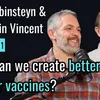
How to design a cancer vaccine (and vastly improve them): Alex Rubinsteyn & Ben Vincent
Spotify: https://open.spotify.com/episode/5xk4OjH1jVYbDR6xTTvqCY?si=11564348b75a459aApple Podcasts: https://podcasts.apple.com/us/podcast/owl-posting/id1758545538?i=1000775598448Youtube: https://youtu.be/EmbciAO9d-MTranscript: https://www.owlposting.com/p/how-to-design-a-cancer-vaccine-and?open=false#%C2%A7transcriptBack in early May, I flew to North Carolina to interview Alex Rubinsteyn (left) and Benjamin Vincent (right). Together, they run the Personalized Immunotherapy Research Lab (PIRL) at UNC-Chapel Hill. It would be difficult for me to emphasize the degree to which Alex and Benjamin are in a league of their own amongst almost any other researcher I have ever met, demonstrating a degree of translational ambition, scientific insight, clarity of thought, and just genuine kindness that one rarely sees. And each time I stumble across a person like this, I try my best to get them in front of a camera. This is the first interview I’ve ever done where I traveled specifically for a guest(s), and I’m very, very glad I did it.We’re in an interesting moment with cancer vaccines. Between Sid Sijbrandij’s ‘founder mode’ journey on his cancer (which involved cancer vaccines), and the dog cancer vaccine story, a lot of eyes are being directed here. As luck would have it, Alex and Benjamin have spent a fairly high fraction of their career in this exact field, and have contributed to some of the most foundation work in it: MHCflurry 2.0, OpenVax, LENS, and plenty of other work. In fact, Alex actually helped run a neoantigen cancer vaccine trial a few years back! So obviously, they’d make for great conversation here. We talked for three hours about this area, eventually stretching beyond cancer vaccines and discussing the grander field of personalized immunotherapy. This is comfortably the longest episode I’ve ever recorded, and I suspect we could have gone for an hour longer.Finally: this is a complicated subject, and we really get into the details. Because of it, it may be worth skimming a companion cancer vaccine essay I released a month back. Many subjects from the article are discussed + expanded upon in the podcast. Here is the essay: https://www.owlposting.com/p/how-to-build-a-cancer-vaccine-andTimestamps:(00:00:26) Introduction(00:01:26) What cancer vaccines are, and the "easy living drug" dream(00:04:34) TAAs vs neoantigens — and why the field switched(00:08:18) MHC, HLA, and neoantigens, defined(00:12:57) The 100,000 MHCs per cell and the information-theoretic problem(00:15:28) Why a cancer can't just drop its MHC(00:20:18) Immunopeptidomics: why predicting antigens isn't knowing them(00:28:57) How many targets you actually need, and the HLA-loss problem(00:30:22) Can a tumor mutate its own MHC?(00:31:34) What are tumor-associated antigens and cancer-testis antigens?(00:34:09) The thymus, AIRE, and why T cells were never trained against CTAs(00:37:35) Why "normal" proteins is still an unfinished reference problem(00:41:05) The short list of T-cell killing success stories(00:43:20) Did the old vaccine literature just need Keytruda?(00:47:31) Why not cut out the middleman and engineer the T cells?(00:50:09) Autologous vs affinity-enhanced TCRs, and a database-matched middle path(00:54:23) Can we TCR-T and CAR-T in-vivo?(01:02:08) Why whole-tumor and lysate vaccines never worked(01:04:46) Immunodominance, or why a great vaccine can still do nothing(01:10:38) Can you predict immunogenicity with ML?(01:12:24) What you tell the FDA for hyperpersonalized drugs(01:14:14) How secret is the computational pipeline?(01:17:40) Why
Podzilla Summary coming soon
Sign up to get notified when the full AI-powered summary is ready.
Free forever for up to 3 podcasts. No credit card required.
Listen to This Episode
More from Owl Posting
The printing press for biological data (Sterling Hooten)
Neurotechnology? For Cancer? (Ben Woodington & Elise Jenkins)
What if we could grow human tissue by recapitulating embryogenesis? (Matthew Osman & Fabio Boniolo)
We don't know what most microbial genes do. Can genomic language models help? (Yunha Hwang, Ep #7)
Get summaries like this every morning.
Free AI-powered recaps of Owl Posting and your other favorite podcasts, delivered to your inbox.
Free forever for up to 3 podcasts. No credit card required.