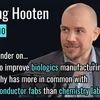
Youtube: https://youtu.be/-rlJDGC2eC8Apple Podcasts: https://podcasts.apple.com/us/podcast/owl-posting/id1758545538?i=1000762410502Spotify: https://open.spotify.com/episode/1OtuQYwNhRhVSwHiHxPrmV?si=tD52iE5IR8i-3W6Q7Bhy8gSubstack/Transcript: https://www.owlposting.com/p/the-printing-press-for-biologicalAfter having written long-form essays over a weirdly diverse number of areas of the life-sciences, I am increasingly confident in my status as someone who knows a little about a lot of things. But every now and then, you meet someone who casually reveals to you an entire subfield who, up until your conversation with them, you’d never even thought of before. This happened to me when I met Sterling a few months back. We met in the elevator as we were both leaving an event, and by the time we’d reached the bottom floor, the conversation had become so interesting that we stood in the lobby for an hour as I pestered him with more and more questions.Sterling runs a company called Iku Bio. Iku ostensibly does something quite simple: it helps biologics manufacturers figure out what to feed their cells. This is called media optimization, and it is done in an astonishingly old-fashioned way. An engineer runs a handful of experiments in a benchtop bioreactor the size of a Fiji water bottle, waits days for analytical results, and repeats, maybe three or four times before timelines force them to stop searching.Sterling’s solution was to use printed circuit boards (PCBs)—the same green wafers inside your phone and your microwave—as the substrate for microfluidic bioreactors. Because PCBs are made via lithography, you get complexity for free. Because they’re already mass-manufactured at planetary scale, you inherit sixty years of cost optimization. And because they’re literally designed to carry electrical signals, you can embed sensors directly into the thing rather than cramming them in after the fact.The result is a device that costs $8 per experimental lane versus $20,000 for the nearest comparable microfluidic system. And there are many, many ways for to improve from here on out.This conversation covers the full stack: what cell culture media actually is and why it’s so much more than sugar water, why biologics manufacturing has more in common with semiconductor fabs than chemistry labs, how Sterling arrived at PCBs, and at the end of the talk, why he thinks a fair bit of lab automation is “philosophically a crime.”Timestamps* [00:00:48] Introduction* [00:01:26] What is Iku Bio?* [00:05:00] Media optimization as the biggest lever* [00:06:23] What actually is media?* [00:13:07] Fetal bovine serum and the move to synthetic media* [00:15:10] Walk me through a media optimization workflow* [00:18:49] Why biologics manufacturing is closer to semiconductors than chemistry* [00:21:50] Matching the phase three batch and generics* [00:24:12] The 200-dimensional search space* [00:37:02] Printed circuit boards as a medium for microfluidics, and the utility of lithography* [00:40:48] Anatomy of the Iku device* [00:57:09] What sensors are on the device today?* [01:01:36] How do you use the Iku device to perform media optimization?* [01:14:44] Does media optimization survive scale-up?* [01:24:32] $8/lane vs. $20,000/lane: the economic utility of Iku’s device* [01:32:05] Why PCB microfluidics didn’t exist 10 years ago* [01:39:24] Who is the customer?* [01:43:14] What is the ultimate goal of Iku?* [01:49:07] What does the validation evidence need to look like?* [01:52:14] What would you do with $100M equity-free?* [01:57:31] Lab automation is in a strange place right now Get full access to Owl Posting at www.owlposting.com/subscribe
Podzilla Summary coming soon
Sign up to get notified when the full AI-powered summary is ready.
Free forever for up to 3 podcasts. No credit card required.
Listen to This Episode
More from Owl Posting
How to design a cancer vaccine (and vastly improve them): Alex Rubinsteyn & Ben Vincent
Neurotechnology? For Cancer? (Ben Woodington & Elise Jenkins)
What if we could grow human tissue by recapitulating embryogenesis? (Matthew Osman & Fabio Boniolo)
We don't know what most microbial genes do. Can genomic language models help? (Yunha Hwang, Ep #7)
Get summaries like this every morning.
Free AI-powered recaps of Owl Posting and your other favorite podcasts, delivered to your inbox.
Free forever for up to 3 podcasts. No credit card required.