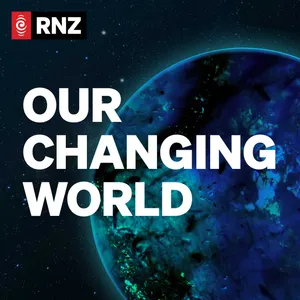
Free Daily Podcast Summary
Our Changing World: Daily Summaries Delivered
by RNZ
Dr Claire Concannon follows scientists into the bush, over rivers, back to their labs and many places in-between to cover the most fascinating research being done in Aotearoa New Zealand.
Latest Episodes
The most recent episodes — sign up to get AI-powered summaries of each one.
- 4 days ago39 min
The tricky work of disentangling whales
Freeing an entangled whale is complex, dangerous and immensely rewarding. Based in Kaikōura, marine ranger Zac Penman leads DOC’s South Island large whale disentanglement team. He speaks to Claire Concannon about their training and mahi. Sign up to the Our Changing World monthly newsletter for episode backstories, science analysis and more.LEARN MORE:Hear Zac Penman tell the full story of the southern right whale disentanglement.Learn how the team freed a southern right whale tangled in a pot line near Rakiura.Explore an Our Changing World episode about researchers tracking southern right whales from the subantarctic Auckland Islands.Read about the record number of humpback whales spotted off Kaikōura.The rules about sharing the coast with marine mammals are on this DOC page.GUESTS:Zac Penman, Kaikōura marine ranger and lead of the Department of Conservation’s South Island large whale disentanglement team.IN THIS EPISODE: Disentanglement of a Southern Right Whale Compliance patrols off Kaikōura. The Hikurangi Marine Reserve. How the team locates, tracks and safely approaches entangled whales. Equipment and training. The backstory, and international guidelines.Go to this episode on rnz.co.nz for more details
- 1 weeks ago25 min
Saving tara-iti, shell by shell
In the dunes of Bream Bay, DOC workers and volunteers are shifting shells by hand to build safer nesting habitat for tara-iti. With only about 45 birds left, every nest matters. Producer Liz Garton tags along on this important working bee.Sign up to the Our Changing World monthly newsletter for your science news.LEARN MORE:Listen Checkpoint covering the 2025 tara-iti breeding seasonMangawhai is one of only four nesting spots for tara-iti, but a local community leader is warning of major environmental concerns3D printed eggs helped ensure a record-breaking 2024 breeding seasonFind the OCW episodes mentioned in the podcast Alison Balance on an egg retrieval and Ayana Piper-Healion’s lizard hunting episode.GUESTS:Ayla Wiles, DOC’s Tara-iti Programme LeadAri Carrington, Patuharekeke Te Taiao UnitRobyn Davies, Waipu About Tern volunteerTHIS EPISODE: Meet tara iti, New Zealand’s rarest endemic breeding bird. What we know about tara iti and their remaining breeding sites. Captive rearing and the breakthrough lifting chick numbers. GPS tracking reveals the birds’ long-distance journeys. Volunteer monitoring and the birds’ distinctive personalities.Go to this episode on rnz.co.nz for more details
- 2 weeks ago25 min
The PINK1 clue in Parkinson's disease
A genetic form of Parkinson’s disease is found at unusually high rates in some Pasifika communities. It affects people who are much younger than the typical Parkinson's patient. Researchers are working with patients to understand PINK1 Parkinson's, raise awareness, and explore new treatments. Sign up to the Our Changing World monthly newsletter for episode backstories, science analysis and more.Parkinson’s New Zealand provides information on symptoms, treatments, support services and local support groups around Aotearoa.But PINK1 sometimes presents differently, so Dr Christina Buchanan says if you’re a young Pasifika person with unusual stiffness you should talk to your GP and you can reach out to her at: Christina.Buchanan@TeWhatuOra.govt.nz Learn more:In 2023, Our Changing World explored how researchers are helping families affected by inherited neurological conditions in Aotearoa.The Neurological Foundation featured more on the PINK1 Parkinson’s discovery and ongoing research in their magazine.Nine To Noon reported on hopes that Parkinson's disease could one day be slowed or prevented through a New Zealand-led breakthrough into the biology of the disease.Katie Kenny of RNZ explains the implications of proposed changes to New Zealand's genetic technologies legislation.Go to this episode on rnz.co.nz for more details
- 3 weeks ago26 min
Are GLP1 drugs worth the hype?
GLP1 - RA weight loss drugs get the Our Changing World treatment! What are they? How do they work? And what does the science say about the benefits, and the risks? Plus, beyond health outcomes, how might things change as they become more widely available? Sign up to the Our Changing World monthly newsletter here for episode backstories, science analysis and more.LEARN MORE:If you’d like a deeper understanding of how drugs such as Ozempic and Wegovy affect appetite and blood sugar regulation, Emile Donovan spoke to Dr Sebastian Furness about this on Nights.Obesity genetics researcher Giles Yeo joined Afternoons to explain why body weight is influenced by much more than willpower, and why biology plays such a powerful role in hunger and weight regulation.The study that Dr Andrew Reynolds contributed to on how obesity trends are changing around the world was published in Nature. You can read the paper here.Curious about how the major incretin drugs compare? This systematic review and meta-analysis examines the effectiveness of semaglutide, liraglutide, dulaglutide and tirzepatide for blood sugar control and other outcomes.GUESTS:Dr Andrew Reynolds, Department of Medicine, University of OtagoIN THIS EPISODE: Introduction How GLP-1 receptor agonists were developed as treatments for type 2 diabetes The biology of incretins, insulin, glucagon and how these drugs work The drugs available and funded in New Zealand Weight loss benefits, side effects and questions about long-term use Retatrutide, future incretin therapies and the emerging “Ozempic economy”Go to this episode on rnz.co.nz for more details
- Oct 5, 202626 min
Black robin: From the brink to Bird of the Year
In September, the Chatham Island black robin was crowned Bird of the Year 2026. This small, round and feisty manu has a remarkable comeback story, from just five birds in 1979 to about 400 today. They are found on just two predator-free islands in the Chatham group.Go to this episode on rnz.co.nz for more details
- Sep 28, 202626 min
The science quest for a green ammonia catalyst
Over a hundred years ago Fritz Haber and Carl Bosch discovered a way to produce ammonia that revolutionised farming. It changed the world. But today this way of making ammonia uses between 1-2% of the world's global energy, and produces about the same greenhouse gas emissions as the whole airline industry. Is there a better way? A team at Earth Sciences New Zealand are on the hunt for a catalyst that could convert water and air into ammonia using renewable electricity. Their dream is to enable efficient and economical small-scale ammonia production, but to get there they must first prove the chemistry is possible. Over a hundred years ago Fritz Haber and Carl Bosch discovered a way to produce ammonia that would revolutionise farming. It changed the world. But today synthetic ammonia production uses between 1-2% of the world global energy, and produces about the same greenhouse gas emissions as the whole airline industry. Is there a better way to make it? A team at Earth Sciences New Zealand are on the hunt for a catalyst that could convert water and air into ammonia using renewable electricty. Their dream is to enable efficient and economical small-scale ammonia production, but to get there they must first prove the chemistry is possible.Go to this episode on rnz.co.nz for more details
- Sep 21, 202626 min
Searching sand dunes for lizards
Over 80% of our coastal dune ecosystems have been lost. So, what about the native species living with them? Ayana Piper-Healion steps into Bream Bay’s sand dunes with a monitoring team to see what lizards can tell us about the health of the sand dunes. Sign up to the Our Changing World monthly newsletter for episode backstories, science analysis and more.Learn more:To find out more on what the local critics think about the Bream Bay Sand Extraction Project’s fast-track application, RNZ’s Peter de Graaf reported on a protest there earlier this year.Further north, Saturday Morning reported on significant damage being caused to dunes by thrill seekers driving vehicles through them. Another region dealing with threatened dunes is Waimarama, where weeds are spreading from people fly-dumping garden waste.In the Hawke’s Bay, the ‘Skink Squad’ are on a mission to save the northern spotted skinks in preparation for an infrastructure project.In 2021, Our Changing World did a deep dive into dune plants and the largest supplier of plants for dune revegetation programs.Guests:Steve Johnson, Patuharakeke Te Pou TaiaoAri Carrington, resource co-ordinator at Patuharakeke Te Pou TaiaoKatrina Hansen, biodiversity specialist Northland Regional CouncilLaura Shaft, biodiversity manager Northland Regional CouncilBrooke Gray, biodiversity advisor Northland Regional CouncilRichard Griffiths, coastal scientist Northland Regional CouncilGo to this episode on rnz.co.nz for more details
- Sep 14, 202620 min
Ireland's experience of H5/N1 bird flu: A conversation with Niall Hatch
Highly pathogenic H5/N1 bird flu strain has been detected in New Zealand, but it's still early days. There are lots of unknowns about when it will start spreading here, and how our wildlife will react to the virus. But what has happened in other countries? Claire Concannon speaks to Niall Hatch of BirdWatch Ireland about what they've experienced. SHOW NOTES:Sign up to the Our Changing World monthly newsletter for episode backstories, science analysis and more.LEARN MORE:The Great Ireland Vs New Zealand Bird-Off took place across two episodes in 2023, during the time when bird flu has having a huge impact on Irish seabirds. Listen to them here: Part 1, Part 2. Read this RNZ explainer about what the confirmation of H5N1 in New Zealand means for wildlife, poultry and the public.Revisit the 2025 Our Changing World episode Getting ready for H5N1 bird flu, which traced the virus’s global spread and New Zealand’s preparations for its arrival.For more on Irish birds and wildlife with Niall Hatch and Ricky Whelan, you can listen to BirdWatch Ireland’s podcast: In Your Nature. GUESTS:Niall Hatch, BirdWatch Ireland.Go to this episode on rnz.co.nz for more details
Get Our Changing World summaries in your inbox
Free AI-powered daily recaps. Key takeaways, quotes, and mentions — in a 5-minute read.
Get Free Summaries →Free forever for up to 3 podcasts. No credit card required.
You Might Also Like
Podcasts in similar categories.
Inside AsembleAI: DeepTech, AI & Science
Experts discuss AI's impact on business, product development, and leadership with researchers, founders, and executives.

Huberman Lab
Explores neuroscience and science-based tools for understanding and improving brain function, behavior, and health.

The Jordan B. Peterson Podcast
Explores how values, religion, and culture shape individuals and society through interviews and lectures.

Gastropod
Explores the science and history behind food and farming, from ancient feasts to modern aquaculture and everything in between.
The Rest Is Science
Hannah Fry and Michael Stevens explore puzzling scientific questions that challenge everyday assumptions about reality.
Plagues with Dr. Keith
A physician examines the science, history, and societal impact of major diseases and pandemics.

Super Data Science: ML & AI Podcast with Jon Krohn
Conversations with data science experts exploring machine learning, AI, and real-world applications to advance technical skills and careers.
Somewhere in the Skies
A weekly exploration of UFO phenomena and unexplained aerial encounters hosted by an author and investigator.
About Our Changing World
Dr Claire Concannon follows scientists into the bush, over rivers, back to their labs and many places in-between to cover the most fascinating research being done in Aotearoa New Zealand.
Customized Recaps
AI-powered recaps with compact key takeaways, quotes, and insights.
Straight to Your Inbox
Get key takeaways from Our Changing World in a 5-minute read.
Save Hours Every Week
Stay current on your favorite podcasts without falling behind.
Frequently Asked Questions
What is Podzilla's Our Changing World daily summary?
It's a free AI-powered email that summarizes new episodes of Our Changing World as soon as they're published. You get the key takeaways, notable quotes, and links & mentions — all in a quick read.
How does the Our Changing World podcast summary work?
When a new episode drops, our AI transcribes and analyzes it, then generates a personalized summary tailored to your interests and profession. It's delivered to your inbox every morning.
Is this an official Our Changing World product?
No. Podzilla is an independent service that summarizes publicly available podcast content. We're not affiliated with or endorsed by RNZ.
Can I get summaries of other podcasts too?
Absolutely! The free plan covers up to 3 podcasts, any in the catalog. Basic raises that to 15, Pro to 40 and Max to 100. Browse our full catalog at /podcasts.
How often does Our Changing World release new episodes?
Our Changing World publishes weekly. Our AI generates a summary within hours of each new episode.
What topics does Our Changing World cover?
Our Changing World covers topics including Science. Our AI identifies the specific themes in each episode and highlights what matters most to you.
Start getting Our Changing World summaries tomorrow morning.
Free forever for up to 3 podcasts. No credit card required.
Free forever for up to 3 podcasts. No credit card required.