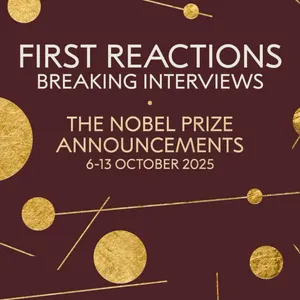
Free Daily Podcast Summary
Nobel Prize Conversations: Daily Summaries Delivered
by Nobel Prize Outreach
Through their lives and work, failures and successes – get to know the individuals who have been awarded the Nobel Prize. The host for this podcast is Adam Smith, who has the happy task of interviewing our Nobel Prize laureates. Sit in on our conversations as we delve into how these personalities found their fields of interest — often by coincidence — how they view collaboration, curiosity and failure, and what keeps them going. The laureates share what they have learned from their career and what they like to do outside of their work – from music to fly-fishing. We let the discussions flow freely, resulting in richly varied stories on topics ranging from poverty prevention to the science of black holes and the importance of being a role model.
Latest Episodes
The most recent episodes — sign up to get AI-powered summaries of each one.
- 3 weeks ago6 min
First reactions | Michael Woodford, prize in economic sciences 2026 | Telephone interview
“They're probably hoping I'll cancel the exam.” – Michael Woodford was scheduled to be setting his economics students an exam on the morning of October 12th, when he was woken by a call from Stockholm at 4:30am. Just after listening to the announcement of the 2026 prize in economic sciences, Woodford spoke to the Nobel Prize's Adam Smith about his feelings for the prize. He praised his co-laureate Robert E. Hall and explained why he admires the Swedish economist Knut Wicksell.© Nobel Prize Outreach.First reactions terms of use: https://www.nobelprize.org/ceremonies/streams-terms-of-use Hosted on Acast. See acast.com/privacy for more information.
- 4 weeks ago6 min
First reactions | Navi Pillay, Nobel Peace Prize 2026 | Telephone interview
In this call with the Nobel Prize soon after the announcement, Pillay says she feels overwhelmed about being a Nobel Peace Prize laureate. “A total surprise, I’m deeply honoured and touched.” – Navi Pillay received the news about her 2026 peace prize at an international conference in the Nuremberg Palace of Justice – more specifically in the famous Courtroom 600 where the WWII war criminals trials took place. Pillay was greeted with a standing ovation that she says she will never forget. In this call with the Nobel Prize soon after the announcement, Pillay says she feels overwhelmed about being a Nobel Peace Prize laureate. “I know it’s a personal award, but for me, it’s for all the institutions I served on as well, all the people I worked for.”© Nobel Prize Outreach.First reactions terms of use: https://www.nobelprize.org/ceremonies/streams-terms-of-use Hosted on Acast. See acast.com/privacy for more information.
- Oct 8, 20265 min
First reactions | Anne Carson, Nobel Prize in Literature 2026 | telephone interview
“Start in the middle, I always say” – Anne Carson was sweeping the kitchen floor at her home in Reykjavík, Iceland, when the phone rang and she learned that she had been awarded the 2026 Nobel Prize in Literature. “It seems a little insane,” Carson says in this conversation with the Nobel Prize just moments after the announcement. She also reveals that she has already started planning how to give away the prize money, shares advice for aspiring writers, and offers a tip for anyone curious about her work: “Find the middle and start there.” © Nobel Prize Outreach.First reactions terms of use: https://www.nobelprize.org/ceremonies/streams-terms-of-use Hosted on Acast. See acast.com/privacy for more information.
- Oct 7, 20262 min
First reactions | Kenso Soai, Nobel Prize in Chemistry 2026 | telephone interview
"I'm very excited to hear the news. Good news. Very good news." – In this brief conversation, recorded shortly after the announcement of his Nobel Prize in Chemistry, Kenso Soai speaks of how happy he is to have his group's work recognised. He tells the Nobel Prize's Adam Smith how the search for the foundations of homochirality is a problem first posed by Louis Pasteur, and how much pleasure he takes in sharing these ongoing explorations with scientific friends around the world.© Nobel Prize Outreach.First reactions terms of use: https://www.nobelprize.org/ceremonies/streams-terms-of-use Hosted on Acast. See acast.com/privacy for more information.
- Oct 6, 20268 min
First reactions | Francis Halzen, Nobel Prize in Physics 2026 | telephone interview
"In retrospect, the most amazing thing is that we got funded for this project." – Francis Halzen recalls greeting each milestone in the creation of the massive IceCube neutrino detector under the South Pole not with pride, but with surprise. In this conversation with the Nobel Prize's Adam Smith, recorded just after Halzen had learnt of his 2026 Nobel Prize in Physics, he speaks about the fruitful collaboration with the technical teams that built the detector. He also speculates on how neutrino astronomy promises to open up new, quite unexpected insights into super high energy processes occurring far away in space, and far back in time.© Nobel Prize Outreach.First reactions terms of use: https://www.nobelprize.org/ceremonies/streams-terms-of-use Hosted on Acast. See acast.com/privacy for more information.
- Oct 5, 20264 min
First reactions | Peter Hegemann, Nobel Prize in Physiology or Medicine 2026 | telephone interview
"Call me back, I have something important for you." – Belatedly recognising the Swedish prefix to the number he was asked to dial, Peter Hegemann called back to discover that he had been awarded the 2026 Nobel Prize in Physiology or Medicine. Here, in this conversation with the Nobel Prize's Adam Smith, he speaks about the pleasure of sharing the award with friends, the value of true curiosity about what nature has to offer, and the unexpected places such inquisitiveness can take you.© Nobel Prize Outreach.First reactions terms of use: https://www.nobelprize.org/ceremonies/streams-terms-of-use Hosted on Acast. See acast.com/privacy for more information.
- Oct 5, 20264 min
First reactions | Georg Nagel, Nobel Prize in Physiology or Medicine 2026 | telephone interview
“I didn't expect this, really... I thought it's still too early to get this prize in medicine optogenetics.” – Georg Nagel's surprise upon learning that he was to be awarded the 2026 Nobel Prize in Physiology or Medicine was evident. He received the news in Italy on a sun-drenched terrace, overlooking olive trees. In this brief conversation with the Nobel Prize's Adam Smith, he shares his joy on receiving the prize and reflects on the key research moment leading to the development of optogenetics.© Nobel Prize Outreach.First reactions terms of use: https://www.nobelprize.org/ceremonies/streams-terms-of-use Hosted on Acast. See acast.com/privacy for more information.
- Oct 5, 20266 min
First reactions | Karl Deisseroth, Nobel Prize in Physiology or Medicine 2026 | telephone interview
"So much mystery now finally seems on the brink of elucidation." – Karl Deisseroth was working on a paper, late into the night, and had just gone to bed when the call came from Stockholm breaking the news that he had been awarded the 2026 Nobel Prize in Physiology or Medicine. In this interview with the Nobel Prize's Adam Smith, recorded while the rest of the household slept, he reflects on the possibilities for unravelling the mysteries of the brain that optogenetics is opening up. He also discusses how his own work with patients with psychiatric disorders informs his appreciation of their basis in the broad sweep of evolution, and his hope that this greater insight will help people understand each other better.© Nobel Prize Outreach. First reactions terms of use: https://www.nobelprize.org/ceremonies/streams-terms-of-use Hosted on Acast. See acast.com/privacy for more information.
Get Nobel Prize Conversations summaries in your inbox
Free AI-powered daily recaps. Key takeaways, quotes, and mentions — in a 5-minute read.
Get Free Summaries →Free forever for up to 3 podcasts. No credit card required.
You Might Also Like
Listeners also like.
From First Principles
Breaks down major science stories weekly, explaining the mechanics behind physics, space, AI, and biotech developments.
From First Principles
Breaks down major science stories weekly, explaining the mechanics behind physics, space, AI, and biotech developments.

The Interview
In-depth 20-minute conversations with global leaders, cultural figures, and decision-makers on the issues shaping our world.

Inquiring Minds
Explores the intersection of science and society through critical thinking and in-depth analysis.
The Life Scientific
A scientist discusses their research, inspirations, and career with physicist Jim Al-Khalili.
The Interview
In-depth interviews with influential figures across culture, politics, business, and sports exploring their motivations and impact.
EconTalk
Long-form conversations on economics, philosophy, history, and human behavior with experts from diverse fields.
ON CRISPR: The Story of Jennifer Doudna with Walter Isaacson
A Nobel-winning biochemist pioneers CRISPR gene editing, sparking scientific breakthroughs, global competition, and ethical debates.

The Jordan Harbinger Show
Conversations with top performers across fields, distilling actionable insights on success, relationships, and personal growth.
Stanford Psychology Podcast
Students interview psychologists about recent research and its real-world applications.
Huberman Lab
Explores neuroscience and science-based tools for understanding and improving brain function, behavior, and health.

The Galileo Interviews with Caspar Gleave
The Galileo Interviews with Caspar Gleave
About Nobel Prize Conversations
Through their lives and work, failures and successes – get to know the individuals who have been awarded the Nobel Prize. The host for this podcast is Adam Smith, who has the happy task of interviewing our Nobel Prize laureates. Sit in on our conversations as we delve into how these personalities found their fields of interest — often by coincidence — how they view collaboration, curiosity and failure, and what keeps them going. The laureates share what they have learned from their career and what they like to do outside of their work – from music to fly-fishing. We let the discussions flow freely, resulting in richly varied stories on topics ranging from poverty prevention to the science of black holes and the importance of being a role model.
Customized Recaps
AI-powered recaps with compact key takeaways, quotes, and insights.
Straight to Your Inbox
Get key takeaways from Nobel Prize Conversations in a 5-minute read.
Save Hours Every Week
Stay current on your favorite podcasts without falling behind.
Frequently Asked Questions
What is Podzilla's Nobel Prize Conversations daily summary?
It's a free AI-powered email that summarizes new episodes of Nobel Prize Conversations as soon as they're published. You get the key takeaways, notable quotes, and links & mentions — all in a quick read.
How does the Nobel Prize Conversations podcast summary work?
When a new episode drops, our AI transcribes and analyzes it, then generates a personalized summary tailored to your interests and profession. It's delivered to your inbox every morning.
Is this an official Nobel Prize Conversations product?
No. Podzilla is an independent service that summarizes publicly available podcast content. We're not affiliated with or endorsed by Nobel Prize Outreach.
Can I get summaries of other podcasts too?
Absolutely! The free plan covers up to 3 podcasts, any in the catalog. Basic raises that to 15, Pro to 40 and Max to 100. Browse our full catalog at /podcasts.
What topics does Nobel Prize Conversations cover?
Nobel Prize Conversations covers topics including Science, Education, Culture, Society & Culture. Our AI identifies the specific themes in each episode and highlights what matters most to you.
Start getting Nobel Prize Conversations summaries tomorrow morning.
Free forever for up to 3 podcasts. No credit card required.
Free forever for up to 3 podcasts. No credit card required.