Free Daily Podcast Summary
Midlife Mayhem: Daily Summaries Delivered
by joanne lee cornish
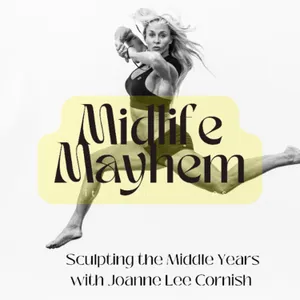
Midlife Mayhem hosted by body composition expert, Joanne Lee Cornish is intended to explain the madness that can occur during midlife. Offering information and solutions to help you avoid what most people experience in Midlife. Aimed at both men and women. Joanne can help those who want to be helped
Latest Episodes
The most recent episodes — sign up to get AI-powered summaries of each one.
- 1 weeks ago45 min
Should Women Rule the World vs Men Over 70
Subject: Should Women Rule the World? (Depends Which Decade) Hey there, this episode is dedicated to my SIL and brother who are "Stranded in Albuquerque," which sounds like a bad movie :) Love you much and good luck getting home tomorrow.... New episode of Midlife Mayhem is live, and this one got away from me a little — in the best way. I started with a silly question (should women run the world?) and ended up going down a genuine rabbit hole on hormones, age, and what actually makes a good leader. Whether you listen or just want the highlights, here's the full rundown — grab a coffee, this one's a long one. --- **THE QUESTION** If you had to hand the keys to civilization over to women, no debate, no committee, just hand them over — would we actually be better off? My honest answer isn't "women, full stop." It depends enormously on which decade of a woman's hormonal life you're talking about. A 28-year-old, a 45-year-old white-knuckling through perimenopause, and a 62-year-old on the other side of it are basically running on different fuel, different brain chemistry, different priorities. And fair's fair — the men get the exact same treatment later on. If we're going to talk hormones and leadership, testosterone doesn't get a free pass. One honest caveat before any of this: we're talking about averages here. There's enormous overlap between men and women on every trait below — plenty of men are more patient than the average woman, plenty of women are more reckless than the average man. Picture two bell curves stacked almost entirely on top of each other, with just the tails poking out on either side. That's what most of this research actually looks like. Averages tell us about tendencies at a population level. They don't tell you anything about the specific woman or man standing in front of you. **PATIENCE ISN'T ONE THING, IT'S TWO** Women tend to have a real, measurable edge on delayed gratification — waiting for the bigger payoff instead of grabbing the smaller one right now. That's a huge asset for long-horizon leadership: the difference between greenlighting a policy that won't pay off for ten years versus needing a visible win by next quarter to survive the news cycle. Some of this comes down to dopamine and reward sensitivity, both of which are influenced by testosterone — higher average testosterone tracks with more impulsive, immediate-reward-seeking behavior, in both sexes. But patience for other people's behavior — frustration tolerance — is a totally different animal, and women don't score especially high there. Shorter fuse, faster escalation to interpersonal slights, even while showing more patience with numbers and long-term payoffs. So "patience" as a leadership trait is really two separate skills, and women only clearly win on one of them. There's also a workplace wrinkle worth mentioning: wanting more time or more data before committing to a decision is a real form of patience, but it's culturally read as weak, while slamming your hand on the table and deciding right now gets read as strong. Which one is actually better leadership? Depends entirely on whether you're in a five-alarm fire or making a call that'll play out over a decade. **THE NEGOTIATION MYTH, BUSTED** The old research (Linda Babcock's "Women Don't Ask") found women negotiate less assertively for themselves — smaller salaries, smaller raises, faster concessions, across multiple industries and countries. But later work, especially by Hannah Riley Bowles, found that gap almost completely disappears — or reverses — the moment a woman is negotiating on behalf of someone else: a client, a team, a department, a cause. Women assigned to advocate for someone other than themselves perform just as assertively as men, sometimes more so. So it was never a competence gap or a confidence gap. It's a social penalty — women get judged more harshly by observers of both genders for self-advocacy specifically, sometimes called the "backlash effect," which creates a rational incentive to soften their own asks. And since leadership is almost always negotiating on someone else's behalf — a country, a shareholder base, a cause — this stereotype falls apart exactly where it matters most. There's a style difference worth a mention too: women tend to favor integrative, win-win approaches slightly more than purely winner-takes-all ones. In complex multi-party negotiations — trade deals, coalitions, multi-stakeholder mergers — that instinct finds trades a purely competitive negotiator would walk right past. **TEND-AND-BEFRIEND VS. FIGHT-OR-FLIGHT** The classic stress response — fight or flight — was studied almost entirely in men for decades, which is a genuinely embarrassing gap in the scientific record. When researchers (Shelley Taylor at UCLA) finally looked at women specifically, they found oxytocin and estrogen often produce a parallel stress respo
- 2 weeks ago51 min
Sue's Hair Regrowth Journey
Midlife Hair Loss: Sue McLea’s Hair Regrowth Story & Why She Chose MONAT Hair thinning and hair loss are among the biggest frustrations I hear from women in midlife. Our hair can feel like part of our identity, so watching it become thinner, more fragile or seeing our scalp where we never used to see it can have a surprisingly big impact on confidence. For this episode, I invited my longtime friend and client Sue McLea to share her own experience. I’ve known Sue for years, so I knew what her hair looked like before. Over the last several months I started noticing the incredible difference in her hair — not simply longer hair, but visibly thicker hair and new growth in areas where she had previously experienced significant thinning. Sue has now been using MONAT for approximately eight months and is also a MONAT ambassador. She joined me to explain what she experienced, what she uses and exactly how she uses it. Sue’s Hair Loss Story Sue began experiencing significant hair thinning around age 59–60, particularly around her temples. It progressed to the point where she described having noticeable bald areas on either side of her head. Hairstyles she had worn for years suddenly became difficult because pulling her hair back exposed those areas. Initially, she assumed this was simply another part of getting older. Eventually, after watching the results her niece was experiencing with MONAT, Sue decided to try the products herself. She was skeptical and gave herself a simple test: Two months. If she didn't see a difference, she was done. Instead, Sue says she began seeing tiny new “baby hairs” within approximately 30 days. Eight months later, the difference in her hair is remarkable. Her hair has become so much thicker that she says she now needs to rethink her hairstyle because of all the new growth coming through. The Big Philosophy: Your Scalp Is Skin One of the most interesting parts of our conversation was the emphasis on scalp health. We spend enormous amounts of time and money taking care of the skin on our faces, yet most of us give very little thought to the skin underneath our hair. Sue’s approach is to create a healthier scalp environment while also protecting the hair itself from breakage and damage. Hair naturally moves through different stages — growth, resting and shedding — so the goal isn't simply to coat the existing hair and make it temporarily look better. The discussion centered around supporting the scalp and follicle environment while also protecting the hair you already have. Sue’s MONAT Routine Sue didn't simply add another shampoo to her shower. She committed to a complete routine. 1. Rejuveniqe Oil – Before Washing Sue uses Rejuveniqe Oil as a pre-shampoo scalp treatment approximately once or twice per week. She applies the oil throughout the scalp, massages it in and brushes it through the hair. She often applies it at night and leaves it in before washing. The oil contains a blend of plant-based oils and is designed to hydrate the scalp and hair while helping reduce dryness, frizz and breakage. It can also be worked through the lengths of the hair rather than simply used on the scalp. 2. Double Shampoo MONAT shampoo is highly concentrated, so Sue uses only about a dime-sized amount. She emulsifies it thoroughly in her hands before applying it primarily to the scalp. She then shampoos twice. The first wash is used to remove product, oil and environmental buildup. After rinsing thoroughly, she repeats the process. Sue says the second wash produces considerably more lather. Rather than piling shampoo through the ends of the hair, the focus is the scalp. 3. Conditioner Conditioner goes primarily from the ears down, rather than being applied heavily to the scalp. Sue recommends allowing it to sit for several minutes before rinsing so it has time to work through the hair. 4. IR Clinical Hair Thinning Defense Serum – Every Day This was one of the most important products in Sue's routine. Sue keeps the serum somewhere she will see it every day — initially beside her toothbrush — because consistency matters.
- 3 weeks ago42 min
Big Boned, Big Thighs & the Truth Your Tape Measure Won't Tell You
Midlife Mayhem — Episode Show Notes Hey there, Two Instagram posts sent me down a rabbit hole this week, and I couldn't wait to bring it to you. Post one: a woman says if you can't wrap your fingers around your wrist, you're "big boned" — not overweight, just built bigger. Post two: if your thigh isn't over 24 inches around, you'll apparently live longer. As someone who's trained for 44 years, can squat 200lbs, and still only measures 20 inches on a good day... I had thoughts. So this episode is a myth autopsy. Both claims have real research behind them — that's exactly why they spread so fast. But both get flattened and distorted by the time they hit your feed. In this one, I break down: Where the "wrist test" actually comes from, and what it's really measuring (hint: not what you think) Why your skeleton makes up roughly 12–15% of your body weight no matter your frame size — and why that number barely moves The real 2009 Danish study behind the thigh circumference claim, and the threshold it actually found (not the straight line social media is selling you) Why a tape measure can't tell muscle from fat — and why that matters more than the number itself The one waist measurement I'd actually pay attention to instead What genuinely protects your bones and muscle in midlife (spoiler: it's not a tape measure) I also measure my own wrist and thigh live on the mic, so you can hear exactly how the numbers play out on someone who's spent a lifetime training. Grab your own tape measure before you hit play — you'll want to check your own numbers along the way. This week's shoutout: I'm filming with my friend Sue this week about hair thinning in midlife and what actually helped her — keep an eye out for that one on YouTube and right here on the podcast. A little something for you My products are all made from what I use on myself, every single day — nothing I sell just to sell it. Right now you can save on all of it: 🛍️ Shop the full range: www.joanneleestore.com 5-Amino-1MQ SLU-PP-332 Blue Theory Face Serum Blue Theory Body Booster (new!) Blue Theory Face and Body Oil Use code LABORDAY for 15% off — and check the dropdown menus, because several products are already bundled at a discount, so stacking the code on top saves you even more. ⏰ Code expires September 8th — I'm heading off on vacation and won't be able to ship for a week after that, so this one has a hard cutoff. Thanks for listening, and thank you for being part of Midlife Mayhem. If you enjoyed this one, share it with a friend who needs to hear it, and I'll catch you in the next episode. Joanne Lee Cornish hello@joannlee.com Follow along: Instagram, Facebook, TikTok, YouTube — just search Joann Lee Cornish
- 4 weeks ago50 min
Crepey Skin, Sagging Skin & the Science of GHK-Cu
If you’re fit, strong and taking care of yourself — but suddenly feel like your skin didn’t get the memo — this episode is for you. Crepey skin. Sagging skin. Wrinkly skin. Skin that suddenly seems too big for your body. It is one of the biggest frustrations I hear from women and men in midlife. You can be in fantastic shape, yet suddenly you’re thinking twice about sleeveless tops because of your upper arms. You’re noticing the skin above your knees. Your chest looks different. The backs of your hands look older. And sometimes it genuinely feels as though it happened overnight. So in this episode of Midlife Mayhem, we’re going deep into what is actually happening to our skin as we move through our 40s, 50s, 60s and beyond — and, more importantly, what the science tells us we can potentially do about it. And yes, this is a science-heavy episode. Because over the past year I have gone rather spectacularly down the rabbit hole of regenerative skincare while developing my Blue Theory™ range — particularly my Regenerative Face Serum and the new GHK-Cu Body Booster. Why does our skin suddenly change so much? Collagen makes up a huge proportion of the structure of our skin, but we begin losing it surprisingly early in adulthood. That decline becomes particularly noticeable around perimenopause and menopause as estrogen falls. At the same time, we're losing some of the substances responsible for keeping skin hydrated and plump, including hyaluronic acid. Elastin becomes damaged. And the biological signals telling our skin to repair and rebuild itself become quieter. That last part became incredibly important to me. When I started formulating Blue Theory, I wasn't interested in creating something that simply sat on top of the skin and made it look shiny for a few hours. I wanted to understand the ingredients involved in the skin's own repair and regenerative processes. And that search led me to GHK-Cu. So what on earth is GHK-Cu? Don't let the name put you off. GHK is simply a tiny peptide made from three amino acids: glycine, histidine and lysine. Cu is copper. Put them together and you have the copper peptide GHK-Cu. The story behind it is fascinating. GHK was identified in human plasma in the 1970s, and researchers became interested in its relationship with cellular activity and tissue repair. What really sent me down the rabbit hole was discovering that our natural levels of GHK decline dramatically as we age — at the same time that our skin becomes less capable of repairing and regenerating itself. Suddenly, GHK-Cu wasn't simply another trendy skincare ingredient to me. I wanted to know everything about it. GHK-Cu, collagen and mature skin In the podcast I walk you through some of the research that originally stopped me in my tracks. We talk about studies examining topical GHK-Cu and its relationship with collagen production, skin firmness, laxity, texture, pigmentation, density and thickness. And this is an important distinction I make in the episode: the research that initially got me excited about GHK-Cu was topical research. People frequently ask me about injectable GHK-Cu. I've used injectable GHK-Cu myself, but that's not what this particular conversation is about. For skin, I became fascinated by what researchers were seeing when GHK-Cu was applied topically. Then I found the GHK-Cu + hyaluronic acid research This was another big moment for me. A 2023 study examined GHK-Cu combined with lower-molecular-weight hyaluronic acid and reported a dramatic increase in type IV collagen synthesis in human dermal fibroblast cultures. Type IV collagen is particularly interesting because it is involved in the junction between the epidermis and dermis — an area that becomes weaker as skin ages. But I make an important distinction in the podcast. That dramatic number came from laboratory research — not a clinical trial showing someone's skin suddenly producing 25 times more collagen. Cell-culture results don't translate one-for-one to what happens when we put a serum on our bodies. N
- Aug 18, 202629 min
TURKEY TEETH - MY EXPERIENCE
Why I Went to Istanbul for Dental Work — and Why I Chose Esnan What happens when dental work that has lasted more than 30 years finally needs replacing — and you realize you don't necessarily want to have it done in the United States? In this episode of Midlife Mayhem, I’m sharing my entire experience of traveling to Istanbul, Turkey, for extensive dental work: why I started looking overseas, why my first attempt in Cancún ended with me getting on a plane and coming home without having anything done, and the research that eventually led me to Esnan Dental Hospital in Istanbul. My dental history is a little complicated. I had bridges, crowns and veneers from a relatively young age, and much of that work had been in my mouth for an incredible 32 years. It still looked pretty good from the outside, but receding gums, sensitivity and a broken tooth made me realize I didn't want to spend the next decade simply patching things up one tooth at a time. In this episode, I talk about: Why I originally traveled to Cancún for dental treatment — and why I walked away when the proposed treatment was far more aggressive than I expected. The overwhelming process of researching dental clinics overseas and trying to distinguish excellent facilities from excellent marketing. Why Esnan stood out to me as a full dental hospital with five locations, rather than simply a cosmetic dental clinic. The Zoom consultation I had with a dental surgeon before I ever booked my trip, including their approach to preserving healthy natural roots rather than automatically replacing them with implants. What happened when another clinic learned I had chosen Esnan — and why that interaction actually made me feel even more confident in my decision. What it was really like arriving in Istanbul: airport pickup, hotel arrangements, drivers, coordinators and the level of organization throughout the entire experience. How the dental team used different temporary teeth to let me actually see and choose the shape and proportions I preferred before the final teeth were made. The process of choosing tooth color and how the aesthetics team individually shaded and detailed my monolithic zirconia crowns to create a more natural appearance. How much time I actually spent in the dental chair — surprisingly, less than seven hours over the entire week — which left plenty of time to enjoy Istanbul. What my treatment cost, why my final bill was actually reduced when I didn't need the anticipated root canals, and why I believe price should never be the only consideration when choosing dental treatment overseas. Most importantly, I talk about the part that's difficult to understand from photographs and online reviews: the experience of being there. Dental tourism can feel incredibly overwhelming. You're trusting someone with your face, your smile and your health in another country. I spent about a year researching my options, traveled to Cancún and came home without treatment, contacted multiple clinics and asked a ridiculous number of questions before making my decision. I couldn't be happier that I eventually chose Esnan Skyland in Istanbul. Thinking About Dental Work in Turkey? If you're considering dental work at Esnan and would like to discuss your situation, arrange a consultation or set up a Zoom call, contact: M. Rashed — Esnan Dental WhatsApp: +90 549 470 26 64 Email: mohammad.rashed@esnandent.com Please mention my name, Joanne Lee Cornish, when you contact him. And if you're overwhelmed by all the choices, I completely understand. That's one of the main reasons I wanted to record this episode and share the good, the bad and everything I learned along the way. Midlife Mayhem with Joanne Lee Cornish If you have any questions about this - please email me joanne@joannelee.com
- Aug 14, 202629 min
Fat Is Not Free
Dietary Fat Is NOT a Free Food: Have We Become Too Comfortable With Fat? For decades, we were terrified of dietary fat. Everything was low-fat, fat-free or reduced-fat, and eating fat was almost automatically associated with gaining body fat. Then the pendulum swung. We learned more about carbohydrates, blood glucose and insulin. Low-carb and ketogenic diets exploded in popularity. Avocados, nuts, olive oil, cheese and other high-fat foods went from foods we feared to foods we were actively encouraged to eat. But have we swung a little too far in the other direction? One of the biggest mistakes Joanne sees today is the assumption that because dietary fat has very little immediate effect on blood glucose—and doesn't require a large insulin response—it somehow doesn't matter when it comes to body composition. In this episode of Midlife Mayhem, Joanne explains where that misunderstanding came from and why “insulin stores fat” does not mean “without insulin, fat can't be stored.” She follows dietary fat from your plate through the lymphatic system and into circulation, explains the role of lipoprotein lipase (LPL) in fat storage, and looks at why a perfectly healthy low-carb meal can quietly become extraordinarily high in calories. You'll also hear why the combination of high fat + high carbohydrate is particularly easy to overconsume, how the thermic effect of fat differs dramatically from protein, and why the body's response to excess calories depends partly on which macronutrients those calories come from. In this episode: How we went from being afraid of fat to perhaps becoming too comfortable with it Why dietary fat's minimal effect on blood glucose can create a false sense of security The difference between saying “insulin promotes fat storage” and saying “insulin is required to store fat” How dietary fat travels through the lymphatic system What lipoprotein lipase (LPL) does Why low-carb foods can still add up to an enormous calorie intake How ketogenic diets contributed to some of today's confusion around dietary fat Why high-fat + high-carbohydrate meals can be particularly problematic The thermic effect of food and the striking difference between protein, carbohydrates and fat What overfeeding research tells us about how the body handles excess carbohydrate versus excess dietary fat An introduction to nutrient partitioning—and why it deserves an episode of its own Joanne also introduces the relationship between NNMT, 5-Amino-1MQ and nutrient partitioning, a subject she'll explore in greater depth in a future episode. The takeaway Dietary fat isn't the enemy. But it isn't a free food either. We've gone from one extreme—being terrified of fat—to another, where adding olive oil, avocado, nuts, cheese and other fats barely seems to count because they're considered “healthy.” They absolutely can be healthy. But healthy fat is still fat, and quantity still matters. Sometimes what looks like an incredibly clean, low-carb diet has quietly become an extremely high-fat, high-calorie diet without you even realizing it. Mentioned in this episode 5-Amino-1MQ To learn more about 5-Amino-1MQ and Joanne's other products, visit: www.joanneleestore.com
- Jul 30, 202635 min
Teenage Boys, Puberty & Body Image: The Conversation We're Not Having
Teenage Boys, Puberty & Body Image: The Conversation We're Not Having Most people assume body image struggles during puberty are a girls' issue. They're wrong. In this episode of Midlife Mayhem, Joanne shares why so many teenage boys are quietly struggling with their bodies—and why parents, coaches and even healthcare professionals often miss the signs. Drawing on current research and over 30 years of coaching experience, Joanne explains the powerful hormonal changes happening during puberty, why boys compare themselves so harshly, and why many are judging themselves long before their bodies have reached their true muscle-building years. This is an important conversation for anyone raising, coaching or supporting teenage boys. In this episode: Why teenage boys experience significant emotional changes during puberty—not just aggression. The remarkable 20-fold increase in testosterone during adolescence. Why muscle development continues long after height growth has finished. Why two boys of the same age can be years apart biologically. The hidden impact of comparison in the gym, on sports teams and on social media. What research tells us about body dissatisfaction and muscle dysmorphia in adolescent males. Warning signs that normal motivation may be becoming unhealthy rigidity. Why emotional vulnerability in boys is often misunderstood. Practical advice for parents and coaches on supporting teenage boys without adding pressure. Why "you're not behind—you’re simply mid-build" may be one of the most important messages a teenage boy can hear. Key Takeaways Puberty isn't simply a period of growth—it's one of the biggest hormonal transitions the human body ever experiences. Many boys believe they should already look like fully developed young men, when in reality their greatest years for building muscle often don't begin until their late teens and early twenties. Understanding this timeline can dramatically reduce unnecessary anxiety, comparison and self-criticism. As Joanne reminds us: Your body isn't behind schedule. It's simply mid-build. Mentioned in this episode Testosterone and male puberty Peak muscle-building years Body image in adolescent boys Muscle dysmorphia (research overview) Emotional regulation during adolescence Coaching teenage athletes Parent and coach communication strategies Share this episode If you know a parent, grandparent, teacher, coach or anyone working with teenage boys, please share this episode. It's a conversation that deserves far more attention. Connect with Joanne 🌐 Website: https://joannelee.com 📧 Email: hello@joannelee.com If you enjoyed this episode, please subscribe, leave a review and share it with someone who could benefit from hearing it.
- Jul 19, 202636 min
Would You Trade Your Hair for 10 Pounds?
🎁 Listener Discount As a thank you for listening to Midlife Mayhem, I'm giving you 20% off with the code FIRSTTIMER. Despite the name, this is a one-time-use code, so even if you've ordered from me before, you can still use it—as long as you haven't used the FIRSTTIMER code previously. Whether you'd like to try my Blue Theory skincare or my body composition supplements, it's my way of saying thank you for supporting the podcast. Visit joanneleestore.com and enter FIRSTTIMER at checkout. Episode Summary - Would You Trade Your Hair for 10 Pounds? Everyone talks about muscle loss with weight loss medications. Some people mention "Ozempic face." But almost nobody talks about hair loss—and perhaps they should. In this episode, Joanne explains why hair may actually be one of the first things your body sacrifices during periods of rapid weight loss, calorie restriction, or inadequate protein intake. Whether you're using GLP-1 medications, following a very low-calorie diet, recovering from bariatric surgery, or simply trying to lose those final stubborn pounds, understanding what happens to your hair could change how you approach your nutrition. The good news? Hair loss isn't inevitable—but preventing it requires planning. Joanne breaks down the biology behind hair growth, why shedding often appears months after the trigger, what the latest research is showing about GLP-1 medications and hair loss, and, most importantly, what you can do to dramatically reduce your risk while still reaching your body composition goals. In This Episode Why hair is one of the body's "optional" tissues during calorie restriction The surprising similarities between muscle loss and hair loss Why many women don't notice the connection until months later The three stages of the hair growth cycle explained simply Why rapid weight loss can trigger dramatic shedding several months after dieting begins What recent research is showing about GLP-1 medications and hair loss Why midlife women may be especially vulnerable The important role of protein, calories, iron, zinc, and overall nutrition Why slower, better-supported weight loss may protect both muscle and hair Practical strategies to reduce the risk without abandoning your weight loss goals Key Takeaway Losing weight shouldn't mean sacrificing your hair. Whether you're using weight loss medications or losing weight naturally, protecting your nutrition—especially your protein intake—isn't optional. It may be one of the most important investments you can make for your muscle, your metabolism, and your long-term health. Resources Mentioned Blue Theory™ GHK-Cu Face Serum Blue Theory™ Face & Body Oil 5-Amino-1MQ SLU-PP-332 Use code FIRSTTIMER for 20% off your first order at joanneleestore.com. If you enjoyed this episode, please subscribe, leave a review, and share Midlife Mayhem with someone who's considering weight loss medication or is struggling with unexplained hair loss. Your support helps more people make informed decisions about their health.
About Midlife Mayhem
Midlife Mayhem hosted by body composition expert, Joanne Lee Cornish is intended to explain the madness that can occur during midlife. Offering information and solutions to help you avoid what most people experience in Midlife. Aimed at both men and women. Joanne can help those who want to be helped
Customized Recaps
AI-powered recaps with compact key takeaways, quotes, and insights.
Straight to Your Inbox
Get key takeaways from Midlife Mayhem in a 5-minute read.
Save Hours Every Week
Stay current on your favorite podcasts without falling behind.
Frequently Asked Questions
What is Podzilla's Midlife Mayhem daily summary?
It's a free AI-powered email that summarizes new episodes of Midlife Mayhem as soon as they're published. You get the key takeaways, notable quotes, and links & mentions — all in a quick read.
How does the Midlife Mayhem podcast summary work?
When a new episode drops, our AI transcribes and analyzes it, then generates a personalized summary tailored to your interests and profession. It's delivered to your inbox every morning.
Is this an official Midlife Mayhem product?
No. Podzilla is an independent service that summarizes publicly available podcast content. We're not affiliated with or endorsed by joanne lee cornish.
Can I get summaries of other podcasts too?
Absolutely! The free plan covers up to 3 podcasts. Upgrade to Pro for 15, or Premium for 50. Browse our full catalog at /podcasts.
How often does Midlife Mayhem release new episodes?
Midlife Mayhem publishes 2x weekly. Our AI generates a summary within hours of each new episode.
What topics does Midlife Mayhem cover?
Midlife Mayhem covers topics including Education, Fitness, Health & Fitness, Self-Improvement. Our AI identifies the specific themes in each episode and highlights what matters most to you.
Start getting Midlife Mayhem summaries tomorrow morning.
Free forever for up to 3 podcasts. No credit card required.
Free forever for up to 3 podcasts. No credit card required.