Free Daily Podcast Summary
Fast Hours: Daily Summaries Delivered
by Drew Brucker and Rory Flynn
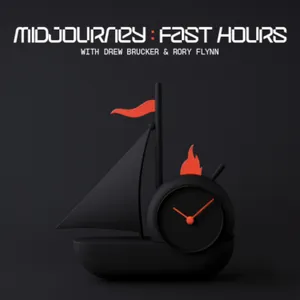
Fast Hours is a weekly generative AI podcast where Drew Brucker and Rory Flynn dig into the craft, taste, and business of making creative work with AI. Every week, they unpack what’s changing across AI image and video generation, creative workflows, models, platforms, culture, creative careers, and the business of creative work. What matters? What works? What’s overhyped? And where does leverage exist for creatives? Expect AI news, practical workflows, experiments, guest conversations, and strong opinions from two dudes actually using it in their professional work.
Latest Episodes
The most recent episodes — sign up to get AI-powered summaries of each one.
- 1 weeks ago1h 7m
What Can OpenAI’s Astra and GPT Image 2.5 Actually Do?
So, what can OpenAI’s Astra and GPT Image 2.5 actually do?Drew Brucker and Rory Flynn put OpenAI’s Astra and GPT Image 2.5 models through a golf course build, a vintage typewriter animation, and a round of image edits. Rory’s golf course experiment burns 70% of his weekly allowance. Drew spends three hours getting a typewriter to type. Their gift for turning a quick test into a side project remains undefeated. The pro-AI half of the show. The other half: a viral AI resignation that looks planned to the minute, Anthropic's 154-page report on how people misused Claude, and GPT Image 2.5 quietly fixing the reasons everyone kept running back to Nano Banana.This episode covers OpenAI Astra with computer use, two ChatGPT chats collaborating inside one project, Three.js and Blender renders, a fantasy football analytics hub, and Astra running Midjourney with mood boards and style references. GPT Image 2.5 multi-edit comments, sketch input, custom aspect ratios, and template creator. Anthropic's threat report, Moonshot and Kimi distillation, and the viral AI researcher resignation. ---⏱️ Fast Hour00:00 What’s on Fast Hours this week?06:35 Why do traumatic moments burn into memory07:42 What was different before social media13:48 This week: Astra, GPT Image 2.5, a viral resignation15:04 Did an AI researcher really resign over ASI18:40 How to tell what is true in AI news20:42 Why quitting your AI job can't stop superintelligence27:01 What do the cited reports allege about Kimi28:33 What AI misuse examples do the hosts discuss?34:07 How did Astra build a golf course prototype? 35:35 How did research improve Astra’s first attempt? 36:33 What happened when two AI chats collaborated?39:29 Why did Rory stop the drainage research?40:02 How did Drew approach his Blender experiment?40:52 How did Astra recreate Drew’s typewriter? 43:49 How long does AI-assisted 3D work take?44:43 How did Drew build a ChatGPT dashboard? 48:32 What happened when Astra explored Midjourney? 53:56 How did mood boards shape Astra’s prompts?58:49 What improved in GPT Image 2.5?01:00:24 How do GPT Image 2.5 edit comments work?01:01:47 How do you request multiple image variations? 01:03:30 How well did GPT Image 2.5 resize ads? 01:07:11 How reusable templates in GPT Image 2.5 can help brands 01:08:37 What’s coming next for Fast Hours?
- 2 weeks ago1h 57m
How We Use AI to Run Our Businesses With Skills, Agents & MCPs
To run a solo business on AI, build a system of small skills and agents that handle the admin, comms, and ops so your time goes to creating.---Two founders who swore AI would give them their time back open the hood on what they actually run. Drew walks through 37 hand-built skills and a 21-layer system for writing in his own voice. Rory runs his whole business out of Notion and Claude, down to finding an online fax machine for New York State. Neither of them can remember what half their own skills do. That's kind of the point.This episode covers building an AI operating system for a one-person business. Topics include Claude skills and agents, a voice system for writing, email and call ingestion, Notion as a CRM, red-teaming contracts and MSAs, predicting LinkedIn reach, Nano Banana prompt engineering, and handling taxes, invoices, and vendor forms. Fable and Astra model releases open the show.
- 3 weeks ago1h 42m
A 24 Year Old AI Creative Director Gives Away Her Playbook (feat. Jamey Gannon)
An AI creative director combines design fundamentals, AI fluency, tool selection, and repeatable workflows to produce better creative work.The boys over at Fast Hour invites a 24-year-old AI creative director to give away her playbook and somehow gets reminded that buying more AI subscriptions does not count as mastery. Jamey Gannon explains why AI is a skill, what top operators do differently, how Midjourney mood boards become brand systems, and why sometimes the smartest AI move is opening Photoshop.Jamey Gannon explains how self-taught design, social media, freelancing, and AI fluency shaped her work as an AI creative director. Jamey Gannon demonstrates Midjourney mood boards, SREFs, Midjourney V8.2 Edit, Krea K2, Claude, Figma, Photoshop, Flora, Nano Banana, and the CXO brand system, including when to build custom tools instead of forcing an existing workflow.---⏱️ Fast Hour00:00 Who is Jamey Gannon?06:43 How Jamey taught herself design at 1512:23 Why Gen Z chases money over job titles15:35 What first freelance clients look like at 1718:43 Why social media is a freelance prerequisite22:16 Freelance math: 20 clients vs one salary24:13 How her sister makes $5K–$10K/month with AI27:08 What is an AI creative director?28:58 What the AI Creative Director course teaches33:05 Is Krea catching Midjourney?35:53 The "easy, fast, cheap" AI lie38:43 Three moments that hooked Jamey on AI42:23 How to build brand mood boards46:00 How one SREF cracked the brand style46:27 Midjourney + Figma: the pixel shader pipeline49:06 When you should not use AI51:53 Two ways to use Midjourney mood boards56:44 What top AI creatives do differently59:44 Build the tool when the workflow doesn't exist1:11:28 Midjourney V8.2 Edit: first live tests1:15:00 What works and what drifts in Midjourney Edit1:20:06 Midjourney Edit vs Nano Banana: identity lock1:21:32 Can Midjourney edit text and fonts now?1:25:23 Can Midjourney's edit model preserve logos and apparel graphics?1:31:05 Is Midjourney inpainting or regenerating?1:34:33 The verdict: using Nano Banana less1:37:34 Where Nano Banana still fits
- 4 weeks ago1h 51m
AI Workflows Brands Actually Pay Five Figures For
Brands pay five figures for AI workflows that turn repetitive creative work into reusable systems teams can run at scale.Drew Brucker and Rory Flynn speedrun their way into a useful business model while trying to explain node-based AI without melting anyone’s brain. The opportunity itself is practical. Find expensive, repetitive creative bottlenecks, turn them into reusable workflows, and make the complicated machinery simple enough that an entire team can actually use it.The boys break down Figma Weave, node-based AI workflows, system prompts, batch processing, arrays, Claude, ChatGPT, Gemini, Flux, Nano Banana, Gen Effect, and MCP. SharkNinja and BarkBox examples show how AI workflows support localization, product visualization, asset re-versioning, creative production, team handoff, and scalable content generation.The bigger idea here is that the value comes from encoding the process, creative logic, and standards into a system that can be reused across hundreds of assets without starting from zero.#AIWorkflows #CreativeAutomation #GenerativeAI #FigmaWeave #aiforbusiness ---⏱️ Fast Hour00:00 Cold opener07:22 Why a full Figma Weave episode09:53 How node workflows went mainstream in a year14:10 Why use a node-based AI tool at all?19:02 Inside the Figma Weave AI toolbox20:53 How to sell AI workflows to businesses23:24 Why brands pay five figures for AI workflows24:33 How SharkNinja localizes across 35 markets30:07 Why recurring tasks belong in workflows31:34 Live build: your first AI workflow39:09 What the Gen Effect node can do44:00 How to turn an image into a 3D asset48:46 Scale one fashion image into reusable assets55:18 How to build a batch-processing engine1:03:24 Prompt vs system prompt: what's the difference?1:05:38 Turn a node graph into a reusable tool1:12:17 Engineering an automated listicle video1:14:51 One-shot video vs modular AI production1:24:29 How BarkBox fixed one production bottleneck1:35:20 Where AI workflows create business ROI1:38:20 Why workflows survive every new AI model1:39:29 Paste your workflow into Claude to debug it1:42:57 Use AI workflows as callable functions1:44:28 Publish your workflows into Claude MCP1:46:09 Resources and wrap-up---FIGMA WEAVE 15% OFF: Use code FASTHOURS15 at checkout- 15% off the first purchase of a Figma Weave Starter, Pro, or Team subscription- One-time use per person- Applies to the first month (for monthly plans) OR first year (for annual plans)OUR FREE FIGMA WEAVE WORKFLOWS:Drew's Apparel Photoshoot: https://app.weavy.ai/flow/JV8vBtbkOl3vNeiJjAYwxNDrew's Product Social Images: https://app.weavy.ai/flow/la8iMD20eGX4eGF91qunVuRory's Listicle: https://app.weavy.ai/flow/SpLj0jsU8hThMmHWtfmT37Rory's SD2.5 Prompting: https://app.weavy.ai/flow/MdYt6UJi6ch0MkgxTaCe6rRory's GenEffects Collage: https://app.weavy.ai/flow/sX4dJgsrp9DIrOz5f9ojX1Rory's Batch Generator: https://app.weavy.ai/flow/f9OljOQLkPbJ9Q04iN8UouRory's El Camino Concept: https://app.weavy.ai/flow/BPfVXywHhoymEi3CFxOO3Q
- Aug 14, 20261h 22m
He Built an 8 Figure AI Business in One Year (feat. Rourke Sefton-Minns)
Rourke Sefton-Minns scaled his AI creator business from zero to eight figures in one year by turning audience, education, and creative AI into a business system.Drew and Rory invited Rourke Sefton-Minns on to discuss AI and somehow ended up reverse-engineering a business built on sleep streaming, 420 straight days of posting, multiple failed creator experiments, hitting zero in the bank, and an apparently unhealthy refusal to quit. Rourke breaks down how Gen HQ grew, why brand partnerships now drive hundreds of thousands in monthly revenue, why learning AI tools is often the least important part of getting paid, and why the best move for aspiring AI creatives may be finding the client before figuring out every last detail.Rourke Sefton-Minns explains Gen HQ, AI creator businesses, brand partnerships, LinkedIn client acquisition, spec work, creative partner programs, Meta advertising, Adobe Photoshop Generative Fill, CapCut, Google Gemini, node-based workflows, narrative-loop content, creator burnout, AI careers, and generative AI-powered fandom. He also shares a practical three-month playbook for landing paid AI creative work and his mission to create 100,000 jobs for creatives through AI.---⏱️ Fast Hour00:00 Rourke Sefton-Minns, Gen HQ and 100K jobs02:55 Five social pages before the one that worked05:03 The sleep-streaming business that changed everything09:03 Making $10K a month at 21, then burning out13:04 Betting everything on a six-month ski channel17:11 The persistence lesson behind hitting zero20:50 420 days of posting before the AI pivot28:40 Why Gen Z sees generative AI as the enemy33:01 Why great AI content starts with communication35:10 Inside his vibe-coded content idea system39:19 How long a viral AI video takes to make43:20 Why AI creators burn out46:14 Outsourcing creativity made burnout worse47:27 Why changing formats brought the fun back50:25 How narrative-loop videos create retention52:44 How his 8-figure AI business makes money56:10 Why $40K a month in Meta ads is not enough57:12 The business skills AI creatives overlook01:00:51 The 100,000-jobs North Star01:03:29 How to land your first paying AI client01:07:51 What major AI brands actually want01:12:30 Why boring products can win spec-work clients01:14:09 The four-post strategy for winning brands01:17:47 AI fan content as a new growth engine
- Aug 9, 20261h 30m
How to Build an AI Universe That Compounds (feat. BLVCKL!GHT)
Build an AI universe by compounding recognizable characters, consistent worlds, recurring stories, and creative assets instead of starting from zero. BLVCKL!GHT has spent thousands of hours doing the thing most AI creators accidentally avoid: sticking with one weird idea long enough for it to become an actual universe. Route 47 now spans 28 interconnected shows and characters, four seasons, recurring locations, expanding lore, and even a game in development. characters → worlds → stories → audience → distribution → monetizationDrew and Rory dig into:+ how creative consistency becomes leverage+ why cult audiences can beat virality+ and why every finished asset can make the next one easier to create.BLVCKL!GHT breaks down AI world-building, Route 47, original AI IP, character development, consistent AI art styles, audience compounding, and FAST TV distribution. Krea, Magnific, MiniMax H3, Seedance 2.5, Flux 3, Runway, RunComfy, Comfy Cloud, Higgsfield, and Luma Dream Machine frame the AI image and video workflow discussion. AI agents, creator economics, model costs, synthetic media, and creative ownership shape the broader conversation.---⏱️ Fast Hour 00:00 Who is Blvckl!ght?04:15 Why did Blvckl!ght change his mind on AI?09:06 Why does Gen Z hate AI but love his work?12:15 What shaped Blvckl!ght's visual style?16:19 What is Route 47?19:04 How do you build an AI universe?22:31 How do you stay creatively consistent?24:35 Which AI tools does Blvckl!ght use?26:42 Can AI agents make creatives slower?29:14 Why can a cult audience beat virality?30:15 How can AI creators monetize on FAST TV?32:44 How does AI content reach mainstream media?34:34 How do AI film projects get financed?38:14 What is “Hi-Fi Slop” and why does it fail?40:00 How do shorts become a real series?46:52 Why can obvious AI feel more authentic?47:57 What is AI's real creative opportunity?50:14 MiniMax H3 vs Seedance 2.553:38 Local AI video vs cloud generation54:39 How fast can one AI creator produce?55:55 What is Flux 3?56:57 How do you control AI generation costs?59:06 How do unlimited AI generations work?01:00:29 Brand equity vs capability in AI tools01:03:26 Why do creators stay loyal to AI tools?01:10:13 Where should AI creators draw the line?01:18:26 Should AI make personal decisions?01:27:01 Where should you start with Route 47?01:28:45 How can AI check story consistency?
- Aug 2, 20261h 37m
How to Build AI Workflows That Never Start From Zero
A good AI workflow remembers what worked last time, so you don’t have to rebuild the same process from scratch.Drew Brucker and Rory Flynn attempt to explain how advanced AI workflows actually work, then accidentally expose the mildly concerning machinery behind their own. The useful version of AI goes far beyond isolated prompts. It remembers prior decisions, pulls from real conversations, reuses approved skills, evaluates its own output, and saves the human from rebuilding the same process every Tuesday like a highly caffeinated goldfish.The episode breaks down context files, AI agents, evaluation loops, prompt amplifiers, reusable skills, call transcripts, sales data, and personal knowledge systems. Drew and Rory also examine Seedance 2.5, Midjourney V8.2, emerging AI-assisted 3D workflows, synthetic video detection from NVIDIA, LinkedIn’s AI slop button, and the growing gap between generating faster and building systems that improve with use.---⏱️ Fast Hour00:00 What is next for Fast Hours?05:39 Why criticize AI while using it?08:56 How can AI recover old creative work?10:46 Why did 90s sports design feel better?19:07 What is LinkedIn's AI slop button?22:37 Why did LinkedIn reward lower effort?29:10 How are creators gaming account reach?32:43 Why do large platforms ship so slowly?33:48 What changed in Seedance 2.5?39:57 What is new in Midjourney V8.2?43:48 How does texture improve AI prompting?49:25 Why is Midjourney regaining momentum?50:04 Why is AI entering its 3D moment?58:12 Can people still detect synthetic video?01:01:21 How does NVIDIA detect fake video?01:07:10 Why does speed devalue AI creative work?01:11:13 How do eval loops prevent AI slop?01:13:00 How can calls create original content?01:16:20 Why can't AI automate your opinion?01:21:54 What should AI content systems ingest?01:25:27 How can AI improve sales calls?01:29:41 Why should prompts stop starting at zero?01:31:08 How should AI skills be customized?01:33:29 When should AI workflows be deleted?01:35:12 How do you build an AI skill vault?01:38:23 What is Fast Hours' next milestone?
- Jul 26, 20261h 39m
How to Make AI Images That Don’t Scream “I Used AI”
AI images stop looking generic when creators steer models with real expertise, original references, hand-built assets, and selective craft.Finn McKenty joins Drew Brucker and Rory Flynn to explain why the fastest route to better AI work may involve drawing by hand, reading the manual, and making fewer things. The three alleged efficiency experts also wander into AI burnout, fake UGC, Higgsfield trust problems, Midjourney’s long game, and the deeply inconvenient possibility that one great image may beat the 1,000 they can generate before lunch.Topics and tools covered:Midjourney, Weavy, ComfyUI, Claude, Gemini 2.5, GPT Image, Nano Banana, Flux, Krea, Figma, Adobe Photoshop, and Higgsfield anchor the practical discussion. Sketch references, image references, style references, out-of-distribution inputs, material-specific prompting, systems thinking, AI adoption, fake UGC, creator trust, and durable AI-assisted SEO define the core concepts.---⏱️ Fast Hour00:00Who is Finn McKenty?03:13 Why did Finn quit YouTube?05:30 Do creators need a large audience?12:05 Which existing skills create an AI edge?14:26 Does expertise accelerate AI mastery?16:27 Are creatives too attached to process?18:17 Why do companies fail to adopt AI?20:17 Why does advanced AI work cause burnout?27:33 Where should creators invest brainpower?29:31 How do creators steer probabilistic AI?31:27 What made Midjourney click for Finn?34:00 How did AI produce 10x SEO traffic?37:44 Why reject polished AI perfection?38:41 Why does handmade design feel better?41:06 How should AI and manual craft combine?46:24 Why does making more have zero value?50:57 How does material knowledge improve prompts?55:03 Why choose Weavy over ComfyUI?55:44 How do sketches improve AI images?58:33 How should creators divide work with AI?01:02:12 What does out-of-distribution mean?01:05:56 How do original references beat AI slop?01:07:03 Why does fake AI UGC destroy trust?01:11:31 What went wrong with Higgsfield?01:22:33 Why did Midjourney acquire Co-Star?01:24:09 Has Midjourney had the right vision?01:27:30 Why are creators returning to Midjourney?01:29:10 Why does bootstrapping protect creativity?01:34:01 Why does AI creative work need fun again?01:35:04 Does direct attribution kill creativity?#Midjourney #AICreativity #AIDesign #GenerativeAI #FastHours
Get Fast Hours summaries in your inbox
Free AI-powered daily recaps. Key takeaways, quotes, and mentions — in a 5-minute read.
Get Free Summaries →Free forever for up to 3 podcasts. No credit card required.
You Might Also Like
Listeners also like.

How I AI
A practical guide to using AI tools in work and life, featuring guests who share specific, actionable techniques and workflows.

AI For Humans: Weekly AI News, Tools & Trends
A weekly breakdown of major AI news, tools, and breakthroughs for both newcomers and seasoned enthusiasts.

AI and I
Interviews with professionals who use AI tools in their work, exploring how AI affects creativity, thinking, and daily life through live demonstrations.

AI Hustle: Make Money with AI
Explores how entrepreneurs use artificial intelligence to build businesses and create new income streams.

OpenAI Podcast
Conversations with OpenAI researchers and builders exploring how frontier AI models are developed and used in practice.

Everyday AI Podcast – An AI and ChatGPT Podcast
Practical AI and ChatGPT tips for professionals to improve productivity and grow their careers.
The AI Daily Brief: Artificial Intelligence News and Analysis
A daily analysis of artificial intelligence news, exploring its creative potential, industry impacts, and ethical challenges.

The AI XR Podcast.
Industry insiders interview top founders and executives on AI, spatial computing, VR/AR, and synthetic media.

80,000 Hours Podcast
Discusses artificial intelligence and global catastrophic risks with experts and researchers.

Eye On A.I.
A biweekly podcast exploring artificial intelligence through conversations with key figures shaping its development and global impact.

A Beginner's Guide to AI
Explains artificial intelligence concepts and interviews professionals to help beginners understand and use AI effectively.
"The Cognitive Revolution"
Interviews with AI developers and researchers exploring the transformative impact of artificial intelligence on society and technology.
About Fast Hours
Fast Hours is a weekly generative AI podcast where Drew Brucker and Rory Flynn dig into the craft, taste, and business of making creative work with AI. Every week, they unpack what’s changing across AI image and video generation, creative workflows, models, platforms, culture, creative careers, and the business of creative work. What matters? What works? What’s overhyped? And where does leverage exist for creatives? Expect AI news, practical workflows, experiments, guest conversations, and strong opinions from two dudes actually using it in their professional work.
Customized Recaps
AI-powered recaps with compact key takeaways, quotes, and insights.
Straight to Your Inbox
Get key takeaways from Fast Hours in a 5-minute read.
Save Hours Every Week
Stay current on your favorite podcasts without falling behind.
Frequently Asked Questions
What is Podzilla's Fast Hours daily summary?
It's a free AI-powered email that summarizes new episodes of Fast Hours as soon as they're published. You get the key takeaways, notable quotes, and links & mentions — all in a quick read.
How does the Fast Hours podcast summary work?
When a new episode drops, our AI transcribes and analyzes it, then generates a personalized summary tailored to your interests and profession. It's delivered to your inbox every morning.
Is this an official Fast Hours product?
No. Podzilla is an independent service that summarizes publicly available podcast content. We're not affiliated with or endorsed by Drew Brucker and Rory Flynn.
Can I get summaries of other podcasts too?
Absolutely! The free plan covers up to 3 podcasts. Upgrade to Pro for 15, or Premium for 50. Browse our full catalog at /podcasts.
How often does Fast Hours release new episodes?
Fast Hours publishes weekly. Our AI generates a summary within hours of each new episode.
What topics does Fast Hours cover?
Fast Hours covers topics including Arts, Design. Our AI identifies the specific themes in each episode and highlights what matters most to you.
Start getting Fast Hours summaries tomorrow morning.
Free forever for up to 3 podcasts. No credit card required.
Free forever for up to 3 podcasts. No credit card required.